1877
elysian fields (Arnold Böcklin, 1877)
Arnold Böcklin (1827–1901) made elysian fields. It dates from 1877.
- 1877

 Preview

 Hand Made Oil Painting
 Send
 Share
 Guide


 Download
 Similars
 X-Ray
 Diaporama
 Q&A

 Stats
elysian fields: the essentials
- Title
- elysian fields
- Artist
- Arnold Böcklin (1827–1901)
- Artist born in
- Basel, Switzerland
- Date
- 1877
elysian fields in high resolution
Arnold Böcklin, elysian fields (1877). Public domain.
A digital expert checks the colors against the original painting and retouches the file, faithful to the artist's brushwork.
Buy the high-resolution imageQuestions about elysian fields
Is "elysian fields" by Arnold Böcklin a bright or a dark artwork?
Overall, "elysian fields" is recorded as shadow. Perceived brightness describes how light or dark the work appears.
What is the format of "elysian fields"?
"elysian fields" by Arnold Böcklin has a landscape format. The format describes the proportions of the composition.
How is the palette of "elysian fields" by Arnold Böcklin described?
The palette of "elysian fields" by Arnold Böcklin is described as dark. It is a compact description of the work's colors.
Who made "elysian fields", and when?
Arnold Böcklin made "elysian fields" in 1877.
Where can I download "elysian fields" by Arnold Böcklin?
The image of "elysian fields" by Arnold Böcklin can be downloaded from the artwork's Download page: a high-resolution digital image download.
Can I preview "elysian fields" by Arnold Böcklin before ordering?
The Preview page of "elysian fields" lets you preview the artwork before ordering.
Where can I find artworks similar to "elysian fields" by Arnold Böcklin?
Artworks similar to "elysian fields" by Arnold Böcklin are gathered on the artwork's Similars page.
How is the color composition of "elysian fields" by Arnold Böcklin built?
In "elysian fields", a bold contrast is paired with a strong color unity harmony.
How strong is the contrast in "elysian fields" by Arnold Böcklin?
The contrast level of "elysian fields" by Arnold Böcklin is bold.
About the artist, Arnold Böcklin
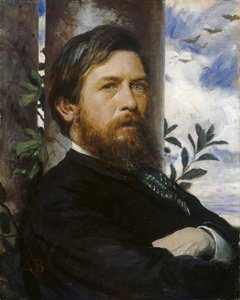
1827–1901, Switzerland
Arnold Böcklin
The Shadow of the Isle Basel, Switzerland, provides the starting point for a life defined by the tension between the tangible and the spectral. Born on October 16, 1827, to Christian Frederick Böcklin and Ursula Lippe, the young man would eventually move beyond the silk trade of his father to the rigorous halls of the Düsseldorf Academy. Under the guidance of Schirmer, he began to absorb the language of landscape, a skill that would later be used to map the geography of the human soul. He did not merely paint scenery; he constructed realms where the classical and the macabre collide.
 The isle of the dead (First Version)1880
 Autorretrato con la muerte tocando el violín
 La Guerre1896
 Island of the Dead (Version 5)1886