Perseus and Andromeda
Oil On Canvas
WallArt
Neoclassicism
1774
227.0 x 154.0 cm
Hermitage Museum
Hand Made Oil Reproduction
Hand-painted oil on canvas in your size and frame, made to order by our artists.
P118B $10
P118H $10
P118W $10
P438Z $10
P508JH $12
P508YH $12
P805H $10
P805Z $10
P919BZ $10
P919G $10
P919XJ $10
P959ZH $10
P968JZ $12
W106C $8
W218G $10
W218JH $8
W218Y $10
W307PJ $10
W316G $10
W316PJ $8
W316Y $10
W398PJ $8
W4111J $10
W500HY $15
W500JH $15
W692G $12
W849H $8
W940BG $15
W953PJ $8
Pick from our preset sizes that match the artwork's original proportions.
You may enter your own dimensions to fit a specific frame or space. If your selected size does not match the original image's proportions, we will either crop the artwork or extend the painting with additional hand-painted elements. A digital mockup will be sent for your approval before production begins.

Please note that the on-screen preview does not reflect the actual cropping or extension. Only the mockup will accurately show the final composition.
While custom sizes are available, we recommend selecting a dimension from the predefined list to preserve the original proportions.
After order, OriginalUniqueArt.com team will email client for instructions and provide a mockup preview
Worldwide Delivery () in 3/4 weeks instead of standard 5 weeks. (23 July). No compromise on quality.
Free Worldwide Express Shipping
High-Quality Linen Canvas
Full Shipping Insurance
Customs Tax Refund Guarantee
True Color Matching Guarantee
60-Day Return Policy (Defects Only)
100% Money-Back Guarantee
Bulk Discount Offer
Perseus and Andromeda
Reproduction Medium
Reproduction Size
-
Total Price
-
Artwork Description
A Vision of Heroic Virtue
Anton Raphael Mengs’ “Perseus and Andromeda” stands as a cornerstone of Neoclassicism, capturing the spirit of Enlightenment ideals within a breathtaking depiction of Greek mythology. Painted in 1774, this monumental oil on canvas transcends mere representation; it embodies a profound philosophical statement about beauty, morality, and triumph over adversity—themes central to the artistic sensibilities of its time.
- Subject Matter: The artwork portrays Perseus, the hero who slew Medusa and rescued Andromeda from Cetus, a monstrous sea serpent. Venus, his mother, and Mercury, his father, accompany him on this perilous journey, symbolizing divine protection and guidance.
- Style: Mengs’ adherence to classical principles is unmistakable. The composition prioritizes clarity and balance, mirroring the ideals of ancient Greek sculpture—a deliberate rejection of Rococo frivolity.
Technical Mastery: Chiaroscuro and Precise Detail
Mengs' skill as a painter is evident in his masterful use of chiaroscuro – dramatic contrasts between light and dark – which sculpts the figures against a rugged landscape backdrop. This technique isn’t merely decorative; it serves to heighten emotional impact, emphasizing Perseus’ muscular physique and conveying the urgency of their quest. Every brushstroke demonstrates meticulous attention to detail, from the folds of drapery to the texture of rock formations.
- Technique: Mengs employed glazing techniques—applying thin layers of translucent paint over previous coats—to achieve luminous colors and subtle gradations of tone. Scumbling adds textural richness, particularly in portraying the rocky terrain.
- Materials: The canvas was primed with gesso, ensuring optimal adhesion for the oil paints used – primarily ochres, browns, reds, blues, and whites.
Symbolism and Emotional Resonance
Beyond its aesthetic beauty, “Perseus and Andromeda” is laden with symbolic significance. Mercury embodies intellect and divine patronage, Venus represents maternal love and grace, while Perseus embodies courage and heroic virtue—qualities revered during the Enlightenment era. The scene speaks to a narrative of overcoming obstacles through strength and piety, resonating with viewers as an affirmation of moral fortitude.
- Mythological Narrative: The story recounts Andromeda’s abduction by Cetus, a terrifying sea monster, and Perseus' daring intervention—killing Medusa with her severed head—to save her life.
- Emotional Impact: Mengs’ depiction aims to inspire awe and admiration for heroic ideals, conveying the triumph of reason over barbarism and highlighting the importance of moral character.
A Legacy Enduring Through Reproduction
Today, a high-quality reproduction of “Perseus and Andromeda” offers an opportunity to experience Mengs’ artistic genius firsthand. Its enduring appeal stems from its timeless depiction of heroism and beauty—a testament to the artist's profound understanding of classical ideals and his ability to translate them into a powerfully emotive visual statement.
Artist Biography
A Bridge Between Worlds: The Life and Art of Anton Raphael Mengs
Anton Raphael Mengs emerged during a fascinating period in European art, a time when the ornate flourishes of the Rococo were beginning to yield to a renewed appreciation for classical ideals. Born in 1728 in Ústí nad Labem, Bohemia – a region now part of the Czech Republic – his artistic journey was profoundly shaped by both his lineage and the intellectual currents of the Enlightenment. His father, Ismael Mengs, a Danish painter who found patronage at the Dresden court, recognized young Anton’s exceptional talent early on. This recognition led to a pivotal move in 1741: a relocation to Rome, where the budding artist was immersed in the study of ancient masterpieces and the works of Renaissance masters like Raphael. It was this exposure that would indelibly mark his aesthetic sensibilities, instilling within him a deep reverence for classical form, clarity, and composition – qualities that would become hallmarks of his mature style. The early years were dedicated to meticulous copying, not merely as an exercise in technique but as a profound act of artistic pilgrimage, absorbing the essence of Raphael’s genius.From Dresden to Madrid: A Career Across Courts
Mengs' career unfolded across several prominent European courts, each leaving its unique imprint on his artistic development. In 1749, he secured a prestigious position as court painter to Frederick Augustus, Elector of Saxony, a role that provided both financial stability and the freedom to maintain a base in Rome – the epicenter of his artistic inspiration. However, it was his frescoes that truly established his reputation. The *Parnassus* at the Villa Albani in Rome, completed around 1761, became an instant sensation, lauded for its harmonious composition, elegant figures, and subtle yet powerful evocation of classical mythology. This work wasn’t simply a decorative flourish; it was a statement – a deliberate attempt to synthesize Baroque grandeur with emerging Neoclassical principles. Further commissions followed, including the stunning fresco adorning the dome of the Church of Sant'Eusebio in Rome, showcasing his mastery of monumental decoration and spatial illusion. Perhaps his most ambitious undertaking came with an invitation from the Spanish court in 1761. He traveled to Madrid, where he was tasked with decorating several royal palaces, culminating in the magnificent ceiling of the Banqueting Hall of the Royal Palace – a work considered among his finest achievements, demonstrating a remarkable ability to blend Italianate elegance with Spanish sensibilities.The Winckelmann Connection: Shaping Neoclassical Thought
Mengs’ artistic evolution wasn't solely driven by visual study; it was deeply intertwined with intellectual discourse. A crucial turning point came with his close friendship and collaboration with Johann Joachim Winckelmann, the pioneering art historian whose writings would become foundational to the Neoclassical movement. Winckelmann championed a return to the perceived purity and simplicity of ancient Greek art, advocating for an aesthetic based on reason, order, and idealized forms. Mengs wasn’t merely illustrating Winckelmann's theories; he was actively engaged in shaping them, translating abstract concepts into tangible artistic expressions. Together, they believed that true beauty resided not in superficial ornamentation but in the underlying principles of harmony and proportion found in classical antiquity. This partnership extended beyond theoretical discussions; it manifested in Mengs’ paintings themselves, which increasingly reflected Winckelmann's emphasis on noble simplicity and restrained emotion. The influence was reciprocal: Winckelmann’s writings provided a philosophical framework for Mengs’ artistic endeavors, while Mengs’ art served as visual proof of the viability – and beauty – of Neoclassical ideals.Legacy and Influence: A Pioneer of His Time
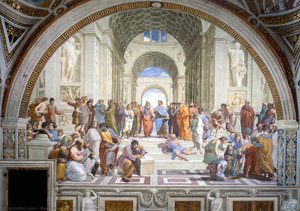
Anton Raphael Mengs died in Rome in 1779, leaving behind a legacy that extended far beyond his impressive body of work. He was more than just a painter; he was a pivotal figure in the transition from one artistic era to another. While rooted in the Baroque tradition – evident in his dramatic use of light and shadow and his mastery of illusionistic techniques – Mengs courageously embraced the emerging principles of Neoclassicism, paving the way for artists like Jacques-Louis David and Antonio Canova. His emphasis on classical ideals, combined with his technical virtuosity, established him as a leading force in shaping 18th-century art. The School of Athens, painted for the Duke of Northumberland, stands as a testament to his ability to synthesize historical precedent with contemporary artistic sensibilities. Beyond his paintings and frescoes, Mengs’ influence extended to education; he served as director of the Vatican Painting School, nurturing a new generation of artists steeped in classical principles. He was a complex figure – a devout Catholic who also engaged with Enlightenment thought, an artist who balanced tradition with innovation. His life and work represent a fascinating intersection of artistic skill, intellectual curiosity, and historical circumstance, solidifying his place as a true pioneer of Neoclassical art. His impact resonates even today, reminding us of the enduring power of classical ideals to inspire and transform artistic expression.Anton Raphael Mengs
1728 - 1779 , Czech Republic
Quick Facts
- Artistic Movement Or Style: Neoclassical painting
- Artists Or Movements Influenced By This Artist: ['Neoclassicism']
- Artists Who Influenced This Artist:
- Raphael
- Titian
- Correggio
- Date Of Birth: March 22, 1728
- Date Of Death: June 29, 1779
- Full Name: Anton Raphael Mengs
- Nationality: German-Bohemian
- Notable Artworks:
- Parnassus
- School of Athens
- Charles IV as Prince
- Place Of Birth: Ústí nad Labem, Czech Republic

Glass option is only available in size under 110 CM