Preview
 Send
Send Share
Share
 Details
 Guide
Guide

 Download
 Similars
 X-Ray
X-Ray Diaporama
 Stats
StatsCrouching Tiger


 Read More
Hand Made Oil Reproduction
Hand-painted oil on canvas in your size and frame, made to order by our artists. ( Switch to Print Switch to Digital Image)




P118B $10

P118H $10

P118W $10

P438Z $10

P508JH $12

P508YH $12

P805H $10

P805Z $10

P919BZ $10

P919G $10

P919XJ $10

P959ZH $10

P968JZ $12

W106C $8

W218G $10

W218JH $8

W218Y $10

W307PJ $10

W316G $10

W316PJ $8

W316Y $10

W398PJ $8

W4111J $10

W500HY $15

W500JH $15

W692G $12

W849H $8

W940BG $15

W953PJ $8




Pick from our preset sizes that match the artwork's original proportions.

Type the width and the height you need, to fit your frame or your wall. This is hand-painted, so for a size with a different shape the artist can paint a bit more around the picture, or cut a bit — you choose. We send you a digital mockup to approve before the painting starts. The picture shown on this page does not show the real result — only the mockup does.
After order, OriginalUniqueArt.com team will email client for instructions and provide a mockup preview
Worldwide Delivery () in 3/4 weeks instead of standard 5 weeks. (24 October). No compromise on quality.

Free Worldwide Express Shipping

High-Quality Linen Canvas

Full Shipping Insurance

Customs Tax Refund Guarantee

True Color Matching Guarantee

100-Day Return Policy (Defects Only)

100% Money-Back Guarantee

Bulk Discount Offer
 Glass option is only available in size under 110 CM

Crouching Tiger
Reproduction Medium
Reproduction Size
-


Total Price
$ 300
The Quiet Intensity of the Wild
In the delicate, translucent layers of Antoine-Louis Barye’s Crouching Tiger, we encounter a moment of profound stillness that belies the raw power contained within the subject. This exquisite watercolor serves as a masterclass in the animalier style, capturing not just the likeness of a predator, but its very essence. The tiger lies nestled within a lush, grassy expanse, its heavy limbs relaxed against the earth, suggesting a state of repose that feels both peaceful and potentially explosive. As the eye wanders through the soft, dappled light of the landscape, one feels the weight of the creature's presence, a silent sentinel of the natural world resting amidst the verdant textures of its habitat.
Barye, a pioneer who revolutionized the depiction of fauna in the 19th century, brings an unparalleled anatomical precision to this work. His technique, honed through years of meticulous study at the Paris Zoological Gardens, allows him to render the muscular structure and the soft weight of the tiger with breathtaking realism. The watercolor medium, often used for preparatory sketches, is utilized here to create a sense of atmosphere and depth; the bleeding edges of the greenery and the subtle shifts in tone across the tiger's coat evoke a sense of humidity and life. It is this marriage of scientific accuracy and Romantic sensibility that makes the piece so captivating—it is at once a biological study and a poetic meditation on nature.
A Legacy of Motion and Stillness
To understand the emotional resonance of Crouching Tiger, one must look to the artist's broader legacy as a master of bronze sculpture. While Barye is celebrated for the dramatic, kinetic energy of his metal works, this watercolor reveals his ability to capture the "breath" between movements. There is a profound symbolism in the tiger's posture; it represents the duality of nature—the capacity for absolute tranquility and the latent strength of the wild. For the discerning collector or interior designer, this piece offers a sophisticated focal point that introduces an element of organic majesty into a space. It does not demand attention through loud colors, but rather commands it through a quiet, dignified grace.
Integrating a high-quality reproduction of such a masterpiece into a curated environment allows for a dialogue between classical history and modern aesthetics. Whether placed in a sunlit study or a contemporary living area, the painting brings a sense of timelessness and an infusion of the natural world. The soft palette and fluid brushwork harmonize beautifully with neutral tones, while the subject matter provides a compelling narrative thread that invites contemplation. Owning a piece that echoes the spirit of Barye is more than an aesthetic choice; it is an invitation to experience the enduring beauty of the animal kingdom through the eyes of one of history's greatest observers.
Questions & Answers
What palette and what feeling does "Crouching Tiger" combine?
The earthy palette of "Crouching Tiger" by Antoine-Louis Barye goes together with its tranquil emotional tone. Color is one of the ways a work conveys feeling.
How does the subject of "Crouching Tiger" relate to Antoine-Louis Barye's usual themes?
"Crouching Tiger" depicts tiger, grass, trees, field, nature, while Antoine-Louis Barye's recorded themes are anatomical realism, animalier genre pioneer, preparatory bronze sketch, romanticism influence, zoological study. Comparing the two shows how the work relates to the artist's usual subjects.
Can I watch "Crouching Tiger" as a full-screen slideshow?
"Crouching Tiger" by Antoine-Louis Barye can be viewed as a slideshow on the artwork's Diaporama page.
Artist Biography
A Pioneer of Animal Sculpture: The Life and Legacy of Antoine-Louis Barye
Antoine-Louis Barye, born in Paris on September 24, 1795, emerged as a pivotal figure in the world of 19th-century sculpture. He wasn’t merely depicting animals; he was imbuing them with a dramatic intensity and anatomical accuracy previously unseen, effectively launching the *animalier* genre – a dedicated focus on animal forms – into the realm of fine art. Barye's journey began not in the studio of a sculptor, but as an apprentice goldsmith following in his father’s footsteps. This early training instilled within him a meticulous attention to detail and a mastery of technique that would prove invaluable throughout his career. He honed these skills further under sculptors like François-Joseph Bosio and Baron Antoine-Jean Gros, absorbing classical principles while simultaneously developing a uniquely Romantic sensibility. His formal education at the École des Beaux-Arts provided a solid foundation, but it was an encounter with the living world – specifically, the animals housed within the Jardin des Plantes in Paris around 1823 – that truly ignited his artistic vision.From Goldsmith to Animalier: The Development of a Unique Style
Barye’s dedication to observing animals was obsessive. He didn't simply glance; he studied, sketched, and meticulously analyzed their anatomy, movements, and behaviors. This commitment to realism wasn’t cold or clinical, however. It was infused with the emotional fervor characteristic of the Romantic movement. Early works like “Milo of Crotana Devoured by a Lion” (1819) and “Hercules with the Erymanthean Boar” (c. 1820), created while still a student, hinted at his emerging talent for dynamic composition and dramatic narrative. But it was with sculptures such as "Tiger Devouring a Gavial Crocodile" (1831) – a monumental plaster that caused a sensation at the Salon – and “Lion Crushing a Serpent” (1832), cast in bronze, that Barye truly established his signature style. These weren’t static representations; they were moments of raw power frozen in time, capturing the brutal beauty of nature's struggle for survival. He moved beyond mere imitation to convey the very essence of animal life – their strength, agility, and untamed spirit. His work resonated with a growing public fascination with the exotic and the wild, reflecting a Romantic yearning for experiences beyond the confines of civilized society.Major Works and Monumental Commissions
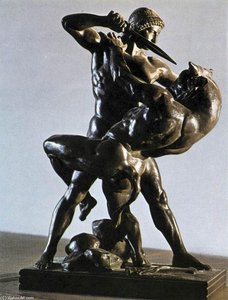
Throughout his career, Barye produced an astonishing array of sculptures, each demonstrating his unparalleled skill in capturing animal form and movement. Beyond the iconic “Tiger Devouring a Gavial Crocodile” and “Lion Crushing a Serpent,” masterpieces like "Theseus and the Minotaur" (1843), “Roger and Angelica on the Hippogriff” (1846), “Lapitha and Centaur” (1848) and “Jaguar Devouring a Hare” (1850) showcased his versatility and imaginative power. He wasn’t limited to depictions of predatory encounters; he also explored mythological scenes, imbuing them with the same dynamic energy and anatomical precision that defined his animal studies. His talent extended beyond smaller-scale bronzes as well. Barye received prestigious commissions for monumental works, including the “Lion of the Column of July,” a powerful symbol of French resilience, and sculptures adorning the Tuileries Garden in Paris. These large-scale projects demonstrated his ability to translate his artistic vision into public art, solidifying his reputation as one of France’s leading sculptors.Influences, Struggles, and Lasting Significance
Barye's work was a synthesis of diverse influences. The Romantic emphasis on emotion and individualism is palpable in the dramatic tension of his sculptures. Simultaneously, he drew inspiration from classical art, evident in his attention to anatomical accuracy and idealized forms. However, what truly set him apart was his scientific approach to observation – a direct result of his countless hours spent studying animals at the Jardin des Plantes. Despite achieving critical acclaim, Barye’s life wasn't without hardship. He struggled with financial difficulties throughout much of his career, largely due to poor business acumen. A bankruptcy in 1848 forced him to sell his models and molds, leading to a period where inferior copies flooded the market, damaging his reputation. He found some stability as Professor of Drawings at the Museum of Natural History in 1854, but it was only posthumously that his genius received its full due. Today, Antoine-Louis Barye is recognized as the father of modern animal sculpture. His influence on subsequent generations of artists is undeniable, and his works are celebrated for their power, realism, and enduring beauty. He elevated the *animalier* genre from a niche pursuit to a respected form of artistic expression, leaving an indelible mark on the history of sculpture. His legacy continues to inspire awe and admiration in collectors and museums worldwide.
Antoine-Louis Barye
1796 - 1875 , France
Quick Facts
- Full Name: Antoine-Louis Barye
- Nationality: French
- Date Of Birth: 1796
- Date Of Death: 1875
- Place Of Birth: Paris, France
- Notable Artworks:
- Tiger Devouring a Gavial
- Lion Crushing a Serpent
- Theseus and the Minotaur
- Roger & Angelica
- Lapitha and Centaur
- Jaguar Devouring Hare
- Artistic Movement Or Style: Romanticism
- Artists Who Influenced This Artist:
- Francois-Joseph Bosio
- Baron Antoine-Jean Gros
- Artists Or Movements Influenced By This Artist: ['Animal sculptors']
Related Articles

Ephemeral Visions: Exploring the Artistic Legacy & Nuances of Watercolor Painting
Explore the captivating world of watercolor painting! Discover its rich history, essential techniques, influential artists & collecting tips from art experts. A comprehensive guide for enthusiasts.

Watercolor Wonders: 10 Masterpieces That Redefined Art History | OriginalUniqueArt
Journey through 10 legendary watercolor masterpieces by Sargent, Turner & Homer! Explore iconic landscapes, portraits & floral art that redefined history. Find museum-quality reproductions and curated decor ideas at OriginalUniqueArt.com.

The Enduring Appeal of Watercolor: History, Techniques & Contemporary Practice
Explore the captivating world of watercolor painting! Discover its rich history, essential techniques, influential artists, and collecting tips. A comprehensive guide for art enthusiasts.

Ephemeral Visions: Exploring the History & Emotional Resonance of Watercolor Painting
Explore the captivating history of watercolor painting, from ancient techniques to modern masters like Kandinsky & Blake. Discover essential artists, collecting tips & the emotional power of this luminous medium. Expert insights for art enthusiasts.

Ephemeral Visions: Exploring the Artistic Legacy & Contemporary Practice of Watercolor Painting
Explore the captivating world of watercolor painting! Discover its rich history, essential techniques, influential artists & collecting tips. A comprehensive guide for art enthusiasts from OriginalUniqueArt.