Preview
 Send
Send Share
Share
 Details
 Guide
Guide

 Download
 Similars
 X-Ray
X-Ray Diaporama
 Q&A
Q&A Stats
StatsSelf Portrait (7)
 Oil On Canvas
- WallArt
- Post Impressionism
 1932
1932 474.0 x 702.0 cm
 National Gallery of Modern Art
 Read More
Giclée / Art Print
Museum-quality giclée or canvas print with fast production and flexible finish options. ( Buy Hand Made Painting Switch to Digital Image)




P118B $10

P118H $10

P118W $10

P438Z $10

P508JH $12

P508YH $12

P805H $10

P805Z $10

P919BZ $10

P919G $10

P919XJ $10

P959ZH $10

P968JZ $12

W106C $8

W218G $10

W218JH $8

W218Y $10

W307PJ $10

W316G $10

W316PJ $8

W316Y $10

W398PJ $8

W4111J $10

W500HY $15

W500JH $15

W692G $12

W849H $8

W940BG $15

W953PJ $8




Pick from our preset sizes that match the artwork's original proportions.

Type the width and the height you need, to fit your frame or your wall. A print can only be cut, never made bigger than the picture, so a size with a different shape loses a part of the image. We send you a digital mockup to approve before we print anything. The picture shown on this page does not show the real cut — only the mockup does.
Worldwide Delivery () in 2 weeks instead of standard 4/5 weeks. (30 October)

Free Worldwide Express Shipping

High-Quality Linen Canvas

Full Shipping Insurance

Customs Tax Refund Guarantee

True Color Matching Guarantee

100-Day Return Policy (Defects Only)

100% Money-Back Guarantee

Bulk Discount Offer
 Glass option is only available in size under 110 CM

Self Portrait (7)
Giclée / Art Print
Reproduction Size
-


Total Price
$ 81
The Luminous Gaze of Amrita Sher-Gil
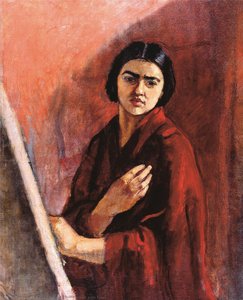
To stand before a self-portrait by Amrita Sher-Gil is to encounter not merely an image on canvas, but a confluence of worlds—a vibrant dialogue between the structured elegance of European modernism and the deep, soulful resonance of Indian tradition. This piece, dating from 1932, captures the artist at a pivotal moment in her life, when her itinerant spirit was beginning to settle, drawing her back toward the rich soil of India after formative years spent absorbing the artistic currents of Paris. The subject gazes out with an arresting intensity; it is a portrait that feels both intimately personal and universally resonant.
Technique and Expressive Brushwork
Sher-Gil’s mastery in this work is evident in her handling of paint. The technique employed suggests the rich materiality of oil paints on canvas, characterized by visible, confident brushstrokes. These strokes do not merely describe form; they imbue it with life and palpable energy. Observe how the artist has layered color to build up the luminosity of the skin tones—warm, glowing hues that seem to capture the soft diffusion of light itself. In contrast, the background dissolves into indistinct washes of cooler blues, a deliberate choice that pushes all focus onto the figure. This masterful use of shallow depth of field ensures that every curve of her dark, cascading hair and the subtle play of shadow across her neck demands the viewer's undivided attention.
Symbolism of Self-Possession
The subject matter itself—a self-portrait—is inherently complex. It is a study in self-possession, yet it hints at the vibrant emotional spectrum that defined Sher-Gil’s artistic journey. The gentle tilt of her head and the teasing quality of her smile suggest a playful confidence, while the overall composure speaks to deep contemplation. Symbolically, the gesture of her hands, held delicately near her lap, introduces an element of quiet modesty or perhaps an offering—a presentation of self that is both vulnerable and utterly assured. She embodies the tension between the outward allure and the inner depth.
Historical Echoes and Emotional Impact
Amrita Sher-Gil’s life was a bridge; she carried the influences of Gauguin's post-impressionism from Paris while nurturing an aesthetic rooted in her Indian heritage. This painting is a beautiful artifact of that bridging process. For the collector or admirer, owning a reproduction allows one to connect with this moment where two worlds met within one singular artistic vision. The emotional impact is immediate: it draws you into a private conversation with a brilliant mind navigating identity. It speaks to the enduring power of art to capture not just what we look like, but who we feel ourselves to be.
A Statement for Any Space
Whether adorning a gallery wall or lending an air of sophisticated cultural depth to a grand drawing-room, this piece offers unparalleled visual richness. Its blend of expressive technique and classical portraiture ensures it functions as both a historical document and a vibrant focal point. It is art that whispers stories of migration, genius, and the enduring spirit of artistic reinvention.
Questions & Answers
What technique was used for "Self Portrait (7)", and when was it created?
The medium of "Self Portrait (7)" by Amrita Sher-Gil is oil on canvas, and the work is dated 1932.
How do emotion and gift occasion combine for "Self Portrait (7)" by Amrita Sher-Gil?
With its reflective emotional tone, "Self Portrait (7)" by Amrita Sher-Gil is recommended as a gift for anniversary.
Who is "Self Portrait (7)" suggested for as a present, and for what use?
The gift recommendation for "Self Portrait (7)" by Amrita Sher-Gil combines anniversary with accent.
Artist Biography
A Life Bridging Worlds: The Story of Amrita Sher-Gil
Amrita Sher-Gil, a name synonymous with the dawn of modern Indian art, was an artist whose brief but incandescent career left an indelible mark on the cultural landscape. Born in Budapest in 1913 to a fascinatingly diverse parentage – Umrao Singh Sher-Gil Majithia, a Sikh aristocrat and scholar, and Marie Antoinette Gottesmann, a Hungarian Jewish opera singer – her life was destined to be one of compelling contrasts. This unique heritage instilled within her a sensibility that would profoundly shape her artistic vision, allowing her to navigate the complexities of identity and belonging with remarkable depth. From an early age, Amrita displayed a precocious talent for painting, receiving formal lessons at eight years old. Her childhood in Budapest exposed her to the rich tapestry of European art and culture, while summers spent in India ignited a burgeoning fascination with its vibrant traditions and social realities. The guidance of her uncle, Ervin Baktay, an Indologist, proved pivotal; he recognized her potential and provided critical feedback, laying a strong foundation for her artistic development.From Parisian Studios to the Indian Soul
Amrita’s formal training led her to Paris in 1929, where she enrolled at the Académie de la Grande Chaumière under Pierre Vaillent and Lucien Simon, later attending the École des Beaux-Arts. Immersed in the bohemian atmosphere of the city, she absorbed the influences of European modernism, particularly the works of Paul Cézanne and Paul Gauguin. However, a profound shift occurred upon her return to India in 1934. This wasn’t merely a geographical relocation; it was an artistic homecoming. Inspired by the grandeur of Mughal paintings, the delicate lyricism of Pahari miniatures, and the ancient frescoes of Ajanta, Amrita began to explore Indian subjects with newfound fervor. She sought to capture the essence of everyday life – the quiet dignity of rural communities, the intimate moments shared between women, the raw beauty of the Indian landscape. This marked a turning point in her artistic journey, as she consciously moved away from purely Western styles and embarked on a quest to forge a uniquely Indian visual language.A Distinctive Style: Color, Form, and Psychological Depth
Amrita Sher-Gil’s style is instantly recognizable for its bold use of color, simplified forms, and expressive figures. She possessed an extraordinary ability to convey psychological depth in her portraits, capturing not just the physical likeness of her subjects but also their inner lives, their hopes, and their struggles. Her paintings are characterized by a sense of quiet intensity, a melancholic beauty that resonates with viewers even today. Works like “Young Girls” (1932), which garnered international acclaim – winning a gold medal and election as an associate of the Grand Salon in Paris – demonstrate her mastery of composition and color. “Self Portrait (7)” and "Sleep" further showcase her evolving artistic vision, revealing a willingness to experiment with form and explore themes of identity and sensuality. She didn’t merely depict what she saw; she imbued her paintings with emotion, creating works that are both visually stunning and deeply moving.Legacy and Lasting Impact
Amrita Sher-Gil's tragically short life – she died in 1941 at the age of 28 – belies the immense impact she had on Indian art. She is rightfully regarded as a pioneer of modern Indian painting, bridging Western artistic techniques with indigenous traditions and paving the way for future generations of artists. Her work subtly critiqued social inequalities and explored themes of identity, gender, and class in colonial India, making her an artist ahead of her time. Today, her paintings are among the most valuable by Indian women painters, a testament to their historical significance and artistic merit. Beyond her technical skill, Amrita Sher-Gil’s legacy lies in her ability to capture the soul of India – its beauty, its complexity, and its enduring spirit. Her personal letters, revealing complex relationships including same-sex affairs, offer further insight into the artist's life and perspective, adding another layer to the understanding of this remarkable woman and her art. She remains an icon, a symbol of artistic innovation and cultural fusion, whose work continues to inspire and captivate audiences around the world.Major Works
- Young Girls (1932): A pivotal early work that brought her international recognition.
- Self Portrait (7): Demonstrates her evolving style and exploration of identity.
- Sleep (1933): A poignant nude portrait reflecting her unique artistic vision.
- Village Scene (1936-37): Captures the essence of rural Indian life with remarkable sensitivity.
- Three Women (1934): A powerful depiction of female companionship and resilience.

Amrita Sher-Gil
1913 - 1941 , Slovakia
Quick Facts
- Full Name: Amrita Sher-Gil
- Nationality: Hungarian-Indian
- Date Of Birth: 1913
- Date Of Death: 1941
- Place Of Birth: Budapest, Slovakia
- Notable Artworks:
- Young Girls
- Self Portrait (7)
- Sleep
- Artistic Movement Or Style: Modern Indian art, Avant-garde
- Artists Who Influenced This Artist:
- Paul Cézanne
- Paul Gauguin
- Artists Or Movements Influenced By This Artist: Modern Indian artists
Related Articles

Raja Ravi Varma: Bridging Tradition & Modernity in 19th-Century Indian Art
Explore the life & art of Raja Ravi Varma, a pioneer who fused European techniques with Indian iconography. Discover his iconic paintings, lasting legacy, and influence on modern Indian art at OriginalUniqueArt.

The Enduring Power of Painting: A Historical & Contemporary Exploration of Form and Emotion
Explore the rich history & enduring techniques of oil painting with OriginalUniqueArt. Discover masterpieces, learn about art collecting, and find authentic handmade reproductions crafted by skilled artists.
Reflecting the Self: A History of Portraiture & Psychological Insight
Explore the fascinating history of self-portraiture from Renaissance masters like Dürer & Rembrandt to modern interpretations. Discover the psychological insights and artistic techniques behind these iconic works. Expert analysis for art enthusiasts.

The Enduring Legacy of Oil on Canvas: Technique, History & Aesthetic Impact
Explore the rich history & techniques of oil painting – from Renaissance masters to Impressionism. Discover pigments, layering methods, and why this timeless medium endures. Expert insights for artists & art enthusiasts.

Oil on Canvas: A Historical & Technical Exploration of a Timeless Artistic Medium
Explore the rich history & enduring techniques of oil painting on canvas. Discover the science behind its longevity, conservation practices, and contemporary relevance. Expert insights for art enthusiasts.