Preview
 Send
Send Share
Share
 Details
 Guide
Guide

 Download
 Similars
 X-Ray
X-Ray Diaporama
 Stats
Statsuntitled (1561)


 Read More
Hand Made Oil Reproduction
Hand-painted oil on canvas in your size and frame, made to order by our artists. ( Switch to Print Switch to Digital Image)




P118B $10

P118H $10

P118W $10

P438Z $10

P508JH $12

P508YH $12

P805H $10

P805Z $10

P919BZ $10

P919G $10

P919XJ $10

P959ZH $10

P968JZ $12

W106C $8

W218G $10

W218JH $8

W218Y $10

W307PJ $10

W316G $10

W316PJ $8

W316Y $10

W398PJ $8

W4111J $10

W500HY $15

W500JH $15

W692G $12

W849H $8

W940BG $15

W953PJ $8




Pick from our preset sizes that match the artwork's original proportions.

Type the width and the height you need, to fit your frame or your wall. This is hand-painted, so for a size with a different shape the artist can paint a bit more around the picture, or cut a bit — you choose. We send you a digital mockup to approve before the painting starts. The picture shown on this page does not show the real result — only the mockup does.
After order, OriginalUniqueArt.com team will email client for instructions and provide a mockup preview
Worldwide Delivery () in 3/4 weeks instead of standard 5 weeks. (24 October). No compromise on quality.

Free Worldwide Express Shipping

High-Quality Linen Canvas

Full Shipping Insurance

Customs Tax Refund Guarantee

True Color Matching Guarantee

100-Day Return Policy (Defects Only)

100% Money-Back Guarantee

Bulk Discount Offer
 Glass option is only available in size under 110 CM

untitled (1561)
Reproduction Medium
Reproduction Size
-


Total Price
$ 300
A Symphony of Ornamentation: The Soul of Art Nouveau
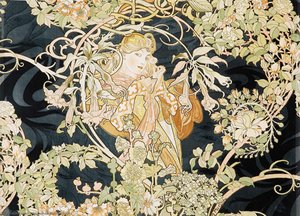
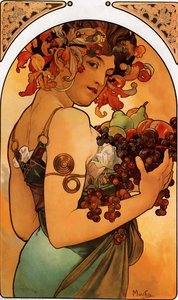
To step into the world of Alphonse Mucha is to surrender to a dreamscape where the boundaries between fine art and decorative elegance dissolve into a single, flowing rhythm. His work, particularly seen in pieces like untitled (1561), serves as a breathtaking portal to the Belle Époque, an era defined by a profound longing for beauty amidst the encroaching rigidity of the industrial age. Mucha did not merely paint; he orchestrated a visual language composed of sinuous lines, organic motifs, and a sense of ethereal movement that would eventually define the Art Nouveau movement. His mastery lies in his ability to transform the flat surface of a canvas or poster into a lush, multidimensional experience, where every curve feels alive with the pulse of nature.
The composition of this particular work invites the viewer into an opulent interior, a sanctuary of craftsmanship and refined taste. At its heart lies a magnificent, ornate table, acting as an anchor for a room that breathes with warmth and grandeur. The palette is a rich tapestry of autumnal tones—deep reds, burnt oranges, and earthy browns—which bathe the scene in a soft, diffused light. This warmth creates an atmosphere of intimacy and luxury, making the space feel less like a static room and more like a living, breathing extension of the natural world. For the discerning collector or interior designer, such a piece offers more than mere decoration; it provides a focal point of historical depth and sensory richness.
Symbolism and the Language of Nature
Beyond its immediate aesthetic splendor, the artwork is steeped in the symbolic vocabulary that Mucha championed throughout his illustrious career. The presence of the peacock motif within the stained glass window is particularly poignant; in the lexicon of Art Nouveau, the peacock represents a duality of beauty, pride, and immortality. This element, paired with the intricate geometric patterns and stylized floral flourishes, connects the domestic interior to the wild, untamed elegance of the natural realm. Mucha’s ability to weave these symbols into the very fabric of the architecture suggests a philosophy where art is not separate from life, but rather an essential component of a well-lived existence.
The interplay of textures further enhances this symbolic narrative. The smooth, polished surfaces of the wood contrast beautifully with the reflective glint of metal accents and the translucent, textured quality of the glass. This tactile variety engages the viewer on a subconscious level, evoking the sensation of touching the fine materials of a bygone era. It is this meticulous attention to detail—the way light catches a curved edge or settles into a deep shadow—that gives the piece its enduring emotional resonance. It evokes a sense of nostalgia for a time when craftsmanship was a sacred pursuit and every decorative element told a story of grace and intention.
A Timeless Legacy for the Modern Collector
For those seeking to infuse their contemporary spaces with character and historical weight, a high-quality reproduction of Mucha’s vision offers unparalleled inspiration. Whether placed in a grand salon or a quiet study, the artwork commands attention through its sophisticated balance of complexity and harmony. It serves as a bridge between the past and the present, bringing the romanticism of the late 19th century into the modern home. The piece does not merely occupy space; it transforms it, creating an environment of contemplative beauty and refined luxury.
Investing in such a work is an embrace of the Art Nouveau spirit—a celebration of the organic, the decorative, and the profoundly beautiful. As a centerpiece for interior design, it provides a foundation of warmth and narrative depth that complements both classical and modern aesthetics. To possess a piece of Mucha’s legacy is to hold a fragment of a golden age, ensuring that the flowing lines and luminous colors of his incomparable vision continue to inspire generations of art lovers and connoisseurs alike.
Questions & Answers
What stage of Alphonse Mucha's development does "untitled (1561)" represent?
"untitled (1561)" represents the Mature Period of Alphonse Mucha.
Does "untitled (1561)" show strong light-dark contrasts?
"untitled (1561)" by Alphonse Mucha shows a gentle contrast between its light and dark areas.
What is "untitled (1561)" about?
The themes present in "untitled (1561)" by Alphonse Mucha include luxury interior, decorative design, peacock motif, art nouveau style, elegant composition, rich color palette, ornate furniture. Together they summarize the artwork's subject matter.
Artist Biography
Early Life and Education
- Born: July 15, 1860, in Ivanačice, Moravia (now part of the Czech Republic)
- Showed artistic talent from a young age.
- Studied at the Academy of Fine Arts in Prague but became disillusioned with traditional approaches.
- Moved to Paris in 1887 to pursue his own style.
Artistic Style and Notable Works
- Known for distinctive Art Nouveau style characterized by flowing lines, organic forms, and a sense of movement.
- Influenced by artists like Pierre-Auguste Renoir and Gustave Moreau.
- Notable Works:
- The Slavonic Uprising - Showcases blending traditional Czech motifs with modern Art Nouveau elements.
- Salon des Cent
- Paintings inspired by works like The Daughters of Tespio by Gustave Moreau, and La Ribambelle des Gobelins by Piero Dorazio.
- Illustrations based on Young Farmers Breaking Flax by Sir Hubert von Herkomer.
- Frequently featured idealized women in flowing robes surrounded by lush flowers.
Career Highlights and Major Commissions
- Sarah Bernhardt Collaboration: Created posters and designs for the actress Sarah Bernhardt, starting with the poster for Gismonda (1894), which launched his career.
- Universal Exhibition in Paris (1900): His Art Nouveau style gained international recognition at this exhibition. He decorated the Bosnia and Herzegovina Pavilion and collaborated on the Austrian Pavilion.
- Charles Richard Crane Patronage: Received support from Charles Richard Crane, which enabled him to create the monumental series The Slav Epic (1912-30).
- Post-Independence Czechoslovakia: Designed postage stamps, banknotes, and government documents for newly independent Czechoslovakia.
Influences and Legacy
- Influenced by Czech artistic traditions and modern European art movements.
- His unique style paved the way for future generations of artists in Art Nouveau and Secessionism.
- Inspired other artists like Eva Prokopcová.
- Legacy extends beyond his artwork to influence design and aesthetics.
Later Life and Death
- Married Maruska (Marie/Maria) Chytilová in 1906.
- Visited the United States from 1906-1910, where their daughter Jaroslava was born.
- Died on July 14, 1939, in Prague, Czechoslovakia.

Alphonse Mucha
1860 - 1939 , Czech Republic
Quick Facts
- Full Name: Alphonse Maria Mucha
- Nationality: Czech
- Date Of Birth: 1860
- Date Of Death: 1939
- Place Of Birth: Brno, Czech Republic
- Notable Artworks:
- Slavic Uprising
- Salon des Cent
- The Daughters of Tespio
- La Ribambelle des Gobelins
- Young Farmers Breaking Flax
- Artistic Movement Or Style: Art Nouveau
- Artists Who Influenced This Artist:
- Pierre-Auguste Renoir
- Gustave Moreau
- Dante Gabriel Rossetti
- Artists Or Movements Influenced By This Artist: ['Eva Prokopcová']
Related Articles
Art Nouveau's Golden Age: 10 Masterpieces for Your Home |
Journey into Art Nouveau's golden age! Explore 10 masterpieces by Klimt, Mucha & more. Discover captivating stories behind iconic paintings, floral motifs & flowing lines. Find museum-quality art reproductions for your home at .
Alphonse Mucha: A Comprehensive Exploration of Art Nouveau's Master of Decorative Symbolism
Explore the life & art of Alphonse Mucha, master of Art Nouveau! Discover his iconic posters, stunning illustrations, and the monumental Slav Epic. A comprehensive guide for collectors & enthusiasts.
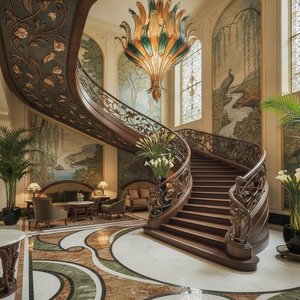
Art Nouveau Guide: Integrating Elegant Curves and Organic Design into Luxury Hotel Interiors
Master Art Nouveau integration for luxury hotel interiors. Discover expert strategies for utilizing organic curves, whiplash lines, and botanical motifs to create sophisticated, high-end hospitality spaces with scalable, professional art procurement solutions.
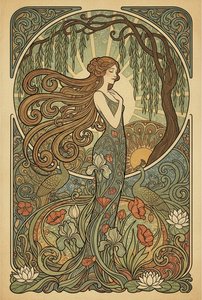
The Flowing Line & Flourishing Form: Exploring Art Nouveau's Aesthetic Legacy
Explore the captivating world of Art Nouveau! Discover its origins, key artists like Horta & Mucha, regional styles, innovative techniques, and lasting influence on architecture & design. A comprehensive guide for art enthusiasts.

The Elegance of Art Nouveau: Discovering Beauty in Nature’s Sinuous Curves and the Belle Époque Spirit
Immerse yourself in the romantic allure of Art Nouveau. Explore the sinuous curves and floral elegance of the Belle Époque through our exquisite, hand-painted reproductions. Discover a timeless connection to nature’s beauty with our museum-quality collection.