Art Nouveau
(45) (Alphonse Mucha)
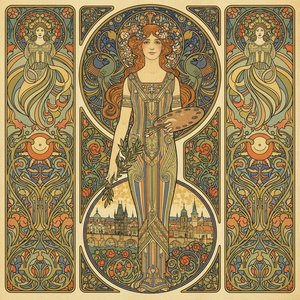
Alphonse Mucha (1860–1939) made (45). It belongs to the Art Nouveau movement. It is made in oil.
- Oil

 Preview

 Hand Made Oil Painting
 Send
 Share
 Fact sheet


 Download
 Similars
 X-Ray
 Diaporama
 Q&A

 Stats
(45), in brief
- Title
- (45)
- Artist
- Alphonse Mucha (1860–1939)
- Artist born in
- Ivančice, Czech Republic
- Medium
- Oil
- Movement
- Art Nouveau
- Period
- 19th Century
- Subject
- nude figure, floral art, decorative, symmetry, elegant, vintage
What does (45) depict?
The Essence of Art Nouveau
Alphonse Mucha stands as a towering figure within the Art Nouveau movement, a stylistic revolution that swept across Europe between 1890 and 1910. Rejecting academic conventions, Mucha forged a path toward an aesthetic rooted in organic forms, flowing lines, and meticulous ornamentation. His work is characterized by a mesmerizing blend of curvilinear lines, stylized floral motifs, and graceful curves. Through his masterful manipulation of line and color, he created images that are both visually captivating and psychologically stimulating, transporting viewers into worlds of beauty and wonder.
Mucha’s technique involved painstaking hand-painting, primarily utilizing oil paints, with meticulous attention to detail and layering. He embraced innovative printing methods, experimenting with chromolithography and halftone printing to achieve stunning color reproductions. His recurring motifs, such as irises, lilies, and stylized female figures, carried symbolic significance, reflecting themes of femininity, spirituality, and the harmonious relationship between humanity and nature. Ultimately, his art possesses an enduring emotional resonance, capturing a sense of romanticism, elegance, and enchantment.
Artwork Description
This vertical Art Nouveau illustration depicts a reclining nude woman surrounded by irises. The composition is vertically oriented, with the woman centrally positioned and framed by an ornate circular border containing intricate floral patterns and geometric designs. The background features a warm, textured surface suggesting aged paper or canvas.
The visual elements of the piece include:
The lighting appears diffused and warm, casting soft shadows that enhance the three-dimensionality of the figure and flowers. The perspective is flattened, prioritizing decorative effect. The technique appears to be primarily hand-painted, likely using oil paints, with careful attention paid to detail and layering.
High-resolution images of (45)
Alphonse Mucha, (45). Public domain.
Questions on (45), answered
What medium is "(45)" by Alphonse Mucha executed in?
The medium of "(45)" by Alphonse Mucha is oil. Reproductions aim to render the appearance of this technique.
What subjects appear in "(45)" by Alphonse Mucha?
"(45)" by Alphonse Mucha depicts: nude figure, floral art, decorative, symmetry, elegant, vintage, symbolism, alphonse mucha.
Is "(45)" by Alphonse Mucha in the public domain?
Regarding copyright, "(45)" is in the public domain - its copyright has expired.
Who created "(45)"?
"(45)" was created by Alphonse Mucha. The information on this page describes Alphonse Mucha's original work.
Which artistic current is "(45)" by Alphonse Mucha part of?
The movement associated with "(45)" by Alphonse Mucha is Art Nouveau. This classification situates the work among related artists and artworks.
What stage of Alphonse Mucha's development does "(45)" represent?
"(45)" represents the Mature Period of Alphonse Mucha.
What explains the copyright situation of "(45)" by Alphonse Mucha?
"(45)" by Alphonse Mucha is in the public domain - its copyright has expired. Copyright duration runs from the artist's death, which occurred in 1939.
How does "(45)" fit into Alphonse Mucha's themes and style?
"(45)" belongs to Alphonse Mucha's Art Nouveau work, whose recorded themes include slav epic series", poster design style, decorative arts pioneer, art nouveau style, pre-raphaelite influence, japanese woodblock prints, sensuality & beauty, symbolic nature.
Where does "(45)" stand among Alphonse Mucha's recurring subjects?
"(45)" depicts nude figure, floral art, decorative, symmetry, elegant, vintage, symbolism, alphonse mucha, while Alphonse Mucha's recorded themes are slav epic series", poster design style, decorative arts pioneer, art nouveau style, pre-raphaelite influence, japanese woodblock prints, sensuality & beauty, symbolic nature. Comparing the two shows how the work relates to the artist's usual subjects.
About the artist, Alphonse Mucha

1860–1939, Czech Republic
Alphonse Mucha
Early Life and EducationBorn: July 15, 1860, in Ivanačice, Moravia (now part of the Czech Republic)Showed artistic talent from a young age.Studied at the Academy of Fine Arts in Prague but became disillusioned with traditional approaches.Moved to Paris in 1887 to pursue his own style.Artistic Style and Notable WorksKnown for distinctive Art Nouveau style characterized by flowing lines, organic forms, and a sense of movement.Influenced by artists like Pierre-Auguste Renoir and Gustave Moreau.Notable Works:The Slavonic Uprising - Showcases blending traditional Czech motifs with modern Art Nouveau elements.Salon des CentPaintings inspired by works like The Daughters of Tespio by Gustave Moreau, and La Ribambelle des Gobelins by Piero Dorazio.Illustrations based on Young Farmers Breaking Flax by Sir Hubert von Herkomer.Frequently featured idealized women in flowing robes surrounded by lush flowers.Career Highlights and Major CommissionsSarah Bernhardt Collaboration: Created posters and designs for the actress Sarah Bernhardt, starting with the poster for Gismonda (1894), which launched his career.Universal Exhibition in Paris (1900): His Art Nouveau style gained international recognition at this exhibition. He decorated the Bosnia and Herzegovina Pavilion and collaborated on the Austrian Pavilion.Charles Richard Crane Patronage: Received support from Charles Richard Crane, which enabled him to create the monumental series The Slav Epic (1912-30).Post-Independence Czechoslovakia: Designed postage stamps, banknotes, and government documents for newly independent Czechoslovakia.Influences and LegacyInfluenced by Czech artistic traditions and modern European art movements.His unique style paved the way for future generations of artists in Art Nouveau and Secessionism.Inspired other artists like Eva Prokopcová.Legacy extends beyond his artwork to influence design and aesthetics.Later Life and DeathMarried Maruska (Marie/Maria) Chytilová in 1906.Visited the United States from 1906-1910, where their daughter Jaroslava was born.Died on July 14, 1939, in Prague, Czechoslovakia.
Also by Alphonse Mucha
 The Moon
 Nude
 The Apotheosis of the Slavs1926
 Stained-Glass Window in St. Vitus Cathedral
Essays around (45)
 Masterpieces of the Habsburgs: Top 25 Must-See Artworks at the Albertina, ViennaJourney through the Albertina’s legacy with our curated guide to 25 iconic masterpieces. From Dürer's precision to Habsburg grandeur, explo…
 Art Nouveau Guide: Integrating Elegant Curves and Organic Design into Luxury Hotel InteriorsMaster Art Nouveau integration for luxury hotel interiors. Discover expert strategies for utilizing organic curves, whiplash lines, and bot…
 Alphonse Mucha: A Comprehensive Exploration of Art Nouveau's Master of Decorative SymbolismExplore the life & art of Alphonse Mucha, master of Art Nouveau! Discover his iconic posters, stunning illustrations, and the monumental Sl…