

 Preview
 Send
Send Share
Share
 Details
 Guide
Guide

 Download
 Similars
 X-Ray
X-Ray Diaporama
 Stats
StatsAutumn Flowers


 Read More
Giclée / Art Print
Museum-quality giclée or canvas print with fast production and flexible finish options. ( Buy Hand Made Painting Switch to Digital Image)




P118B $10

P118H $10

P118W $10

P438Z $10

P508JH $12

P508YH $12

P805H $10

P805Z $10

P919BZ $10

P919G $10

P919XJ $10

P959ZH $10

P968JZ $12

W106C $8

W218G $10

W218JH $8

W218Y $10

W307PJ $10

W316G $10

W316PJ $8

W316Y $10

W398PJ $8

W4111J $10

W500HY $15

W500JH $15

W692G $12

W849H $8

W940BG $15

W953PJ $8




Pick from our preset sizes that match the artwork's original proportions.

You may enter your own dimensions to fit a specific frame or space. If your selected size does not match the original image's proportions, we will either crop the artwork or extend the image with a mirrored or solid-fill edge. A digital mockup will be sent for your approval before production begins.
Please note that the on-screen preview does not reflect the actual cropping or extension. Only the mockup will accurately show the final composition.
While custom sizes are available, we recommend selecting a dimension from the predefined list to preserve the original proportions.
Worldwide Delivery () in 2 weeks instead of standard 4/5 weeks. (3 October)

Free Worldwide Express Shipping

High-Quality Linen Canvas

Full Shipping Insurance

Customs Tax Refund Guarantee

True Color Matching Guarantee

100-Day Return Policy (Defects Only)

100% Money-Back Guarantee

Bulk Discount Offer
 Glass option is only available in size under 110 CM

Autumn Flowers
Giclée / Art Print
Reproduction Size
-


Total Price
$ 81
A Portrait of a Moment: The Enigmatic Beauty of *Autumn Flowers*
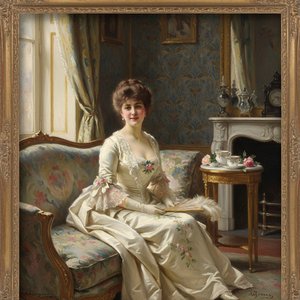
Alfred Stevens’s *Autumn Flowers*, painted in 1867, isn't merely a depiction of a woman amidst flowers; it’s an exquisitely crafted meditation on stillness, light, and the subtle poetry of everyday life. At first glance, the painting presents a seemingly simple arrangement: a seated lady, her posture suggesting quiet contemplation, surrounded by a still-life tableau of fabrics, blossoms, and a delicately rendered table. Yet, beneath this surface lies a profound exploration of form, color, and the very essence of observation – a hallmark of Stevens’s unique artistic vision.
Stevens, a pivotal figure in 19th-century Belgian art, deliberately eschewed the prevailing trends of his time. Rejecting the fleeting effects of Impressionism's vibrant light and atmosphere, he instead focused on capturing an immutable quality – the frozen gesture, the fixed expression, the enduring presence of the subject. This deliberate choice is powerfully evident in *Autumn Flowers*. The woman’s hand, poised as if about to touch a flower, isn’t caught in motion; it's suspended, imbued with a sense of timelessness. Her gaze, directed slightly off-canvas, invites us into her private world, suggesting an inner life beyond the immediate scene.
The Language of Color and Texture: Stevens’s Masterful Technique
What immediately draws the eye is Stevens's extraordinary command of color and texture. He employs a remarkably restrained palette – primarily shades of grey, black, and muted browns – punctuated by flashes of pastel pink, chestnut brown, and the glossy sheen of the table cover. This deliberate limitation isn’t a sign of restraint but rather a strategic choice to emphasize form and light. The artist masterfully utilizes chiaroscuro, creating dramatic contrasts between light and shadow that sculpt the figures and objects with remarkable precision. Notice how the highlights on the woman's chignon and the delicate folds of her dress draw our attention while simultaneously deepening the shadows around her face, lending a sense of mystery and depth.
Stevens’s technique is equally noteworthy for its meticulous detail. He employs a smooth, almost polished surface – reminiscent of 17th-century Dutch masters like Rembrandt and Vermeer – achieved through careful layering of paint and the use of a knife to blend colors seamlessly. This creates an illusion of tactile reality, inviting us to reach out and touch the fabrics, feel the texture of the flowers, and appreciate the subtle variations in color and tone. The artist’s attention to detail extends beyond mere representation; it's a deliberate attempt to capture the *essence* of each element within the composition.
Symbolism and the Portrait of Modernity
Beyond its technical brilliance, *Autumn Flowers* is rich in symbolic meaning. The woman herself represents a type of modern femininity – poised, elegant, and seemingly detached from the bustle of Parisian life. Her attire, with its jet frills and flounces, speaks to the fashionable trends of the era while simultaneously conveying a sense of quiet dignity. The surrounding still-life elements—the fabrics, flowers, and table—are not merely decorative; they function as a carefully constructed visual language, hinting at themes of luxury, domesticity, and the fleeting beauty of life.
Stevens’s comparison to Gustave Vanzype – that the painting is a still life composed of the fabrics in which she is dressed and the things around her – reveals a deeper intention. He wasn't simply depicting a woman; he was creating a miniature world, a carefully orchestrated tableau that captures a specific moment in time and reflects the values and aesthetics of his era. The reference to Whistler’s ambition to “use colours to compete with the musician who uses sounds” underscores Stevens’s own desire to elevate color from mere decoration to an expressive element within the painting.
A Legacy of Stillness: Stevens's Enduring Appeal
*Autumn Flowers* stands as a testament to Alfred Stevens’s singular artistic vision. It is a painting that rewards careful observation, inviting us to linger and contemplate its subtle nuances. Its enduring appeal lies not in dramatic gestures or fleeting effects but in its quiet beauty, its masterful technique, and its profound exploration of the human condition. Reproductions of this captivating work offer a window into a bygone era, capturing the elegance and sophistication of 19th-century Parisian life while simultaneously reminding us of the timeless power of stillness and observation.
Questions & Answers
Can I see "Autumn Flowers" by Alfred Stevens on my own wall before buying?
"Autumn Flowers" has an augmented reality preview: the artwork's AR Preview page shows it in your own space on a compatible device.
How old was Alfred Stevens when creating "Autumn Flowers" in 1867?
Alfred Stevens was 44 years old when creating "Autumn Flowers" in 1867. The age is computed from the artist's birth year, 1823.
How does "Autumn Flowers" balance light and dark?
"Autumn Flowers" by Alfred Stevens is recorded as deep_shadow, with a dark luminance.
Who is the artist behind "Autumn Flowers"?
The artist behind "Autumn Flowers" is Alfred Stevens. The work is catalogued under Alfred Stevens's name.
In what year was "Autumn Flowers" by Alfred Stevens created?
"Autumn Flowers" by Alfred Stevens was created in 1867.
Is "Autumn Flowers" by Alfred Stevens a portrait, landscape or square composition?
"Autumn Flowers" by Alfred Stevens is a portrait composition. The proportions are worth checking before choosing a print size.
Are there works similar to "Autumn Flowers"?
Works similar to "Autumn Flowers" are listed on the artwork's Similars page.
Artist Biography
early life and training
alfred émile léopold stevens, a renowned belgian painter, was born on may 11, 1823, in brussels. his family was deeply rooted in the visual arts, with his older brother joseph (1816–1892) and son léopold (1866–1935) being painters, while another brother arthur (1825–99) was an art dealer and critic.artistic career
stevens began his artistic journey at the académie royale des beaux-arts in brussels, where he studied under the guidance of françois navez, a neo-classical painter. in 1843, he moved to paris, joining his brother joseph, and was admitted to the école des beaux-arts. although it is disputed whether he became a student of jean auguste dominique ingres, stevens' early work, such as the pardon or absolution (hermitage, st. petersburg), signed and dated 1849, showcases his mastery of conventional naturalistic style, influenced by 17th-century dutch genre painting.rise to prominence
stevens' work was first publicly exhibited in 1851 at the brussels salon, earning him a third-class medal at the paris salon in 1853 and a second-class medal at the universal exposition in paris in 1855. his painting ce qu'on appelle le vagabondage (musée d'orsay, paris) caught the attention of napoleon iii, leading to a significant change in the treatment of the poor.notable works and legacy
- la dame en rose or woman in pink (musées royaux des beaux-arts de belgique, brussels), painted in 1866, exemplifies stevens' work during this period, combining a fashionably dressed woman with a detailed examination of japanese objects.
- stevens received the legion of honor (chevalier) from the french government in 1863 and was promoted to officer of the legion of honor in 1867.

Alfred Stevens
1823 - 1906 , Belgium
Quick Facts
- Artistic Movement Or Style: Realism, Dutch genre painting influence
- Artists Or Movements Influenced By This Artist: ['Impressionists']
- Artists Who Influenced This Artist:
- François Navez
- Pieter de Hooch
- Vermeer
- Full Name: Alfred Émile Léopold Stevens
- Nationality: Belgian
- Notable Artworks:
- The Pardon or Absolution
- Ce qu'on appelle le vagabondage
- Woman in Pink
- The Bath
- Pleasant Letter
- Place Of Birth: Brussels, Belgium
- Date Of Birth: 1823
- Date Of Death: 1906
Related Articles

Sir Alfred Munnings' Masterpieces: 25 Paintings That Define Equine Art | OriginalUniqueArt
Explore 25 iconic Sir Alfred Munnings paintings! Discover the beauty of British Impressionism, equine art & rural England. Find museum-quality reproductions and elevate your home decor with OriginalUniqueArt. Explore the full collection online.

Alfred Stevens: Capturing Parisian Life with Intimate Realism & Symbolist Flair
Explore the captivating world of Alfred Stevens, a pioneer of intimate realism & Symbolist painting. Discover his elegant portraits of Parisian women and learn about his Dutch influences & lasting legacy. Art history insights at OriginalUniqueArt.
Alfred Stevens: Capturing Parisian Elegance & Fin-de-Siècle Intimacy
Discover the captivating world of Alfred Stevens, master of Parisian elegance & intimate portraiture. Explore his techniques, influences, and legacy – a prized collection for discerning art enthusiasts.

Romantic Realism's Finest: 10 Masterpieces for Your Home | OriginalUniqueArt
Explore 10 defining masterpieces of Romantic Realism! Discover Courbet, Millet & Daumier's powerful paintings—capturing emotion and social realities. Find museum-quality reproductions for your home at OriginalUniqueArt.com.
Realism's Masters: 10 Artworks That Capture Life's Essence | OriginalUniqueArt
Explore 10 iconic realism artworks by Courbet, Millet & more! Discover the stories behind these masterpieces of 19th-century painting. Find museum-quality art reproductions and elevate your home decor with OriginalUniqueArt.com.


