

 Preview
 Send
Send Share
Share
 Details
 Guide
Guide

 Download
 Similars
 X-Ray
X-Ray Diaporama
 Stats
StatsNemo


 Read More
The artwork displayed on this page is protected by copyright law, which means we cannot legally create or sell an identical reproduction. This protection is enforced under international agreements such as the Berne Convention and by national laws, including those outlined by the U.S. Copyright Law - Title 17.
This method fully complies with copyright regulations because it does not involve copying or duplicating the protected artwork. Instead, it is a creative reinterpretation - a new painting that is influenced by the original but not identical to it.
Giclée / Art Print
Museum-quality giclée or canvas print with fast production and flexible finish options. ( Buy Hand Made Painting Switch to Digital Image)




P118B $10

P118H $10

P118W $10

P438Z $10

P508JH $12

P508YH $12

P805H $10

P805Z $10

P919BZ $10

P919G $10

P919XJ $10

P959ZH $10

P968JZ $12

W106C $8

W218G $10

W218JH $8

W218Y $10

W307PJ $10

W316G $10

W316PJ $8

W316Y $10

W398PJ $8

W4111J $10

W500HY $15

W500JH $15

W692G $12

W849H $8

W940BG $15

W953PJ $8




Pick from our preset sizes that match the artwork's original proportions.

Type the width and the height you need, to fit your frame or your wall. A print can only be cut, never made bigger than the picture, so a size with a different shape loses a part of the image. We send you a digital mockup to approve before we print anything. The picture shown on this page does not show the real cut — only the mockup does.
Worldwide Delivery () in 2 weeks instead of standard 4/5 weeks. (22 October)

Free Worldwide Express Shipping

High-Quality Linen Canvas

Full Shipping Insurance

Customs Tax Refund Guarantee

True Color Matching Guarantee

100-Day Return Policy (Defects Only)

100% Money-Back Guarantee

Bulk Discount Offer
 Glass option is only available in size under 110 CM

Nemo
Giclée / Art Print
Reproduction Size
-


Total Price
$ 81
Nemo – A Symphony of Geometric Form and Chance
Alexander Milne Calder’s “Nemo” stands as a testament to the enduring fascination with abstraction—a captivating exploration of color, shape, and movement that transcends mere visual representation. Created in 1947, this striking piece embodies Calder's signature approach: eschewing realism for a deliberate embrace of spontaneity and serendipity, mirroring the very essence of his celebrated mobiles.
The Visual Language of Equilibrium
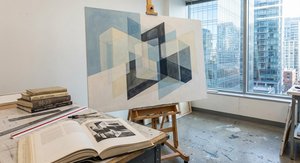
Dominating the canvas is an intricate composition featuring overlapping circles and squares—a bold declaration of geometric principles. The palette bursts with vibrant hues—primarily reds, yellows, and blues—that harmonize to create a dynamic visual experience. Calder meticulously crafted these shapes using a flat painting technique, prioritizing form over texture; there’s no visible brushwork, reflecting his unwavering commitment to precision and control despite the illusion of movement.
A Reflection of Constructivism's Legacy
“Nemo” firmly roots itself within the influential Constructivist movement of the early 20th century. Like its contemporaries—artists who sought to liberate art from traditional conventions—Calder aimed to convey emotion and ideas through simplified geometric forms, rejecting decorative embellishments in favor of intellectual rigor. This stylistic choice underscores Calder’s belief that art should communicate directly with the viewer's intellect as well as their senses.
Symbolism Embedded in Motionless Form
Despite its apparent stillness, “Nemo” pulsates with an underlying sense of dynamism—a subtle suggestion of movement achieved through the careful arrangement of shapes and colors. Calder’s genius lies in transforming static form into a conduit for conveying emotion; the overlapping circles and squares evoke feelings of balance, harmony, and perhaps even controlled chaos. The artist deliberately avoided explicit symbolism, allowing viewers to interpret the artwork's impact on their own emotional landscape.
A Monumental Contribution to Modern Art
Alexander Milne Calder’s “Nemo” represents more than just a beautiful painting—it embodies a pivotal moment in artistic history. His pioneering exploration of kinetic sculpture and his unwavering dedication to geometric abstraction paved the way for subsequent generations of artists, establishing him as one of the most influential sculptors of the 20th century. This artwork continues to inspire admiration for its elegance, innovation, and profound engagement with fundamental principles of visual art.
Questions & Answers
In which movement and which era is "Nemo" by Alexander Milne Calder placed?
In "Nemo" by Alexander Milne Calder, the Modernism movement meets the Modern era.
How strong is the contrast in "Nemo" by Alexander Milne Calder?
The contrast level of "Nemo" by Alexander Milne Calder is statement.
Which museum holds the original "Nemo"?
You can see the original "Nemo" at the Biennale Internazionale dell'Antiquariato di Firenze, Florence, Italy.
Artist Biography
introduction to alexander milne calder
alexander milne calder was a scottish american sculptor, born in aberdeen, scotland in 1846. he is best known for his architectural sculpture of philadelphia city hall, and both his son, alexander stirling calder, and grandson, alexander 'sandy' calder, became significant sculptors in the 20th century.early life and career
alexander milne calder began his career in scotland, working for sculptor john rhind, while attending the royal academy in edinburgh. he moved to london and worked on the albert memorial. calder immigrated to the united states in 1868 and settled in philadelphia, where he studied with joseph a. bailly and took classes with thomas eakins at the pennsylvania academy of fine arts.notable works
some of alexander milne calder's notable works include:- philadelphia city hall: a commission that involved more than 250 pieces in marble and bronze, taking calder 20 years to complete.
- william penn: a colossal bronze statue that was to crown the city hall's tower.
- indian figure: a sculpture prior to its installation on city hall.
- south portal and west portal: illuminated with colored lights, showcasing calder's attention to detail.
legacy
alexander milne calder's legacy extends beyond his own work, as both his son and grandson became prominent sculptors. his contributions to the world of art can be seen in various museums, including the smithsonian american art museum and the galleria civica di arte moderna e contemporanea torino. to learn more about alexander milne calder and his work, visit https://OriginalUniqueArt.com/@/alexander-milne-calder or explore the wahoo art timeline for a detailed overview of art history. important to note that alexander milne calder's work has been recognized and appreciated by art enthusiasts and scholars alike, making him a significant figure in the world of art. his contributions will continue to be celebrated and studied for generations to come.
Alexander Milne Calder
1898 - 1976 , United Kingdom
Quick Facts
- Full Name: Alexander Milne Calder
- Nationality: Scottish-American
- Date Of Birth: 1898
- Date Of Death: 1976
- Place Of Birth: Aberdeen, United Kingdom
- Notable Artworks:
- Philadelphia City Hall
- William Penn statue
- Indian figure
- Artistic Movement Or Style: Architectural sculpture
- Artists Who Influenced This Artist: ['John Rhind']
- Artists Or Movements Influenced By This Artist:
- Alexander Stirling Calder
- Alexander Calder
Related Articles

Beyond Form & Color: Geometric Abstraction's Evolution in 20th/21st Century Art
Explore the evolution of geometric abstraction from Cubism to contemporary art. Discover key artists like Malevich & Mondrian, investment insights, and expert collecting advice at OriginalUniqueArt.

Neo-Abstract Art: The High-Impact Evolution of Modern Visual Energy and Geometric Sophistication
Discover the power of Neo-Abstract art. Explore how bold geometric forms and high-impact visual energy are redefining modern design. Learn to curate sophisticated, high-energy spaces with the latest trends in contemporary abstraction and structural color.
Beyond Form & Color: Geometric Abstraction's Enduring Legacy in Art History
Explore the captivating world of geometric abstraction! Discover its origins, key artists like Malevich & Mondrian, and why this movement remains highly valued by art collectors today. Expert insights at OriginalUniqueArt.

Kandinsky's Masterpieces: 25 Paintings That Define Abstract Art | OriginalUniqueArt
Journey through Wassily Kandinsky's 25 most iconic abstract paintings. Explore his revolutionary use of color, form & spiritual expressionism. Find museum-quality Kandinsky reproductions and elevate your home decor with OriginalUniqueArt.com. Discover all masterpieces on OriginalUniqueArt.com!

Geometric Abstraction's 10 Defining Masterpieces | Art for Your Home - OriginalUniqueArt
Explore 10 defining masterpieces of Geometric Abstraction! Discover Kandinsky, Mondrian & Malevich’s iconic works. Find museum-quality art reproductions and curated decor ideas to elevate your home at OriginalUniqueArt.com.


