Preview
 Send
Send Share
Share
 Details
 Guide
Guide

 Download
 Similars
 X-Ray
X-Ray Diaporama
 Q&A
Q&A Stats
StatsEyewear

 Read More
The artwork displayed on this page is protected by copyright law, which means we cannot legally create or sell an identical reproduction. This protection is enforced under international agreements such as the Berne Convention and by national laws, including those outlined by the U.S. Copyright Law - Title 17.
This method fully complies with copyright regulations because it does not involve copying or duplicating the protected artwork. Instead, it is a creative reinterpretation - a new painting that is influenced by the original but not identical to it.
Giclée / Art Print
Museum-quality giclée or canvas print with fast production and flexible finish options. ( Buy Hand Made Painting Switch to Digital Image)




P118B $10

P118H $10

P118W $10

P438Z $10

P508JH $12

P508YH $12

P805H $10

P805Z $10

P919BZ $10

P919G $10

P919XJ $10

P959ZH $10

P968JZ $12

W106C $8

W218G $10

W218JH $8

W218Y $10

W307PJ $10

W316G $10

W316PJ $8

W316Y $10

W398PJ $8

W4111J $10

W500HY $15

W500JH $15

W692G $12

W849H $8

W940BG $15

W953PJ $8




Pick from our preset sizes that match the artwork's original proportions.

Type the width and the height you need, to fit your frame or your wall. A print can only be cut, never made bigger than the picture, so a size with a different shape loses a part of the image. We send you a digital mockup to approve before we print anything. The picture shown on this page does not show the real cut — only the mockup does.
Worldwide Delivery () in 2 weeks instead of standard 4/5 weeks. (15 November)

Free Worldwide Express Shipping

High-Quality Linen Canvas

Full Shipping Insurance

Customs Tax Refund Guarantee

True Color Matching Guarantee

100-Day Return Policy (Defects Only)

100% Money-Back Guarantee

Bulk Discount Offer
 Glass option is only available in size under 110 CM

Eyewear
Giclée / Art Print
Reproduction Size
-


Total Price
$ 81
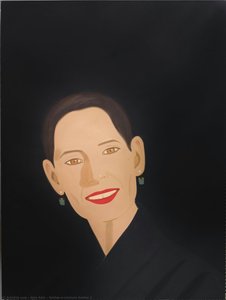
A Study in Cool Detachment: Alex Katz’s “Eyewear”
- Subject & Composition: “Eyewear” presents a strikingly simple yet compelling portrait of a man, his face largely obscured by dark sunglasses. The composition is boldly frontal and centered, emphasizing the subject's presence while simultaneously creating a sense of distance. Katz masterfully uses this direct gaze – or rather, *lack* of gaze due to the sunglasses – to invite contemplation.
- Style & Technique: This work exemplifies Alex Katz’s signature style: a flattened pictorial space, bold outlines, and a deliberate reduction of detail. It's not about meticulous realism; it’s about capturing an *essence*. The digital painting technique contributes to the smooth, almost graphic quality, reminiscent of screen printing or billboard advertising. Katz eschews traditional modeling with light and shadow, opting instead for areas of flat color that define form. This approach aligns him with Pop Art sensibilities, though his work maintains a distinct coolness and emotional restraint often absent in more exuberant examples of the movement.
- Historical Context & Influences: Alex Katz emerged as a significant figure in American art during the 1950s and 60s, bridging Abstract Expressionism and Pop Art. While influenced by artists like Kitagawa Utamaro – known for his refined portraits of Japanese beauties – Katz developed a uniquely contemporary aesthetic. He rejected the intensely personal expression of the Abstract Expressionists, favoring instead a more objective and detached observation of modern life. His work often reflects the visual culture of advertising and mass media.
- Symbolism & Emotional Impact: The sunglasses are key to understanding the emotional core of “Eyewear.” They act as a barrier, shielding the subject’s eyes – traditionally considered windows to the soul – from direct engagement. This creates an air of mystery and aloofness. Is this a statement about privacy in modern society? A commentary on the performative nature of identity? Or simply an exploration of formal qualities—the interplay of dark shapes against a solid background? The ambiguity is intentional, allowing viewers to project their own interpretations onto the work. The cool palette and simplified forms contribute to a sense of emotional distance, inviting contemplation rather than immediate empathy.
- Interior Design & Collectibility: “Eyewear”’s bold simplicity makes it an exceptionally versatile piece for interior design. Its graphic quality complements modern and contemporary spaces, adding a sophisticated touch without overwhelming the room. The limited color palette – dark grey and white with black accents – ensures it integrates seamlessly into various décor schemes. As a work by a highly respected artist like Alex Katz, this piece (or a high-quality reproduction) represents not only an aesthetic investment but also a connection to a significant chapter in art history.
- This artwork is a testament to Katz’s ability to distill complex ideas into strikingly simple forms. It's a portrait that doesn't reveal everything, and perhaps, that's precisely its power.
Questions & Answers
How intense are the colors in "Eyewear" by Alex Katz?
"Eyewear" by Alex Katz shows a balanced color intensity.
What other names is Alex Katz known by?
Alex Katz is also known as ألكس كاتس, アレックス・カッツ, Алекс Кац, 亞歷克斯·卡茨.
What color saturation does "Eyewear" by Alex Katz have?
The palette of "Eyewear" is muted in saturation.
Artist Biography
Early Life and Education
- Born: July 24, 1927, Sheepshead Bay, Brooklyn, New York, USA
- Family moved to St. Albans, Queens at a young age.
- Developed an interest in art early on.
- Studied at the Cooper Union (1946-1949), learning Modern art theories and techniques under Morris Kantor.
- Attended the Skowhegan School of Painting and Sculpture in Maine, honing painting skills and emphasizing painting from life. This experience proved pivotal to his artistic development.
Artistic Style and Influences
- Style: Characterized by simplicity, bold colors, and cool emotional detachment. Often divided into portraiture and landscape genres.
- Influences: Kitagawa Utamaro (Japanese artist known for woodcuts). Comparisons have been drawn to Andy Warhol and Keith Haring.
- Techniques: Experimentation with "cutouts" – painting on cut panels of wood or aluminum. Direct painting onto shaped aluminum sheets became a signature technique.
- Monochrome Backgrounds: A defining characteristic, separating him from gestural figure painters and anticipating Pop Art.
- Photographic & Cinematic Strategies: Incorporation of cropping, decoupage, and repetition to create rhythm within paintings.
Notable Works and Development
- Early Works: Small collages of figures in landscapes (late 1950s).
- Portraiture Focus: Paintings of friends and his wife, Ada, became central themes.
- Significant Pieces: "Alex Katz: Thursday Night," "Alex Katz: Ada in Black Sweater."
- Large-Scale Paintings (1960s): Dramatic cropping of faces influenced by film and advertising.
- Landscape Series (late 1980s & 1990s): “Environmental” landscapes with loosened edges and painterly brushstrokes.
- Night Pictures: Exploration of new light sources, departing from sunlit landscapes.
- Floral Paintings: Profusion of blossoms covering canvases (early 2000s).
- Recent Works: Drastic cropping of individual portraits and sequencing images across linen. iPhone photography used as a starting point for compositions.
Achievements and Historical Significance
- Pop Art Association: Often associated with the Pop Art movement, reflecting influences from popular culture.
- Innovation in Technique: Pioneering use of "cutouts" and experimentation with printmaking techniques.
- Collaborations: Designed sets and costumes for choreographer Paul Taylor.
- Recognition & Awards: Numerous awards and recognition throughout his career. Work held in prominent collections (Centre Georges Pompidou, Tate Gallery, Guggenheim Museum Bilbao).
- Longevity and Influence: A seven-decade career establishing him as a key figure in contemporary art, influencing generations of artists with his distinctive style and approach to portraiture and landscape painting.

Alex Katz
1927 - , United States
Quick Facts
- Full Name: Alex Katz
- Nationality: American
- Date Of Birth: 1927
- Place Of Birth: Brooklyn, United States of America
- Notable Artworks:
- Thursday night
- Ada in black sweater
- Penobscot
- 3 PM, November
- Upside Down Ada
- Artistic Movement Or Style: Pop Art, Figurative art
- Artists Who Influenced This Artist: ['Kitagawa Utamaro']
Related Articles

Pop Art Icon: The Top 25 Roy Lichtenstein Artworks You Must Know
Explore 25 iconic Roy Lichtenstein masterpieces. Discover the Pop Art legend's genius and explore the full collection on OriginalUniqueArt.com.
More Than Meets the Eye: Decoding the Hidden Symbols and Bold Layers of Allegorical Pop Art
Unlock the secrets of Pop Art. From Warhol's influence to aggressive modern aesthetics, we decode the bold layers and hidden symbols in contemporary icons. Elevate your urban space with high-impact, hand-painted reproductions and custom commissions designed for the bold.
Digital Collage Unleashed: How to Remix Reality into High-Impact Pop Art
Master the art of digital collage. Discover how to remix pop culture icons, glitch aesthetics, and vibrant textures into high-impact Pop Art for modern urban spaces. Elevate your collection with bold, trend-setting visual strategies from the experts in contemporary graphic art.

Digital Painting 101: A Collector's Guide to the New Era of Digital Mastery and Algorithmic Art
Master the new era of art with our expert guide to digital painting. Discover how modern aesthetics like Glitch Pop meet traditional mastery, offering sophisticated insights for collectors looking to curate meaningful, high-value contemporary works for their home.

Digital Painting Unleashed: The High-Impact Future of Glitch Pop and Algorithmic Aesthetics
Explore the high-impact future of modern art with our deep dive into Glitch Pop, cyberpunk aesthetics, and algorithmic design. Discover how digital innovation is redefining visual impact and ownership in the new digital renaissance.