Expressionism
The dead christ (Albin Egger-Lienz)
Albin Egger-Lienz (1868–1926) made The dead christ. It belongs to the Expressionism movement. It is kept at Schloss Bruck in Lienz, Austria.

 Preview

 Hand Made Oil Painting
 Send
 Share
 Fact sheet


 Download
 Similars
 X-Ray
 Diaporama
 Q&A

 Stats
The dead christ, in brief
- Title
- The dead christ
- Artist
- Albin Egger-Lienz (1868–1926)
- Artist born in
- Stribach, Austria
- Where to see it
- Schloss Bruck, Lienz, Austria
- Movement
- Expressionism
- Subject
- nude figure, religious imagery, anatomy study, mortality theme, dark palette, impasto texture
Which museum holds The dead christ?
Schloss Bruck
Lienz, Austria
The History of Schloss Bruck Schloss Bruck, also known as Burg Bruck, is a medieval castle situated in Lienz, Tyrol, Austria. The history of the site is closely linked to the development of the surrounding region. Lienz itself was first mentioned as Luenzina in a deed issued by the Bishop of Brixen around 1030.
High-resolution images of The dead christ
Albin Egger-Lienz, The dead christ, Schloss Bruck. Public domain.
Questions on The dead christ, answered
Where is "The dead christ" by Albin Egger-Lienz on display today?
The original "The dead christ" by Albin Egger-Lienz is held at the Schloss Bruck, Lienz, Austria. A reproduction allows the work to be displayed at home.
What does "The dead christ" by Albin Egger-Lienz depict?
The subjects of "The dead christ" are nude figure, religious imagery, anatomy study, mortality theme, dark palette, impasto texture, austrian art.
Is "The dead christ" free of copyright?
The copyright answer for "The dead christ" by Albin Egger-Lienz: the work is in the public domain - its copyright has expired. This determines whether reproductions of the image may be freely made.
Who is the artist behind "The dead christ"?
"The dead christ" was created by Albin Egger-Lienz. The information on this page describes Albin Egger-Lienz's original work.
What style does "The dead christ" belong to?
"The dead christ" by Albin Egger-Lienz belongs to the Expressionism movement. This movement provides the stylistic context of the work.
What stage of Albin Egger-Lienz's development does "The dead christ" represent?
Within Albin Egger-Lienz's career, "The dead christ" falls in the Mature Period. The phase helps compare it with the artist's other works.
Is "The dead christ" by Albin Egger-Lienz in the public domain, and why?
"The dead christ" by Albin Egger-Lienz is in the public domain - its copyright has expired. Copyright duration runs from the artist's death, which occurred in 1926.
Is "The dead christ" by Albin Egger-Lienz kept in the artist's home country?
Yes - the artwork is kept in the artist's home country. "The dead christ" is held in Austria, while Albin Egger-Lienz was born in Austria.
What does "The dead christ" share with the rest of Albin Egger-Lienz's output?
"The dead christ" belongs to Albin Egger-Lienz's Expressionism work, whose recorded themes include rustic genre studies, exploration of form, bold expressionism, renaissance anatomy, hodler's monumentality, classical nudity, religious mortality, austrian folklore.
About the artist, Albin Egger-Lienz

1868–1926, Austria
Albin Egger-Lienz
Albin Egger-Lienz: Life and Legacy Early Life and Training Born: January 29, 1868, in Dölsach-Stribach near Lienz, Tyrol, Austria. Parentage: He was the natural son of Maria Trojer, a peasant girl, and Georg Egger, a church painter. He later adopted his father’s surname combined with his birthplace. His initial artistic education came from his father, laying the foundation for his future career.
Also by Albin Egger-Lienz
 From Him1887
 On the Church Choir of the Lienzer Pfarrkirche St. Andrä1890
 Saint Sebastian1887
 Good Friday1892
Essays around The dead christ
 25 Masterpieces by Rogier van der Weyden: The Pinnacle of Emotional ArtImmerse yourself in the profound emotion of Rogier van der Weyden’s greatest works. From Northern Renaissance mastery to exquisite textures…
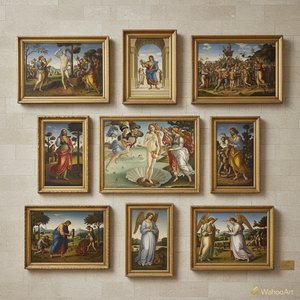 Early Renaissance Masters: 10 Paintings That Changed Art History |Journey through the Early Renaissance! Explore 10 iconic paintings by Botticelli, Leonardo da Vinci & Michelangelo. Discover their stories,…
 Masterpieces of the German Renaissance: Top 25 Albrecht Dürer ArtworksExplore 25 iconic Albrecht Dürer masterpieces of the German Renaissance. Discover the full collection online at OriginalUniqueArt.com.