Social Realism
The Blind - (Albin Egger-Lienz)
Albin Egger-Lienz (1868–1926) made The Blind -. It belongs to the Social Realism movement. It is kept at Schloss Bruck in Lienz, Austria.

 Preview

 Hand Made Oil Painting
 Send
 Share
 Guide


 Download
 Similars
 X-Ray
 Diaporama
 Q&A

 Stats
The Blind -: the essentials
- Title
- The Blind -
- Artist
- Albin Egger-Lienz (1868–1926)
- Artist born in
- Stribach, Austria
- Where to see it
- Schloss Bruck, Lienz, Austria
- Movement
- Social Realism
- Subject
- rural life, blindness theme, community support, social realism, human resilience, austrian landscape
Which museum holds The Blind -?
Schloss Bruck
Lienz, Austria
The History of Schloss Bruck Schloss Bruck, also known as Burg Bruck, is a medieval castle situated in Lienz, Tyrol, Austria. The history of the site is closely linked to the development of the surrounding region. Lienz itself was first mentioned as Luenzina in a deed issued by the Bishop of Brixen around 1030.
The Blind - in high resolution
Albin Egger-Lienz, The Blind -, Schloss Bruck. Public domain.
A digital expert checks the colors against the original painting and retouches the file, faithful to the artist's brushwork.
Buy the high-resolution imageQuestions about The Blind -
Is "The Blind -" by Albin Egger-Lienz in the public domain, and why?
"The Blind -" by Albin Egger-Lienz is in the public domain - its copyright has expired. Copyright duration runs from the artist's death, which occurred in 1926.
How do I preview a reproduction of "The Blind -" by Albin Egger-Lienz?
A preview of "The Blind -" by Albin Egger-Lienz is available on the artwork's Preview page.
How is the color composition of "The Blind -" by Albin Egger-Lienz built?
The color composition of "The Blind -" by Albin Egger-Lienz combines a gentle contrast with a unified palette harmony.
What does "The Blind -" by Albin Egger-Lienz depict?
"The Blind -" by Albin Egger-Lienz depicts: rural life, blindness theme, community support, social realism, human resilience, austrian landscape, working class figures.
How do movement and era meet in "The Blind -" by Albin Egger-Lienz?
"The Blind -" by Albin Egger-Lienz is placed in the Social Realism movement, within the 19th-Century era of its creator.
What does "The Blind -" share with the rest of Albin Egger-Lienz's output?
Within Albin Egger-Lienz's output, "The Blind -" sits in the Social Realism style, alongside the themes of social realism influence, austrian rural life, community solidarity, human resilience theme, religious allegory subtle, political critique muted, early 20th-century style, iconic artist's work.
Is "The Blind -" typical of what Albin Egger-Lienz usually created?
Among Albin Egger-Lienz's recorded themes - social realism influence, austrian rural life, community solidarity, human resilience theme, religious allegory subtle, political critique muted, early 20th-century style, iconic artist's work - "The Blind -" brings its own focus on rural life, blindness theme, community support, social realism, human resilience, austrian landscape, working class figures.
Does "The Blind -" have an augmented reality preview?
"The Blind -" has an augmented reality preview: the artwork's AR Preview page shows it in your own space on a compatible device.
Is a download available for "The Blind -"?
A download is available for "The Blind -": the artwork's Download page offers a high-resolution digital image download.
About the artist, Albin Egger-Lienz

1868–1926, Austria
Albin Egger-Lienz
Albin Egger-Lienz: Life and Legacy Early Life and Training Born: January 29, 1868, in Dölsach-Stribach near Lienz, Tyrol, Austria. Parentage: He was the natural son of Maria Trojer, a peasant girl, and Georg Egger, a church painter. He later adopted his father’s surname combined with his birthplace. His initial artistic education came from his father, laying the foundation for his future career.
Also by Albin Egger-Lienz
 On the Church Choir of the Lienzer Pfarrkirche St. Andrä1890
 Good Friday1892
 Saint Sebastian1887
 From Him1887
Essays around The Blind -
 Ivan Bilibin: A Synthesis of Folklore, Modernism & National Identity in Russian IllustrationExplore the enchanting world of Ivan Bilibin, a master Russian illustrator who synthesized folklore, Art Nouveau & national identity. Disco…
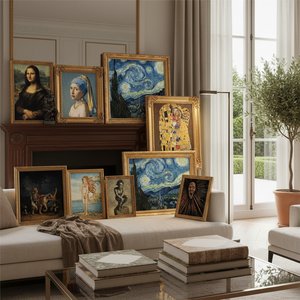 Timeless Masterpieces: 10 Classic Artworks for Elegant Homes |Explore 10 timeless masterpieces – from Van Gogh to Rembrandt – that define classic art & evoke enduring moods. Discover art history, techn…
 The Dignity of Toil: How Realism and Impressionism Captured the Essence of the Working ClassExplore how Realism and Impressionism captured the dignity of labor through masters like Courbet and Van Gogh. Discover the truth in art.