Menu
FREE ART CONSULTATION
PreviewPreview Buy print Buy printBuy Image Buy Image SendSend
DetailsDetails Add to favorites Add to favorites DownloadDownload SimilarsSimilars X-RayX-Ray DiaporamaDiaporama

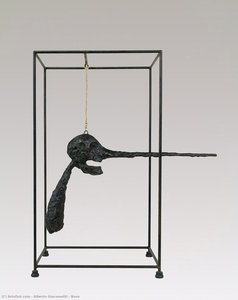
Disagreeable Object

Explore the unsettling abstraction of Giacometti's Disagreeable Object (1931), a minimalist sculpture evoking existential thought; discover this modern masterpiece today.

Explore Alberto Giacometti (1901-1966), the Swiss sculptor & painter renowned for his iconic, elongated figures embodying existentialism and modern art's exploration of the human condition.

Hand Made Oil Reproduction

Hand-painted oil on canvas in your size and frame, made to order by our artists.

Standard
custom
CM
INCH

Pick from our preset sizes that match the artwork's original proportions.

width
height

You may enter your own dimensions to fit a specific frame or space. If your selected size does not match the original image's proportions, we will either crop the artwork or extend the painting with additional hand-painted elements. A digital mockup will be sent for your approval before production begins.
Please note that the on-screen preview does not reflect the actual cropping or extension. Only the mockup will accurately show the final composition.
While custom sizes are available, we recommend selecting a dimension from the predefined list to preserve the original proportions.

Examples of what can be changed: Replace face with customer photo; Add pet (e.g., replace cat with dog); Include hidden message in background; Change background landscape or elements.
After order, OriginalUniqueArt.com team will email client for instructions and provide a mockup preview

Worldwide Delivery () in 3/4 weeks instead of standard 5 weeks. (25 July). No compromise on quality.

why_choose_icon
Free Worldwide Express Shipping
why_choose_icon
High-Quality Linen Canvas
why_choose_icon
Full Shipping Insurance
why_choose_icon
Customs Tax Refund Guarantee
why_choose_icon
True Color Matching Guarantee
why_choose_icon
60-Day Return Policy (Defects Only)
why_choose_icon
100% Money-Back Guarantee
why_choose_icon
Bulk Discount Offer

Total Price

-

reproduction

Disagreeable Object

Reproduction Medium

Reproduction Size

-

Total Price

-

Quick Facts

  • Artist: Alberto Giacometti
  • Dimensions: 6 1/8 x 19 5/16 x 4 5/16"
  • Subject or theme: Abstract sculptural form
  • Artistic style: Surrealism
  • Location: Private collection, promised gift to The Museum of Mo
  • Year: 1931
  • Title: Disagreeable Object

Art Quiz

There is only one correct answer for each question.

Question 1:
What is the title of the artwork being described?
Question 2:
In what year was 'Disagreeable Object' created by Alberto Giacometti?
Question 3:
Which artistic movement is suggested by the style of 'Disagreeable Object'?
Question 4:
What is the primary color palette observed in the photograph of the sculpture?
Question 5:
What material is suggested for the sculpture, based on its appearance?

Artwork Description

The Enigmatic Form of Giacometti's "Disagreeable Object"

To stand before Alberto Giacometti’s Disagreeable Object is not merely to observe sculpture; it is to engage in a quiet, profound dialogue with absence and presence. Created in 1931, this piece transcends the definition of mere decoration. It presents an object so stark, so deliberately ambiguous, that its power lies entirely within the space it occupies and the questions it forces us to confront. The composition itself—a smooth, elongated form resting upon a muted plane—is deceptively simple. Giacometti strips away narrative flourish, leaving behind pure geometry imbued with existential weight. For the collector or designer seeking an anchor piece that speaks volumes without uttering a word, this work offers unparalleled intellectual depth.

A Study in Materiality and Line

Technically, the sculpture embodies the modernist fascination with elemental materials. While its original medium is often cited as wood, the visual impact—the interplay of light across its subtly textured surface—suggests a permanence akin to polished stone or concrete. The lines are breathtakingly fluid; there are no jarring angles, only continuous, organic curves that seem to have been coaxed into existence rather than carved. This masterful handling of form directs the eye along its gentle arc, creating a visual rhythm that is both calming and restless. When considering a high-quality reproduction for your interior space, paying attention to the subtle tonal variations in the material finish will be key to capturing this delicate interplay between light and shadow.

Symbolism and the Human Condition

Giacometti’s oeuvre is deeply rooted in the anxieties of the 20th century, a period marked by profound upheaval. This object, with its ambiguous silhouette—sometimes interpreted as phallic, sometimes simply as an abstract residue—refuses easy categorization. It embodies that unsettling quality he mastered: the beautiful discomfort. It challenges our ingrained expectations of what art should look like or mean. Does it represent isolation? A lingering memory? The sheer weight of existence itself? This ambiguity is its greatest gift; it allows every viewer, from the seasoned connoisseur to the first-time admirer, to project their own deepest concerns onto its smooth surface.

Integrating Art into Living Space

For interior design, Disagreeable Object serves as a powerful counterpoint to opulent or overly ornate surroundings. It demands negative space around it, allowing its quiet drama to unfold unimpeded. Placed on a console table, atop a minimalist mantelpiece, or within a gallery setting, it acts as an intellectual focal point. Its muted palette of grays and creams ensures that it harmonizes with sophisticated decor schemes while simultaneously injecting a vital spark of modernist contemplation. It is not just art to be looked at; it is an object meant to be contemplated, elevating the everyday act of viewing into a moment of quiet philosophical reckoning.


Artist Biography

A Life Sculpted by Existential Echoes

Alberto Giacometti, a name synonymous with the hauntingly elongated figures that define much of 20th-century sculpture, was born in 1901 amidst the breathtaking landscapes of Borgonovo, Switzerland. This alpine setting, nestled near the Italian border, instilled within him an early appreciation for form and space – qualities that would profoundly shape his artistic vision. He wasn’t simply entering a world of art; he was *born* into it. His father, Giovanni Giacometti, was a respected Post-Impressionist painter, and this familial immersion provided both encouragement and a foundation upon which young Alberto could build. The echoes of the Reformation resonated within his lineage too, as his family descended from Protestant refugees who had sought sanctuary from persecution, perhaps contributing to a lifelong exploration of isolation and the human condition. His brothers, Diego – himself a sculptor – and Bruno, an architect, further cemented art’s central role in their lives, creating a dynamic creative atmosphere that fostered experimentation and mutual influence.

From Cubism to the Void: A Shifting Artistic Landscape

Giacometti's formal artistic journey began at the Geneva School of Fine Arts, but it was his move to Paris in 1922 that truly ignited his creative fire. He entered the studio of Antoine Bourdelle, a former associate of Rodin, absorbing classical techniques while simultaneously being swept up by the avant-garde currents swirling through the city. The early years were marked by an exploration of Cubism, dismantling and reassembling forms in a manner reflective of the era’s intellectual ferment. However, Giacometti wasn't content to merely mimic; he sought his own voice, moving towards a more personal style that focused intently on the human figure. This period saw him gravitating toward Surrealism, creating works imbued with dreamlike imagery and psychological depth, associating with luminaries like Miró, Ernst, and Picasso. Yet, even within this movement, Giacometti felt constrained. He ultimately rejected its purely subconscious approach, yearning for a more rigorous analysis of figurative composition – a desire to understand the essence of being through form. The late 1930s witnessed a dramatic shift in scale; he began producing incredibly small sculptures, often no larger than seven centimeters tall. These diminutive figures weren’t simply miniature representations but rather expressions of distance, both physical and emotional, reflecting a sense of detachment and loss that permeated his worldview.

The Post-War Silhouette: Fragility and the Human Condition

The devastation of World War II profoundly impacted Giacometti's work. Taking refuge in Switzerland during the conflict, he continued to sculpt, but it was after the war that he achieved his most iconic style – the tall, attenuated figures for which he is celebrated today. These weren’t portraits in the traditional sense; they were distillations of human presence, stripped down to their essential forms. Rough surfaces and elongated limbs conveyed a profound sense of fragility and isolation, mirroring the existential anxieties of the post-war era. They seem perpetually on the verge of dissolving into nothingness, embodying the precariousness of existence. These sculptures weren’t merely *of* people; they were explorations of what it meant to *be* human in a world grappling with trauma and uncertainty. The space surrounding these figures is as crucial as the forms themselves – an imaginary yet tangible realm that speaks to our own sense of alienation and longing. Simultaneously, Giacometti's painting gained prominence, mirroring the themes of isolation and attenuation found in his sculptures through almost monochromatic depictions of the human form.

Legacy of a Visionary

Giacometti’s artistic contributions were recognized with increasing acclaim throughout his career, culminating in the Grand Prize for Sculpture at the Venice Biennale in 1962. However, despite this success, he remained relentlessly self-critical, constantly reworking and sometimes even destroying sculptures that failed to meet his exacting standards. His unfinished commission for the Chase Manhattan Bank Building in New York – *Grande Femme Debout I–IV* – stands as a testament to his dissatisfaction with the relationship between art and its environment, highlighting his uncompromising artistic integrity. His work resonates deeply with existentialist philosophy, grappling with themes of human existence, mortality, and the search for meaning in an absurd world. He wasn’t simply creating aesthetically pleasing objects; he was posing fundamental questions about what it means to be alive. Alberto Giacometti is rightfully considered one of the most important sculptors of the 20th century, his influence continuing to inspire artists and captivate audiences with its profound exploration of the human condition and its uniquely evocative visual language. His sculptures are not merely representations of figures; they are embodiments of our shared vulnerability and search for connection in an increasingly fragmented world.
Alberto Giacometti

Alberto Giacometti

1901 - 1966 , Switzerland

Quick Facts

  • Artistic Movement Or Style: Surrealism, Existentialism
  • Artists Who Influenced This Artist:
    • Antoine Bourdelle
    • Rodin
    • Miró
    • Max Ernst
    • Picasso
  • Date Of Birth: 1901
  • Date Of Death: 1966
  • Full Name: Alberto Giacometti
  • Nationality: Swiss
  • Notable Artworks:
    • The City Square
    • Reclining Woman Who Dreams
    • Surrealist Table
  • Place Of Birth: Borgonovo, Switzerland
Explore artworks organized by themes, styles, and characteristics.