() ·

A painting made for you, by hand

Judas

Hand Made Oil Reproduction

Hand-painted oil on canvas in your size and frame, made to order by our artists. ( Switch to Print Switch to Digital Image)

Collectible Description

Albert Tucker's haunting 'Judas' (1955) is an Expressionist masterpiece depicting betrayal and despair through distorted figures & earthy tones. Explore the painting’s symbolism and the artist’s legacy.

Artist Biography

Explore the art of Albert Tucker (1905-1995), a Canadian artist known for his expressive figurative paintings, social commentary, and depictions of city life & wartime experiences. Discover works reflecting themes of alienation, morality, and human c

from ·

Chapter 1

How large should it be?

Slide to change the size; the picture on the left shows the frame at its real width. The proportions of the original are kept.

Standard
custom
CM
INCH

Pick from our preset sizes that match the artwork's original proportions.

width
height

Type the width and the height you need, to fit your frame or your wall. This is hand-painted, so for a size with a different shape the artist can paint a bit more around the picture, or cut a bit — you choose. We send you a digital mockup to approve before the painting starts. The picture shown on this page does not show the real result — only the mockup does.

Chapter 2

How should it arrive?

Choose the edges of the stretched canvas

Choose your frame

Corner sample of the WhiteWrap canvas edge finish, stretched on solid wood bars
White $1
Corner sample of the BlurSideWrap canvas edge finish, stretched on solid wood bars
Blurside $1
Corner sample of the ExtendedWrap canvas edge finish, stretched on solid wood bars
Extended $1
Corner sample of the P118B picture frame: moulded polystyrene, 5 cm wide and 3 cm thick
P118B $10
Corner sample of the P118H picture frame: moulded polystyrene, 5 cm wide and 3 cm thick
P118H $10
Corner sample of the P118W picture frame: moulded polystyrene, 5 cm wide and 3 cm thick
P118W $10
Corner sample of the P438Z picture frame: moulded polystyrene, 5.5 cm wide and 3.5 cm thick
P438Z $10
Corner sample of the P508JH picture frame: moulded polystyrene, 7 cm wide and 3.5 cm thick
P508JH $12
Corner sample of the P508YH picture frame: moulded polystyrene, 7 cm wide and 3.5 cm thick
P508YH $12
Corner sample of the P805H picture frame: moulded polystyrene, 5 cm wide and 3.5 cm thick
P805H $10
Corner sample of the P805Z picture frame: moulded polystyrene, 5 cm wide and 3.5 cm thick
P805Z $10
Corner sample of the P919BZ picture frame: moulded polystyrene, 7 cm wide and 3.5 cm thick
P919BZ $10
Corner sample of the P919G picture frame: moulded polystyrene, 7 cm wide and 3.5 cm thick
P919G $10
Corner sample of the P919XJ picture frame: moulded polystyrene, 7 cm wide and 3.5 cm thick
P919XJ $10
Corner sample of the P959ZH picture frame: moulded polystyrene, 5 cm wide and 3 cm thick
P959ZH $10
Corner sample of the P968JZ picture frame: moulded polystyrene, 6 cm wide and 4 cm thick
P968JZ $12
Corner sample of the W106C picture frame: solid wood, 5 cm wide and 3 cm thick
W106C $8
Corner sample of the W218G picture frame: solid wood, 5 cm wide and 3 cm thick
W218G $10
Corner sample of the W218JH picture frame: solid wood, 5 cm wide and 3 cm thick
W218JH $8
Corner sample of the W218Y picture frame: solid wood, 5 cm wide and 3 cm thick
W218Y $10
Corner sample of the W307PJ picture frame: solid wood, 6 cm wide and 3 cm thick
W307PJ $10
Corner sample of the W316G picture frame: solid wood, 6 cm wide and 3 cm thick
W316G $10
Corner sample of the W316PJ picture frame: solid wood, 6 cm wide and 3 cm thick
W316PJ $8
Corner sample of the W316Y picture frame: solid wood, 6 cm wide and 3 cm thick
W316Y $10
Corner sample of the W398PJ picture frame: solid wood, 5 cm wide and 3 cm thick
W398PJ $8
Corner sample of the W4111J picture frame: solid wood, 6.5 cm wide and 3.5 cm thick
W4111J $10
Corner sample of the W500HY picture frame: solid wood, 7 cm wide and 5 cm thick
W500HY $15
Corner sample of the W500JH picture frame: solid wood, 7 cm wide and 5 cm thick
W500JH $15
Corner sample of the W692G picture frame: solid wood, 8 cm wide and 4 cm thick
W692G $12
Corner sample of the W849H picture frame: solid wood, 5 cm wide and 3 cm thick
W849H $8
Corner sample of the W940BG picture frame: solid wood, 7.5 cm wide and 4.5 cm thick
W940BG $15
Corner sample of the W953PJ picture frame: solid wood, 6 cm wide and 3.5 cm thick
W953PJ $8
Corner sample of the H24-GOLD picture frame: carved wood with gesso, 10 cm wide and 6 cm thick
H24-GOLD $30
Corner sample of the H24-SILVER picture frame: carved wood with gesso, 10 cm wide and 6 cm thick
H24-SILVER $30
Corner sample of the H36-GOLD picture frame: carved wood with gesso, 15 cm wide and 6.5 cm thick
H36-GOLD $45
Corner sample of the H36-SILVER picture frame: carved wood with gesso, 15 cm wide and 6.5 cm thick
H36-SILVER $45
Frame preview
Framed

Moulding: . Overall size with the frame: .

Chapter 3

Who paints it, and should anything change?

Examples of what can be changed: Replace face with customer photo; Add pet (e.g., replace cat with dog); Include hidden message in background; Change background landscape or elements.
After order, OriginalUniqueArt.com team will email client for instructions and provide a mockup preview

Worldwide Delivery () in 3/4 weeks instead of standard 5 weeks. (6 November). No compromise on quality.

Chapter 4

The finishing touches

A nameplate, as in a museum?

Engraved Bronze Plaque Details

This elegant plaque features the artist's name and the title of the artwork, finely engraved for a timeless presentation.

It is made from bronze with a refined, elegant finish. The text is precisely laser-engraved for a sharp and permanent result. Measuring 9x2 cm, the plaque is compact yet easy to read. It's built to be durable and scratch-resistant, offering a professional, museum-quality look. Mounting is simple thanks to the included adhesive backing.

Transparent Acrylic Plaque Details

The plaque includes essential engraved details such as the artist's name, the title of the artwork, the date it was created, the type of media used-like oil on canvas or watercolor-a brief description of the piece, and a QR code that links to the complete artwork information.

It is crafted from clear acrylic, offering a sleek, modern appearance. The text is UV-engraved in black to ensure strong visual contrast. With a size of 10x15 cm, it ensures optimal readability. It comes equipped with two metal hooks for secure wall mounting. The plaque is designed to be weather-resistant, making it suitable for various environments, and it includes interactive features that work seamlessly with smartphone scanning.

Black Acrylic Plaque Details

This elegant plaque includes engraved information such as the artist's name, the title of the artwork, the date it was created, the type of media used (like oil on canvas or watercolor), a short description of the artwork, and a QR code for quick access to more information.

The plaque itself is made from refined black acrylic with a premium finish. The text is laser-engraved in white for high contrast and readability. Its size is 10x15 cm, designed to be easy to read. It comes with two metal hooks for professional mounting. The design is sleek and fits any interior style. It is also weather-resistant and durable, with built-in digital integration for mobile compatibility.

A protective varnish?

When do you need it?

Chapter 5

Your painting, as you ordered it

Judas

Reproduction Medium

Reproduction Size

-

Elite Senior Artist

More detail, finesse, and extra production time

-

Reproduction Frame

-

-

For artworks or reproductions larger than 105 cm (approximately 41 inches) on any side, the frame will be shipped as a kit, disassembled. This method ensures safe delivery and prevents damage during transport.

Professional assembly required - this is not a DIY product.
The kit must be assembled and the canvas stretched by an experienced professional framer, using wood glue (not supplied), a canvas stretching plier and clamps to hold the bars square while the glue dries. Incorrect assembly or uneven canvas tension can permanently damage the artwork and is not covered by our warranty.

  • All solid wood bars are included, precisely cut to size.

  • Assembled with the screws provided, plus wood glue for the corner joints, which is not supplied and must be sourced by your framer.

  • Professional tools are required and not included: a canvas stretching plier (tensioner) and clamps to hold the bars square while the glue dries.

Important:
The corner joints require wood glue, the bars must be held with clamps until the glue is fully dry, and tightening the canvas on the assembled frame requires a canvas stretching plier. None of these are included in the kit. Please arrange an experienced professional framer before ordering this size.

Nameplate

-

-

Protective Varnish

Glossy Varnish (enhances colors, protects against light/moisture)

-

Customize My Artwork

Examples of what can be changed: Replace face with customer photo; Add pet (e.g., replace cat with dog); Include hidden message in background; Change background landscape or elements.

-

Urgent

Worldwide Delivery () in 3/4 weeks instead of standard 5 weeks. (6 November). No compromise on quality.

-

Express Shipping

Worldwide Delivery () in 5 weeks. (13 November).

Included

Total Price

$ 300

Total Price $ 300

Glass option is only available in size under 110 CM

Included with every order

  • Free Worldwide Express Shipping
  • High-Quality Linen Canvas
  • Full Shipping Insurance
  • Customs Tax Refund Guarantee
  • True Color Matching Guarantee
  • 100-Day Return Policy (Defects Only)
  • 100% Money-Back Guarantee
  • Bulk Discount Offer

Judas – A Study in Regret and Betrayal by Albert Tucker

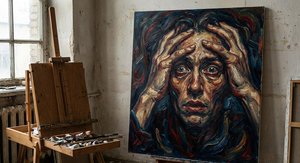
Albert Tucker’s “Judas,” painted in 1955, isn't merely a depiction of the biblical figure; it’s a profoundly unsettling exploration of guilt, isolation, and the enduring consequences of transgression. Rendered in his signature Expressionistic style, the painting immediately commands attention with its earthy palette – deep browns, ochres, and muted yellows—a visual embodiment of sorrow and decay. Tucker masterfully employs visible brushstrokes, layering paint to create a textured surface that feels both rough and vulnerable, mirroring the subject’s internal turmoil.

The composition is strikingly intimate, focusing on Judas's face – a study in shadowed features and downcast eyes. The figure dominates the frame, positioned slightly off-center within a tightly cropped space, creating a dynamic tension that draws the viewer into his despair. A stark rectangular block, held firmly by his hands, acts as a powerful visual barrier, isolating him from any potential solace or connection. This deliberate framing amplifies the sense of loneliness and reinforces the weight of his actions.

The Language of Expressionism

Tucker’s choice of technique is crucial to understanding the painting's emotional resonance. He eschews realistic representation in favor of a highly expressive approach, utilizing jagged lines to define Judas’s features – emphasizing the sharp edges of his regret and the fractured nature of his psyche. The brushwork itself is deliberately visible, conveying a sense of urgency and immediacy. Thick impasto builds up on certain areas, particularly around the face, creating a tactile quality that invites close inspection and encourages an emotional response.

The use of color further enhances this expressive intent. The dominant earth tones evoke a feeling of heaviness and stagnation, while the strategic application of red – in the hair and skin—adds a dramatic intensity to the scene, symbolizing both passion and violence. The diffused lighting, lacking any clear source, contributes to the overall atmosphere of gloom and despair, casting long shadows that seem to cling to Judas’s form.

Symbolism and Historical Context

“Judas” is steeped in religious symbolism, depicting a pivotal moment in Christian scripture – the betrayal of Jesus Christ. The scattered coins at the base of the painting are a potent reminder of the thirty pieces of silver Judas received for his treachery, representing the material cost of his actions. The rectangular block itself has been interpreted as a symbol of burden or perhaps even a barrier—a physical manifestation of the guilt and shame he carries.

Understanding the historical context is key to appreciating the painting’s depth. Created during a period of significant social and political upheaval, Tucker's work often grappled with themes of alienation, morality, and the complexities of human relationships. His exploration of Judas reflects a broader concern with the darker aspects of human nature – the capacity for betrayal and the enduring consequences of wrongdoing. The painting’s creation coincided with Tucker’s own personal struggles, adding another layer of emotional intensity to the work.

A Timeless Portrait of Regret

“Judas” is more than just a historical depiction; it's a hauntingly beautiful portrait of regret and isolation. Tucker’s masterful use of color, composition, and technique creates an image that lingers in the mind long after viewing. It serves as a powerful reminder of the enduring consequences of our choices and the profound impact of betrayal—a timeless meditation on human fallibility and the search for redemption.

Questions & Answers

What level of contrast does "Judas" by Albert Tucker show?

The contrast level of "Judas" by Albert Tucker is statement.

What size is "Judas" by Albert Tucker in real life?

"Judas" measures 96 x 130 cm in its original form. Original dimensions are a useful reference when choosing a reproduction size.

What mood and emotion come together in "Judas"?

In "Judas", a dramatic mood accompanies a melancholic emotion.

More about this painting

Preview AR preview Switch to Print Switch to Digital Image Send
Details Guide Add to favorites Download Similars X-Ray Diaporama Q&A Stats

In numbers

  • 1955the year it was painted
  • 29frames to choose from
  • standard sizes, in its own proportions
  • 5weeks to paint and deliver it

About the original

Dimensions
96.0 x 130.0 cm
Albert Tucker

Albert Tucker

1905 - 1995, Canada

Quick facts about Albert Tucker

  • Full Name: Albert William Tucker
  • Nationality: Canadian
  • Date Of Birth: 1905
  • Date Of Death: 1995
  • Place Of Birth: Oshawa, Canada
  • Notable Artworks:
    • Philosopher
    • Memory of Leonski
  • Artistic Movement Or Style: Expressionism

Artist Biography

Albert Tucker: A Life Bridging Mathematics and Art

  • Born: Oshawa, Canada (1905)
  • Died: 1995

Albert William Tucker was a remarkable figure whose life defied easy categorization. While primarily recognized as a distinguished Canadian mathematician, his legacy extends into the realm of art and intellectual history. He is celebrated for significant contributions to topology, game theory (particularly for popularizing the "Prisoner's Dilemma"), and non-linear programming, while also leaving behind a body of artistic work that reflects themes of alienation, morality, and social commentary.

Early Life and Education: A Foundation in Mathematics

Tucker’s journey began in Oshawa, Ontario. His upbringing emphasized education, fostering an early aptitude for mathematics. He pursued his undergraduate studies at the University of Toronto, earning a B.A. in 1928 and an M.A. in 1929. His pursuit of advanced knowledge led him to Princeton University where he earned his Ph.D. under the guidance of Solomon Lefschetz in 1932 with a dissertation titled *An Abstract Approach to Manifolds*. This period laid the groundwork for his future contributions, establishing a strong foundation in abstract mathematics.

Mathematical Contributions and Legacy

  • The Prisoner's Dilemma: Tucker is widely known for giving name and interpretation to Merrill M. Flood and Melvin Dresher’s model of cooperation and conflict, solidifying its place as a cornerstone of game theory.
  • Karush-Kuhn-Tucker Conditions: His work on the Karush-Kuhn-Tucker conditions significantly advanced non-linear programming.
  • Mathematical Education: Tucker was deeply committed to mathematics education, serving as chair of the AP Calculus committee for the College Board (1960-1963) and actively participating with the Committee on the Undergraduate Program in Mathematics (CUPM). He also served as president of the Mathematical Association of America (MAA) from 1961-1962.
  • Mentorship: Tucker’s influence extended through his mentorship of numerous prominent figures, including Nobel Prize winners John Nash and Lloyd Shapley, and Turing Award winner Marvin Minsky. His collaborations with Harold W. Kuhn further enriched the mathematical landscape.

Tucker's legacy is not solely confined to his direct contributions; it also encompasses his role as a vital source for oral histories within the mathematics community, solidifying his position as a respected and influential figure.

Artistic Expression: Themes of Isolation and Social Commentary

While primarily known for his mathematical achievements, Tucker was also an artist. His paintings, often characterized by expressive figurative styles, explored themes of alienation, morality, and the complexities of human existence. His artistic output reflects a keen observation of social issues and wartime experiences, offering poignant commentary on the human condition.

  • Style: Expressionism
  • Recurring Themes: Isolation, contemplation, moral dilemmas, depictions of city life, wartime experiences.

Notable artworks such as "Philosopher" exemplify his ability to convey profound emotions through bold lines, dramatic lighting, and a rich color palette. His artistic vision provides another layer to understanding the multifaceted nature of Albert Tucker's intellectual pursuits.

Quick Facts

  • Artistic style: Distorted forms
  • Subject or theme: Betrayal & Regret
  • Dimensions: 96 x 130 cm
  • Artist: Albert Tucker
  • Influences: Emotional portrayal
  • Title: Judas

Art Quiz

There is only one correct answer for each question.

Question 1:
What artistic movement is most closely associated with Albert Tucker’s painting ‘Judas’?
Question 2:
The rectangular block held by Judas in the painting likely symbolizes:
Question 3:
What year was Albert Tucker’s painting ‘Judas’ created?
Question 4:
According to the description, what color palette dominates the painting?
Question 5:
Albert Tucker was a prominent figure in which field besides art?