Preview
 Send
Send Share
Share
 Details
 Guide
Guide

 Download
 Similars
 X-Ray
X-Ray Diaporama
 Stats
StatsA Musician


 Read More
Hand Made Oil Reproduction
Hand-painted oil on canvas in your size and frame, made to order by our artists. ( Switch to Print Switch to Digital Image)




P118B $10

P118H $10

P118W $10

P438Z $10

P508JH $12

P508YH $12

P805H $10

P805Z $10

P919BZ $10

P919G $10

P919XJ $10

P959ZH $10

P968JZ $12

W106C $8

W218G $10

W218JH $8

W218Y $10

W307PJ $10

W316G $10

W316PJ $8

W316Y $10

W398PJ $8

W4111J $10

W500HY $15

W500JH $15

W692G $12

W849H $8

W940BG $15

W953PJ $8




Pick from our preset sizes that match the artwork's original proportions.

Type the width and the height you need, to fit your frame or your wall. This is hand-painted, so for a size with a different shape the artist can paint a bit more around the picture, or cut a bit — you choose. We send you a digital mockup to approve before the painting starts. The picture shown on this page does not show the real result — only the mockup does.
After order, OriginalUniqueArt.com team will email client for instructions and provide a mockup preview
Worldwide Delivery () in 3/4 weeks instead of standard 5 weeks. (24 October). No compromise on quality.

Free Worldwide Express Shipping

High-Quality Linen Canvas

Full Shipping Insurance

Customs Tax Refund Guarantee

True Color Matching Guarantee

100-Day Return Policy (Defects Only)

100% Money-Back Guarantee

Bulk Discount Offer
 Glass option is only available in size under 110 CM

A Musician
Reproduction Medium
Reproduction Size
-


Total Price
$ 350
A Musician by Albert Joseph Moore: An Echo of Classical Grace
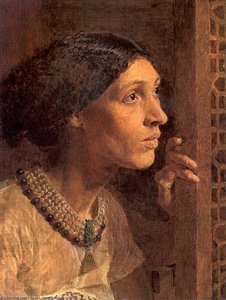
Albert Joseph Moore’s “A Musician,” painted circa 1867, is more than just a depiction of an ancient scene; it's a carefully constructed tableau brimming with romanticism, classical ideals, and a subtle yearning for harmony. Housed within the Yale Center for British Art, this oil on canvas invites us into a meticulously rendered world where music, beauty, and contemplation intertwine. The painting immediately establishes a sense of serene elegance, transporting the viewer to a space that feels both timeless and deeply personal.
The composition centers around three figures: a seated woman, her gaze fixed intently upon a musician playing a lyre – likely an instrument associated with Apollo himself. A second figure stands beside her, adding a layer of quiet formality to the scene. The architectural backdrop, though somewhat indistinct, suggests a classical interior, perhaps a temple or palace chamber, lending gravitas and reinforcing the painting’s connection to antiquity. Moore masterfully employs triangular composition, creating visual stability while simultaneously drawing our attention to the central figures. Notice how the musician's posture subtly directs the viewer's eye towards the woman, establishing a dynamic relationship between performer and listener.
A Palette of Warmth and Refined Detail
Moore’s color palette is dominated by rich, warm tones – deep yellows, golds, and soft pinks – punctuated by subtle browns and muted greens. These hues evoke a sense of luxuriousness and intimacy, bathing the scene in a gentle, diffused light. The artist's brushwork is remarkably detailed, particularly evident in the rendering of the drapery, which flows with an almost ethereal quality. Observe how he captures the folds and textures of fabric, suggesting both weight and movement. The skin tones are rendered with a delicate smoothness, contributing to the overall impression of idealized beauty – a hallmark of Moore’s aesthetic.
Technically, “A Musician” exemplifies Moore's mastery of academic realism, informed by his deep appreciation for classical art. He skillfully utilizes linear perspective to create depth within the architectural space, subtly receding forms into the background. The delicate lines delineating details – from the folds of the clothing to the intricate carvings on the unseen architecture – demonstrate a meticulous attention to craft. The layering and blending techniques employed in oil painting are evident in the smooth transitions between colors and tones, creating a luminous effect that enhances the painting’s overall beauty.
Symbolism and Emotional Resonance
Beyond its formal qualities, “A Musician” is rich with symbolic meaning. The lyre itself represents music, knowledge, and divine inspiration – connecting the scene to ancient mythology. The seated woman's attentive gaze suggests a profound appreciation for the musician’s performance, perhaps representing the pursuit of beauty or the contemplation of higher ideals. The overall atmosphere is one of serenity and refined elegance, inviting viewers to pause and reflect on the power of music to evoke emotion and inspire the soul.
Moore's work reflects the Aesthetic Movement, a late 19th-century artistic current that emphasized beauty, feeling, and individualism. He sought to capture not just outward appearances but also the inner emotional states of his subjects. “A Musician” is a testament to this philosophy, offering a glimpse into a world where art serves as a conduit for experiencing profound beauty and contemplation. It’s a painting that lingers in the memory long after viewing, prompting us to consider the timeless appeal of music, art, and human connection.
Questions & Answers
How strong is the contrast in "A Musician" by Albert Joseph Moore?
"A Musician" by Albert Joseph Moore shows a gentle contrast between its light and dark areas.
Where can I see the original "A Musician" by Albert Joseph Moore?
You can see the original "A Musician" at the Yale Center for British Art, New Haven, United States of America.
How does "A Musician" fit into Albert Joseph Moore's themes and style?
"A Musician" shares with Albert Joseph Moore's other works its Academic Realism style and the recorded themes: ruskin influence, classical ideals, aesthetic movement, luxury themes, decorative art, opulent settings, female form, idealized beauty.
Artist Biography
early life and education
albert joseph moore, a renowned english painter, was born on september 4, 1841, in york, united kingdom. he was the thirteenth son and fourteenth child of well-known portrait-painter william moore and his second wife, sarah collingham. several of his numerous brothers were educated as artists, including henry moore, r.a., a notable sea painter. albert moore received education at archbishop holgate's school and st. peter's school in york, where he also received instruction in drawing and painting from his father.artistic career
moore's early works show the influence of ruskin, and by 1857, he had already exhibited at the royal academy, showcasing a goldfinch and a woodcock. his artistic style evolved over time, with a marked neo-classical character emerging in the 1860s. this period saw moore designing tiles, wallpaper, and stained glass for morris, marshall, faulkner and co., as well as working as an ecclesiastic and domestic mural painter.notable works and style
moore's paintings typically feature single female figures with formalized proportions, neo-classical drapery, and floral accessories, establishing a major strand of the aesthetic movement. some of his notable works include:- the marble seat (1865), a long series of purely decorative pictures
- elijah's sacrifice (1863), showcasing the influence of ford madox brown and edward armitage
- the loves of the seasons and the winds, one of his most elaborate and painstaking works, painted for mr. mcculloch
museums and collections
moore's work can be found in various museums, including:- york museums trust (york, united kingdom), featuring paintings such as kingcups
- the royal academy (london, united kingdom), where moore frequently exhibited
legacy and later life
moore relied solely on his own judgment in matters both social and artistic, which sometimes proved a bar to his admission into the ranks of the royal academy. despite suffering from a painful and incurable illness, moore continued working until his death on september 25, 1893.- view more works by albert joseph moore at https://OriginalUniqueArt.com/@/albertjosephmoore
- explore the york museums trust collection at https://OriginalUniqueArt.com/@@/as844t-albert-joseph-moore-kingcups
- discover more about the aesthetic movement and its notable artists at https://en.wikipedia.org/wiki/aesthetic_movement

Albert Joseph Moore
1841 - 1893 , United Kingdom
Quick Facts
- Full Name: Albert Joseph Moore
- Nationality: British
- Date Of Birth: 1841
- Date Of Death: 1893
- Place Of Birth: York, United Kingdom
- Notable Artworks:
- The Marble Seat
- Elijah's Sacrifice
- The Loves of The Seasons
- Artistic Movement Or Style: Aesthetic Movement
- Artists Who Influenced This Artist:
- Ruskin
- Ford Madox Brown
- Edward Armitage
Related Articles
Mastering Reality: A Definitive Guide to the Precision and Elegance of Academic Realism
Explore the profound elegance of Academic Realism. Discover the rigorous techniques, historical context, and anatomical precision that define this timeless movement through an expert art-history lens.

Mastering Perfection: A Definitive Guide to the Elegance and Precision of Academic Classicism
Explore the rigorous beauty of Academic Classicism. Discover the principles of order, precision, and historical reverence that define this timeless art movement through an expert guide to its enduring legacy and technical mastery.

The Beauty of Perfection: A Journey Through the Rigor and Radiance of Academic Realism
Explore the profound elegance of Academic Realism. Discover how meticulous observation, anatomical precision, and the pursuit of ideal beauty created a timeless legacy of technical mastery and emotional depth in the world's most revered art academies.
Academic Realism's Finest: 10 Masterpieces for Art Lovers & Home Decor
Explore 10 defining Academic Realism masterpieces by Bouguereau, Gérôme & Cabanel. Discover the stories behind these iconic paintings and bring timeless art into your home with museum-quality reproductions from OriginalUniqueArt.com. Explore the full collection online!
The Timeless Elegance of Academic Classicism: A Journey Through Order, Precision, and the Pursuit of Perfection
Explore the profound beauty of Academic Classicism. Discover how masters used order, precision, and classical ideals to achieve timeless perfection in art history, from Neoclassical portraits to the pursuit of ideal beauty.