Preview
 Send
Send Share
Share
 Details
 Guide
Guide

 Download
 Similars
 X-Ray
X-Ray Diaporama
 Q&A
Q&A Stats
StatsMerrymakers in an Inn

- 47.0 x 41.0 cm


 Read More
Giclée / Art Print
Museum-quality giclée or canvas print with fast production and flexible finish options. ( Buy Hand Made Painting Switch to Digital Image)




P118B $10

P118H $10

P118W $10

P438Z $10

P508JH $12

P508YH $12

P805H $10

P805Z $10

P919BZ $10

P919G $10

P919XJ $10

P959ZH $10

P968JZ $12

W106C $8

W218G $10

W218JH $8

W218Y $10

W307PJ $10

W316G $10

W316PJ $8

W316Y $10

W398PJ $8

W4111J $10

W500HY $15

W500JH $15

W692G $12

W849H $8

W940BG $15

W953PJ $8




Pick from our preset sizes that match the artwork's original proportions.

Type the width and the height you need, to fit your frame or your wall. A print can only be cut, never made bigger than the picture, so a size with a different shape loses a part of the image. We send you a digital mockup to approve before we print anything. The picture shown on this page does not show the real cut — only the mockup does.
Worldwide Delivery () in 2 weeks instead of standard 4/5 weeks. (4 November)

Free Worldwide Express Shipping

High-Quality Linen Canvas

Full Shipping Insurance

Customs Tax Refund Guarantee

True Color Matching Guarantee

100-Day Return Policy (Defects Only)

100% Money-Back Guarantee

Bulk Discount Offer
 Glass option is only available in size under 110 CM

Merrymakers in an Inn
Giclée / Art Print
Reproduction Size
-


Total Price
$ 81
A Snapshot of Dutch Life: “Merrymakers in an Inn” by Adriaen van Ostade
Adriaen van Ostade’s “Merrymakers in an Inn,” painted in 1674, isn't merely a depiction of tavern revelry; it’s a poignant window into the everyday realities and social dynamics of 17th-century Holland. This remarkable work, now residing within the esteemed collection of The Art Institute of Chicago, transcends simple genre painting to offer a remarkably intimate portrait of a community bound by shared experience – laughter, drink, music, and the comforting familiarity of a local gathering place.
Van Ostade’s genius lies in his ability to capture not just the outward appearance of his subjects but also their inner lives. The scene unfolds within a rustic tavern, its interior rendered with meticulous detail—the rough-hewn wooden beams supporting the ceiling, the shelves laden with earthenware jugs and tankards, all bathed in the warm, earthy tones characteristic of the artist’s style. These elements immediately establish a sense of groundedness, anchoring the scene firmly in the realities of peasant life.
The Human Tapestry: Characters and Interactions
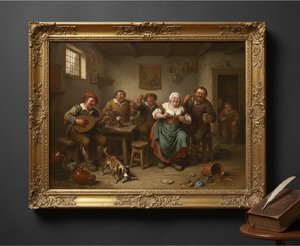
At the heart of the composition stands a man in blue, holding a brimming glass of wine – a figure that draws the eye with his confident posture and animated expression. To his right, another man is lost in the intricate melodies of a lute, adding an element of musical delight to the scene. Yet, it’s the smaller, more intimate interactions that truly elevate the painting. A woman in a vibrant red dress engages in conversation with a man sporting a black hat; their exchange suggests a shared moment of connection amidst the general merriment. These individual portraits, interwoven within the larger group, reveal a complex social fabric – friendships, rivalries, and unspoken bonds all subtly conveyed through gesture and expression.
Van Ostade’s skill isn't limited to capturing physical likeness; he masterfully utilizes body language to communicate personality and mood. The postures of the figures—leaning forward in conversation, gesturing with enthusiasm, or simply observing the scene—speak volumes about their characters and relationships. The artist avoids idealization, presenting his subjects as they truly were – flawed, boisterous, and undeniably human.
A Baroque Palette: Technique and Style
Executed in oil on panel, “Merrymakers in an Inn” exemplifies the hallmarks of the Dutch Baroque style. Van Ostade’s technique is characterized by a remarkable attention to detail—the textures of the clothing, the grain of the wood, the glint of light on the wine glasses – all rendered with painstaking precision. However, he avoids excessive ornamentation, favoring instead a directness and realism that was highly valued in Dutch painting during this period.
The color palette is deliberately restrained, dominated by earthy tones—browns, ochres, and greys—creating a warm and inviting atmosphere. The striking contrast between the blue of the central figure’s dress and the red of the woman on the left immediately draws the viewer's eye, while the overall lighting scheme emphasizes the intimacy of the scene. This careful orchestration of color and light contributes significantly to the painting’s emotional impact.
Echoes of a Time Past: Historical Context
“Merrymakers in an Inn” offers a valuable glimpse into the social and cultural landscape of 17th-century Holland. Tavern scenes were incredibly popular subjects for Dutch artists, reflecting the importance of communal gatherings and public spaces in daily life. These paintings weren’t simply celebrations of revelry; they often served as social commentary, subtly critiquing excessive drinking or highlighting the virtues of community spirit. Van Ostade's work, like that of his contemporaries, provides a rich tapestry of insights into the lives of ordinary people during a pivotal era in Dutch history.
The painting’s enduring appeal lies in its ability to transport us back in time, allowing us to connect with the shared human experiences depicted within its frame. Whether viewed as a historical document or simply a captivating work of art, “Merrymakers in an Inn” remains a testament to Adriaen van Ostade's artistic skill and his profound understanding of the human condition.
Questions & Answers
Did "Merrymakers in an Inn" stay in its artist's homeland?
No - the artwork is kept abroad. The birth country of Adriaen van Ostade is Netherlands, and the museum holding the original of "Merrymakers in an Inn" is in United States of America.
Which color stands out most in "Merrymakers in an Inn"?
espresso (#69493f) is the leading color of "Merrymakers in an Inn" by Adriaen van Ostade.
Who sells hand-painted copies of "Merrymakers in an Inn" by Adriaen van Ostade?
You can order a hand-painted reproduction of "Merrymakers in an Inn" by Adriaen van Ostade directly on its Hand-Painted Reproduction page: a hand-painted oil reproduction on linen canvas, made to order.
Artist Biography
Adriaen van Ostade: A Life in Dutch Genre Painting
Early Life and Training
- Born: 1610 in Haarlem, Netherlands.
- Van Ostade came from a family of artists; his father, Jan van Ostade, was a tapestry weaver. This artistic environment likely fostered his early interest in visual arts.
- Initial Training: He and his brother, Isaack Jansz van Ostade, were initially pupils of Frans Hals, a celebrated Dutch Golden Age painter known for his lively portraits and genre scenes.
- However, their time with Hals was relatively brief. They soon diverged from Hals’s style, developing their own distinct approaches to painting.
Artistic Development and Style
- Early Works (1630s): Van Ostade's early paintings often imitated Hals’s loose brushwork, but he gradually refined his technique.
- He began to focus on genre scenes – depictions of everyday life, particularly those involving peasants and working-class individuals.
- Distinctive Style: His style is characterized by meticulous detail, a subtle use of light and shadow (chiaroscuro), and an emphasis on realistic portrayals of his subjects.
- He skillfully captured the textures of clothing, objects, and environments, creating a sense of authenticity in his work.
- Subject Matter: Common themes included tavern scenes, village fairs, peasant interiors, and depictions of rural life.
Major Works and Achievements
- Saying Grace (c. 1660): This painting, housed at the Cleveland Museum of Art, is considered one of his masterpieces. It exemplifies his ability to imbue even humble subjects with dignity and poetic beauty.
- A Laughing Peasant (1634): A small but captivating work in the Kremer Collection, Amsterdam, showcasing his skill in capturing expressive faces and gestures.
- Tavern Scenes: Van Ostade produced numerous tavern scenes, offering glimpses into the social lives of 17th-century Dutch people. These paintings often depict lively gatherings with drinking, smoking, and music.
- Landscape Paintings: While primarily known for his genre works, he also created landscapes, often featuring rustic settings and figures engaged in everyday activities.
Influences and Legacy
- Frans Hals’s Influence: His initial training under Frans Hals provided a foundation in Dutch painting techniques and genre subject matter.
- Comparison with David Teniers the Younger: Art historians often compare Van Ostade's work to that of David Teniers the Younger, another prominent genre painter. However, their paintings reflect different regional characteristics – Van Ostade focused on Holland, while Teniers depicted Brabant.
- Impact on Later Artists: Van Ostade’s emphasis on naturalism and everyday life paved the way for later artistic movements like Impressionism and Realism. His attention to light and shadow also influenced Baroque painting.
- Historical Significance: He is considered a key figure in Dutch Golden Age painting, providing valuable insights into the lives and customs of 17th-century Dutch society.
Later Life and Death
- Guild Membership: Van Ostade became a member of the Haarlem Guild of St. Luke in 1634, signifying his recognition as a professional artist.
- Continued Success: He enjoyed continued success throughout his career, receiving commissions from wealthy patrons and establishing himself as a respected painter.
- Death: Adriaen van Ostade died in Haarlem in 1685. His works continue to be admired for their realism, charm, and historical significance.

Adriaen van Ostade
1610 - 1685 , Netherlands
Quick Facts
- Name: Adriaen van Ostade
- Movement: Dutch Golden Age painting
- Birth_Date: 1610
- Death_Date: 1685
- Birth_Place: Haarlem, Netherlands
- Nationality: Dutch
- Date Of Birth: 1610
- Date Of Death: 1685
- Influenced_By: Frans Hals
- Notable_Works:
- Saying Grace
- A Laughing Peasant
- Place Of Birth: Haarlem, Netherlands
Related Articles

Mastering Light and Shadow: The 25 Greatest Artworks by Rembrandt van Rijn
Explore Rembrandt's greatest Baroque masterpieces through light and shadow. Discover the full collection online at OriginalUniqueArt.com.

Dutch Baroque Masters: 10 Paintings That Shaped an Era | OriginalUniqueArt
Journey through the Golden Age with our guide to the Top 10 Dutch Baroque masterpieces! Explore iconic paintings by Rembrandt, Vermeer & Frans Hals. Find museum-quality art reproductions and elevate your home decor at OriginalUniqueArt.com.
Genre Painting: A Window into Daily Life & Societal Values of the Dutch Golden Age
Explore the captivating world of Dutch Golden Age genre painting! Discover realistic depictions of daily life, masterful artists like Ostade & Metsu, and hidden symbolism. Learn about this influential art movement with OriginalUniqueArt.
Adriaen van Ostade: A Master of Dutch Genre Painting & Social Commentary
Explore the life & work of Adriaen van Ostade, a leading Dutch Golden Age painter. Discover his realistic genre scenes, social commentary, and lasting influence on art history. Learn more at OriginalUniqueArt.

Golden Age Reflections: Dutch Baroque Painting & Cultural Innovation
Explore the Dutch Golden Age of painting! Discover key artists like Vermeer & ter Borch, their innovative techniques, and the rich cultural context behind these Baroque masterpieces. Learn about collecting & appreciating this iconic art period.