Menu
FREE ART CONSULTATION
Buy Print Buy PrintBuy Image Buy Image SendSend
DetailsDetails Add to favorites Add to favorites DownloadDownload SimilarsSimilars DiaporamaDiaporama

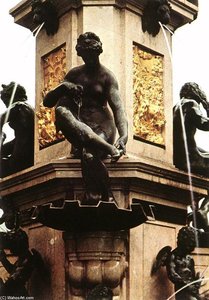
Mercury and Psyche

Experience the dynamic tension of Adriaen de Vries's Mannerist bronze sculpture, Mercury and Psyche, capturing mythological romance for your collection.

Adriaen de Vries (1556-1626) was a Dutch Mannerist sculptor renowned for his dynamic bronze works, serving Emperor Rudolf II. Explore his refined modeling, mythological scenes & transition to Baroque style.

Hand Made Oil Reproduction

Hand-painted oil on canvas in your size and frame, made to order by our artists. (Buy Print Buy PrintBuy Image Buy Image)

Standard
custom
CM
INCH

Pick from our preset sizes that match the artwork's original proportions.

width
height

You may enter your own dimensions to fit a specific frame or space. If your selected size does not match the original image's proportions, we will either crop the artwork or extend the painting with additional hand-painted elements. A digital mockup will be sent for your approval before production begins.
Please note that the on-screen preview does not reflect the actual cropping or extension. Only the mockup will accurately show the final composition.
While custom sizes are available, we recommend selecting a dimension from the predefined list to preserve the original proportions.

Examples of what can be changed: Replace face with customer photo; Add pet (e.g., replace cat with dog); Include hidden message in background; Change background landscape or elements.
After order, OriginalUniqueArt.com team will email client for instructions and provide a mockup preview

Worldwide Delivery () in 3/4 weeks instead of standard 5 weeks. (21 August). No compromise on quality.

why_choose_icon
Free Worldwide Express Shipping
why_choose_icon
High-Quality Linen Canvas
why_choose_icon
Full Shipping Insurance
why_choose_icon
Customs Tax Refund Guarantee
why_choose_icon
True Color Matching Guarantee
why_choose_icon
60-Day Return Policy (Defects Only)
why_choose_icon
100% Money-Back Guarantee
why_choose_icon
Bulk Discount Offer

Total Price

$ 300

reproduction

Mercury and Psyche

Reproduction Medium

Reproduction Size

-

Total Price

$ 300

Quick Facts

  • Year: 1593
  • Influences: Giambologna
  • Medium: Bronze sculpture
  • Title: Mercury and Psyche
  • Movement: Mannerist
  • Artist: Adriaen de Vries
  • Artistic style: Classical

Art Quiz

There is only one correct answer for each question.

Question 1:
What is the primary subject matter depicted in Mercury and Psyche?
Question 2:
Which artistic period is Mercury and Psyche associated with?
Question 3:
What material was used to create Mercury and Psyche?
Question 4:
Where is Mercury and Psyche currently housed?
Question 5:
Who commissioned the sculpture of Mercury and Psyche?

Artwork Description

Mercury and Psyche by VRIES, Adriaen de

Adriaen de Vries’s *Mercury and Psyche*, created in 1593, stands as a testament to the artistic fervor of the Northern Mannerist period—a time marked by intellectual curiosity, psychological depth, and an embrace of stylized forms that prioritized expressive emotion over strict realism. This monumental bronze sculpture resides at the Musée du Louvre in Paris, offering visitors a glimpse into the aesthetic sensibilities of Rudolf II’s court and cementing de Vries's place as one of Europe’s most celebrated sculptors of his era. The sculpture depicts Mercury—the Roman messenger god—lifting Psyche, the Egyptian goddess of soul and beauty, upwards towards Mount Olympus, symbolizing their arduous journey toward reconciliation after a tale steeped in mythological romance and divine intervention. Unlike the idealized depictions prevalent in earlier Renaissance art, de Vries’s portrayal eschews conventional grace for a dynamic tension that captures the essence of their struggle—a palpable sense of upward movement juxtaposed with the vulnerability of Psyche's posture. This deliberate imbalance reflects the Mannerist preoccupation with unsettling perspectives and conveying emotional states through distorted forms. De Vries’s masterful technique exemplifies the pinnacle of bronze casting during his lifetime. Utilizing *cire perdue* (lost wax method), he meticulously crafted a detailed model from wax, which was then encased in clay and heated to melt away the wax residue, leaving behind a hollow bronze shell. This process allowed for unparalleled precision in capturing intricate musculature and drapery folds—characteristics that would become hallmarks of Mannerist sculpture. The resulting patina—a darkened surface layer formed through oxidation—adds depth and richness to the sculpture’s appearance, hinting at its considerable age and conveying an aura of solemn contemplation. The sculpture's historical context is inextricably linked to Rudolf II’s patronage of the arts in Prague. Rudolf II was a fervent supporter of Mannerist art, recognizing its ability to convey profound psychological truths—a fascination that extended beyond mere visual beauty. He commissioned numerous sculptures from Giambologna and other prominent artists, transforming Prague into a crucible for artistic innovation. De Vries's work embodies this spirit of experimentation and intellectual engagement, reflecting the broader cultural currents shaping Europe during the turbulent years of the Thirty Years’ War. Beyond its formal qualities, *Mercury and Psyche* resonates with symbolic significance rooted in classical mythology. Mercury represents intellect and communication—essential attributes for overcoming obstacles and achieving spiritual enlightenment—while Psyche embodies purity and vulnerability—symbols of feminine grace and resilience. Their ascent towards Olympus signifies a quest for divine favor and the triumph of love over adversity. The sculpture’s enduring appeal lies in its ability to evoke contemplation on themes of devotion, perseverance, and the transformative power of emotion—a timeless narrative rendered with breathtaking artistry and technical virtuosity. The sculpture's presence at the Rijksmuseum in Amsterdam is a remarkable feat considering its fate during the Sack of Prague in 1648. The Swedish army seized Rudolf II’s vast collection of artworks, transporting many sculptures to Sweden where they were subsequently displayed for Queen Christina—a pivotal moment in art history that ensured *Mercury and Psyche* would survive into the modern era. Today, it stands as a beacon of Mannerist sculpture, inviting viewers to immerse themselves in its captivating beauty and contemplate its profound symbolic message.

Artist Biography

Lorenzo Lotto: A Life of Quiet Intensity

Lorenzo Lotto (c. 1480 – 1556/57) remains one of the most intriguing and deliberately obscure figures in Renaissance art. Often relegated to a footnote in the grand narratives of Venetian and Florentine painting, his career was characterized by constant movement, an idiosyncratic style, and a profound sense of unease that permeated his work. He wasn’t a flamboyant innovator or a court painter seeking fame; rather, Lotto was a deeply personal artist, driven by a restless spirit and a unique ability to capture the psychological complexities of his subjects. His story is one of quiet intensity, marked by both periods of remarkable productivity and frustrating obscurity.

Born in Venice – though the exact details of his early life remain shrouded in mystery – Lotto’s artistic training is debated. While traditionally associated with Giovanni Bellini, a connection that's now viewed with increasing skepticism, it’s clear he absorbed influences from a wider range of sources. Early works like the Virgin and Child with St. Jerome (1506) demonstrate a nascent Giorgionesque naturalism, characterized by soft light, atmospheric perspective, and an emphasis on capturing fleeting moments. However, Lotto quickly developed his own distinctive voice, moving beyond mere imitation to forge a style that was both unsettling and profoundly affecting.

A Wandering Career

Unlike many of his contemporaries who established themselves within the patronage networks of powerful families or city-states, Lotto’s career was marked by constant travel. He spent his formative years in Treviso (1503–1506), followed by periods in Rome (1508–1510), Bergamo (1513–1525), and Venice (1525–1549). He also worked extensively in the Marches, particularly in Ancona, and later served as a lay brother at the monastery of Loreto until his death in 1556/57. This peripatetic existence reflects not only his personal temperament – described by some contemporary accounts as troubled and melancholic – but also a pragmatic approach to securing commissions. He wasn’t reliant on a single patron; instead, he cultivated relationships with a diverse range of clients, from wealthy merchants to religious institutions.

His artistic output during this period is remarkably uneven. Some works, like the Annunciation (c. 1527) at the Pinacoteca Civica in Recanati, are breathtakingly inventive and emotionally charged – a riot of color, dramatic lighting, and unsettling details, including a particularly memorable startled cat. These pieces showcase Lotto’s mastery of composition, his ability to create a palpable sense of atmosphere, and his willingness to experiment with unconventional poses and expressions. However, many other works, while technically proficient, lack the same emotional depth and originality.

Style and Technique

Lotto's style is notoriously difficult to categorize. He drew inspiration from a variety of sources – Venetian painting, Florentine naturalism, and even Northern European influences – but he never fully assimilated any single tradition. His figures are often rendered with a remarkable degree of realism, yet they’re simultaneously imbued with an air of psychological tension. He frequently employed distorted perspectives, exaggerated gestures, and unsettling facial expressions to convey a sense of unease or inner turmoil.

His use of color is particularly noteworthy. Lotto was known for his vibrant palette – rich reds, blues, and greens – but he also possessed a subtle understanding of how to create depth and atmosphere through the skillful manipulation of light and shadow. He frequently employed *chiaroscuro*, using dramatic contrasts between light and dark to heighten the emotional impact of his compositions.

Legacy and Significance

For centuries, Lotto’s work was largely ignored by art historians, overshadowed by the more celebrated figures of Bellini, Titian, and Raphael. However, in the mid-19th century, Bernard Berenson's influential monograph on Lotto sparked a renewed interest in his art. Berenson recognized Lotto’s unique vision and argued that he represented a crucial transitional stage between the High Renaissance and Mannerism.

Today, Lotto is increasingly appreciated for his psychological depth, his innovative use of color and composition, and his ability to capture the complexities of human emotion. His paintings offer a rare glimpse into the inner lives of his subjects – a testament to the power of art to reveal not just what we see, but also what we feel.

adriaen de vries

adriaen de vries

1556 - 1626 , Netherlands

Quick Facts

  • Artistic Movement Or Style: High Renaissance, Mannerism
  • Artists Or Movements Influenced By This Artist: ['Correggio']
  • Artists Who Influenced This Artist:
    • Giovanni Bellini
    • Giorgione
  • Date Of Birth: c. 1480
  • Date Of Death: 1556/57
  • Full Name: Lorenzo Lotto
  • Nationality: Italian
  • Notable Artworks:
    • Annunciation (c.1527)
    • Young Man in his Study (c.1527)
  • Place Of Birth: Venice, Italy
Explore artworks organized by themes, styles, and characteristics.