Preview
 Send
Send Share
Share
 Details
 Guide
Guide

 Download
 Similars
 X-Ray
X-Ray Diaporama
 Q&A
Q&A Stats
StatsShepherdess with Grape Bowl

- 104.0 x 83.0 cm


 Read More
Giclée / Art Print
Museum-quality giclée or canvas print with fast production and flexible finish options. ( Buy Hand Made Painting Switch to Digital Image)




P118B $10

P118H $10

P118W $10

P438Z $10

P508JH $12

P508YH $12

P805H $10

P805Z $10

P919BZ $10

P919G $10

P919XJ $10

P959ZH $10

P968JZ $12

W106C $8

W218G $10

W218JH $8

W218Y $10

W307PJ $10

W316G $10

W316PJ $8

W316Y $10

W398PJ $8

W4111J $10

W500HY $15

W500JH $15

W692G $12

W849H $8

W940BG $15

W953PJ $8




Pick from our preset sizes that match the artwork's original proportions.

Type the width and the height you need, to fit your frame or your wall. A print can only be cut, never made bigger than the picture, so a size with a different shape loses a part of the image. We send you a digital mockup to approve before we print anything. The picture shown on this page does not show the real cut — only the mockup does.
Worldwide Delivery () in 2 weeks instead of standard 4/5 weeks. (4 November)

Free Worldwide Express Shipping

High-Quality Linen Canvas

Full Shipping Insurance

Customs Tax Refund Guarantee

True Color Matching Guarantee

100-Day Return Policy (Defects Only)

100% Money-Back Guarantee

Bulk Discount Offer
 Glass option is only available in size under 110 CM

Shepherdess with Grape Bowl
Giclée / Art Print
Reproduction Size
-


Total Price
$ 81
Abraham Bloemaert’s ‘Shepherdess with Grape Bowl’: A Window into Dutch Baroque Pastoral
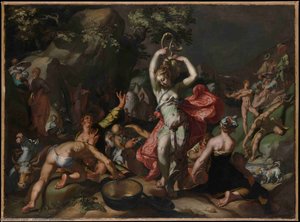
Abraham Bloemaert's “Shepherdess with Grape Bowl,” painted in 1628, is more than just a charming depiction of rural life; it’s a meticulously crafted window into the artistic currents of the Dutch Golden Age. Executed during a period of immense social and religious change – the painting emerged amidst the ongoing Thirty Years' War – Bloemaert skillfully balances dramatic intensity with an undeniable sense of serene beauty, hallmarks of his distinctive style. This particular work, measuring 104 x 83 cm and currently residing in the Staatliche Kunsthalle Karlsruhe, offers a captivating glimpse into the world of a Dutch pastoral scene, rendered with remarkable detail and imbued with symbolic resonance.
A Masterclass in Mannerist Technique
Bloemaert’s artistic lineage is deeply rooted in the Mannerist tradition, yet he was already anticipating the stylistic shifts towards Baroque that would dominate the latter half of the 17th century. The painting showcases his mastery of *disegno*, a core principle of Renaissance art emphasizing precise drawing and compositional clarity. Observe the carefully constructed pyramid of figures – the shepherdess at its apex, surrounded by her attendants – a common device employed to create visual stability and grandeur. His brushwork is characterized by a deliberate layering of color and texture, creating a palpable sense of depth and volume. The use of chiaroscuro, the dramatic interplay of light and shadow, further enhances the three-dimensionality of the scene, drawing the viewer’s eye across the canvas with captivating effect.
Symbolism and the Language of the Dutch Countryside
The subject matter itself is rich in symbolic meaning. The shepherdess, a recurring motif in Northern European art, represents innocence, piety, and connection to nature. The bowl of grapes – a symbol of abundance and fertility – reinforces this theme. Beyond these immediate symbols, the inclusion of horses and cows within the pastoral landscape speaks to the economic realities of the time, highlighting the importance of agriculture to Dutch society. The presence of birds adds an element of lightness and joy, while the trees and distant hills create a sense of vastness and timelessness. Bloemaert’s meticulous attention to detail – from the individual strands of hair on the shepherdess's head to the texture of the animal hides – elevates this scene beyond mere representation, transforming it into a carefully constructed allegory.
Historical Context and Artistic Influences
Painted in 1628, “Shepherdess with Grape Bowl” reflects the broader artistic landscape of the Dutch Republic. Bloemaert’s career was shaped by his early training under his father, Cornelis Bloemaert I, a renowned architect, and subsequent studies with prominent Utrecht artists like Gerrit Splinter and Joos de Beer. A formative three-year sojourn in Paris exposed him to the influences of Jehan Bassot and Maistre Herry, broadening his stylistic horizons and introducing him to the burgeoning artistic trends of the era. This synthesis of influences – rooted in Dutch tradition yet informed by Continental developments – is powerfully evident in this remarkable work, solidifying Bloemaert’s position as a leading figure within the Dutch Baroque movement.
Questions & Answers
What mood and emotion come together in "Shepherdess with Grape Bowl"?
The recorded mood of "Shepherdess with Grape Bowl" by Abraham Bloemaert is romantic, and its emotional tone is nostalgic.
Is "Shepherdess with Grape Bowl" available as a fine art print?
"Shepherdess with Grape Bowl" is available as a fine art print on cotton canvas or archival canvas paper. Orders are placed on its Fine Art Print page, in the size of your choice.
What stage of Abraham Bloemaert's development does "Shepherdess with Grape Bowl" represent?
"Shepherdess with Grape Bowl" belongs to the Mannerist/Baroque of Abraham Bloemaert's career. This classification relates the work to the artist's development.
Artist Biography
A Life Immersed in Art: The World of Abraham Bloemaert
Abraham Bloemaert, born in Gorinchem in 1564 and passing away in Utrecht in 1651, stands as a pivotal figure bridging the Mannerist and Baroque periods in Dutch painting. His long and prolific career unfolded against a backdrop of religious and political upheaval, yet he consistently produced works imbued with both dramatic intensity and subtle beauty. Bloemaert’s journey began under the tutelage of his father, Cornelis Bloemaert I, an architect who instilled in him a foundational understanding of form and composition. This early training was further refined through studies with Gerrit Splinter and Joos de Beer in Utrecht, laying the groundwork for his artistic explorations. A crucial period followed – three years spent in Paris from 1581 to 1583. There, he absorbed influences from Jehan Bassot and Maistre Herry, while also encountering the works of Hieronymus Francken, a fellow Dutch artist who broadened his stylistic horizons. This Parisian sojourn proved formative, exposing him to the refined elegance of the French School and setting the stage for his later innovations.From Mannerism to Baroque: A Shifting Aesthetic
Upon returning to Utrecht, Bloemaert quickly established himself as a leading artist. Initially, his style aligned with the prevailing Haarlem Mannerism – characterized by elongated figures, elegant poses, and often complex allegorical narratives. However, he was not content to remain solely within this framework. As the 17th century dawned, Bloemaert began to embrace the emerging Baroque aesthetic, a shift marked by increased dynamism, emotional intensity, and a heightened sense of realism. This transition wasn’t abrupt; rather, it represented a gradual evolution, blending elements of both styles into a uniquely personal artistic language. He skillfully incorporated dramatic lighting effects, rich color palettes, and expressive gestures to convey powerful narratives and evoke profound emotions in his viewers. His paintings began to resonate with a new energy, reflecting the changing cultural landscape of the Dutch Republic.A Master of Diverse Subjects and Techniques
Bloemaert’s artistic output was remarkably diverse. He excelled in history painting, bringing biblical stories and classical myths to life with compelling detail and emotional depth. Landscapes also held a special place in his repertoire, often serving as settings for religious or mythological scenes, but increasingly becoming subjects in their own right – picturesque vistas populated with figures engaged in everyday activities. Beyond painting, Bloemaert was a highly skilled printmaker, proficient in both etching and engraving. These prints served to disseminate his artistic vision more widely, contributing significantly to his reputation and influence. His technical mastery extended to still lifes and animal paintings as well, demonstrating an exceptional versatility that set him apart from many of his contemporaries. Notable works such as “The Expulsion of Hagar and Ishmael,” “Venus and Adonis”, and "Warrior & Young Standard-Bearer" exemplify this range, showcasing his ability to handle complex compositions and convey nuanced emotions with equal skill.A Prolific Teacher and Lasting Legacy
Abraham Bloemaert was not only a gifted artist but also an influential teacher. He established a thriving workshop in Utrecht, attracting numerous students who would go on to become prominent artists themselves. Remarkably, his four sons – Hendrick, Frederick, Cornelis, and Adriaan – all followed in his footsteps, achieving considerable success as painters and engravers. Beyond his immediate family, Bloemaert mentored a generation of Dutch artists, including Jan Aerntsz de Hel, Nicolaes van Bercheyck, Leonaert Bramer, Bartholomeus Breenbergh, Hendrick ter Brugghen, and Gerrit van Honthorst. His influence was particularly profound on the Utrecht Caravaggisti – a group of painters who embraced the dramatic realism and tenebrism (the use of strong contrasts between light and dark) pioneered by Caravaggio. Bloemaert’s teachings helped to shape their distinctive style, solidifying his position as a central figure in the development of Dutch Baroque painting. His legacy continues to resonate today, with his works admired for their technical brilliance, emotional power, and historical significance. They stand as testaments to a life dedicated to artistic exploration and innovation, leaving an indelible mark on the art world.
Abraham Bloemaert
1564 - 1651 , Netherlands
Quick Facts
- Artistic Movement Or Style: Baroque, Mannerism
- Artists Or Movements Influenced By This Artist: ['Utrecht Caravaggisti']
- Artists Who Influenced This Artist: ['Hieronymus Francken']
- Date Of Birth: 1564
- Date Of Death: 1651
- Full Name: Abraham Bloemaert
- Nationality: Dutch
- Notable Artworks:
- Expulsion of Hagar
- Venus and Adonis
- Landscape with Peasants
- Place Of Birth: Gorinchem, Netherlands
Related Articles
Masterpieces of the 17th Century: Art, History & Decor Inspiration | OriginalUniqueArt
Journey through 17th century art with masterpieces by Rembrandt, Vermeer & Caravaggio. Explore Baroque paintings, Dutch Golden Age techniques & timeless beauty. Find museum-quality reproductions and elevate your home decor on OriginalUniqueArt.com.

Giclée Prints: Archival Quality & Aesthetic Nuances for the Discerning Collector
Explore the world of giclée prints with OriginalUniqueArt. Learn about archival quality, aesthetic nuances & investment potential. Expert guidance for discerning art collectors seeking museum-quality reproductions and lasting value.

Baroque Classicism: The Grandeur of Order and Drama in 17th-Century Art History
Explore the profound elegance of Baroque Classicism. Discover how 17th-century masters synthesized dramatic emotion with classical order through the lens of the Counter-Reformation and the works of legends like Carlo Maratta and Andrea Sacchi.

Golden Age Reflections: Dutch Baroque Painting & Cultural Innovation
Explore the Dutch Golden Age of painting! Discover key artists like Vermeer & ter Borch, their innovative techniques, and the rich cultural context behind these Baroque masterpieces. Learn about collecting & appreciating this iconic art period.

Dutch Baroque Masters: 10 Paintings That Shaped an Era | OriginalUniqueArt
Journey through the Golden Age with our guide to the Top 10 Dutch Baroque masterpieces! Explore iconic paintings by Rembrandt, Vermeer & Frans Hals. Find museum-quality art reproductions and elevate your home decor at OriginalUniqueArt.com.