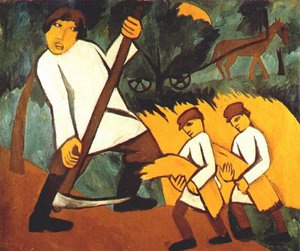
Portrait of Natalia Goncharova

The 76 Most Famous Natalia Goncharova Paintings, a Gallery Selection

Updated November 2026 · ranked by our popularity score (searches, visits and orders for each work) · 76 works by Natalia Goncharova in our catalogue

In short

Of all the originals Natalia Goncharova left, the most famous is Design for final backcloth (1926). Close behind it come Harvest (1911) and Composition (1914). Our catalog holds 76 works by Natalia Goncharova; the gallery has kept the 76 the world admires most, each shown with its date, its museum and its story.

1881 – 1962, Nagaevo-Karbonier Cubo-futurism Most works: Thyssen-Bornemisza Museum

Natalia Goncharova's top 10 paintings: the gallery's choice

1
Design for final backcloth (1926) by Natalia Goncharova

Design for final backcloth

1926

Created in 1926, this work emerged during a period when the artist was active in Paris. The piece reflects a transition in the artist's career, moving through various stylistic phases including Cubo-Futurism and a focus on stage design. The subject matter, a detailed cityscape with temporal elements like clocks, aligns with the artist's history of designing sets and costumes for the Ballets Russes. The composition functions as a visual blueprint…

5
Fishing (1909) by Natalia Goncharova

Fishing

1909 · Oil On Canvas · Thyssen-Bornemisza Museum, Madrid

is a Post-Impressionist oil on canvas painting executed by Natalia Goncharova in 1909. The work belongs to the Russian avant-garde movement, reflecting a period of intense stylistic experimentation. It represents a significant moment in the artist's development, occurring before her later involvement with Rayonism and her collaborations with the Ballets Russes.

The Natalia Goncharova selection continues, 11 to 76

11The Nativity, for Liturgy (1915) by Natalia GoncharovaThe Nativity, for Liturgy1915 12Queen Of Shamakhan from 'Le Coq d'Or' (1913) by Natalia GoncharovaQueen Of Shamakhan from 'Le Coq d'Or'1913 13Liturgy six winged Seraph (1914) by Natalia GoncharovaLiturgy six winged Seraph1914 14Two Russian maidens (1920) by Natalia GoncharovaTwo Russian maidens1920 15Harvesting (1907) by Natalia GoncharovaHarvesting1907 · The State Russian Museum 16Forest (1913) by Natalia GoncharovaForest1913 · Thyssen-Bornemisza Museum 17L'Electricité (1910) by Natalia GoncharovaL'Electricité1910 18The Weaver (1910) by Natalia GoncharovaThe Weaver1910 · National Museum Cardiff 19Costume design for bride by Natalia GoncharovaCostume design for bride 20The ice cutters (1911) by Natalia GoncharovaThe ice cutters1911 21The rowers (1911) by Natalia GoncharovaThe rowers1911 22Washerwomen (1911) by Natalia GoncharovaWasherwomen1911 23Pillars of salt (1908) by Natalia GoncharovaPillars of salt1908 24Planting potatoes (1909) by Natalia GoncharovaPlanting potatoes1909 25Elder with seven stars (1910) by Natalia GoncharovaElder with seven stars1910 26The little station (1911) by Natalia GoncharovaThe little station1911 27Haycutting (1910) by Natalia GoncharovaHaycutting1910 28The evangelists (in four parts) (1911) by Natalia GoncharovaThe evangelists (in four parts)1911 29Moscow Street (1911) by Natalia GoncharovaMoscow Street1911 30Nativity (1910) by Natalia GoncharovaNativity1910 31Stone maiden (Still life) (1908) by Natalia GoncharovaStone maiden (Still life)1908 32Self-portrait with yellow lilies (1907) by Natalia GoncharovaSelf-portrait with yellow lilies1907 33Still life with shoe and mirror (1906) by Natalia GoncharovaStill life with shoe and mirror1906 34Landscape at Ladyzhino (1908) by Natalia GoncharovaLandscape at Ladyzhino1908 35Sheep shearing (1907) by Natalia GoncharovaSheep shearing1907 36Green forest (1911) by Natalia GoncharovaGreen forest1911 37Linen (1908) by Natalia GoncharovaLinen1908 38The Forest (1913) by Natalia GoncharovaThe Forest1913 39The Bridge (1916) by Natalia GoncharovaThe Bridge1916 40Study for a Curtain for 'Le Coq d'Or' (1914) by Natalia GoncharovaStudy for a Curtain for 'Le Coq d'Or'1914 41Set design for 'Le Coq d'Or' (1914) by Natalia GoncharovaSet design for 'Le Coq d'Or'1914 42Peasants Gathering Grapes (1913) by Natalia GoncharovaPeasants Gathering Grapes1913 43Landscape, 47 (1912) by Natalia GoncharovaLandscape, 471912 44Designs for the stage wings of ‘Le Coq d’Or’ (1914) by Natalia GoncharovaDesigns for the stage wings of ‘Le Coq d’Or’1914 45Curtain for Le Coq d'Or: Third Act (1914) by Natalia GoncharovaCurtain for Le Coq d'Or: Third Act1914 46Costume for Sadko (1916) by Natalia GoncharovaCostume for Sadko1916 47Costume for 'Le Coq d'Or' (1914) by Natalia GoncharovaCostume for 'Le Coq d'Or'1914 · Los Angeles County Museum of Art 48The weaver (loom+woman) (1913) by Natalia GoncharovaThe weaver (loom+woman)1913 49Espagnole (1914) by Natalia GoncharovaEspagnole1914 50Forest (Red-green) (1914) by Natalia GoncharovaForest (Red-green)1914 51Liturgy - sketch of a costume (1914) by Natalia GoncharovaLiturgy - sketch of a costume1914 52Electric lamp (1913) by Natalia GoncharovaElectric lamp1913 53Liturgy, St. Andrew (1914) by Natalia GoncharovaLiturgy, St. Andrew1914 54Liturgy, The Seraph's costume (1914) by Natalia GoncharovaLiturgy, The Seraph's costume1914 55Flowers (1912) by Natalia GoncharovaFlowers1912 56Russian woman's costume from Le coq d'or (1914) by Natalia GoncharovaRussian woman's costume from Le coq d'or1914 57Sabbath (1912) by Natalia GoncharovaSabbath1912 58Rayonist lilies (1913) by Natalia GoncharovaRayonist lilies1913 · Perm State Arts Gallery 59Dynamo machine (1913) by Natalia GoncharovaDynamo machine1913 60Still life with ham (1912) by Natalia GoncharovaStill life with ham1912 61Cats (Rayonist perception in rose, black and yellow) (1913) by Natalia GoncharovaCats (Rayonist perception in rose, black and yellow)1913 · Solomon R. Guggenheim Museum 62Stage Design for The Firebird, Act II (1926) by Natalia GoncharovaStage Design for The Firebird, Act II1926 63Coronation backdrop for ‘The Firebird’ (1926) by Natalia GoncharovaCoronation backdrop for ‘The Firebird’1926 · Victoria and Albert Museum 64Composition with Blue Rectangle (1959) by Natalia GoncharovaComposition with Blue Rectangle1959 · Thyssen-Bornemisza Museum 65Still Life with a Tige (1915) by Natalia GoncharovaStill Life with a Tige1915 66Dogwood Blossoms by Natalia GoncharovaDogwood Blossoms 67Still Life by Natalia GoncharovaStill Life 68Pink Light by Natalia GoncharovaPink Light 69Flower vase by Natalia GoncharovaFlower vase 70Portrait of a woman (Tatiana Ryabushinskaya) by Natalia GoncharovaPortrait of a woman (Tatiana Ryabushinskaya) 71Harmony in Blue and Green. Abstract Composition by Natalia GoncharovaHarmony in Blue and Green. Abstract Composition 72Corner of a garden Sun by Natalia GoncharovaCorner of a garden Sun 73La Forêt Rouge by Natalia GoncharovaLa Forêt Rouge 74L'Oiseau de Feu, La Lettre A by Natalia GoncharovaL'Oiseau de Feu, La Lettre A 75Cyclist (1913) by Natalia GoncharovaCyclist1913 · The State Russian Museum 76Round dance (1910) by Natalia GoncharovaRound dance1910 · Serpukhov historical-art museum

Natalia Goncharova's famous paintings, period by period

The subjects that held Natalia Goncharova's eye

The four subjects that come back most often in these originals, each with its finest example.

The museums that keep Natalia Goncharova's originals

The 8 museums that hold the most of the paintings on this page.

Museum City Works by Natalia Goncharova Paintings from this list
Thyssen-Bornemisza Museum, MadridThyssen-Bornemisza Museum Madrid 3 Fishing, Forest, Composition with Blue Rectangle
The State Russian Museum, St. PetersburgThe State Russian Museum St. Petersburg 2 Harvesting, Cyclist
Metropolitan Museum of Art, New YorkMetropolitan Museum of Art New York 1 Decor for the Ballet "Liturgie"
Yekaterinburg Museum of Fine Arts, YekaterinburgYekaterinburg Museum of Fine Arts Yekaterinburg 1 Reapers
National Museum Cardiff, CardiffNational Museum Cardiff Cardiff 1 The Weaver
Los Angeles County Museum of Art, Los AngelesLos Angeles County Museum of Art Los Angeles 1 Costume for 'Le Coq d'Or'
Perm State Arts Gallery, PermPerm State Arts Gallery Perm 1 Rayonist lilies
Solomon R. Guggenheim Museum, New YorkSolomon R. Guggenheim Museum New York 1 Cats (Rayonist perception in rose, black and yellow)

Natalia Goncharova decade by decade: the original that defines each

Works per decade

Pick a decade to see the original that defines it.

Collectors' questions about Natalia Goncharova's paintings

Which work is Natalia Goncharova most famous for?Reveal the answer

Design for final backcloth (1926). Harvest (1911) and Composition (1914) come next.

What age was Natalia Goncharova when Design for final backcloth was made?Reveal the answer

45 years old: Design for final backcloth dates from 1926, and Natalia Goncharova was born in 1881.

What are the ten most famous Natalia Goncharova paintings?Reveal the answer

Design for final backcloth, Harvest, Composition, Decor for the Ballet "Liturgie", Fishing, Peasant Women, Haymaking, Airplane over train, Reapers and Boy with rooster. The ranking above gives each one's year and museum.

How many paintings did Natalia Goncharova leave?Reveal the answer

Our catalog holds 76 works by Natalia Goncharova, dated from 1906 to 1959.

In which museums do Natalia Goncharova's masterpieces hang?Reveal the answer

Mostly in Thyssen-Bornemisza Museum (Madrid), The State Russian Museum (St. Petersburg) and Metropolitan Museum of Art (New York). The museum table above lists them all.

In which years did Natalia Goncharova paint the most famous works?Reveal the answer

In 1910s: 51 of the 76 works on this page were made then, Harvest among them.

What are the first and the last famous originals of Natalia Goncharova?Reveal the answer

On this page, the earliest is Still life with shoe and mirror (1906) and the latest Composition with Blue Rectangle (1959).

Which subjects did Natalia Goncharova choose most often?Reveal the answer

Flowers (6), Russian art (5) and Russian art style (5), across the 76 works on this page.

Which technique did Natalia Goncharova use most?Reveal the answer

Oil On Canvas, for 3 of the 76 works on this page.

To which art movement does Natalia Goncharova belong?Reveal the answer

Cubo-futurism, judging by the originals on this page.

Which Natalia Goncharova works hang at the Thyssen-Bornemisza Museum?Reveal the answer

Fishing, Forest and Composition with Blue Rectangle: the Thyssen-Bornemisza Museum, Madrid holds 3 of the works on this page.

Natalia Goncharova: life and work

A Russian Soul Forged in Avant-Garde Fire

Natalia Sergeevna Goncharova, born in 1881 amidst the vast landscapes of Russia, stands as a pivotal figure in the exhilarating world of early 20th-century art. Her life was a testament to artistic courage, a relentless pursuit of innovation that bridged the gap between Russia’s rich cultural heritage and the burgeoning modernist movements sweeping across Europe. From her beginnings studying sculpture in Moscow to her eventual embrace of Rayonism, Cubo-Futurism, and ultimately, a celebrated career as a stage designer for Sergei Diaghilev's Ballets Russes, Goncharova consistently challenged conventions and redefined artistic boundaries. Her journey wasn’t merely one of stylistic evolution; it was a passionate exploration of what art *could* be—a vibrant expression of the Russian spirit filtered through a distinctly modern lens. The echoes of her work continue to resonate today, influencing artists and captivating audiences with their dynamic energy and profound originality.

Early Influences and the Seeds of Rebellion

Goncharova’s artistic inclinations were nurtured from an early age, influenced by her father, Sergey Mikhaylovich Goncharov, an architect with a formal art education. This familial connection provided a foundation for her own explorations, leading her to enroll at the Moscow Institute of Painting, Sculpture and Architecture in 1901. Initially focused on sculpture, she soon found herself drawn to painting, a shift profoundly impacted by her encounter with Mikhail Larionov, who would become both her artistic partner and life companion. Their shared studio became a crucible for experimentation, a space where traditional techniques were questioned and new forms of expression sought. This period witnessed Goncharova’s early engagement with the Russian art world, marked by participation in exhibitions and recognition—a silver medal for sculpture in 1903 signaled her rising talent. However, it was also a time of growing dissatisfaction with academic constraints. The rigid expectations of portraiture classes, exemplified by Konstantin Korovin's instruction, chafed against their desire to embrace the radical innovations emerging from Europe. This frustration culminated in expulsion—a defiant act that paved the way for the formation of “Jack of Diamonds,” a group dedicated to artistic independence and challenging established norms. It was within this atmosphere of rebellion that Goncharova began to truly find her voice, rejecting academic tradition in favor of a more authentic and expressive approach.

Rayonism, Primitivism, and the Exploration of Light

The founding of "Jack of Diamonds" in 1910 marked a turning point in Goncharova’s career. It was a declaration of intent—a commitment to forging a uniquely Russian path within the international avant-garde. Her early works during this period reveal a fascination with *luboks*, traditional Russian folk prints, and icons, drawing inspiration from their bold colors, simplified forms, and spiritual resonance. This embrace of “Primitivism” wasn’t merely stylistic imitation; it was an attempt to tap into the raw energy and authentic expression of Russia's cultural roots. But Goncharova didn’t remain confined to these influences for long. Alongside Larionov, she embarked on a groundbreaking exploration of light and perception that resulted in Rayonism. This abstract art movement sought to depict not objects themselves, but rather the rays of light reflected from them—a dynamic interplay of lines and colors intended to capture the essence of visual experience. Paintings like “Electric Lamp” (1913) exemplify this approach, dissolving form into a swirling vortex of energy. This period also saw Goncharova’s work increasingly influenced by Cubism and Futurism, resulting in compositions that were both fragmented and dynamic—a reflection of the rapidly changing world around her. She wasn't simply adopting these styles; she was synthesizing them with her own unique vision, creating a distinctly Russian brand of modernism.

Ballets Russes and a Legacy of Innovation

Goncharova’s artistic versatility extended beyond painting and abstraction. In 1915, she began a fruitful collaboration with Sergei Diaghilev's Ballets Russes, designing costumes and sets that brought a new level of visual spectacle to the stage. This wasn’t simply applied art; it was an opportunity to synthesize her diverse artistic interests—her understanding of Russian folk traditions, her mastery of color and form, and her avant-garde sensibilities. Though ambitious projects like “Liturgy” remained unrealized, her contributions significantly enhanced the aesthetic impact of Diaghilev's productions. Following the Russian Revolution, Goncharova settled in Paris in 1921, continuing to work as a designer and painter. She even ventured into fashion design between 1922 and 1926, creating garments for Marie Cuttoli’s Maison Myrbor that blended Russian motifs with Byzantine influences—a testament to her ability to translate artistic principles across different mediums. Natalia Goncharova's legacy is one of fearless experimentation, a commitment to pushing boundaries, and a profound understanding of the power of art to reflect and shape culture. She was a true pioneer of the Russian avant-garde, whose work continues to inspire artists today—a testament to her enduring vision and unwavering dedication to artistic innovation. Her marriage to Larionov in 1955 secured their place in art history as collaborators and pioneers, ensuring that their contributions would be celebrated for generations to come. Her influence extends beyond the canvas, impacting design, theater, and the very definition of modern art itself. She remains a beacon of creativity and a symbol of artistic freedom.