Portrait of Mstislav Dobuzhinsky

Mstislav Dobuzhinsky Paintings: The 61 Most Famous, Through a Gallery's Eye

Updated October 2026 · ranked by our popularity score (searches, visits and orders for each work) · 61 works by Mstislav Dobuzhinsky in our catalogue

In short

To the gallery's eye, Mstislav Dobuzhinsky's most famous painting is Pskov. Fish market at the foot of the cathedral. (1923). A Cottage in St. Petersburg (1905) and Glassmakers Street in Vilno (1906) complete the trio every eye recognises. Of the 61 works by Mstislav Dobuzhinsky in our catalog, the gallery presents the 61 most famous below, each original with its year, its museum and what makes it unique.

1875 – 1957, Novgorod Symbolism Most works: Lithuanian National Museum of Art

The gallery's top 10 Mstislav Dobuzhinsky paintings

Mstislav Dobuzhinsky paintings, ranked 11 to 61

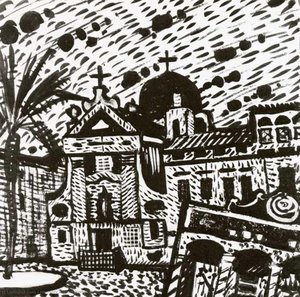
11Old Russia (1912) by Mstislav DobuzhinskyOld Russia1912 · Lithuanian Art Centre TARTLE 12Silence (1918) by Mstislav DobuzhinskySilence1918 13Embankment of Pryazhka river (1921) by Mstislav DobuzhinskyEmbankment of Pryazhka river1921 14White Nights (1922) by Mstislav DobuzhinskyWhite Nights1922 15From the life in Petrograd in 1920 (1920) by Mstislav DobuzhinskyFrom the life in Petrograd in 19201920 16Pskov (1923) by Mstislav DobuzhinskyPskov1923 17Kaunas, old houses (1931) by Mstislav DobuzhinskyKaunas, old houses1931 18An illustration from A. Pushkin's ''Eugene Onegin'' (1936) by Mstislav DobuzhinskyAn illustration from A. Pushkin's ''Eugene Onegin''1936 19Spring in Kaunas (1923) by Mstislav DobuzhinskySpring in Kaunas1923 · Lithuanian National Museum of Art 20Pan by Mstislav DobuzhinskyPanLithuanian National Museum of Art 21Tsarskoye Selo. Gate of Cameron's gallery. (1904) by Mstislav DobuzhinskyTsarskoye Selo. Gate of Cameron's gallery.1904 22Trinity Bridge (1904) by Mstislav DobuzhinskyTrinity Bridge1904 23October Idyll (1905) by Mstislav DobuzhinskyOctober Idyll1905 24Unknown woman in red (1901) by Mstislav DobuzhinskyUnknown woman in red1901 25A Small House in St. Petersburg (1905) by Mstislav DobuzhinskyA Small House in St. Petersburg1905 26Rooftops (1901) by Mstislav DobuzhinskyRooftops1901 27Illustration for Dostoyevsky's White Nights 3 by Mstislav DobuzhinskyIllustration for Dostoyevsky's White Nights 3 28Evening Landscape by Mstislav DobuzhinskyEvening Landscape 29The Kiss by Mstislav DobuzhinskyThe Kiss 30The Blue Lounge 1 by Mstislav DobuzhinskyThe Blue Lounge 1 31Self-Portrait by Mstislav DobuzhinskySelf-Portrait 32Peter the Great in Holland by Mstislav DobuzhinskyPeter the Great in Holland 33Project for the first Almanac ''Chipovnick'' (1906) by Mstislav DobuzhinskyProject for the first Almanac ''Chipovnick''1906 34Roadway in Vilnius (1910) by Mstislav DobuzhinskyRoadway in Vilnius1910 35City Types (City Grimaces) (1908) by Mstislav DobuzhinskyCity Types (City Grimaces)1908 36Barbershop Window (1906) by Mstislav DobuzhinskyBarbershop Window1906 37Vilno. Street. (1906) by Mstislav DobuzhinskyVilno. Street.1906 38Finland. A Street in Lovisa. (1915) by Mstislav DobuzhinskyFinland. A Street in Lovisa.1915 39The Swineherd (1917) by Mstislav DobuzhinskyThe Swineherd1917 40Naples (1914) by Mstislav DobuzhinskyNaples1914 41Courtyard in St. Petersburg (1920) by Mstislav DobuzhinskyCourtyard in St. Petersburg1920 42The Lion Bridge in Petrograd (1922) by Mstislav DobuzhinskyThe Lion Bridge in Petrograd1922 43Vitebsk (1919) by Mstislav DobuzhinskyVitebsk1919 44A Street Scene from Riga (1925) by Mstislav DobuzhinskyA Street Scene from Riga1925 45Monument to Peter the Great (1923) by Mstislav DobuzhinskyMonument to Peter the Great1923 46Dredger (1923) by Mstislav DobuzhinskyDredger1923 47The English Embankment at snow (1923) by Mstislav DobuzhinskyThe English Embankment at snow1923 48Kedainiai. View of the city. (1933) by Mstislav DobuzhinskyKedainiai. View of the city.1933 49Šaukėnai (1930) by Mstislav DobuzhinskyŠaukėnai1930 50Farm in New England (1940) by Mstislav DobuzhinskyFarm in New England1940 51Illustration for Dostoyevsky's White Nights 1 by Mstislav DobuzhinskyIllustration for Dostoyevsky's White Nights 1 52Bridge in London by Mstislav DobuzhinskyBridge in London 53St Isaac's Cathedral in Snow-Storm by Mstislav DobuzhinskySt Isaac's Cathedral in Snow-Storm 54The Blue Lounge by Mstislav DobuzhinskyThe Blue Lounge 55Lion Bridge across the Catherine Canal by Mstislav DobuzhinskyLion Bridge across the Catherine Canal 56Kaunas. Zhalyakalnis winter. by Mstislav DobuzhinskyKaunas. Zhalyakalnis winter. 57Man with Spectacles. Portrait of the Art Critic and Poet Constantin Sunnerberg by Mstislav DobuzhinskyMan with Spectacles. Portrait of the Art Critic and Poet Constantin Sunnerberg 58The game of Robin and Marion by Mstislav DobuzhinskyThe game of Robin and Marion 59Tsarskoye Selo by Mstislav DobuzhinskyTsarskoye Selo 60Vilna. Nocturnal Scene by Mstislav DobuzhinskyVilna. Nocturnal Scene 61Pacification by Mstislav DobuzhinskyPacification

Mstislav Dobuzhinsky's famous paintings, period by period

The subjects that held Mstislav Dobuzhinsky's eye

The four subjects that come back most often in these originals, each with its finest example.

The museums that keep Mstislav Dobuzhinsky's originals

The 2 museums that hold the most of the paintings on this page.

Museum City Works by Mstislav Dobuzhinsky Paintings from this list
Lithuanian National Museum of Art, VilniusLithuanian National Museum of Art Vilnius 2 Spring in Kaunas, Pan
Lithuanian Art Centre TARTLE, VilniusLithuanian Art Centre TARTLE Vilnius 1 Old Russia

Mstislav Dobuzhinsky, one signature painting per decade

Works per decade

Pick a decade to see the original that defines it.

Mstislav Dobuzhinsky's paintings: the gallery answers

Which Mstislav Dobuzhinsky painting is the most famous of all?Reveal the answer

Pskov. Fish market at the foot of the cathedral. (1923). A Cottage in St. Petersburg (1905) and Glassmakers Street in Vilno (1906) come next.

How old was Mstislav Dobuzhinsky on completing Pskov. Fish market at the foot of the cathedral.?Reveal the answer

48 years old: Pskov. Fish market at the foot of the cathedral. dates from 1923, and Mstislav Dobuzhinsky was born in 1875.

Which are Mstislav Dobuzhinsky's top 10 paintings?Reveal the answer

Pskov. Fish market at the foot of the cathedral., A Cottage in St. Petersburg, Glassmakers Street in Vilno, Twilight, The Provinces in the 1830s, Omnibus in Vilno, The blacksmith's courtyard, Portrait of the Artist's Daughter, Vera, Street in London and Denmark. A Small Theatre.. The ranking above gives each one's year and museum.

How many works did Mstislav Dobuzhinsky create?Reveal the answer

Our catalog holds 61 works by Mstislav Dobuzhinsky, dated from 1900 to 1940.

Where do Mstislav Dobuzhinsky's most famous originals hang?Reveal the answer

Mostly in Lithuanian National Museum of Art (Vilnius) and Lithuanian Art Centre TARTLE (Vilnius). The museum table above lists them all.

When did Mstislav Dobuzhinsky create the most famous paintings?Reveal the answer

In 1900s: 15 of the 61 works on this page were made then, A Cottage in St. Petersburg among them.

Which are Mstislav Dobuzhinsky's earliest and latest famous works?Reveal the answer

On this page, the earliest is Twilight (1900) and the latest Farm in New England (1940).

Which subjects did Mstislav Dobuzhinsky return to most?Reveal the answer

Roads (8), Saints (6) and Bridges (4), across the 61 works on this page.

Which movement is Mstislav Dobuzhinsky associated with?Reveal the answer

Symbolism and Art nouveau, judging by the originals on this page.

Which Mstislav Dobuzhinsky originals does the Lithuanian National Museum of Art hold?Reveal the answer

Spring in Kaunas and Pan: the Lithuanian National Museum of Art, Vilnius holds 2 of the works on this page.

Mstislav Dobuzhinsky: the artist

Mstislav Dobuzhinsky: A Visionary of Urban Decay

Mstislav Valerianovich Dobuzhinsky (1875-1957), a name perhaps less familiar than some of his contemporaries, remains a profoundly evocative figure in the history of Russian art. Born in Novgorod and carrying Lithuanian heritage, he carved out a unique artistic voice defined by a haunting exploration of urban decay, industrial landscapes, and the psychological toll of modernity. His work isn’t merely depictions of crumbling buildings; it's a visceral expression of isolation, anxiety, and the unsettling beauty found within the shadows of rapidly changing cities. Dobuzhinsky’s legacy lies in his ability to transform the mundane realities of 20th-century Russia into powerfully expressive images that continue to resonate with viewers today.

Early Life and Artistic Training

Dobuzhinsky's artistic journey began modestly, attending the Drawing School of the Society for the Promotion of Artists in Novgorod before pursuing law at Saint Petersburg Imperial University while simultaneously studying privately. This dual pursuit reflects a restless intellectual curiosity that would inform his later work. Crucially, he received formal training from prominent European artists – Anton Ažbe in Munich and Simon Hollósy in Austria-Hungary – exposing him to the burgeoning influences of Jugendstil (Art Nouveau) and other contemporary movements. These early experiences shaped his technical skills and introduced him to a broader artistic vocabulary, which he would later synthesize into his distinctive style. His association with the Mir iskusstva circle, an artistic group that idealized the 18th century as a golden age of elegance and refinement, proved pivotal in shaping his perspective on art’s role within society – a perspective that ultimately led him to confront the darker aspects of modern urban life.

The Expressionist Cityscape

Dobuzhinsky's artistic breakthrough came with his exploration of the Russian cityscape during a period of rapid industrialization and social upheaval. Rejecting the idealized representations favored by many of his contemporaries, he focused on the gritty realities of factories, tenements, and crowded streets. His palette was often dominated by somber browns, grays, and deep reds – colors that conveyed both the physical decay and the emotional intensity of these environments. Bold lines and dramatic contrasts accentuated the sense of claustrophobia and alienation inherent in urban existence. His work isn’t simply a record of architectural changes; it's an investigation into the human condition within those spaces—a portrayal of loneliness, desperation, and the struggle for survival amidst relentless progress. The influence of Expressionism is undeniable, but Dobuzhinsky developed a uniquely Russian sensibility, informed by his personal experiences and observations.

Notable Works and Artistic Techniques

Several key works exemplify Dobuzhinsky’s artistic vision. “Pskov” (1923), for instance, captures the melancholic atmosphere of a Russian harbor town with meticulous pencil detail, revealing the subtle beauty within its decay. “October Idyll” (1905) is a particularly striking example of his expressive style, depicting a brutal urban scene of violence and poverty rendered in bold lines and intense reds – a testament to the unsettling realities of industrial Russia. His illustrations for Dostoevsky’s “White Nights” (1923) further showcased his ability to convey complex emotions through visual storytelling, utilizing a muted palette and evocative compositions. Dobuzhinsky's mastery extended beyond painting; he was also a skilled set designer, contributing significantly to theatrical productions in Paris, Brussels, and elsewhere, demonstrating a versatility that underscored his artistic depth.

Legacy and Historical Significance

Mstislav Dobuzhinsky’s work holds significant historical importance as a document of early 20th-century Russia. He captured a pivotal moment in the nation's transformation—the transition from agrarian society to industrial metropolis—and offered a critical perspective on its social and psychological consequences. His unflinching portrayal of urban decay challenged conventional notions of beauty and progress, forcing viewers to confront uncomfortable truths about modernity. While his work may not have achieved widespread fame during his lifetime, it has since been recognized as a seminal contribution to Russian Expressionism and a powerful reflection of the anxieties and uncertainties of the modern age. His influence can be seen in subsequent generations of artists who continued to explore themes of urban alienation and social critique. Today, Dobuzhinsky’s haunting cityscapes continue to provoke contemplation on the relationship between humanity and its environment, reminding us of the enduring power of art to illuminate both beauty and darkness.