Portrait of John La Farge

John La Farge Paintings: The 100 Most Famous, Through a Gallery's Eye

Updated November 2026 · ranked by our popularity score (searches, visits and orders for each work) · 376 works by John La Farge in our catalogue

In short

To the gallery's eye, John La Farge's most famous painting is A Samoan Lady, whose original hangs in the Brooklyn Museum, New York City. Water Lily (1896) and Ruth and Naomi, Study for a Window complete the trio every eye recognises. Of the 376 works by John La Farge in our catalog, the gallery presents the 100 most famous below, each original with its year, its museum and what makes it unique.

1835 – 1910, New York City Aestheticism Most works: Museum of Fine Arts

The gallery's top 10 John La Farge paintings

1
A Samoan Lady by John La Farge

A Samoan Lady

Oil On Canvas · Brooklyn Museum, New York City

A Portrait of Grace: Exploring John La Farge’s “A Samoan Lady” The canvas holds an arresting stillness—a nude female figure bathed in diffused sunlight against the hazy backdrop of Polynesian landscape. This is “A Samoan Lady,” painted by John La Farge in 1893, a work that transcends mere representation to embody a profound meditation on beauty, vulnerability, and the interconnectedness between humanity and nature. La Farge’s artistic legacy extends far…

2
Water Lily (1896) by John La Farge

Water Lily

1896

is a work by the American artist John La Farge. Created in 1896, the piece reflects the aesthetic development of an artist born in New York City in 1835. La Farge remained a significant presence in the American art landscape until his death in 1910.

3
Ruth and Naomi, Study for a Window by John La Farge

Ruth and Naomi, Study for a Window

Watercolor

Ruth and Naomi, Study for a Window is a work by the American artist John La Farge. This study focuses on the biblical figures of Ruth and Naomi, preparing the visual framework for a larger stained-glass design. The composition centers on the relationship between the two women, positioned within structured, arched niches.

5
Venus Anadyomene (1862) by John La Farge

Venus Anadyomene

1862 · Oil

In this work from about 1862, John La Farge presents us with Venus Anadyomene, the goddess of love and beauty from Greek mythology. The scene captures a quiet moment on a beach, where the goddess is seen looking at herself in a mirror. Her hair flows down her back, and a necklace rests around her neck as she prepares herself. There is a profound sense of serenity and beauty in…

9
William James (1859) by John La Farge

William James

1859 · Oil On Canvas · National Portrait Gallery, Washington, D.C.

This profile portrait painting by John La Farge depicts the subject, William James. The work is a medium close-up shot of the young man from the waist up, positioned slightly to the left of center. He is shown facing left in a formal yet candid pose. The subject holds a palette, which suggests a moment of artistic creation. This depiction was created about 1859.

10
Study of Boy (1859) by John La Farge

Study of Boy

1859 · Oil On Canvas · New Britain Museum of American Art, New Britain

In this close-up portrait, John La Farge presents a study of a young boy, positioned slightly off-center to create a sense of naturalism. The composition focuses on the subject's head and upper body, capturing a child absorbed in the quiet act of reading or writing. By utilizing an eye-level perspective, the artist establishes a direct emotional connection between the subject and the viewer.

John La Farge paintings, ranked 11 to 100

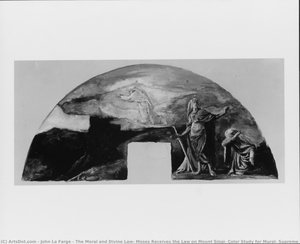
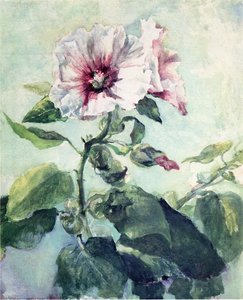
11Andromeda (1859) by John La FargeAndromeda1859 12A Brittany Beadle-Sketch from Nature (1856) by John La FargeA Brittany Beadle-Sketch from Nature1856 · Bavarian State Painting Collections 13Woman Bending Down Branch (Study for Cornelius Vanderbilt II, House, New York) (1881) by John La FargeWoman Bending Down Branch (Study for Cornelius Vanderbilt II, House, New York)1881 · Museum of Fine Arts 14Japanese Peasant Girl (1886) by John La FargeJapanese Peasant Girl1886 · Reading Public Museum 15The Recording Angel (1890) by John La FargeThe Recording Angel1890 · Isabella Stewart Gardner Museum 16Fishing Party in Canoes, Samoa (1890) by John La FargeFishing Party in Canoes, Samoa1890 17Three Saints (Alternate Study for Chapel Windows, Caldwell House, Newport) (1886) by John La FargeThree Saints (Alternate Study for Chapel Windows, Caldwell House, Newport)1886 18View Over Kyoto From Ya Ami (1886) by John La FargeView Over Kyoto From Ya Ami1886 19The Pool at Bethesda: The Angel Troubling the Water (1898) by John La FargeThe Pool at Bethesda: The Angel Troubling the Water1898 · Worcester Art Museum 20The Pool at Bethesda: The Invalid (1896) by John La FargeThe Pool at Bethesda: The Invalid1896 · Worcester Art Museum 21Resurrection (1894) by John La FargeResurrection1894 · Walters Art Museum 22The Strange Thing Little Kiosai Saw in the River (1897) by John La FargeThe Strange Thing Little Kiosai Saw in the River1897 23The Adjustment of Conflicting Interests: Count Raymond of Toulouse Swears at the Altar to Observe the Liberties of the City;ì Color Study for Mural, Supreme Court Room, Minnesota State Capitol,ì Saint Paul (1903) by John La FargeThe Adjustment of Conflicting Interests: Count Raymond of Toulouse Swears at the Altar to Observe the Liberties of the City;ì Color Study for Mural, Supreme Court Room, Minnesota State Capitol,ì Saint Paul1903 24Untitled (D2X2PQ) (1903) by John La FargeUntitled (D2X2PQ)1903 25The Recording of Precedents: Confucius and His Pupils Collate and Transcribe Documents in Their Favorite Grove; Color Study for Mural, Supreme Court Room, Minnesota State Capitol, Saint Paul (1903) by John La FargeThe Recording of Precedents: Confucius and His Pupils Collate and Transcribe Documents in Their Favorite Grove; Color Study for Mural, Supreme Court Room, Minnesota State Capitol, Saint Paul1903 26The Moral and Divine Law: Moses Receives the Law on Mount Sinai; Color Study for Mural, Supreme Court Room, Minnesota State Capitol, Saint Paul (1903) by John La FargeThe Moral and Divine Law: Moses Receives the Law on Mount Sinai; Color Study for Mural, Supreme Court Room, Minnesota State Capitol, Saint Paul1903 27Butterflies and Foliage 1 (1889) by John La FargeButterflies and Foliage 11889 · Museum of Fine Arts 28Peonnies Blown in the Wind (also known as Peony in the Wind) (1886) by John La FargePeonnies Blown in the Wind (also known as Peony in the Wind)1886 · Museum of Fine Arts 29Portrait of the Painter (1859) by John La FargePortrait of the Painter1859 · Metropolitan Museum of Art 30In Front of Our House, Vaila - Girl on Grass (1890) by John La FargeIn Front of Our House, Vaila - Girl on Grass1890 31Siva Dance. Two Girls (Aotoa and Aolele+ (1891) by John La FargeSiva Dance. Two Girls (Aotoa and Aolele+1891 32Flowers on a Window Ledge (1861) by John La FargeFlowers on a Window Ledge1861 · National Gallery of Art 33Centauress by John La FargeCentauress 34The Last Valley - Paradise Rocks (1868) by John La FargeThe Last Valley - Paradise Rocks1868 · National Gallery of Art 35Sacred Font in the Temple of Iyemitsu, Nikko, From the Platform of the Second Gate (1886) by John La FargeSacred Font in the Temple of Iyemitsu, Nikko, From the Platform of the Second Gate1886 36The Dawn (1899) by John La FargeThe Dawn1899 · Fogg Art Museum 37Hill-side with House. Paradise Farm, Afternoon Sky, Autumn (1861) by John La FargeHill-side with House. Paradise Farm, Afternoon Sky, Autumn1861 · Museum of Fine Arts 38A Grey Day, Newport (1862) by John La FargeA Grey Day, Newport1862 · Museum of Fine Arts 39Autumn: October. Hillside, Noonday, Glen Cove, Long Island (1860) by John La FargeAutumn: October. Hillside, Noonday, Glen Cove, Long Island1860 · Museum of Fine Arts 40In 'The Glen,' Portsmouth, Rhode Island (1859) by John La FargeIn 'The Glen,' Portsmouth, Rhode Island1859 · The Mint Museum 41Old Boathouse Beach, Newport (1859) by John La FargeOld Boathouse Beach, Newport1859 42The Old Barn Under Snow, Newport (1860) by John La FargeThe Old Barn Under Snow, Newport1860 · Isabella Stewart Gardner Museum 43Roses on a Tray (1861) by John La FargeRoses on a Tray1861 44Nosegay of Chrysanthemums (1863) by John La FargeNosegay of Chrysanthemums1863 45Pansies on a Tray (1862) by John La FargePansies on a Tray1862 46Flowers in a Lacquer Bowl (1861) by John La FargeFlowers in a Lacquer Bowl1861 47Hollyhocks (1863) by John La FargeHollyhocks1863 48Red Hollyhocks (1863) by John La FargeRed Hollyhocks1863 49Shell and Flower (1863) by John La FargeShell and Flower1863 50Water-Lilies in a White Bowl - with Red Table Cover (1859) by John La FargeWater-Lilies in a White Bowl - with Red Table Cover1859 51The Last Water Lilies (1862) by John La FargeThe Last Water Lilies1862 52Rising of East Wind, Newport (1859) by John La FargeRising of East Wind, Newport1859 53Portrait of Henry James, the Novelist (1862) by John La FargePortrait of Henry James, the Novelist1862 54On the Bayou Teche, Louisiana (1860) by John La FargeOn the Bayou Teche, Louisiana1860 55Still Life, Study of Silver, Glass and Fruit (1859) by John La FargeStill Life, Study of Silver, Glass and Fruit1859 56Magnolia (1863) by John La FargeMagnolia1863 57Hollyhocks (1864) by John La FargeHollyhocks1864 · Crystal Bridges Museum of American Art 58Snow Storm (1865) by John La FargeSnow Storm1865 59Moonlight (1870) by John La FargeMoonlight1870 60The Last Valley - Paradise Rocks (1867) by John La FargeThe Last Valley - Paradise Rocks1867 61On a Park Terrace (1865) by John La FargeOn a Park Terrace1865 62Flowers in a Japanese Vase (1864) by John La FargeFlowers in a Japanese Vase1864 · Museum of Fine Arts 63Hollyhocks and Corn (1865) by John La FargeHollyhocks and Corn1865 · Museum of Fine Arts 64Wreath of Flowers (1866) by John La FargeWreath of Flowers1866 · Smithsonian American Art Museum 65Flowers, Blue Iris, with Trunk of Dead Apple-Tree (1871) by John La FargeFlowers, Blue Iris, with Trunk of Dead Apple-Tree1871 66Tulips and Hyacinths (1867) by John La FargeTulips and Hyacinths1867 67Morning Glories and Eggplant (1865) by John La FargeMorning Glories and Eggplant1865 68In the Forest (1864) by John La FargeIn the Forest1864 69Self Portrait (1864) by John La FargeSelf Portrait1864 70Paradise Valley (1866) by John La FargeParadise Valley1866 71Wild Roses and Grape Vine, Study from Nature (1871) by John La FargeWild Roses and Grape Vine, Study from Nature1871 72Water-Lily, Study from Nature (1874) by John La FargeWater-Lily, Study from Nature1874 73The Golden Age (1878) by John La FargeThe Golden Age1878 · Smithsonian American Art Museum 74Water Lily (also known as Lotus Leaves) (1872) by John La FargeWater Lily (also known as Lotus Leaves)1872 75Winter Thaw (1874) by John La FargeWinter Thaw1874 76Water Lilies and Hibiscus (1875) by John La FargeWater Lilies and Hibiscus1875 77Snow, Sketch: Hillside with Cedars, Evening (1873) by John La FargeSnow, Sketch: Hillside with Cedars, Evening1873 78Water Lily (1879) by John La FargeWater Lily1879 · Museum of Fine Arts 79Water Lily in Sunlight (1881) by John La FargeWater Lily in Sunlight1881 · Museum of Art 80Roses in a Vase (1884) by John La FargeRoses in a Vase1884 81Waterlilies (1883) by John La FargeWaterlilies1883 82Wild Roses (1883) by John La FargeWild Roses1883 83Single Water-Lily in Sunlight (1879) by John La FargeSingle Water-Lily in Sunlight1879 84Ipomoea (also known as Morning Glory) (1885) by John La FargeIpomoea (also known as Morning Glory)1885 85Roses in a Shallow Bowl (1879) by John La FargeRoses in a Shallow Bowl1879 86Flowers in a Japanese Tray on Mahogany Table (1879) by John La FargeFlowers in a Japanese Tray on Mahogany Table1879 · Brooklyn Museum 87Moonlit Seascape (1883) by John La FargeMoonlit Seascape1883 88Study of Autumn Flowers in Persian Glass Bowl with White Enamel Edge (1884) by John La FargeStudy of Autumn Flowers in Persian Glass Bowl with White Enamel Edge1884 89Water Lily Among Pads (1879) by John La FargeWater Lily Among Pads1879 90Petunias in a Glass Vase (1884) by John La FargePetunias in a Glass Vase1884 91Study at Brenton's Cove, Newport, Looking towards Fort Adams (1884) by John La FargeStudy at Brenton's Cove, Newport, Looking towards Fort Adams1884 92Sleep (also known as Study of Female Figure Asleep) (1884) by John La FargeSleep (also known as Study of Female Figure Asleep)1884 93Water-Lilies, Red and Green Pads (1883) by John La FargeWater-Lilies, Red and Green Pads1883 94Wild Roses in a White Chinese Porcelain Bowl (1880) by John La FargeWild Roses in a White Chinese Porcelain Bowl1880 95Study of Pink Hollyhock in Sunlight, From Nature (1879) by John La FargeStudy of Pink Hollyhock in Sunlight, From Nature1879 96Maua, a Samoan (also known as Maua, Our Boatman) (1891) by John La FargeMaua, a Samoan (also known as Maua, Our Boatman)1891 · Addison Gallery of American Art 97Paradise Rocks - Study at Paradise, Newport, R.I. (1883) by John La FargeParadise Rocks - Study at Paradise, Newport, R.I.1883 98Roses in Old Chinese Bowl (1880) by John La FargeRoses in Old Chinese Bowl1880 99Roses in Blue Crackle Glass Pitcher (1879) by John La FargeRoses in Blue Crackle Glass Pitcher1879 100Camellia in Old Chinese Vase on Black Lacquer Table (1879) by John La FargeCamellia in Old Chinese Vase on Black Lacquer Table1879

John La Farge's famous paintings, period by period

The subjects that held John La Farge's eye

The four subjects that come back most often in these originals, each with its finest example.

The museums that keep John La Farge's originals

The 8 museums that hold the most of the paintings on this page.

Museum City Works by John La Farge Paintings from this list
Museum of Fine Arts, BostonMuseum of Fine Arts Boston 15 Woman Bending Down Branch (Study for Cornelius Vanderbilt II, House, New York), Butterflies and Foliage 1, Peonnies Blown in the Wind (also known as Peony in the Wind)
Isabella Stewart Gardner Museum, BostonIsabella Stewart Gardner Museum Boston 4 The Spirit of the Water Lily, The Recording Angel, The Old Barn Under Snow, Newport
National Gallery of Art, WashingtonNational Gallery of Art Washington 4 The Entrance to the Tautira River, Tahiti. Fisherman Spearing a Fish, Flowers on a Window Ledge, The Last Valley - Paradise Rocks
Smithsonian American Art Museum, Washington, D.C.Smithsonian American Art Museum Washington, D.C. 4 Wreath of Flowers, The Golden Age
Worcester Art Museum, WorcesterWorcester Art Museum Worcester 2 The Pool at Bethesda: The Angel Troubling the Water, The Pool at Bethesda: The Invalid
Metropolitan Museum of Art, New YorkMetropolitan Museum of Art New York 6 Portrait of the Painter
Bavarian State Painting Collections, MunichBavarian State Painting Collections Munich 2 A Brittany Beadle-Sketch from Nature
Fogg Art Museum, CambridgeFogg Art Museum Cambridge 2 The Dawn

John La Farge, one signature painting per decade

Works per decade

Pick a decade to see the original that defines it.

John La Farge's paintings: the gallery answers

Which John La Farge painting is the most famous of all?Reveal the answer

A Samoan Lady, Brooklyn Museum, New York City. Water Lily (1896) and Ruth and Naomi, Study for a Window come next.

Which are John La Farge's top 10 paintings?Reveal the answer

A Samoan Lady, Water Lily, Ruth and Naomi, Study for a Window, Study of Pink Hollyhocks in Sunlight, from Nature, Venus Anadyomene, Girl in Bow of Canoe Spreading Out Her Loin-Cloth for a Sail, Samoa (also known as Fayaway), The Spirit of the Water Lily, The Entrance to the Tautira River, Tahiti. Fisherman Spearing a Fish, William James and Study of Boy. The ranking above gives each one's year and museum.

How many works did John La Farge create?Reveal the answer

Our catalog holds 376 works by John La Farge, dated from 1856 to 1903.

Where do John La Farge's most famous originals hang?Reveal the answer

Mostly in Museum of Fine Arts (Boston), Isabella Stewart Gardner Museum (Boston) and National Gallery of Art (Washington). The museum table above lists them all.

When did John La Farge create the most famous paintings?Reveal the answer

In 1860s: 31 of the 100 works on this page were made then, Venus Anadyomene among them.

Which are John La Farge's earliest and latest famous works?Reveal the answer

On this page, the earliest is A Brittany Beadle-Sketch from Nature (1856) and the latest The Adjustment of Conflicting Interests: Count Raymond of Toulouse Swears at the Altar to Observe the Liberties of the City;ì Color Study for Mural, Supreme Court Room, Minnesota State Capitol,ì Saint Paul (1903).

Which subjects did John La Farge return to most?Reveal the answer

Flowers (18), Water (7) and Woman (7), across the 100 works on this page.

Which medium did John La Farge work in most?Reveal the answer

Watercolor, for 14 of the 100 works on this page.

Which movement is John La Farge associated with?Reveal the answer

Aestheticism, judging by the originals on this page.

Which John La Farge originals does the Museum of Fine Arts hold?Reveal the answer

Woman Bending Down Branch (Study for Cornelius Vanderbilt II, House, New York), Butterflies and Foliage 1 and Peonnies Blown in the Wind (also known as Peony in the Wind): the Museum of Fine Arts, Boston holds 9 of the works on this page.

John La Farge: the artist

A Luminary of American Art: The Life and Legacy of John La Farge

John La Farge, born in New York City in 1835 to wealthy French parents, emerged as a pivotal figure in the evolution of late 19th and early 20th-century American art. His journey was one of constant exploration and innovation, spanning painting, mural design, stained glass artistry, interior decoration, and insightful writing on his travels—particularly those to Asia. Raised bilingually, La Farge’s upbringing instilled in him a cosmopolitan sensibility that would profoundly shape his artistic vision. He initially pursued legal studies but soon gravitated towards the world of art, studying first at Mount St. Mary's University and then at St. John's College (now Fordham University). A formative period followed with training under Thomas Couture in Paris, where he absorbed European artistic traditions while simultaneously developing a uniquely American aesthetic. This early exposure to both Old World mastery and his own burgeoning originality laid the foundation for a career marked by groundbreaking techniques and a distinctive style.

Pioneering Innovation Across Disciplines

La Farge’s artistic output was remarkably diverse, yet consistently characterized by an intense focus on color and light. He began to gain recognition with his illustrations and landscapes, but it was in the realm of mural painting that he first made a significant impact. Commissions for churches like Trinity Church in Boston (1873) and the Church of the Ascension in New York showcased his ability to create luminous, spiritually evocative spaces. However, La Farge’s most enduring legacy lies in his revolutionary work with stained glass. Dissatisfied with the conventional methods of the time, he pioneered a technique involving superimposing multiple layers of colored glass—a process for which he received a patent in 1880. This innovation allowed him to achieve an unprecedented richness and depth of color, transforming stained glass from a merely decorative element into a powerful medium for artistic expression. His stained-glass windows weren’t simply representations; they were immersive experiences of light and hue. Beyond these core disciplines, La Farge also excelled in interior design, creating harmonious environments that integrated his paintings, murals, and decorative arts.

The Influence of the East and a Search for New Forms

A defining aspect of La Farge’s artistic development was his fascination with Japanese art and culture. His travels to Asia, beginning in the 1880s, profoundly influenced his aesthetic sensibilities. He meticulously documented his observations in writings and incorporated elements of Japanese design—such as asymmetry, flattened perspectives, and a refined sense of color—into his own work. This embrace of Eastern aesthetics was not merely imitative; La Farge synthesized these influences with his existing artistic vocabulary to create something entirely new. His studio at 51 West 10th Street in Greenwich Village became a hub for artists interested in exploring non-Western art forms, fostering a spirit of experimentation and cross-cultural exchange. He wasn’t alone in this pursuit—artists like James McNeill Whistler were also captivated by Japanese aesthetics—but La Farge distinguished himself through his ability to seamlessly integrate these influences into his diverse artistic practice. The sacred grove, a forested area in Rhode Island where he painted many mythological scenes, became a personal sanctuary reflecting his spiritual and artistic explorations.
A Lasting Impact on American Art

John La Farge’s contributions extended beyond his individual artworks; he was also a dedicated advocate for the arts and a vocal critic of academic conservatism. He co-founded the Society of American Artists in 1877 as an alternative to the perceived rigidity of the National Academy of Design, championing artistic freedom and innovation. His influence can be seen in the work of subsequent generations of artists, particularly those associated with the Arts and Crafts movement and Symbolism. La Farge’s emphasis on craftsmanship, his exploration of spiritual themes, and his innovative use of color all resonated with artists seeking to break away from traditional conventions. He served as an instructor at the Metropolitan Museum of Art Schools, nurturing young talent and imparting his knowledge and passion for art. Though he faced challenges—including a protracted legal battle with Louis Comfort Tiffany over stained-glass patents—La Farge remained committed to his artistic vision until his death in 1910. His legacy endures as a testament to the power of innovation, the beauty of color, and the enduring influence of cross-cultural exchange.

Beyond the Canvas: Writings and Family

  • Literary Contributions: La Farge was not only a visual artist but also a gifted writer. His travelogues, particularly *An Artist’s Letters from Japan* (1897), offered insightful observations on Japanese culture and art, contributing to a growing Western appreciation for Eastern aesthetics.
  • Family Legacy: The La Farge family continued to contribute to the arts and humanities. His son, Oliver Hazard Perry La Farge II, became a renowned anthropologist and writer, focusing on Native American cultures and winning a Pulitzer Prize for his novel *Laughing Boy* (1929).
  • Final Years: In his later years, La Farge continued to work prolifically, creating murals even into his seventies. He died at Butler Hospital in Providence, Rhode Island, leaving behind a body of work that continues to inspire and captivate audiences today.
  • His interment is at Green-Wood Cemetery in Brooklyn, New York.