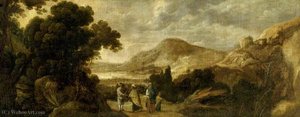
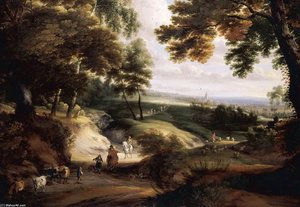
Portrait of Jacques D' Arthois

The 57 Most Famous Jacques D' Arthois Paintings, Each One of a Kind

Updated November 2026 · ranked by our popularity score (searches, visits and orders for each work) · 59 works by Jacques D' Arthois in our catalogue

In short

Family Group in a Landscape (1645) is the Jacques D' Arthois painting that draws the most eyes; the original belongs to the Metropolitan Museum of Art, New York. After it, the eye goes to Extensive forest landscape with St. Stanisław Kostka (1665) and The Ford in the Forest (1660). Among the 59 works of Jacques D' Arthois in our catalog, these 57 are the most famous, each a unique original presented with its year, its museum and the reason it endures.

1613 – 1686, Brussels Baroque Most works: Bavarian State Painting Collections

Top 10 paintings by Jacques D' Arthois, through the gallery's eye

1
Family Group in a Landscape (1645) by Jacques D' Arthois

Family Group in a Landscape

1645 · Oil On Canvas · Metropolitan Museum of Art, New York

A man stands with an arm outstretched, his finger tracing a line toward the distant horizon. Beside him, a woman and three children form a silent, structured group against the wildness of the Belgian countryside. The light falls from the upper left, catching the heavy folds of their period clothing and the pale skin of their faces. They are anchored by the dark, heavy mass of a sprawling tree on…

2
Extensive forest landscape with St. Stanisław Kostka (1665) by Jacques D' Arthois

Extensive forest landscape with St. Stanisław Kostka

1665 · Oil On Canvas · Kunsthistorisches Museum, Vienna

The canvas presents a dense, large-scale forest landscape characterized by an asymmetrical arrangement of ancient trees. On the left, massive trunks with textured, craggy bark dominate the foreground, their sprawling canopies extending toward the center. These dark, heavy forms create a natural frame for the interior of the woods. A winding path or clearing cuts through the mid-ground, leading the eye toward a small group of figures positioned on the…

3
The Ford in the Forest (1660) by Jacques D' Arthois

The Ford in the Forest

1660 · Oil On Canvas · Bavarian State Painting Collections, Munich

The air feels heavy with the scent of damp earth and ancient bark as the eye moves through a dense, dark frame of towering trees. These massive, irregular trunks act as a natural curtain, pulling the viewer into a secluded world where light and shadow perform a quiet dance. In the center of this woodland sanctuary, a shallow stream cuts through the terrain, creating a ford where life moves at…

4
Landscape with Entrance to a Forrest (1650) by Jacques D' Arthois

Landscape with Entrance to a Forrest

1650 · Oil On Canvas · Städel Museum, Frankfurt

A natural archway of heavy, textured bark frames the view. On the left and right, massive trees reach upward, their limbs twisting like slow-moving currents. These foreground sentinels cast long, cooling shadows across the earth, creating a dark vignette that pushes the eye toward a luminous center. Through this organic gateway, a pale blue sky peeks through a canopy of soft white clouds. The light arrives from the upper left,…

5
Extensive forest landscape with St. Francis Borgia (1665) by Jacques D' Arthois

Extensive forest landscape with St. Francis Borgia

1665 · Oil On Canvas · Kunsthistorisches Museum, Vienna

Step into the quietude of this expansive woodland. Jacques d'Arthois invites us into a vast, untamed wilderness where the scale of nature dwarfs the human presence. The composition is framed by heavy, detailed trees on the left and right, creating a natural vignette that draws the eye toward a luminous center. Deep forest greens and earthy ochre tones dominate the foliage, while the sky breaks through the canopy in pale…

6
Landscape with Stag Hunt (1649) by Jacques D' Arthois

Landscape with Stag Hunt

1649 · Oil On Canvas · Bavarian State Painting Collections, Munich

The scene unfolds within Landscape with Stag Hunt, a work that captures a moment of intense pursuit amidst the wild. Jacques D' Arthois, the hand behind this composition, breathes life into the rugged terrain through his precise rendering of the natural world. Born in Brussels, Belgium, in 1613, the artist brings a deep familiarity with the wooded landscapes of his homeland to this 1649 creation. The hunt moves through a…

7
Landscape (1682) by Jacques D' Arthois

Landscape

1682 · Oil On Canvas · Hermitage Museum, Saint Petersburg

The composition is anchored by a dense, dark mass of trees occupying the left and central portions of the frame. These vertical elements create a sense of enclosure, casting much of the woodland into deep shadow. To the left, a sunlit rocky cliffside features a small, cascading waterfall that introduces movement into the otherwise still scene. In the lower foreground, a group of small figures and an animal gather near…

8
Landscape with a Herd (1630) by Jacques D' Arthois

Landscape with a Herd

1630 · Oil On Canvas · Hermitage Museum, Saint Petersburg

In the heart of the Flemish Baroque era, Jacques d'Arthois captured a world where nature and pastoral life exist in a state of eternal, quiet grace. His masterpiece, Landscape with a Herd, is far more than a mere depiction of the countryside; it is an immersive window into a meticulously crafted vision of rural serenity. Painted between 1630 and 1650, this evocative oil on canvas invites the viewer to step…

9
Landscape with a herd (1665) by Jacques D' Arthois

Landscape with a herd

1665 · Oil On Canvas · Kunsthistorisches Museum, Vienna

In this 1630 oil on canvas, we find ourselves standing at the edge of a dense, shadowed woodland. The composition uses a repoussoir technique, where the dark, detailed bark of the foreground trees frames the view, drawing the eye inward toward a luminous, central valley. Sunlight breaks through a heavy, cloud-swept sky, casting a soft light upon the rolling hills and the distant, misty horizon. It is a scene of…

Jacques D' Arthois's famous paintings, numbers 11 to 57

11Path to the Lake (1650) by Jacques D' ArthoisPath to the Lake1650 · Slovak National Gallery 12Deer Hunt (1649) by Jacques D' ArthoisDeer Hunt1649 · Bavarian State Painting Collections 13Falconry (1649) by Jacques D' ArthoisFalconry1649 · Bavarian State Painting Collections 14Landscape with Staffage (1649) by Jacques D' ArthoisLandscape with Staffage1649 · Bavarian State Painting Collections 15A Bay (1649) by Jacques D' ArthoisA Bay1649 · Bavarian State Painting Collections 16Forest Path (1649) by Jacques D' ArthoisForest Path1649 · Bavarian State Painting Collections 17Forest Edge (1649) by Jacques D' ArthoisForest Edge1649 · Bavarian State Painting Collections 18Wilderness Landscape with Waterfall (1649) by Jacques D' ArthoisWilderness Landscape with Waterfall1649 · Bavarian State Painting Collections 19Landscape with Trees and Water (1649) by Jacques D' ArthoisLandscape with Trees and Water1649 · Bavarian State Painting Collections 20Landscape with Trees (1649) by Jacques D' ArthoisLandscape with Trees1649 · Bavarian State Painting Collections 21Sunken Road in a Wood (1658) by Jacques D' ArthoisSunken Road in a Wood1658 · National Museum of Art, Architecture and Design 22Woodland Scene (1653) by Jacques D' ArthoisWoodland Scene1653 · National Museum of Art, Architecture and Design 23Landscape near Brussels (1654) by Jacques D' ArthoisLandscape near Brussels1654 · Hermitage Museum 24Wooded landscape with hunters and travellers (1657) by Jacques D' ArthoisWooded landscape with hunters and travellers1657 · Groninger Museum 25Wooded Landscape with Hunters (1657) by Jacques D' ArthoisWooded Landscape with Hunters1657 · Statens Museum For Kunst 26View taken in Brabant with figures and animals (1660) by Jacques D' ArthoisView taken in Brabant with figures and animals1660 · Musée des Beaux-Arts de Quimper 27Mountain pass with soldiers attacking peasants (1657) by Jacques D' ArthoisMountain pass with soldiers attacking peasants1657 · Staatliche Kunsthalle Karlsruhe 28Rudolf von Habsburg Handing over his Horse to a Priest (1650) by Jacques D' ArthoisRudolf von Habsburg Handing over his Horse to a Priest1650 29Landscape (1665) by Jacques D' ArthoisLandscape1665 · Groeningemuseum 30Landscape with a Group of Trees at the Shore of a Lake, Three Riders on the Road in the Foreground (1667) by Jacques D' ArthoisLandscape with a Group of Trees at the Shore of a Lake, Three Riders on the Road in the Foreground1667 · Städel Museum 31Waters with Planted Dykes (1660) by Jacques D' ArthoisWaters with Planted Dykes1660 · Bavarian State Painting Collections 32Cavaliers Halting on a Road in a Landscape by Jacques D' ArthoisCavaliers Halting on a Road in a LandscapeCalke Abbey 33Landscape with a River and Figures by Jacques D' ArthoisLandscape with a River and Figures 34Wooded Landscape by Jacques D' ArthoisWooded Landscape 35Edge of a Wood by Jacques D' ArthoisEdge of a WoodThe Louvre 36Landscape with Shepherd by Jacques D' ArthoisLandscape with ShepherdРезиденцгалерея Зальцбург 37Pond at the edge of a wood by Jacques D' ArthoisPond at the edge of a woodPalais des Beaux-Arts de Lille 38Landscape with Peasants Repelling Latona by Jacques D' ArthoisLandscape with Peasants Repelling LatonaMusée Des Beaux 39Landscape: Woodland with Lake and Figures by Jacques D' ArthoisLandscape: Woodland with Lake and FiguresAuckland Art Gallery Toi o Tāmaki 40The Sonian forest with figures by Jacques D' ArthoisThe Sonian forest with figuresMuseum of Fine Arts Ghent (MSK) 41Landscape by Jacques D' ArthoisLandscapeRoyal Museum of Fine Arts Antwerp 42Road through a Forest by Jacques D' ArthoisRoad through a ForestMuseum of Fine Arts 43Landscape with a Rider in Red by Jacques D' ArthoisLandscape with a Rider in RedNationalmuseum 44View of the woods of Soignies and the ponds of the Rood Klooster by Jacques D' ArthoisView of the woods of Soignies and the ponds of the Rood Klooster 45Landscape with a Huntsman by Jacques D' ArthoisLandscape with a Huntsman 46Hunting party by Jacques D' ArthoisHunting party 47A wooded landscape by Jacques D' ArthoisA wooded landscape 48Peasants at the Edge of a Forest by Jacques D' ArthoisPeasants at the Edge of a Forest 49Landscape with a Hunting Party by Jacques D' ArthoisLandscape with a Hunting PartyPetworth House 50Landscape with a River and Horsemen by Jacques D' ArthoisLandscape with a River and Horsemen 51Landscape, Riverbank with Figures by Jacques D' ArthoisLandscape, Riverbank with Figures 52Landscape with Figures by Jacques D' ArthoisLandscape with Figures 53Flemish landscape by Jacques D' ArthoisFlemish landscape 54Woody Landscape with Gypsies Telling a Gentleman's Fortune by Jacques D' ArthoisWoody Landscape with Gypsies Telling a Gentleman's Fortune 55Wooded Landscape by Jacques D' ArthoisWooded Landscape 56A rocky cove with fisherfolk on the shore, an artist sketching in the foreground by Jacques D' ArthoisA rocky cove with fisherfolk on the shore, an artist sketching in the foreground 57An Extensive Wooded Landscape with Travellers on a Path by Jacques D' ArthoisAn Extensive Wooded Landscape with Travellers on a Path

The subjects that held Jacques D' Arthois's eye

The four subjects that come back most often in these originals, each with its finest example.

The museums that keep Jacques D' Arthois's originals

The 8 museums that hold the most of the paintings on this page.

Museum City Works by Jacques D' Arthois Paintings from this list
Bavarian State Painting Collections, MunichBavarian State Painting Collections Munich 12 The Ford in the Forest, Landscape with Stag Hunt, Deer Hunt
Kunsthistorisches Museum, ViennaKunsthistorisches Museum Vienna 3 Extensive forest landscape with St. Stanisław Kostka, Extensive forest landscape with St. Francis Borgia, Landscape with a herd
Hermitage Museum, Saint PetersburgHermitage Museum Saint Petersburg 3 Landscape, Landscape with a Herd, Landscape near Brussels
Städel Museum, FrankfurtStädel Museum Frankfurt 2 Landscape with Entrance to a Forrest, Landscape with a Group of Trees at the Shore of a Lake, Three Riders on the Road in the Foreground
National Museum of Art, Architecture and Design, OsloNational Museum of Art, Architecture and Design Oslo 2 Sunken Road in a Wood, Woodland Scene
Metropolitan Museum of Art, New YorkMetropolitan Museum of Art New York 1 Family Group in a Landscape
Slovak National Gallery, BratislavaSlovak National Gallery Bratislava 1 Path to the Lake
Groninger Museum, GroningenGroninger Museum Groningen 1 Wooded landscape with hunters and travellers

Jacques D' Arthois across the decades: one unique original for each

Works per decade

Pick a decade to see the original that defines it.

Jacques D' Arthois's paintings: questions for the gallery

What is the single most famous work of Jacques D' Arthois?Reveal the answer

Family Group in a Landscape (1645), Metropolitan Museum of Art, New York. Extensive forest landscape with St. Stanisław Kostka (1665) and The Ford in the Forest (1660) come next.

At what age did Jacques D' Arthois create Family Group in a Landscape?Reveal the answer

32 years old: Family Group in a Landscape dates from 1645, and Jacques D' Arthois was born in 1613.

Which ten paintings by Jacques D' Arthois are the most famous?Reveal the answer

Family Group in a Landscape, Extensive forest landscape with St. Stanisław Kostka, The Ford in the Forest, Landscape with Entrance to a Forrest, Extensive forest landscape with St. Francis Borgia, Landscape with Stag Hunt, Landscape, Landscape with a Herd, Landscape with a herd and Landscape with waterfall. The ranking above gives each one's year and museum.

How many works by Jacques D' Arthois are known?Reveal the answer

Our catalog holds 59 works by Jacques D' Arthois, dated from 1630 to 1682.

Where can the most famous Jacques D' Arthois originals be seen?Reveal the answer

Mostly in Bavarian State Painting Collections (Munich), Kunsthistorisches Museum (Vienna) and Hermitage Museum (Saint Petersburg). The museum table above lists them all.

During which period did Jacques D' Arthois create the best-known paintings?Reveal the answer

In 1640s: 11 of the 57 works on this page were made then, Family Group in a Landscape among them.

Which famous Jacques D' Arthois painting is the earliest, and which the latest?Reveal the answer

On this page, the earliest is Landscape with a Herd (1630) and the latest Landscape (1682).

What subjects did Jacques D' Arthois favour?Reveal the answer

Landscape (21), Forest (12) and Trees (10), across the 57 works on this page.

What materials did Jacques D' Arthois paint with most?Reveal the answer

Oil On Canvas, for 9 of the 57 works on this page.

Which movement does the work of Jacques D' Arthois belong to?Reveal the answer

Baroque, judging by the originals on this page.

What Jacques D' Arthois originals can I see at the Bavarian State Painting Collections?Reveal the answer

The Ford in the Forest, Landscape with Stag Hunt and Deer Hunt: the Bavarian State Painting Collections, Munich holds 12 of the works on this page.

Jacques D' Arthois: a portrait of the artist

A Brussels Master of Woodland Scenes: The Life and Art of Jacques d’Arthois

Jacques d'Arthois, born in Brussels in 1613, emerged during a vibrant period for Flemish art—a time when landscape painting was steadily gaining prominence alongside the established traditions of portraiture and history. While not as widely celebrated as some of his contemporaries, d’Arthois carved out a significant niche for himself with his meticulously detailed depictions of wooded landscapes populated by figures engaged in everyday life or pastoral pursuits. His career unfolded against a backdrop of political and religious upheaval, yet he managed to cultivate a consistent style that resonated with patrons seeking both beauty and tranquility in their surroundings. Apprenticed to Jan Mertens in 1625, the specifics of his early training remain somewhat obscure; however, it’s clear that d'Arthois quickly developed an affinity for rendering the natural world with remarkable precision. He entered the Brussels Guild of St. Luke in 1634, marking a formal recognition of his artistic abilities and establishing him as a professional painter within the city’s thriving art community.

The Tapestry Designer and the Pastoral Ideal

D'Arthois wasn’t solely dedicated to easel painting; he also achieved considerable success as a tapestry designer, becoming a chartered cartoon designer for the city of Brussels in 1655. This dual role is significant because it illuminates his broader artistic sensibilities—his ability to translate compositions from one medium to another and his understanding of decorative principles. Tapestry design demanded a clarity of form and narrative that likely influenced his paintings, encouraging him to create scenes that were both visually compelling and easily interpretable. His landscapes often evoke a sense of idealized harmony, reflecting the pastoral ideal prevalent in 17th-century art—a longing for a simpler, more virtuous existence rooted in nature. The woods around Brussels served as his primary source of inspiration, and he frequently depicted them with a keen eye for atmospheric effects and subtle variations in light and shadow. Figures were often added to his compositions by other artists, notably David Teniers the Younger and Gonzales Coques, creating collaborative works that showcased both d’Arthois's landscape expertise and the figure painters’ skill in animating the scenes.

Influences and Artistic Development

Tracing the influences on d’Arthois’s style reveals a complex interplay of artistic traditions. Early works demonstrate a clear debt to Lodewijk de Vadder, another prominent Brussels landscape painter whose compositions often featured similar wooded settings and figure groupings. However, d'Arthois gradually developed his own distinctive voice, characterized by a greater emphasis on detail and a more refined sense of atmospheric perspective. The influence of Denis van Alsloot is also discernible in his early paintings, particularly in the rendering of trees and foliage. As he matured, d’Arthois began to experiment with larger-scale landscapes, responding to a growing demand for decorative works that could adorn churches and abbeys. These ambitious compositions required a sophisticated understanding of spatial organization and a mastery of color and tone. While documentary evidence is limited, it's believed that Cornelis Huysmans may have spent time in d’Arthois’s workshop around 1650, though the extent of his influence remains uncertain.

A Legacy of Imitation and Historical Significance

Jacques d’Arthois enjoyed a successful career during his lifetime, attracting commissions from both private patrons and religious institutions. He owned several houses, including one in the Sonian Forest—a testament to his prosperity and connection to the natural world he so often depicted. Despite experiencing financial difficulties later in life, his artistic reputation remained strong. His influence extended beyond Brussels, as evidenced by the presence of pupils who emulated his style and disseminated his aesthetic principles throughout the region. While no works are definitively signed by either his brother Nicolaes or his son Jan Baptist, it is believed that many paintings attributed to Jacques d’Arthois were actually created by these family members. This ambiguity underscores the challenges inherent in attributing 17th-century Flemish landscapes, but it also highlights the enduring appeal of d'Arthois’s style—a style that was widely imitated and followed by other landscape artists for generations. His contribution lies not in radical innovation, but in his skillful execution of a beloved genre and his ability to capture the beauty and tranquility of the Belgian countryside. He represents a vital link in the development of Flemish landscape painting, bridging the gap between earlier traditions and the more sophisticated approaches that would emerge in the following centuries.