Original Unique Art
      Menu
      FREE ART CONSULTATION
      About Us Contact Us
          • Originals
            All Artworks Exclusive Studio Creations Art Auctions Browse All Artworks By Medium By Room & Space
            Decorating Assistant: Living Room Decorating Assistant: Bedroom By Purpose By Gift For What Makes an Artwork Unique
          • Limited Editions
            Browse by Collection Artist Editions What Makes an Edition Valuable
            Certificates of Authenticity Explained Caring for Your Edition
          • Our Artists
            All Artists Browse All Artists Join as an Artist
            Artist Spotlights How We Select Our Artists
          • Commission an Original
            Start Your Commission Order an Art Print Corporate Commissions Free Art Consultation Get Free Art Suggestions
            My Cart Our Creation Process Paintings Showcase How to Commission Custom Artwork
          • Collector's Corner
            Free Artwork Appraisal All Museums All Articles My Dashboard, Favorites, Orders My Collection Collector Reviews
            Art Collecting 101 Art as an Investment Provenance: The Story of Ownership About Us Contact Us Subscribe to our Newsletter
          • Home
          • Artists
          • Giorgio de Chirico
          • Most Popular Paintings
          the collector's folio

          Giorgio de Chirico Most Popular Paintings

          The 25 paintings by Giorgio de Chirico our visitors ask for most, ranked by popularity and presented plate by plate, with the specification of each hand-painted reproduction.

          Hand painted in oil Edition 2026 · 25 plates Each plate painted to order
          Linen canvas · Certificate of authenticity · Delivered worldwide Giorgio de Chirico · 1888 – 1978
          The Child's Brain (1917) — Giorgio de Chirico
          Plate 01

          The Child's Brain

          1917 · Moderna Museum, Stockholm
          Technique
          Hand-painted oil on linen canvas
          Made
          To order, by a trained painter
          Sizes
          From 28 × 36 cm, any size up to 250 cm
          Delivery
          Worldwide, about 5 weeks
          from$200 Commission this plate
          The Prodigal Son (1922) — Giorgio de Chirico
          Plate 02

          The Prodigal Son

          1922 · Galleria d'Arte Moderna, Milan · original 59 x 87 cm
          Technique
          Hand-painted oil on linen canvas
          Made
          To order, by a trained painter
          Sizes
          From 26 × 39 cm, any size up to 250 cm
          Delivery
          Worldwide, about 5 weeks
          from$225 Commission this plate
          The Song of Love (1914) — Giorgio de Chirico
          Plate 03

          The Song of Love

          1914 · original 59 x 73 cm
          Technique
          Hand-painted oil on linen canvas
          Made
          To order, by a trained painter
          Sizes
          From 27 × 37 cm, any size up to 250 cm
          Delivery
          Worldwide, about 5 weeks
          from$200 Commission this plate
          Hector and Andromache (1917) — Giorgio de Chirico
          Plate 04

          Hector and Andromache

          1917 · original 90 x 60 cm
          Technique
          Hand-painted oil on linen canvas
          Made
          To order, by a trained painter
          Sizes
          From 28 × 35 cm, any size up to 250 cm
          Delivery
          Worldwide, about 5 weeks
          from$225 Commission this plate
          The Great Metaphysician (1917) — Giorgio de Chirico
          Plate 05

          The Great Metaphysician

          1917
          Technique
          Hand-painted oil on linen canvas
          Made
          To order, by a trained painter
          Sizes
          From 25 × 39 cm, any size up to 250 cm
          Delivery
          Worldwide, about 5 weeks
          from$200 Commission this plate
          The Uncertainty of the Poet (1913) — Giorgio de Chirico
          Plate 06

          The Uncertainty of the Poet

          1913 · Tate Gallery, London · original 106 x 94 cm
          Technique
          Hand-painted oil on linen canvas
          Made
          To order, by a trained painter
          Sizes
          From 30 × 34 cm, any size up to 250 cm
          Delivery
          Worldwide, about 5 weeks
          from$200 Commission this plate
          Great metaphysical interior (1917) — Giorgio de Chirico
          Plate 07

          Great metaphysical interior

          1917 · MOMA - Museum of Modern Art, New York City
          Technique
          Hand-painted oil on linen canvas
          Made
          To order, by a trained painter
          Sizes
          From 27 × 37 cm, any size up to 250 cm
          Delivery
          Worldwide, about 5 weeks
          from$200 Commission this plate
          The Jewish Angel (1916) — Giorgio de Chirico
          Plate 08

          The Jewish Angel

          1916 · Metropolitan Museum of Art, new york · original 68 x 45 cm
          Technique
          Hand-painted oil on linen canvas
          Made
          To order, by a trained painter
          Sizes
          From 26 × 39 cm, any size up to 250 cm
          Delivery
          Worldwide, about 5 weeks
          from$200 Commission this plate
          Homesicknessof an Engineer — Giorgio de Chirico
          Plate 09

          Homesicknessof an Engineer

          Chrysler Museum of Art, Norfolk
          Technique
          Hand-painted oil on linen canvas
          Made
          To order, by a trained painter
          Sizes
          From 28 × 36 cm, any size up to 250 cm
          Delivery
          Worldwide, about 5 weeks
          from$200 Commission this plate
          Enigma of the arrival of evening — Giorgio de Chirico
          Plate 10

          Enigma of the arrival of evening

          Technique
          Hand-painted oil on linen canvas
          Made
          To order, by a trained painter
          Sizes
          From 35 × 28 cm, any size up to 250 cm
          Delivery
          Worldwide, about 5 weeks
          from$200 Commission this plate
          The Conquest of the Philosopher (1914) — Giorgio de Chirico
          Plate 11

          The Conquest of the Philosopher

          1914 · original 125 x 99 cm
          Technique
          Hand-painted oil on linen canvas
          Made
          To order, by a trained painter
          Sizes
          From 28 × 36 cm, any size up to 250 cm
          Delivery
          Worldwide, about 5 weeks
          from$200 Commission this plate
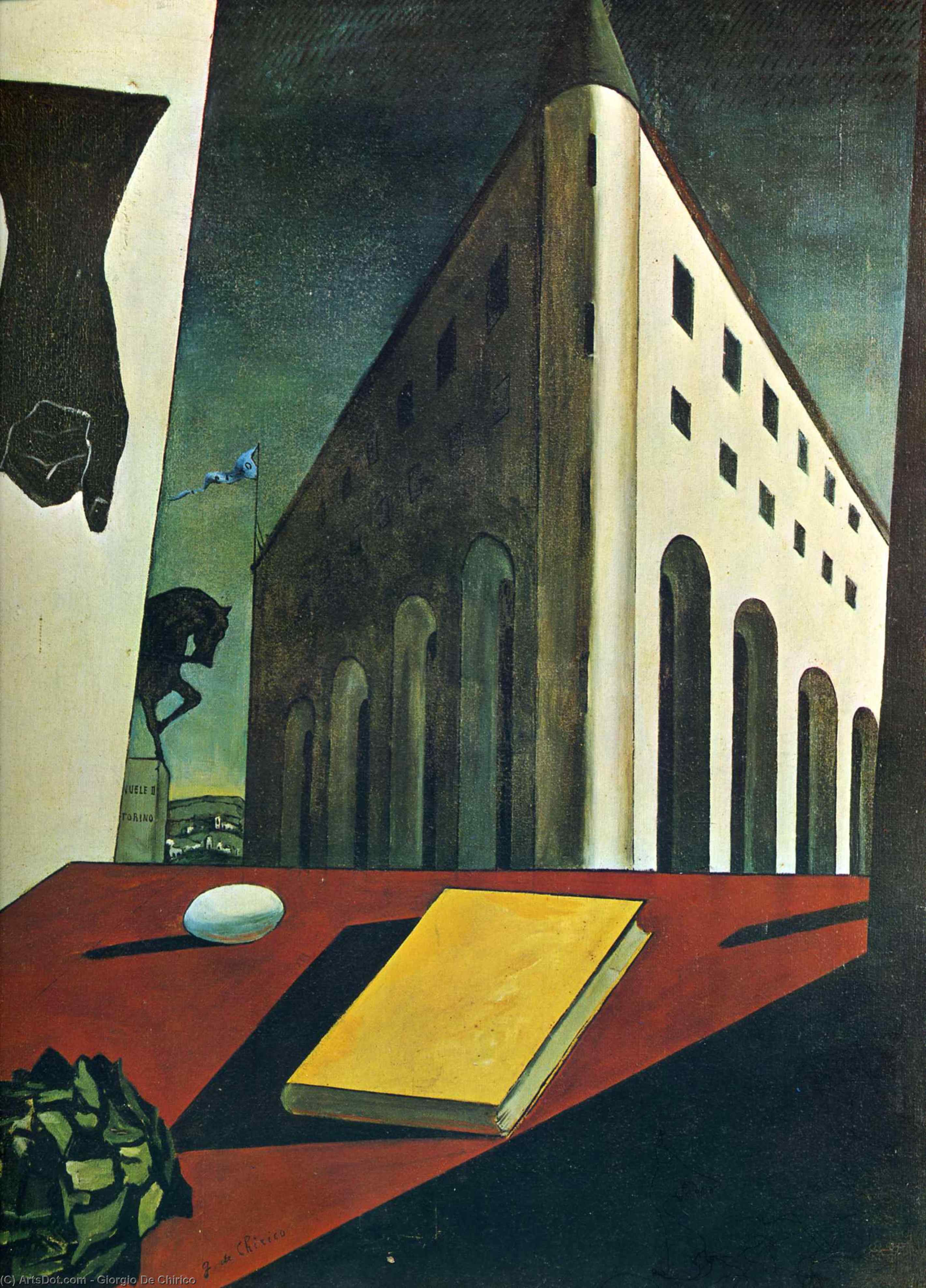
          Turin Spring (1914) — Giorgio de Chirico
          Plate 12

          Turin Spring

          1914 · original 124 x 99 cm
          Technique
          Hand-painted oil on linen canvas
          Made
          To order, by a trained painter
          Sizes
          From 27 × 37 cm, any size up to 250 cm
          Delivery
          Worldwide, about 5 weeks
          from$200 Commission this plate
          Piazza d — Giorgio de Chirico
          Plate 13

          Piazza d

          Legion of Honor, San Francisco · original 59 x 49 cm
          Technique
          Hand-painted oil on linen canvas
          Made
          To order, by a trained painter
          Sizes
          From 29 × 35 cm, any size up to 250 cm
          Delivery
          Worldwide, about 5 weeks
          from$200 Commission this plate
          Melancholy and Mystery of a street — Giorgio de Chirico
          Plate 14

          Melancholy and Mystery of a street

          Technique
          Hand-painted oil on linen canvas
          Made
          To order, by a trained painter
          Sizes
          From 29 × 35 cm, any size up to 250 cm
          Delivery
          Worldwide, about 5 weeks
          from$200 Commission this plate
          The Double Dream of Spring (1915) — Giorgio de Chirico
          Plate 15

          The Double Dream of Spring

          1915 · original 56 x 54 cm
          Technique
          Hand-painted oil on linen canvas
          Made
          To order, by a trained painter
          Sizes
          From 31 × 32 cm, any size up to 250 cm
          Delivery
          Worldwide, about 5 weeks
          from$200 Commission this plate
          Plaza de Italia with equestrian statue — Giorgio de Chirico
          Plate 16

          Plaza de Italia with equestrian statue

          Technique
          Hand-painted oil on linen canvas
          Made
          To order, by a trained painter
          Sizes
          From 29 × 35 cm, any size up to 250 cm
          Delivery
          Worldwide, about 5 weeks
          from$200 Commission this plate
          The Anguish of Departure (1914) — Giorgio de Chirico
          Plate 17

          The Anguish of Departure

          1914 · original 85 x 69 cm
          Technique
          Hand-painted oil on linen canvas
          Made
          To order, by a trained painter
          Sizes
          From 28 × 35 cm, any size up to 250 cm
          Delivery
          Worldwide, about 5 weeks
          from$200 Commission this plate
          untitled (7781) — Giorgio de Chirico
          Plate 18

          untitled (7781)

          Technique
          Hand-painted oil on linen canvas
          Made
          To order, by a trained painter
          Sizes
          From 34 × 29 cm, any size up to 250 cm
          Delivery
          Worldwide, about 5 weeks
          from$200 Commission this plate
          untitled (9996) — Giorgio de Chirico
          Plate 19

          untitled (9996)

          Technique
          Hand-painted oil on linen canvas
          Made
          To order, by a trained painter
          Sizes
          From 28 × 36 cm, any size up to 250 cm
          Delivery
          Worldwide, about 5 weeks
          from$200 Commission this plate
          The Enigma of a Day — Giorgio de Chirico
          Plate 20

          The Enigma of a Day

          Technique
          Hand-painted oil on linen canvas
          Made
          To order, by a trained painter
          Sizes
          From 27 × 36 cm, any size up to 250 cm
          Delivery
          Worldwide, about 5 weeks
          from$200 Commission this plate
          untitled (9526) — Giorgio de Chirico
          Plate 21

          untitled (9526)

          Technique
          Hand-painted oil on linen canvas
          Made
          To order, by a trained painter
          Sizes
          From 34 × 30 cm, any size up to 250 cm
          Delivery
          Worldwide, about 5 weeks
          from$200 Commission this plate
          An Amazon (1913) — Giorgio de Chirico
          Plate 22

          An Amazon

          1913
          Technique
          Hand-painted oil on linen canvas
          Made
          To order, by a trained painter
          Sizes
          From 29 × 35 cm, any size up to 250 cm
          Delivery
          Worldwide, about 5 weeks
          from$200 Commission this plate
          The Nostalgia of the Infinite (1913) — Giorgio de Chirico
          Plate 23

          The Nostalgia of the Infinite

          1913 · original 123 x 52 cm
          Technique
          Hand-painted oil on linen canvas
          Made
          To order, by a trained painter
          Sizes
          From 21 × 47 cm, any size up to 250 cm
          Delivery
          Worldwide, about 5 weeks
          from$200 Commission this plate
          untitled (3704) — Giorgio de Chirico
          Plate 24

          untitled (3704)

          Technique
          Hand-painted oil on linen canvas
          Made
          To order, by a trained painter
          Sizes
          From 25 × 39 cm, any size up to 250 cm
          Delivery
          Worldwide, about 5 weeks
          from$200 Commission this plate
          The Uncertainty of the Poet — Giorgio de Chirico
          Plate 25

          The Uncertainty of the Poet

          Technique
          Hand-painted oil on linen canvas
          Made
          To order, by a trained painter
          Sizes
          From 29 × 34 cm, any size up to 250 cm
          Delivery
          Worldwide, about 5 weeks
          from$200 Commission this plate
          Portrait of Giorgio de Chirico
          The artist

          Giorgio de Chirico

          The Life of Giorgio de Chirico

          Born on 10 July 1888 in Volos, Greece, Giuseppe Maria Alberto Giorgio de Chirico entered a world shaped by movement and diverse roots. His father, Evaristo de Chirico, worked as an engineer, a profession that often required the family to relocate. His mother, Gemma Cervetto, was a Genoese baroness with Greek origins from Smyrna. This blend of identities meant that Giorgio de Chirico grew up as a Greek-born Italian, a distinction that would follow him throughout his life as an artist and writer.

          The family dynamic was one of intellectual and creative energy. His brother, Andrea Francesco Alberto, would eventually find his own way in the world of letters and music, adopting the pseudonym Alberto Savinio. While the family's life was influenced by his father's professional commitments, the foundations of Giorgio de Chirico's own path were being laid in the Mediterranean, amidst the classical atmosphere of his birthplace.

          Early Life, Family and Training

          Born in Volos, Greece, in 1888, Giorgio de Chirico grew up in a family shaped by movement and diverse roots. His father, Evaristo, was a Sicilian engineer, while his mother, Gemma, was a Genoese woman of Greek origins from Smyrna. This blend of identities meant his early years were spent in a household where different cultures met. The family eventually moved to Germany following his father's death in 1905, a transition that would later influence his perspective on the world.

          His formal training began in his birthplace. Starting around 1900 or 1903, he studied drawing and painting at the Athens Polytechnic. These early lessons provided him with a firm grounding in traditional techniques, teaching him the discipline required for precise representation. It was during this period that he first began to express himself through art, creating a simple still life of lemons that marked the beginning of his creative life.

          The search for deeper instruction eventually led him to the Academy of Fine Arts in Munich. In this new environment, he studied under Gabriel von Hackl and Carl von Marr. The academic rigor of Munich, combined with the intellectual atmosphere of pre-war Europe, helped shape the technical skills he would later use to explore much more complex and unsettling subjects.

          The Formative Years in Munich

          The loss of his father in 1906 changed the course of the family's life, leading them to relocate to Germany. In Munich, the young artist entered the Academy of Fine Arts, where his surroundings began to shape his internal world. He spent much of his time absorbing the heavy, symbolic imagery of Arnold Böcklin and Max Klinger. These artists offered a way to look at the world that felt deeply connected to the subconscious, moving away from the simple representation of objects toward something more mysterious.

          His studies were not limited to the canvas. He spent many hours reading the works of Friedrich Nietzsche, Arthur Schopenhauer, and Otto Weininger. Their ideas regarding the irrationality of human desire and the subjective nature of reality stayed with him, providing a philosophical weight to his visual explorations. This period was a time of intense intellectual and creative gathering, where the boundaries of what he could paint began to expand through the influence of these thinkers.

          The impact of his German education is visible in his early output. His 1909 painting, The Dying Centaur, carries the clear influence of Böcklin’s style. It shows a young man finding his way through the tension between classical tradition and a new, unsettling way of seeing. This era in Munich provided the tools and the ideas that would eventually allow him to look at a simple square or a lonely statue and see something much deeper.

          The Birth of Metaphysical Art

          Around 1909, a new way of seeing began to take shape in his work, a style he called “Metaphysical” art. This was not a sudden change but a slow emergence of something strange and quiet. When he moved to Florence in 1910, the atmosphere of the city left a mark on him. He found himself drawn to the simplicity of Giotto and the qualities of primitive Tuscan painting. These influences helped him move away from the heavy academic traditions he had learned earlier, allowing him to explore a more stripped-back, unsettling reality.

          A significant moment in this development happened during a visit to Piazza Santa Croce. The experience there stayed with him, eventually finding its way onto the canvas in The Enigma of an Autumn Afternoon. His metaphysical period lasted from 1909 to 1919, a decade where he sought to capture the hidden, often lonely, essence of the world. He eventually founded the scuola metafisica art movement, a group that shared this interest in the profound stillness and the mystery found within everyday spaces.

          • The Enigma of an Autumn Afternoon
          • The Enigma of the Oracle
          • The Enigma of the Hour

          The Paris Years and Surrealist Connections

          In July 1911, Giorgio de Chirico moved to Paris, a city that would become a central stage for his developing vision. He was no stranger to the intellectual currents of the time, but the atmosphere of the French capital offered a new kind of energy. During these years, he met the poet Guillaume Apollinaire, a figure who would become a significant presence in his life. By 1913, his presence in the Parisian art scene was hard to ignore, as he caught the attention of Pablo Picasso and Apollinaire. These encounters placed him at the heart of a shifting cultural landscape, where the boundaries of what could be depicted on canvas were being constantly tested.

          His professional standing grew as he navigated the complex networks of the art market. In 1914, he signed a contract with the art dealer Paul Guillaume, a move that solidified his place among the avant-garde. This period was marked by a sense of rapid movement and connection, as he moved through the circles of the most influential thinkers and creators of the era. His time in Paris was not merely a stay in a new city, but a period of intense engagement with the ideas that would eventually shape the Surrealist movement. He was part of a generation that looked at the familiar and saw something much stranger beneath the surface.

          Technique and Metaphysical Style

          De Chirico’s approach to painting was a way of looking past the surface of the everyday to find a hidden, unsettling poetry. His metaphysical works often feel suspended in time, characterized by an eerie stillness that makes the viewer feel as though they have stepped into a quiet, lonely dream. He achieved this through a deliberate use of long, dramatic shadows that stretch across empty spaces, creating a sense of heavy, expectant silence. The light in these scenes often feels unnatural, casting a glow that does not quite match the stillness of the objects it touches.

          The way he organized space was intentionally confusing. He utilized illogical perspectives and forced perspective to create an illusionistic space that defies natural laws. This technique makes the architecture of his town squares feel both massive and strangely distant. He frequently placed classical architecture alongside unsettling elements, such as looming statues or faceless mannequins, to create a sense of tension. These figures often appear as hollow shells, adding to the feeling of isolation and the mystery of the human condition. By juxtaposing these familiar yet strange objects, he invited a sense of nostalgia and a feeling of being alone in a world of riddles.

          • The Enigma of an Autumn Afternoon
          • The Song of Love
          • The Red Tower
          • The Uncertainty of the Poet

          Key Works of the Artist

          In the early years of his career, de Chirico began to develop the visual language that would define his reputation. In 1910, he produced The Enigma of the Oracle, a work that signaled his growing interest in the strange and the unexplained. By 1913, his presence in the art world was felt in London, where The Uncertainty of the Poet was exhibited at the Tate Gallery. These early pieces often relied on a sense of stillness, using empty spaces to create a feeling of quiet tension.

          As his style matured, the imagery became even more peculiar. He painted The Song of Love in 1914, a piece that captures the unsettling atmosphere of his metaphysical period. Later, in 1916, he created The Jewish Angel, which is now held in the collection of the Metropolitan Museum of Art in New York. This period of his life was marked by a fascination with how classical forms could feel out of place in a modern, lonely setting.

          By the time he reached the 1920s, his approach to subject matter began to shift. In 1922, he completed The Prodigal Son, a work that reflects his transition toward a more classical style. This painting uses a mannequin to represent the son, placing a familiar biblical theme into a strange, stone-like reality. His output during these decades shows a man constantly re-examining the relationship between the visible world and the hidden thoughts of the mind.

          Later Style and Neoclassicism

          By 1919, the unsettling, dreamlike logic that had defined his earlier work began to recede. De Chirico moved away from the metaphysical approach that had once been his signature, turning instead toward a more traditional way of seeing. He embraced a neoclassical and neo-baroque style, seeking a different kind of order in his compositions. This was not a complete abandonment of his past, but rather a way of revisiting his old themes through a new aesthetic lens. He looked back at the subjects that had once haunted his canvases, yet he rendered them with a different sensibility, focusing on a more structured and classical sense of form.

          This shift in his artistic direction became clearly visible in the 1920s. His work during this period began to favor the clarity and weight of classical traditions over the illogical perspectives of his youth. A significant example of this transition is his painting The Prodigal Son, which marks the moment he began to essay this new neoclassical direction. In this work, the subject is interpreted through a lens of stone-like figures, blending his interest in the classical with his ongoing fascination with the mannequin-like form.

          • The Prodigal Son (1922)

          Legacy and Influence on Surrealism

          The ripples from de Chirico’s metaphysical explorations reached far beyond the quiet, shadowed squares he painted. His work acted as a vital precursor to the Surrealist movement, offering a new way to look at the world through the lens of the subconscious. By stripping away the logic of everyday life, he provided a visual language that others would later adopt to explore the irrational. Artists like René Magritte and Salvador Dalí found deep inspiration in his metaphysical paintings, drawing on his ability to create tension through unexpected juxtapositions and distorted perspectives.

          This influence was not limited to the Surrealists alone. His approach to depicting reality with a heightened sense of mystery and psychological depth also left a mark on the Magic Realism movement. He showed that the mundane could hold a hidden, unsettling weight if viewed from the right angle. His ability to manipulate space and shadow helped shape how subsequent generations approached the relationship between the visible world and the internal mind.

          Even as his own style shifted in later years, his standing in the art world remained significant. In 1974, he was elected to the French Académie des Beaux-Arts, a recognition of the profound impact his vision had on the trajectory of modern art. His legacy lives on in the way we perceive the strange, quiet corners of our own reality.

          Later Years and Death

          As the decades passed, the personal life of Giorgio de Chirico underwent significant changes. In 1925, he married the Russian dancer Raissa Gurievich. This union was followed by another marriage in 1930, when he wed Isabella Pakszwer Far. These chapters of his life occurred as he continued to navigate the shifting currents of the European art scene, moving between different aesthetic sensibilities and maintaining a presence in the cultural centers of the continent.

          The final years of his life were spent in Italy. He passed away on 20 November 1978 in Rome, Italy. His presence in the city remained a part of its history long after his death. In 1992, his remains were moved to the church of San Francesco a Ripa, Rome, providing a final resting place for the man who had spent so much of his life exploring the quiet, strange spaces of the human mind.

          Questions & Answers

          Where are Giorgio de Chirico's artworks grouped by art movement?

          The All Movements page groups Giorgio de Chirico's artworks by art movement.

          Can I browse Giorgio de Chirico's works by color palette?

          The By Palettes page groups Giorgio de Chirico's artworks by their color palettes.

          How is Giorgio de Chirico's career divided into periods?

          The Chronicle of Giorgio de Chirico is a scroll-driven timeline that presents the artist's works in chronological order, grouped into career-period chapters.

          By the OriginalUniqueArt.com Editorial Team Updated Oct. 13, 2026
          Giorgio de Chirico
          Quick facts
          • Top-ranked workThe Child's Brain
          • Copyright statusUnder copyright
          • Room fitliving room
          • Corpus themesnietzschean philosophy, classical symbolism, existential angst, alienation, symbolism
          • Mediumsacrylic on canvas, oil on canvas
          • Died1978
          • Also known asGiuseppe Maria Alberto Giorgio De Chirico
          • Works on APS385
          Collector's quiz
          1. In which city did Giorgio de Chirico study at the Academy of Fine Arts?

          2. Which philosopher's writings were influential to de Chirico's artistic vision?

          3. What was the name of the art movement founded by de Chirico?

          4. Where was Giorgio de Chirico born?

          5. Which artist's works deeply resonated with de Chirico during his time in Munich?

          one You choose the size

          Standard formats or any custom dimension, matched to the proportions of the original.

          two We paint and send a preview

          A photo of the finished canvas for your approval before it is shipped.

          three Delivered, certified

          Rolled, stretched or framed, insured, with a certificate of authenticity.

          Commission your Giorgio de Chirico

          Every painting by Giorgio de Chirico in our catalog can be painted to order, in the size that suits the room.

          All artworks by Giorgio de Chirico
          Unique by definition◆ Once sold, gone forever◆ What you hang, no one else can◆ Miss it, lose it forever◆ Art that belongs to one◆ Straight from the studio◆ Yours and no one else's◆ Exclusive artists◆ One artwork, one owner, no copies◆ One artist, one canvas, one story◆ Unique by definition◆ Once sold, gone forever◆ What you hang, no one else can◆ Miss it, lose it forever◆ Art that belongs to one◆ Straight from the studio◆ Yours and no one else's◆ Exclusive artists◆ One artwork, one owner, no copies◆ One artist, one canvas, one story◆
          Original Unique Art

          Some art should belong to one person only. At OriginalUniqueArt, every piece is an original creation from our exclusive artists — sold once, never repeated, and available nowhere else. Choose paint or print, with an optional NFT to certify what's yours alone. For collectors and investors who value true rarity, this is where uniqueness lives. Claim your one-of-a-kind original before someone else does.

          Email WhatsApp Telegram Viber
          Facebook Twitter Pinterest Instagram
          Originals & Editions
          • Exclusive Studio Creations
          • Art Auctions
          • Browse by Collection
          • Artist Editions
          • All Artworks
          Collecting
          • Free Artwork Appraisal
          • My Collection
          • Art Collecting 101
          • Art as an Investment
          • Provenance: The Story of Ownership
          • Certificates of Authenticity Explained
          • All Articles
          • Museums & Collections
          Services
          • Commission an Original
          • Order an Art Print
          • Corporate Commissions
          • Free Art Consultation
          • Get Free Art Suggestions
          • Sell a Unique Original
          • Our Creation Process
          • Subscribe to our Newsletter
          Company
          • About Us
          • FAQs
          • Collector Reviews
          • Global Statistics
          • My Dashboard, Favorites, Orders
          • Shipping & Returns
          • Terms & Conditions
          • Privacy Policy
          • Contact Us
          Original Unique Art
          Original Unique Art Every piece is sold a single time. No copies can exist.
          © 2026 OriginalUniqueArt.com
          Complete collection index
          O Studio assistant Online · replies in a minute
          Hi! I can help you pick an artwork, track an order, or answer warranty questions. What brings you here?
          Prefer a human? Email us WhatsApp Viber