Portrait of Georges D'Espagnat

Georges D'Espagnat Paintings: The 50 Most Famous, Through a Gallery's Eye

Updated October 2026 · ranked by our popularity score (searches, visits and orders for each work) · 50 works by Georges D'Espagnat in our catalogue

In short

To the gallery's eye, Georges D'Espagnat's most famous painting is Untitled (A Set of Seven Decorative Panels) (1900). Tuna Vessels Saint-gilles Croix De Vié and Girl Painting at an Easel (1910) complete the trio every eye recognises. Of the 50 works by Georges D'Espagnat in our catalog, the gallery presents the 50 most famous below, each original with its year, its museum and what makes it unique.

1870 – 1950, Melun Impressionism Most works: Petit Palais

The gallery's top 10 Georges D'Espagnat paintings

1
Untitled (A Set of Seven Decorative Panels) (1900) by Georges D'Espagnat

Untitled (A Set of Seven Decorative Panels)

1900 · Painting

A set of seven decorative panels captures a quiet moment of feminine connection. Within the composition, two women occupy the foreground; one sits upon a bench while the other stands beside her, their long dresses suggesting a bygone era of formal grace. A third figure lingers in the background, partially obscured, adding a layer of depth to the social tableau. The arrangement of figures creates a sense of private conversation,…

2
Tuna Vessels Saint-gilles Croix De Vié by Georges D'Espagnat

Tuna Vessels Saint-gilles Croix De Vié

Oil On Canvas

The artwork Tuna Vessels Saint-gilles Croix De Vié is an impressionistic oil painting on canvas that captures a lively harbor scene. The composition is horizontally oriented, featuring a horizon line positioned near the center of the frame. In the foreground, several figures are situated near smaller boats, while the midground is occupied by larger vessels and various activities. The background shows additional boats receding into the distance, which creates a…

3
Girl Painting at an Easel (1910) by Georges D'Espagnat

Girl Painting at an Easel

1910 · Oil

In this 1910 work, we find ourselves in a private, domestic space where time seems to have slowed. A woman sits before an easel, her attention entirely consumed by the canvas before her. There is a profound sense of focus in her posture, a stillness that suggests the world outside the room has ceased to exist. On the dining table nearby, a simple arrangement of two apples and a vase…

4
Woman Reading by Georges D'Espagnat

Woman Reading

Oil On Canvas

We are looking at Woman Reading, a work by the French artist Georges D'Espagnat. This piece offers a quiet glimpse into the artist's ability to capture a private, domestic moment. D'Espagnat was born in Melun in 1870 and spent much of his life immersed in the French art scene, eventually passing away in Paris in 1950.

9
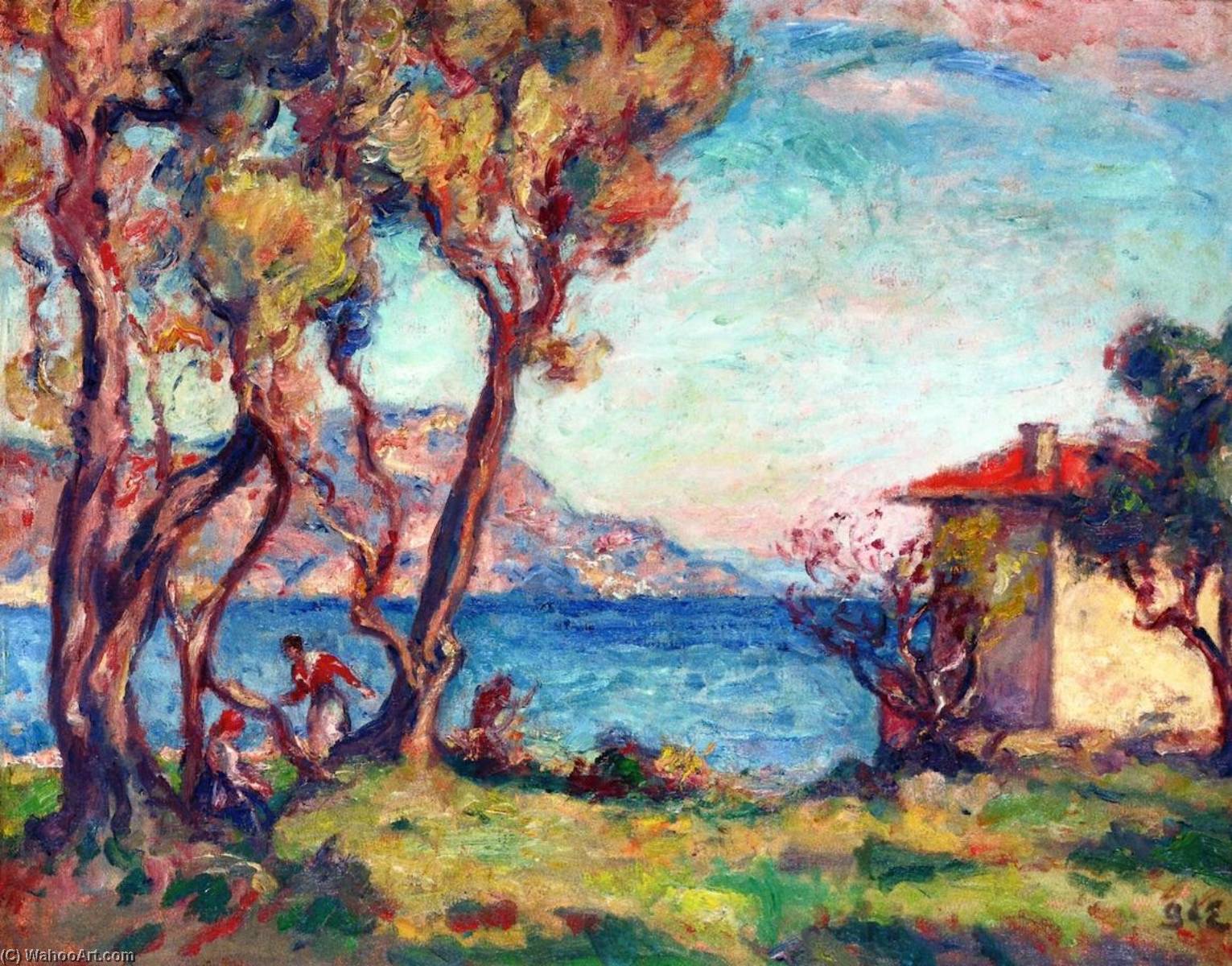
Maisonette by the Sea (1900) by Georges D'Espagnat

Maisonette by the Sea

1900

The painting Maisonette by the Sea is a beautiful depiction of a house by the sea with trees in the background, created by the French artist Georges Despagnat in 1900. This oil on canvas piece measures 66 x 82 cm and is a prime example of Impressionism. The scene features a man standing near a tree, possibly enjoying the view or taking a break from his work. There are several…

Georges D'Espagnat paintings, ranked 11 to 50

The subjects that held Georges D'Espagnat's eye

The four subjects that come back most often in these originals, each with its finest example.

The museums that keep Georges D'Espagnat's originals

The 4 museums that hold the most of the paintings on this page.

Museum City Works by Georges D'Espagnat Paintings from this list
Petit Palais, ParisPetit Palais Paris 2 Woman and Children in an Orchard: Sketch for the Cloister of the Girls' School of Avenue Simon-Bolivar, 19th Arrondissement of Paris, The Sewing: Sketch for the cloister of the girls' school on avenue Simon-Bolivar, 19th arrondissement of Paris
Wallraf-Richartz-Museum, CologneWallraf-Richartz-Museum Cologne 1 Garden in Verneuil
Royal Museums of Fine Arts of Belgium, BrusselsRoyal Museums of Fine Arts of Belgium Brussels 1 Portrait Of Andrée
Dallas Museum of Art, DallasDallas Museum of Art Dallas 1 Jeune Fille Assise

Georges D'Espagnat, one signature painting per decade

Works per decade

Pick a decade to see the original that defines it.

Georges D'Espagnat's paintings: the gallery answers

Which Georges D'Espagnat painting is the most famous of all?Reveal the answer

Untitled (A Set of Seven Decorative Panels) (1900). Tuna Vessels Saint-gilles Croix De Vié and Girl Painting at an Easel (1910) come next.

How old was Georges D'Espagnat on completing Untitled (A Set of Seven Decorative Panels)?Reveal the answer

30 years old: Untitled (A Set of Seven Decorative Panels) dates from 1900, and Georges D'Espagnat was born in 1870.

Which are Georges D'Espagnat's top 10 paintings?Reveal the answer

Untitled (A Set of Seven Decorative Panels), Tuna Vessels Saint-gilles Croix De Vié, Girl Painting at an Easel, Woman Reading, Femmes et enfants dans la terrasse du moulin de Beaulieu à Villennes sur Seine, Woman and Child, Woman and Children in an Orchard: Sketch for the Cloister of the Girls' School of Avenue Simon-Bolivar, 19th Arrondissement of Paris, The Sewing: Sketch for the cloister of the girls' school on avenue Simon-Bolivar, 19th arrondissement of Paris, Maisonette by the Sea and Naked Styling. The ranking above gives each one's year and museum.

How many works did Georges D'Espagnat create?Reveal the answer

Our catalog holds 50 works by Georges D'Espagnat, dated from 1893 to 1933.

Where do Georges D'Espagnat's most famous originals hang?Reveal the answer

Mostly in Petit Palais (Paris), Wallraf-Richartz-Museum (Cologne) and Royal Museums of Fine Arts of Belgium (Brussels). The museum table above lists them all.

When did Georges D'Espagnat create the most famous paintings?Reveal the answer

In 1900s: 10 of the 50 works on this page were made then, Untitled (A Set of Seven Decorative Panels) among them.

Which are Georges D'Espagnat's earliest and latest famous works?Reveal the answer

On this page, the earliest is Garden in Verneuil (1893) and the latest Woman and Children in an Orchard: Sketch for the Cloister of the Girls' School of Avenue Simon-Bolivar, 19th Arrondissement of Paris (1933).

Which subjects did Georges D'Espagnat return to most?Reveal the answer

Flowers (7), Vase (6) and Women (5), across the 50 works on this page.

Which medium did Georges D'Espagnat work in most?Reveal the answer

Oil On Canvas, for 2 of the 50 works on this page.

Which movement is Georges D'Espagnat associated with?Reveal the answer

Impressionism and Post-impressionism, judging by the originals on this page.

Which Georges D'Espagnat originals does the Petit Palais hold?Reveal the answer

Woman and Children in an Orchard: Sketch for the Cloister of the Girls' School of Avenue Simon-Bolivar, 19th Arrondissement of Paris and The Sewing: Sketch for the cloister of the girls' school on avenue Simon-Bolivar, 19th arrondissement of Paris: the Petit Palais, Paris holds 2 of the works on this page.

Georges D'Espagnat: the artist

A Legacy of Light: The Life and Art of Georges D’Espagnat

In the vibrant tapestry of late 19th and early 20th-century French art, few figures embody the transition from tradition to modernity as gracefully as Georges D’Espagnat. Born in Melun in 1870, D’Espagnat was destined for a life steeped in the aesthetics of beauty. His father’s establishment of the legendary Durand-Ruel Gallery provided him with an unparalleled window into the evolution of modernism, placing him at the very heart of the Parisian art world. This early exposure allowed him to witness the shifting tides of art history firsthand, fostering a unique perspective that would later allow him to bridge the gap between the rugged realism of the Barbizon School and the luminous, fleeting sensations of Impressionism.

D’Espiente's artistic journey was one of profound synthesis. While his formative years were shaped by the heavy, honest depictions of rural life championed by masters like Gustave Courbet and Jean-François Millet, his heart gravitated toward a more lyrical and atmospheric expression. He moved to Paris in 1888, where he began an autonomous training process, occasionally guided by painters such as Gustave-Claude-Etienne Courtois. His style eventually blossomed into a sophisticated Post-Impressionist language, heavily indebted to the soft, dappled light of Pierre-Auguste Renoir and the delicate textures of Alfred Sisley. This stylistic duality—the structural integrity of realism paired with the emotive power of color—became the hallmark of his oeuvre.

Mastery of Subject and Spirit

The breadth of D’Espagnat’s subject matter reflects a deep, abiding reverence for both the human form and the natural world. His landscapes are not merely topographical records but emotional evocations of the French countryside. In works such as his 1900 masterpiece "Landscape," one can observe how loose, dancing brushstrokes create an illusion of movement, capturing the very essence of a passing breeze or the shifting sunlight. His ability to convey tranquility through vibrant hues and textured applications allows the viewer to step directly into a serene, natural moment.

Beyond the horizon of nature, D’Espagnat explored the intimacy of the human experience through his nudes and domestic scenes. His depictions of the human form are celebrated for their anatomical precision, yet they are never clinical; instead, they possess a graceful, poetic quality achieved through subtle shading and soft light. This tenderness extends to his genre paintings, such as "Femmes et enfants dans la terrace du moulin de Beaulieu à Villennes sur Seine," where he captures the quiet magic of family life within lush, verdant gardens. Whether painting a still life like the vibrant "Red Flowers and Fruit" or a tender maternal moment in "Woman and Child," his work remains anchored by a palpable sense of atmosphere and emotion.

Historical Significance and Lasting Influence

D’Espagnat was far more than a painter; he was a vital participant in the cultural fabric of his era. His career saw him exhibiting in the prestigious Salon des Refusés and later contributing to the very foundation of the Salon d’Automne, where he eventually served as vice-president. His intellectual reach extended into literature and scenography, as he illustrated works by renowned authors such as Alphonse Daudet and Rémy de Gourmont, proving that his artistic vision was deeply intertwined with the broader literary movements of France.

Today, the historical importance of Georges D’Espagnat is cemented by the presence of his works in the world's most esteemed institutions. His legacy lives on through collections such as:

  • The Musée d’Orsay in Paris, which preserves his contributions to the French Impressionist tradition.
  • The Metropolitan Museum of Art in New York, showcasing his international reach.
  • The Art Institute of Chicago, where his mastery of light and form continues to inspire.
  • The Museo Thyssen-Bornemisza, highlighting his place among the significant exponents of Post-Impressionism.

As we look back on a life that spanned from the height of the Barbizon influence to the dawn of modern abstraction, D’Espagnat remains a luminous figure. He taught us that art could honor the weight of tradition while embracing the ephemeral beauty of the present moment, leaving behind a body of work that continues to breathe with light and life.