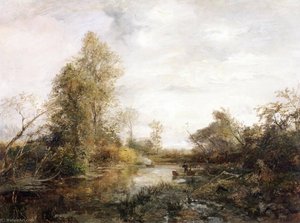
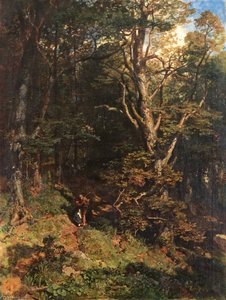
Portrait of Emil Jakob Schindler

The 71 Most Famous Emil Jakob Schindler Paintings, a Gallery Selection

Updated November 2026 · ranked by our popularity score (searches, visits and orders for each work) · 74 works by Emil Jakob Schindler in our catalogue

In short

Of all the originals Emil Jakob Schindler left, the most famous is Aus dem Prater (The Prater Gardens) (1870). Close behind it come Garden in Plankenberg (1886) and Mountain Stream in the Ramau (1868). Our catalog holds 74 works by Emil Jakob Schindler; the gallery has kept the 71 the world admires most, each shown with its date, its museum and its story.

1842 – 1892, Vienna Impressionism Most works: Austrian Gallery Belvedere

Emil Jakob Schindler's top 10 paintings: the gallery's choice

1
Aus dem Prater (The Prater Gardens) (1870) by Emil Jakob Schindler

Aus dem Prater (The Prater Gardens)

1870 · Oil On Canvas

In Aus dem Prater (The Prater Gardens), Emil Jakob Schindler presents a quiet, rural landscape that invites a slow, steady observation. The composition is anchored by a central grouping of trees and figures, where a small group of people is engaged in what appears to be agricultural work. This focal point is set against a vast expanse of grassy land that stretches toward a distant horizon. The perspective is somewhat…

2
Garden in Plankenberg (1886) by Emil Jakob Schindler

Garden in Plankenberg

1886 · Oil On Canvas

The sunlight filters through a dense canopy in Garden in Plankenberg, a landscape that captures a quiet moment within a lush, secluded sanctuary. This oil painting, created by the Austrian artist Emil Jakob Schindler, invites the viewer into a verdant world where nature feels both intimate and vast. The scene unfolds around a winding dirt path that draws the eye toward a solitary figure, creating a sense of peaceful immersion…

3
Mountain Stream in the Ramau (1868) by Emil Jakob Schindler

Mountain Stream in the Ramau

1868 · Oil · Austrian Gallery Belvedere, Vienna

The painting Mountain Stream in the Ramau emerges from the brush of Emil Jakob Schindler, a landscape artist who captures the essence of the natural world. This work, dating to about 1868, invites a close look at the delicate interplay of light and water. The scene feels alive, as if the mountain air is still moving through the trees and over the stones of the stream.

The Emil Jakob Schindler selection continues, 11 to 71

11Village Landscape with Sheep (1875) by Emil Jakob SchindlerVillage Landscape with Sheep1875 12On the Thaya near Lundenburg II (1878) by Emil Jakob SchindlerOn the Thaya near Lundenburg II1878 13Forest Interior with Woman and Cows (1874) by Emil Jakob SchindlerForest Interior with Woman and Cows1874 14On the Thaya near Lundenburg (Břeclav) I (1877) by Emil Jakob SchindlerOn the Thaya near Lundenburg (Břeclav) I1877 15Landscape with figures + sheep (1874) by Emil Jakob SchindlerLandscape with figures + sheep1874 16peasant house in rocky landscape (1874) by Emil Jakob Schindlerpeasant house in rocky landscape1874 17Motif from the Vienna Prater (Krieau) (1876) by Emil Jakob SchindlerMotif from the Vienna Prater (Krieau)1876 18Grazing Cattle in Holland (1875) by Emil Jakob SchindlerGrazing Cattle in Holland1875 · Austrian Gallery Belvedere 19Moonrise in the Prater Meadows (1878) by Emil Jakob SchindlerMoonrise in the Prater Meadows1878 · Austrian Gallery Belvedere 20Scene near Haslau an der Donau (1879) by Emil Jakob SchindlerScene near Haslau an der Donau1879 21Stream in the Wienerwald (1884) by Emil Jakob SchindlerStream in the Wienerwald1884 22Moorland Landscape near Lundenburg (1882) by Emil Jakob SchindlerMoorland Landscape near Lundenburg1882 23Hackinger Au (1880) by Emil Jakob SchindlerHackinger Au1880 24Spring in Hacking (1883) by Emil Jakob SchindlerSpring in Hacking1883 25Nature Study from Goisern (1883) by Emil Jakob SchindlerNature Study from Goisern1883 26Vegetable garden in Plankenberg in September (1885) by Emil Jakob SchindlerVegetable garden in Plankenberg in September1885 · Bavarian State Painting Collections 27The studio of the painter Heinrich von Angeli in Reichenau (1884) by Emil Jakob SchindlerThe studio of the painter Heinrich von Angeli in Reichenau1884 28Weißenkirchen on the Danube (1879) by Emil Jakob SchindlerWeißenkirchen on the Danube1879 29From Haslau on the Danube (1879) by Emil Jakob SchindlerFrom Haslau on the Danube1879 30The Heustadlwasser in the Prater (1879) by Emil Jakob SchindlerThe Heustadlwasser in the Prater1879 31In the Garden at Schloss Niederweiden (1885) by Emil Jakob SchindlerIn the Garden at Schloss Niederweiden1885 32March Atmosphere Early Spring in the Vienna Woods (1884) by Emil Jakob SchindlerMarch Atmosphere Early Spring in the Vienna Woods1884 · Austrian Gallery Belvedere 33Flower Garden in Weissenkirchen (1879) by Emil Jakob SchindlerFlower Garden in Weissenkirchen1879 · Oberösterreichisches Landesmuseum 34Meadow in Hacking (1880) by Emil Jakob SchindlerMeadow in Hacking1880 · Austrian Gallery Belvedere 35Gosau Mill near Ischl (1883) by Emil Jakob SchindlerGosau Mill near Ischl1883 · Austrian Gallery Belvedere 36February Atmosphere Early Spring in the Vienna Woods (1884) by Emil Jakob SchindlerFebruary Atmosphere Early Spring in the Vienna Woods1884 · Austrian Gallery Belvedere 37In March (1888) by Emil Jakob SchindlerIn March1888 · Bavarian State Painting Collections 38Coastal Landscape in Dalmatia (1890) by Emil Jakob SchindlerCoastal Landscape in Dalmatia1890 39The Cemetery near Gravosa near Ragusa (Study for Pax) (1887) by Emil Jakob SchindlerThe Cemetery near Gravosa near Ragusa (Study for Pax)1887 40Turnip Field (1888) by Emil Jakob SchindlerTurnip Field1888 41Autumn Landscape by the River (1887) by Emil Jakob SchindlerAutumn Landscape by the River1887 42Seacoast of Sylt (1892) by Emil Jakob SchindlerSeacoast of Sylt1892 43The Ionian Sea near Corfu (1888) by Emil Jakob SchindlerThe Ionian Sea near Corfu1888 44At the Tullnbach near Plankenberg (1889) by Emil Jakob SchindlerAt the Tullnbach near Plankenberg1889 45On the Dalmatian Coast near Ragusa (1888) by Emil Jakob SchindlerOn the Dalmatian Coast near Ragusa1888 46Forest Lane near Schärfling (1890) by Emil Jakob SchindlerForest Lane near Schärfling1890 · Leopold Museum 47Boulevard of Poplars near Plankenberg (1890) by Emil Jakob SchindlerBoulevard of Poplars near Plankenberg1890 · Leopold Museum 48Pax (The cemetery of Gravosa near Ragusa) (1891) by Emil Jakob SchindlerPax (The cemetery of Gravosa near Ragusa)1891 49Sawmill in the morning mist (1886) by Emil Jakob SchindlerSawmill in the morning mist1886 50Castle wall in Plankenberg (1887) by Emil Jakob SchindlerCastle wall in Plankenberg1887 51scenery with farmer's hut, cattle and women (1886) by Emil Jakob Schindlerscenery with farmer's hut, cattle and women1886 52Poplar - allee (1892) by Emil Jakob SchindlerPoplar - allee1892 53Plains Landscape near Plankenberg (1889) by Emil Jakob SchindlerPlains Landscape near Plankenberg1889 54The potato harvest (1891) by Emil Jakob SchindlerThe potato harvest1891 55Harvest Month in Plankenberg (1890) by Emil Jakob SchindlerHarvest Month in Plankenberg1890 · Austrian Gallery Belvedere 56Forest Path with Sheeps (also known as Waldweg mit Schafen) (1875) by Emil Jakob SchindlerForest Path with Sheeps (also known as Waldweg mit Schafen)1875 · Austrian Gallery Belvedere 57Mill Weir in Plankenberg (1891) by Emil Jakob SchindlerMill Weir in Plankenberg1891 · Austrian Gallery Belvedere 58Duck Hunting in the Prater (1881) by Emil Jakob SchindlerDuck Hunting in the Prater1881 · Austrian Gallery Belvedere 59Motif from the Prate Krieau (1874) by Emil Jakob SchindlerMotif from the Prate Krieau1874 · Austrian Gallery Belvedere 60Kaisermühlen on the Danube (1871) by Emil Jakob SchindlerKaisermühlen on the Danube1871 61Sawmill in Oberösterreich by Emil Jakob SchindlerSawmill in OberösterreichBavarian State Painting Collections 62On the Thaya near Lundenburg by Emil Jakob SchindlerOn the Thaya near Lundenburg 63Prater meadows in Vienna: By the pond by Emil Jakob SchindlerPrater meadows in Vienna: By the pond 64Woodland path by Emil Jakob SchindlerWoodland path 65Street near Lundenburg by Emil Jakob SchindlerStreet near Lundenburg 66The mill in the wood by Emil Jakob SchindlerThe mill in the wood 67Bosnian Refugees in Spalato Cathedral by Emil Jakob SchindlerBosnian Refugees in Spalato Cathedral 68Beim Heustadelwasser (Near the Heustadelwasser) by Emil Jakob SchindlerBeim Heustadelwasser (Near the Heustadelwasser) 69Embrace in the Forest by Emil Jakob SchindlerEmbrace in the Forest 70Aus der Ramsau by Emil Jakob SchindlerAus der Ramsau 71Scene from the Prater Ducks in a River by a Farmhouse two works by Emil Jakob SchindlerScene from the Prater Ducks in a River by a Farmhouse two works

The subjects that held Emil Jakob Schindler's eye

The four subjects that come back most often in these originals, each with its finest example.

The museums that keep Emil Jakob Schindler's originals

The 4 museums that hold the most of the paintings on this page.

Museum City Works by Emil Jakob Schindler Paintings from this list
Austrian Gallery Belvedere, ViennaAustrian Gallery Belvedere Vienna 12 Mountain Stream in the Ramau, Grazing Cattle in Holland, Moonrise in the Prater Meadows
Bavarian State Painting Collections, MunichBavarian State Painting Collections Munich 4 Park Study, Vegetable garden in Plankenberg in September, In March
Leopold Museum, ViennaLeopold Museum Vienna 2 Forest Lane near Schärfling, Boulevard of Poplars near Plankenberg
Oberösterreichisches Landesmuseum, LinzOberösterreichisches Landesmuseum Linz 1 Flower Garden in Weissenkirchen

Emil Jakob Schindler decade by decade: the original that defines each

Works per decade

Pick a decade to see the original that defines it.

Collectors' questions about Emil Jakob Schindler's paintings

Which work is Emil Jakob Schindler most famous for?Reveal the answer

Aus dem Prater (The Prater Gardens) (1870). Garden in Plankenberg (1886) and Mountain Stream in the Ramau (1868) come next.

What age was Emil Jakob Schindler when Aus dem Prater (The Prater Gardens) was made?Reveal the answer

28 years old: Aus dem Prater (The Prater Gardens) dates from 1870, and Emil Jakob Schindler was born in 1842.

What are the ten most famous Emil Jakob Schindler paintings?Reveal the answer

Aus dem Prater (The Prater Gardens), Garden in Plankenberg, Mountain Stream in the Ramau, Birth of the Forest Maidens, watermill, house at a river, Rattenberg (Tyrole) on the Inn, Water - mill at a brook, Landscape in spring, Danube steamships station and Park Study. The ranking above gives each one's year and museum.

How many paintings did Emil Jakob Schindler leave?Reveal the answer

Our catalog holds 74 works by Emil Jakob Schindler, dated from 1867 to 1892.

In which museums do Emil Jakob Schindler's masterpieces hang?Reveal the answer

Mostly in Austrian Gallery Belvedere (Vienna), Bavarian State Painting Collections (Munich) and Leopold Museum (Vienna). The museum table above lists them all.

In which years did Emil Jakob Schindler paint the most famous works?Reveal the answer

In 1880s: 25 of the 71 works on this page were made then, Garden in Plankenberg among them.

What are the first and the last famous originals of Emil Jakob Schindler?Reveal the answer

On this page, the earliest is watermill, house at a river (1867) and the latest Seacoast of Sylt (1892).

Which subjects did Emil Jakob Schindler choose most often?Reveal the answer

Landscape (4), Trees (3) and Austria (3), across the 71 works on this page.

Which technique did Emil Jakob Schindler use most?Reveal the answer

Oil On Canvas, for 5 of the 71 works on this page.

To which art movement does Emil Jakob Schindler belong?Reveal the answer

Impressionism, judging by the originals on this page.

Which Emil Jakob Schindler works hang at the Austrian Gallery Belvedere?Reveal the answer

Mountain Stream in the Ramau, Grazing Cattle in Holland and Moonrise in the Prater Meadows: the Austrian Gallery Belvedere, Vienna holds 12 of the works on this page.

Emil Jakob Schindler: life and work

Emil Jakob Schindler: Life and Legacy

Early Life and Education

  • Born: 1842 in Fischamend, Austria.
  • Schindler’s early life was marked by family tragedy; his father died when he was four years old. His mother remarried, leading to a complex family dynamic.
  • He initially pursued a military career, joining the army in 1857 and potentially participating in the Battle of Solferino.
  • In 1860, he abandoned his military aspirations and enrolled at the Academy of Fine Arts, Vienna, studying under Albert Zimmermann.

Artistic Influences and Development

  • Influenced by Dutch Masters: Schindler drew significant inspiration from 17th-century Dutch landscape painters like Meindert Hobbema and Jacob Izaaksoon van Ruisdael, adopting their atmospheric realism.
  • His early works focused on detailed depictions of nature, gradually evolving towards a more impressionistic style with looser brushwork and an emphasis on light and atmosphere.
  • Travels to Venice, Dalmatia, France, and Holland broadened his artistic horizons and provided new subject matter.

Career and Major Works

  • Schindler achieved early success with “Eine Waldschmiede” (A Forest Blacksmith), sold in 1864 shortly after his first public exhibition.
  • He established himself as a landscape painter, capturing the beauty of the Vienna Woods, the Dalmatian coast, and other scenic locations.
  • Notable Works Include: “Kaisermühlen on the Danube,” “Mountain Stream in the Ramau,” “February Atmosphere Early Spring in the Vienna Woods”, "Gosau Mill near Ischl", and “Flower Garden in Weissenkirchen”.
  • In 1885, he began renting Castle Plankenberg, establishing an artists' colony where he taught several students.
  • He received a commission from Crown Prince Rudolf of Austria to sketch coastal scenery in Dalmatia and Corfu as part of a larger project documenting the Austro-Hungarian monarchy.

Personal Life and Family

  • Schindler’s personal life was complex, marked by marital challenges and suspected infidelity.
  • He married Anna Sofie Bergen in 1879, and they had two daughters: Alma Mahler (a renowned composer and author) and Margaretha Julie (Grete).
  • Rumors circulated regarding the paternity of his daughters, adding a layer of intrigue to his biography.

Achievements and Historical Significance

  • Awards & Recognition: Schindler was awarded the Reichel-Preis in 1881, boosting his career and financial stability.
  • He became an honorary member of both the Vienna Academy (1887) and the Munich Academy (1888).
  • Legacy: Schindler’s work represents a bridge between traditional landscape painting and the emerging Impressionist movement. His atmospheric depictions of Austrian landscapes continue to be admired for their beauty and sensitivity.
  • As the father of Alma Mahler, he is also remembered as part of a prominent artistic family.