


1


Updated October 2026 · ranked by our popularity score (searches, visits and orders for each work) · 93 works by Charles Cundall in our catalogue
In short
To the gallery's eye, Charles Cundall's most famous painting is New York, from Brooklyn (1939), whose original hangs in the Government Art Collection, London. Abingdon Fair (1927) and The Wear Bridge, Sunderland (1930) complete the trio every eye recognises. Of the 93 works by Charles Cundall in our catalog, the gallery presents the 93 most famous below, each original with its year, its museum and what makes it unique.


 Rocquebrune Cap Martin StationGrundy Art Gallery
12
 The Boulogne Express1929 · Bristol Museum - Art Gallery
13
 Dunkirk
14
 Servicing Station, Gourock
15
 Arrival at Freetown, Sierra Leone
16
 Dieppe, August 1939
17
 On Board a Minesweeper
18
 Boom Defence VesselsNational Maritime Museum
19
 Air Gunner Prepared for Action
20
 Italian Landscape1922
21
 Edinburgh1927
22
 Surrey Hills1924
23
 Pont Neuf, Paris1925
24
 The Artist's Mother1926 · Ferens Art Gallery
25
 Quai des Grands Augustins, Paris1927
26
 A Chelsea Cup Tie1923
27
 Temeside, Ludlow1923
28
 The Demolition of Devonshire House1925
29
 Pump Room, Bath1925 · Victoria Art Gallery
30
 The Elephant Ride1924
31
 Bank Holiday, Brighton1933
32
 William Burton, MA, FCS1932
33
 Industrial Landscape1932
34
 The Fish Market, Brighton1931 · Walker Art Gallery
35
 Mills and Moors1932
36
 Liverpool from the Mersey1938
37
 Fixby1937
38
 The Guadarrama Range from Ávila, Spain1936
39
 Building in Berkeley Square1938
40
 Demolition of Waterloo Bridge, 19351935
41
 Battleships at Falmouth, 19401940 · National Maritime Museum
42
 Lancasters1943
43
 Hauling a Catalina up the Slipway1943
44
 American Destroyers Arrive at Plymouth1940
45
 Quebec, Canada1939 · Ferens Art Gallery
46
 Wellingtons at Dusk1940
47
 U570 Surrenders to a 269 Squadron Hudson Aircraft, 27 August 19411941 · Raf Headquarters Air Command
48
 Stirling Bomber, Bow Church, London1943
49
 Waterloo Bridge, London1943 · Nottingham Castle Museum And Art Gallery
50
 St Paul's Cathedral during the Blitz1941
51
 Women's Auxiliary Air Force Kitting Up1943
52
 Libertymen at Lyness1942 · National Maritime Museum
53
 (Coastal) Operational Training Unit, Limavady, Northern Ireland1943
54
 Tank Manufacture1940
55
 RAF Morse School at Olympia, Blackpool1940
56
 The Return of HMS 'Exeter'1940
57
 Stirling Bombers Return of the MacRobert's Reply1942
58
 Catalina Air Gunner1942
59
 Building Submarines1940
60
 Minesweepers1945
61
 Avro Lancaster Bombers at Woodford1944
62
 Lancaster Bombers1944 · Salford Museum - Art Gallery
63
 Halton Training Camp1944
64
 Metropolitan Vickers Works, Trafford Park1945
65
 The Black Watch Receiving the Freedom of Perth, 19471947 · The Black Watch Castle - Museum
66
 River Fishing1945
67
 The Destruction of a Birmingham Small Arms Factory Building1946
68
 Albi1930 · Harris Museum - Art Gallery
69
 The Hipper at Kiel1945
70
 The Clearing1946
71
 Arbroath Harbour
72
 Bantry Bay, County Cork
73
 GravesendRoyal West of England Academy
74
 Early Morning, Josselin, France
75
 The Quay, WaterfordBristol Museum - Art Gallery
76
 Spring Morning
77
 The Hot Baths, Seine
78
 Townscape
79
 Still Life of Summer FlowersGoodenough College
80
 DieppeRoyal West of England Academy
81
 Flower Piece
82
 London Zoo, Elephant WalkRoyal West of England Academy
83
 Their Finest Hour, May 1940The Royal Hospital Chelsea
84
 The Church of St Germain des Prés, Paris, FranceNottingham Castle Museum And Art Gallery
85
 Furnace Smelting at a Steelworks
86
 Low TideThe Hepworth Wakefield
87
 Hamburg DocksLaing Art Gallery
88
 Tom Walker (b.1872), In Pensioner, Late of the Loyal RegimentThe Royal Hospital Chelsea
89
 New Council House Foundation Stone Ceremony, 10th June 1938Council House
90
 City of Bristol Council House, College Green, 10th June 1938, Foundation Stone CeremonyCouncil House
91
 The Lord Mayor's Procession Arriving at the Law Courts, London, 1926Guildhall Art Gallery
92
 The Arena, Assisi1922
93
 Segovia, Spain1946
The four subjects that come back most often in these originals, each with its finest example.
The 8 museums that hold the most of the paintings on this page.
| Museum | City | Works by Charles Cundall | Paintings from this list |
|---|---|---|---|
 National Maritime Museum |
London | 4 | Liberty Boats at Sheerness, 1940, Boom Defence Vessels, Battleships at Falmouth, 1940 |
 Royal West of England Academy |
Bristol | 3 | Gravesend, Dieppe, London Zoo, Elephant Walk |
 Government Art Collection |
London | 2 | New York, from Brooklyn, Derby Day |
 Salford Museum - Art Gallery |
Greater Manchester | 2 | Abingdon Fair, Lancaster Bombers |
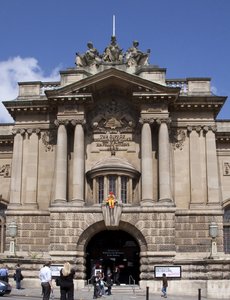 Bristol Museum - Art Gallery |
Bristol | 2 | The Boulogne Express, The Quay, Waterford |
 Ferens Art Gallery |
Hull | 2 | The Artist's Mother, Quebec, Canada |
 Nottingham Castle Museum And Art Gallery |
Nottingham | 2 | Waterloo Bridge, London, The Church of St Germain des Prés, Paris, France |
 The Royal Hospital Chelsea |
London | 2 | Their Finest Hour, May 1940, Tom Walker (b.1872), In Pensioner, Late of the Loyal Regiment |
Pick a decade to see the original that defines it.
New York, from Brooklyn (1939), Government Art Collection, London. Abingdon Fair (1927) and The Wear Bridge, Sunderland (1930) come next.
49 years old: New York, from Brooklyn dates from 1939, and Charles Cundall was born in 1890.
New York, from Brooklyn, Abingdon Fair, The Wear Bridge, Sunderland, Derby Day, Training Camp, Hullavington, Minesweepers off Duty, A Sunderland Being Hauled up the Slipway, Advanced Rigging Instruction, RAF Training Command, Blackpool, Liberty Boats at Sheerness, 1940 and Marine Craft and Sunderlands. The ranking above gives each one's year and museum.
Our catalog holds 93 works by Charles Cundall, dated from 1922 to 1947.
Mostly in National Maritime Museum (London), Royal West of England Academy (Bristol) and Government Art Collection (London). The museum table above lists them all.
In 1940s: 35 of the 93 works on this page were made then, Training Camp, Hullavington among them.
On this page, the earliest is Italian Landscape (1922) and the latest The Black Watch Receiving the Freedom of Perth, 1947 (1947).
Panoramic view (4), Victorian era (3) and British art (3), across the 93 works on this page.
Oil On Canvas, for 3 of the 93 works on this page.
Post-impressionism, judging by the originals on this page.
Liberty Boats at Sheerness, 1940, Boom Defence Vessels and Battleships at Falmouth, 1940: the National Maritime Museum, London holds 4 of the works on this page.
Born in Stretford, Lancashire, Charles Ernest Cundall emerged as a remarkably versatile figure within the British art landscape of the early twentieth century. His journey began not with a brush, but with the delicate precision of a designer, working amidst the intricate patterns of pottery and stained glass for Pilkington's Lancastron Pottery & Tiles. This early foundation in decorative arts provided him with a unique sensitivity to texture and form, which he would later translate into much larger, more sweeping canvases. His formal education at the Manchester School of Art and his subsequent scholarship to the Royal College of Art in 1912 marked the beginning of a profound artistic evolution that would see him master everything from intimate portraits to vast, panoramic townscapes.
The trajectory of Cundall's life was irrevocably altered by the shadows of the Great War. Serving with the Royal Fusiliers, he sustained a significant wound to his right arm, an injury that threatened to silence his creative impulses. Yet, in a testament to his sheer tenacity, he learned to paint with his left arm, returning to the Royal College of Art and later attending the Slade School of Art. This period of recovery and retraining infused his work with a resilient spirit. His travels through Paris, Italy, Sweden, Russia, and Spain further expanded his visual vocabulary, allowing him to absorb the diverse light and atmosphere of the European continent, which would eventually manifest in his mastery of topographical subjects.
Cundall became most renowned for his ability to command large-scale panoramic canvases, works that captured the bustling energy of British life and the quiet majesty of the landscape. He possessed a rare technical facility, particularly when navigating the complexities of crowd scenes and aerial perspectives. His paintings were often rich with texture, light, and movement, making him a master of capturing the ephemeral spirit of a moment. Whether he was depicting the vibrant seaside atmosphere of Bank Holiday, Brighton or the sweeping vistas of townscapes like Gravesend, his work resonated with an ability to blend topographical accuracy with an expressive, almost cinematic quality.
During the tumultuous years of World War II, Cundall’s artistry took on a profound historical weight. Serving as an official artist for the Air Ministry and working on commissions for the Admiralty, he documented the vital rhythms of the war effort. His canvases from this era, such as those focusing on Bomber Command, Coastal Command, and the arrival of American troops in Northern Ireland, serve as poignant visual records of a nation in flux. Through his eyes, we see the heavy machinery of war—the servicing of a Sunderland or the presence of the B-17 Flying Fortress—rendered with a profound sense of duty and artistic grace.
The significance of Cundall's contribution to art lies in his ability to bridge the gap between decorative design and monumental painting. His election as a Royal Academician in 1944 was a crowning achievement, reflecting his standing among the most distinguished painters of his generation. Throughout his career, he remained a mainstay of the Royal Academy, exhibiting consistently and contributing to the prestige of institutions such as the New English Arts Club and the Royal Watercolour Society.
His artistic legacy is characterized by several key elements:
Though much of his work as a war artist has yet to receive the full breadth of attention it deserves, Cundall remains an essential thread in the tapestry of twentieth-century British art history. His ability to find beauty in both the grand panoramic view and the detailed topographical subject ensures his place in the annals of painters who captured the very soul of their era.
