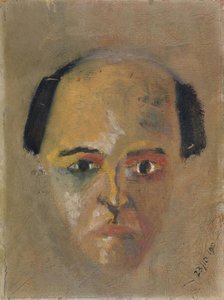
Portrait of Arnold Schoenberg

The 65 Most Famous Arnold Schoenberg Paintings, Each One of a Kind

Updated October 2026 · ranked by our popularity score (searches, visits and orders for each work) · 65 works by Arnold Schoenberg in our catalogue

In short

Pierrot lunaire, op. 21 - Night (1912) is the Arnold Schoenberg painting that draws the most eyes; the original belongs to the Arnold Schönberg Center, Vienna. After it, the eye goes to Arnold Schönberg’s calendar (1935) and Suite, op. 29 - Bi-directional twelve-tone row chart (1924). Among the 65 works of Arnold Schoenberg in our catalog, these 65 are the most famous, each a unique original presented with its year, its museum and the reason it endures.

1874 – 1951, Vienna Expressionism Most works: Arnold Schönberg Center

Top 10 paintings by Arnold Schoenberg, through the gallery's eye

1
Pierrot lunaire, op. 21 - Night (1912) by Arnold Schoenberg

Pierrot lunaire, op. 21 - Night

1912 · Acrylic On Canvas · Arnold Schönberg Center, Vienna

Arnold Schönberg’s *Pierrot lunaire*, op. 21, stands as a monumental achievement in the evolution of modern music, a work born from the anxieties and aesthetic explorations of early 20th-century Europe. This particular rendition, “Night,” meticulously captured in this evocative photographic reproduction, offers a profound glimpse into Schönberg’s expressionistic vision – a world of fractured emotion, haunting beauty, and unsettling psychological depth. Composed in Berlin in 1912, the piece was commissioned…

2
Arnold Schönberg’s calendar (1935) by Arnold Schoenberg

Arnold Schönberg’s calendar

1935 · Acrylic On Canvas · Arnold Schönberg Center, Vienna

A Snapshot of Hollywood Harmony: Arnold Schönberg’s Calendar The image captures a moment frozen in time – a candid photograph depicting Arnold Schönberg alongside his wife, Gertrud Kolisch Schoenberg, seated in the backseat of a vintage automobile. Taken in 1935 during their relocation to Los Angeles, California, this seemingly simple tableau speaks volumes about the artist’s life and creative spirit amidst the burgeoning American landscape. The woman, dressed in a…

3
Suite, op. 29 - Bi-directional twelve-tone row chart (1924) by Arnold Schoenberg

Suite, op. 29 - Bi-directional twelve-tone row chart

1924 · Acrylic On Canvas · Arnold Schönberg Center, Vienna

Arnold Schönberg's "Suite, op. 29 – Bi-directional twelve-tone row chart" isn’t merely a musical score; it’s a visual manifestation of radical innovation, a testament to the composer’s relentless pursuit of sonic and artistic boundaries. Created in 1924, during a period of intense experimentation within his own compositional methods—specifically, his “Method of composing with twelve tones which are related only with one another”—this work represents a pivotal moment in 20th-century music…

4
Peace on Earth, op. 13 (1907) by Arnold Schoenberg

Peace on Earth, op. 13

1907 · Black and White Photography · Arnold Schönberg Center, Vienna

To gaze upon this depiction of Arnold Schoenberg's "Peace on Earth, op. 13" is not merely to look at an aged sheet of music; it is to encounter a preserved echo of profound human yearning. This composition, born from the charged atmosphere of early twentieth-century Europe, transcends its musical notation to become a tangible artifact of hope. The visual evidence—the sepia tones, the delicate creases, the faint patina of time…

5
Phantasy for Violin with Piano Accompaniment, op. 47 (1949) by Arnold Schoenberg

Phantasy for Violin with Piano Accompaniment, op. 47

1949 · Acrylic On Canvas · Arnold Schönberg Center, Vienna

This meticulously crafted hand-painted reproduction captures a pivotal moment in the oeuvre of Arnold Schoenberg, a composer who irrevocably altered the landscape of 20th-century music. The piece, “Phantasy for Violin with Piano Accompaniment,” op. 47, born from a commission in 1949, represents more than just a musical composition; it’s a tangible link to a brilliant mind grappling with radical innovation and profound personal transformation. The photograph itself – a stark…

7
Blue Gaze (1910) by Arnold Schoenberg

Blue Gaze

1910 · Oil On Board · Arnold Schönberg Center, Vienna

“Blue Gaze,” painted in 1910 by the titan of musical innovation, Arnold Schoenberg, is more than just a portrait; it's a visceral manifestation of artistic struggle and a testament to the burgeoning power of abstraction. Created during a pivotal period in Schoenberg’s life – a time when he was simultaneously wrestling with the radical new techniques of atonality in music and exploring the uncharted territories of visual expression – this…

8
Transfer ticket for public transport in Berlin (1927) by Arnold Schoenberg

Transfer ticket for public transport in Berlin

1927 · Acrylic On Canvas · Arnold Schönberg Center, Vienna

This meticulously crafted hand-painted reproduction captures a pivotal moment in design history – the 1927 transfer ticket for the Berlin tram system, conceived by the visionary composer Arnold Schönberg. Far more than simply a means of payment, this circular artifact represents a radical shift towards efficiency and user experience, anticipating modern transit systems by nearly a century. Schönberg’s design wasn't born from artistic indulgence; it stemmed from a pragmatic desire…

9
The Musical Idea - W. A. Mozart K 465 (1934) by Arnold Schoenberg

The Musical Idea - W. A. Mozart K 465

1934 · Giclée Print · Arnold Schönberg Center, Vienna

W.A. Mozart’s K. 465, “The Musical Idea,” takes on an entirely new dimension through the lens of Arnold Schönberg's profound inquiry into musical representation. This isn’t merely a reproduction of a classical score; it’s a visual echo of Schönberg’s seminal work, "Der Musikalische Gedanke," a treatise that fundamentally shifted our understanding of composition and its relationship to logic, technique, and artistic expression. The photograph itself – a meticulously annotated music…

10
Piano Piece, op. 19/6 (1911) by Arnold Schoenberg

Piano Piece, op. 19/6

1911 · Acrylic On Canvas · Arnold Schönberg Center, Vienna

This meticulously crafted hand-painted reproduction captures Arnold Schönberg’s poignant “Piano Piece, op. 19/6,” a deceptively simple work born from a moment of profound grief and artistic experimentation. Created in 1911, shortly after the death of Gustav Mahler – a figure Schönberg deeply revered as both mentor and friend – the piece offers a rare glimpse into the composer’s emotional landscape during a period of intense creative upheaval. The image presented…

Arnold Schoenberg's famous paintings, numbers 11 to 65

11Excerpt from Arnold Schönberg’s own handwritten library catalogue: Works of Richard Strauss (1914) by Arnold SchoenbergExcerpt from Arnold Schönberg’s own handwritten library catalogue: Works of Richard Strauss1914 · Arnold Schönberg Center 12Self-Portrait (1910) by Arnold SchoenbergSelf-Portrait1910 · Arnold Schönberg Center 13The Biblical Way (Act I, Scene 2), Stadium (1927) by Arnold SchoenbergThe Biblical Way (Act I, Scene 2), Stadium1927 · Arnold Schönberg Center 14The Lucky Hand (scene 1) (1910) by Arnold SchoenbergThe Lucky Hand (scene 1)1910 · Arnold Schönberg Center 15Gertrud Schönberg (1930) by Arnold SchoenbergGertrud Schönberg1930 · Arnold Schönberg Center 16Tears (1910) by Arnold SchoenbergTears1910 · Arnold Schönberg Center 17Garden Scene (1907) by Arnold SchoenbergGarden Scene1907 · Arnold Schönberg Center 18Playing Cards for Whist/Bridge - Jack of Spades (1910) by Arnold SchoenbergPlaying Cards for Whist/Bridge - Jack of Spades1910 · Arnold Schönberg Center 19Formation scheme for the Gurrelieder (1918) by Arnold SchoenbergFormation scheme for the Gurrelieder1918 · Arnold Schönberg Center 20The Lucky Hand (scene 2) (1910) by Arnold SchoenbergThe Lucky Hand (scene 2)1910 · Arnold Schönberg Center 21Red Gaze (1910) by Arnold SchoenbergRed Gaze1910 · Arnold Schönberg Center 22Piano Concerto, op. 42 - Programmatic keywords (1942) by Arnold SchoenbergPiano Concerto, op. 42 - Programmatic keywords1942 · Arnold Schönberg Center 23Playing Cards for Whist/Bridge - King of Hearts (1910) by Arnold SchoenbergPlaying Cards for Whist/Bridge - King of Hearts1910 · Arnold Schönberg Center 24Structural Functions of Harmony - Chart of the Regions (1948) by Arnold SchoenbergStructural Functions of Harmony - Chart of the Regions1948 · Arnold Schönberg Center 25Interior and Portrait of a Woman (1910) by Arnold SchoenbergInterior and Portrait of a Woman1910 · Arnold Schönberg Center 26Blue Self-Portrait (1910) by Arnold SchoenbergBlue Self-Portrait1910 · Arnold Schönberg Center 27Self-Portrait (1918) by Arnold SchoenbergSelf-Portrait1918 · Arnold Schönberg Center 28Mathilde Schönberg (1909) by Arnold SchoenbergMathilde Schönberg1909 · Arnold Schönberg Center 29Expectation (Scene 3) (1911) by Arnold SchoenbergExpectation (Scene 3)1911 · Arnold Schönberg Center 30Handwriting samples (1923) by Arnold SchoenbergHandwriting samples1923 · Arnold Schönberg Center 31Suite for Piano, op. 25 - Prelude (1921) by Arnold SchoenbergSuite for Piano, op. 25 - Prelude1921 · Arnold Schönberg Center 32Landscape (1910) by Arnold SchoenbergLandscape1910 · Arnold Schönberg Center 33Erwartung, op. 17 (1909) by Arnold SchoenbergErwartung, op. 171909 · Arnold Schönberg Center 34Exlibris (1910) by Arnold SchoenbergExlibris1910 · Arnold Schönberg Center 35Alliance (Hands) (1910) by Arnold SchoenbergAlliance (Hands)1910 · Arnold Schönberg Center 36Portrait of a Woman (1910) by Arnold SchoenbergPortrait of a Woman1910 · Arnold Schönberg Center 37Coalition Chess (1925) by Arnold SchoenbergCoalition Chess1925 · Arnold Schönberg Center 38Moses and Aron (1930) by Arnold SchoenbergMoses and Aron1930 · Arnold Schönberg Center 39Playing Cards for Whist/Bridge - Queen of clubs (1909) by Arnold SchoenbergPlaying Cards for Whist/Bridge - Queen of clubs1909 · Arnold Schönberg Center 40Playing card design (1910) by Arnold SchoenbergPlaying card design1910 · Arnold Schönberg Center 41Brief to Wilhelm von Wymetal (1907) by Arnold SchoenbergBrief to Wilhelm von Wymetal1907 · Arnold Schönberg Center 42Alexander Zemlinsky (1910) by Arnold SchoenbergAlexander Zemlinsky1910 · Arnold Schönberg Center 43Green Self-Portrait (1910) by Arnold SchoenbergGreen Self-Portrait1910 · Arnold Schönberg Center 44Memory of Oskar Kokoschka (1910) by Arnold SchoenbergMemory of Oskar Kokoschka1910 · Arnold Schönberg Center 45Mathilde Schönberg cooking (1912) by Arnold SchoenbergMathilde Schönberg cooking1912 · Arnold Schönberg Center 46Model of a set of dentures (1926) by Arnold SchoenbergModel of a set of dentures1926 · Arnold Schönberg Center 47Coalition Chess - Plane (1925) by Arnold SchoenbergCoalition Chess - Plane1925 · Arnold Schönberg Center 48Gaze (Karl Kraus – The Great Wall of China) (1910) by Arnold SchoenbergGaze (Karl Kraus – The Great Wall of China)1910 · Arnold Schönberg Center 49Furniture design (1931) by Arnold SchoenbergFurniture design1931 · Arnold Schönberg Center 50Self-Portrait (1935) by Arnold SchoenbergSelf-Portrait1935 · Arnold Schönberg Center 51Self-Portrait (1922) by Arnold SchoenbergSelf-Portrait1922 · Arnold Schönberg Center 52The Musical Idea - Chart of the Regions (1934) by Arnold SchoenbergThe Musical Idea - Chart of the Regions1934 · Arnold Schönberg Center 53Schematic representation of European Jewry (1934) by Arnold SchoenbergSchematic representation of European Jewry1934 · Arnold Schönberg Center 54Model of a chair / library ladder (1945) by Arnold SchoenbergModel of a chair / library ladder1945 · Arnold Schönberg Center 55Five Pieces for Orchestra, op. 16/5 – First written copy (1909) by Arnold SchoenbergFive Pieces for Orchestra, op. 16/5 – First written copy1909 · Arnold Schönberg Center 56Staffliner for drawing staves (1950) by Arnold SchoenbergStaffliner for drawing staves1950 · Arnold Schönberg Center 57Maurice Zam (1935) by Arnold SchoenbergMaurice Zam1935 · Arnold Schönberg Center 58Critic I (1910) by Arnold SchoenbergCritic I1910 · Arnold Schönberg Center 59Emil Hertzka (1910) by Arnold SchoenbergEmil Hertzka1910 · Arnold Schönberg Center 60Speak not always of the leaves, op. 15/14 (1909) by Arnold SchoenbergSpeak not always of the leaves, op. 15/141909 · Arnold Schönberg Center 61Music Typewriter (1909) by Arnold SchoenbergMusic Typewriter1909 · Arnold Schönberg Center 62Piano Piece, op. 11/2 (1909) by Arnold SchoenbergPiano Piece, op. 11/21909 · Arnold Schönberg Center 63Walking Self-Portrait (1911) by Arnold SchoenbergWalking Self-Portrait1911 · Arnold Schönberg Center 64Chess Set by Arnold SchoenbergChess SetArnold Schönberg Center 65Tape Dispenser (1945) by Arnold SchoenbergTape Dispenser1945 · Arnold Schönberg Center

Arnold Schoenberg's famous paintings, period by period

The subjects that held Arnold Schoenberg's eye

The four subjects that come back most often in these originals, each with its finest example.

The museums that keep Arnold Schoenberg's originals

The museum that holds the most of the paintings on this page.

Museum City Works by Arnold Schoenberg Paintings from this list
Arnold Schönberg Center, ViennaArnold Schönberg Center Vienna 65 Pierrot lunaire, op. 21 - Night, Arnold Schönberg’s calendar, Suite, op. 29 - Bi-directional twelve-tone row chart

Arnold Schoenberg across the decades: one unique original for each

Works per decade

Pick a decade to see the original that defines it.

Arnold Schoenberg's paintings: questions for the gallery

What is the single most famous work of Arnold Schoenberg?Reveal the answer

Pierrot lunaire, op. 21 - Night (1912), Arnold Schönberg Center, Vienna. Arnold Schönberg’s calendar (1935) and Suite, op. 29 - Bi-directional twelve-tone row chart (1924) come next.

At what age did Arnold Schoenberg create Pierrot lunaire, op. 21 - Night?Reveal the answer

38 years old: Pierrot lunaire, op. 21 - Night dates from 1912, and Arnold Schoenberg was born in 1874.

Which ten paintings by Arnold Schoenberg are the most famous?Reveal the answer

Pierrot lunaire, op. 21 - Night, Arnold Schönberg’s calendar, Suite, op. 29 - Bi-directional twelve-tone row chart, Peace on Earth, op. 13, Phantasy for Violin with Piano Accompaniment, op. 47, Accompaniment to a Cinematographic Scene, op. 34 - Twelve-tone row chart, Blue Gaze, Transfer ticket for public transport in Berlin, The Musical Idea - W. A. Mozart K 465 and Piano Piece, op. 19/6. The ranking above gives each one's year and museum.

How many works by Arnold Schoenberg are known?Reveal the answer

Our catalog holds 65 works by Arnold Schoenberg, dated from 1907 to 1950.

Where can the most famous Arnold Schoenberg originals be seen?Reveal the answer

Mostly in Arnold Schönberg Center (Vienna). The museum table above lists them all.

During which period did Arnold Schoenberg create the best-known paintings?Reveal the answer

In 1910s: 29 of the 65 works on this page were made then, Pierrot lunaire, op. 21 - Night among them.

Which famous Arnold Schoenberg painting is the earliest, and which the latest?Reveal the answer

On this page, the earliest is Peace on Earth, op. 13 (1907) and the latest Staffliner for drawing staves (1950).

What subjects did Arnold Schoenberg favour?Reveal the answer

Atonality (10), Self-portrait (6) and Early 20th century (6), across the 65 works on this page.

What materials did Arnold Schoenberg paint with most?Reveal the answer

Acrylic On Canvas, for 22 of the 65 works on this page.

Which movement does the work of Arnold Schoenberg belong to?Reveal the answer

Expressionism and Expressionist modernism, judging by the originals on this page.

What Arnold Schoenberg originals can I see at the Arnold Schönberg Center?Reveal the answer

Pierrot lunaire, op. 21 - Night, Arnold Schönberg’s calendar and Suite, op. 29 - Bi-directional twelve-tone row chart: the Arnold Schönberg Center, Vienna holds 65 of the works on this page.

Arnold Schoenberg: a portrait of the artist

early life and musical beginnings

arnold schoenberg, an austrian-american composer, was born on september 13, 1874, in vienna, austria. his early life was marked by a humble beginning, with his father being a shoe-shopkeeper. despite this, schoenberg's innate passion for music led him to largely self-educate himself in the field. schoenberg's early works, such as verklärte nacht (1899), showcased a brahmsian–wagnerian synthesis. as he progressed, he became the central figure of the second viennese school, alongside anton webern and alban berg. his compositions, including string quartet no. 2 (1907–1908), erwartung (1909), and pierrot lunaire (1912), exemplified his innovative approach to atonality. schoenberg resigned from the prussian academy of arts in 1933 due to the nazi's rise to power, labeling his music as "degenerate." he then taught in the us, including at the university of california, los angeles (1936–1944), where facilities are named in his honor. [https://OriginalUniqueArt.com/@/arnold-schoenberg](discover more about schoenberg's life and works on OriginalUniqueArt). as the world learned of the holocaust, schoenberg memorialized its victims in a survivor from warsaw (1947). the israel conservatory and academy of music elected him honorary president in 1951. [https://OriginalUniqueArt.com/@@/a@d3bqc7-the-museum-destroyed-by-fire-(united-states)](learn more about the impact of his work on OriginalUniqueArt). key points: * schoenberg's innovative music was among the most influential and polemicized of 20th-century classical music. * at least three generations of composers extended its somewhat formal principles. * his aesthetic and music-historical views influenced musicologists theodor w. adorno and carl dahlhaus. [https://OriginalUniqueArt.com/@@/a@d3cl2x--a-journey-through-art-history-with-OriginalUniqueArt-s-extensive-collection-](explore the vast collection of art on OriginalUniqueArt, spanning from the 12th to the 20th century).