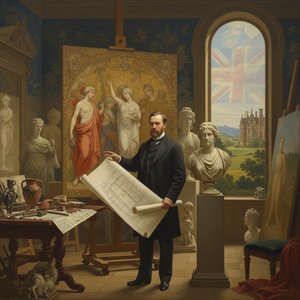
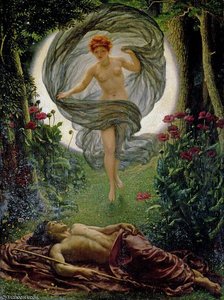
Sir Edward John Poynter, 1st Baronet GCVO, PRA (born March 20, 1836 – died July 26, 1919) was a leading English painter, designer, and draughtsman. He served as President of the Royal Academy, solidifying his place in Victorian art history. Poynter was born in Paris, France, to architect Ambrose Poynter, though his family soon returned to Britain. His early education took place at Brighton College and Ipswich School, but ill health led him to spend winters in Madeira and Rome. It was in Rome in 1853 that he met Frederick Leighton, a pivotal encounter that profoundly influenced his artistic direction. He furthered his studies at Leigh's Academy in London and the Royal Academy Schools before venturing to Paris, where he studied under the classicist painter Charles Gleyre, alongside fellow students James McNeill Whistler and George du Maurier..
Artistic Development and Influences
Poynter’s artistic development was shaped by a blend of classical ideals, historical narratives, and an emerging interest in exoticism. His early works demonstrated a strong foundation in academic technique, honed through his rigorous training. Leighton's influence is evident in Poynter’s meticulous attention to detail and refined aesthetic sensibility. The atmosphere of Paris and the teachings of Gleyre instilled in him an appreciation for classical form and composition. He was also influenced by archaeological discoveries and a growing Victorian fascination with ancient cultures, particularly those of Egypt and the Near East.
Major Works and Themes
Poynter is best known for his large-scale historical paintings. Some of his most celebrated works include:
Israel in Egypt (1867): A dramatic depiction of the biblical exodus, showcasing Poynter’s skill in narrative composition and atmospheric effects.
St George for England (1869): A mosaic created for the Palace of Westminster, embodying a patriotic theme and demonstrating his versatility as an artist.
King Solomon (1890): Another significant work exploring biblical themes with a focus on grandeur and historical accuracy.
His works often explored themes of mythology, history, and the exotic, reflecting the intellectual and cultural currents of his time.
Official Positions and Recognition
Poynter’s career extended beyond painting; he held several prestigious positions within the art establishment:
First Slade Professor at University College London (1871-1875)
Principal of the National Art Training School (1875-1881)
Director of the National Gallery (1894-1904), overseeing the opening of the Tate Gallery.
He was admitted as an Associate of the Royal Academy in 1869 and became a full Royal Academician in 1876. In 1896, he succeeded Sir John Millais as President of the Royal Academy, receiving a knighthood in the same year. He was created a Baronet in 1902.
Historical Significance and Legacy
Sir Edward John Poynter’s contributions to Victorian art were substantial. As an artist, he captured the spirit of his age through grand historical paintings and evocative depictions of classical themes. His leadership roles within the Royal Academy helped shape artistic education and policy during a period of significant change. He bridged the gap between academic tradition and emerging modern trends. Furthermore, his family connections – including ties to Rudyard Kipling and Stanley Baldwin – placed him at the heart of Victorian society. His work continues to be admired for its technical skill, narrative power, and insightful reflection of the Victorian era’s cultural values.
By the OriginalUniqueArt.com Editorial Team
Quiz
There is only one correct answer for each question.
Question 1:
Sir Edward John Poynter held several important positions within the art world. Which of these roles did he *not* occupy?
Question 2:
Poynter's painting 'The Visit of the Queen of Sheba to King Solomon' is representative of what broader artistic and cultural trend?
Question 3:
Poynter's family connections were quite prominent. How was he related to Rudyard Kipling?
Question 4:
Before becoming a renowned painter, where did Poynter initially study art?
Explore the captivating world of Sir Edward Poynter, a leading figure of Aestheticism & Victorian art. Discover his archaeological narratives, iconic paintings like 'Day Dream Fine,' and lasting influence on British art history.
Explore the captivating world of David Roberts, a pioneering Scottish painter renowned for his detailed Orientalist scenes & stunning Egyptian landscapes. Discover his legacy and find museum-quality reproductions at OriginalUniqueArt.