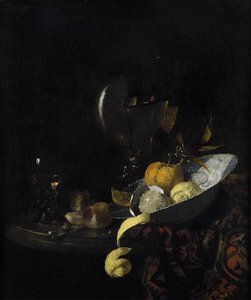
Portret Willem Kalf

82 najsłynniejszych obrazów artysty Willem Kalf, każdy niepowtarzalny

Aktualizacja: Listopad 2026 · ranking według naszego wskaźnika popularności (liczba wyszukiwań, wizyt i zamówień dla każdego dzieła) · 86 dzieł Willem Kalf w naszym katalogu

W skrócie

Still Life with an oriental Rug (1660) to obraz autorstwa Willem Kalf, który przyciąga najwięcej spojrzeń; oryginał znajduje się w Ashmolean Museum of Art and Archaeology, Oksford. Następnie wzrok kieruje się na Still-Life (1665) i Still-Life with a Nautilus Cup (detail) (1662). Spośród 86 dzieł Willem Kalf w naszym katalogu, tych 82 jest najbardziej znanych – każde z nich to unikatowy oryginał, przedstawiony wraz z rokiem powstania, muzeum oraz powodem, dla którego przetrwało próbę czasu.

1619 – 1693, Rotterdam Baroque Najwięcej dzieł: Museum Boijmans Van Beuningen

10 najlepszych obrazów autorstwa Willem Kalf według oka galerii

1
Still Life with an oriental Rug (1660) autorstwa Willem Kalf

Still Life with an oriental Rug

1660 · Acrylic On Canvas · Ashmolean Museum of Art and Archaeology, Oksford

The painting’s creation coincided with the zenith of Dutch economic dominance—a period marked by unchallenged control over global trade routes and a flourishing mercantile culture. The wealth generated from overseas ventures financed ambitious artistic endeavors, fostering an environment where artists like Kalf could explore innovative stylistic approaches and engage in intellectual discourse. Furthermore, the humanist spirit of the time permeated artistic expression, emphasizing human dignity and rational thought—values subtly conveyed…

2
Still-Life (1665) autorstwa Willem Kalf

Still-Life

1665 · Oil On Canvas · Rijksmuseum, Amsterdam

In this 1665 work, Still-Life, Willem Kalf presents a quiet arrangement of objects that reflects the prosperity of the Dutch Golden Age. Born in Rotterdam, Netherlands, in 1619, the artist developed a specific way of seeing that would define much of his career until his death in 1693. This particular painting captures a moment of stillness, focusing on the tactile reality of a bowl of oranges and various metalware set…

3
Still-Life with a Nautilus Cup (detail) (1662) autorstwa Willem Kalf

Still-Life with a Nautilus Cup (detail)

1662 · Oil On Canvas · Thyssen-Bornemisza Museum, Madryt

In the quiet, shadowed corners of the seventeenth-century Dutch Golden Age, few artists captured the intoxicating essence of prosperity quite like Willem Kalf. His masterpiece, Still-Life with a Nautilus Cup (detail), is far more than a mere arrangement of objects; it is a meticulously choreographed performance of light, texture, and prestige. As one gazes upon this breathtaking composition, they are immediately transported into a world of refined luxury, where every…

4
Still-life (detail) (1650) autorstwa Willem Kalf

Still-life (detail)

1650 · Oil On Canvas · Ermitaż, Sankt Petersburg

Willem Kalf's “Still Life,” painted around 1650 and now residing within the hallowed halls of The Hermitage Museum in St. Petersburg, is more than just a depiction of fruit and glass; it’s a meticulously crafted window into the burgeoning wealth and extravagant tastes of 17th-century Holland. Kalf, a master of the “pronkstilleven” – literally “showy still lifes” – elevated the genre to an art form, transforming everyday objects into symbols…

5
Still-Life with Drinking-Horn (1653) autorstwa Willem Kalf

Still-Life with Drinking-Horn

1653 · Oil On Canvas · National Gallery, Londyn

A Window Into Dutch Opulence: Willem Kalf’s Still Life with Drinking Horn Willem Kalf stands as one of the most recognizable figures in the pantheon of Dutch Golden Age painters, celebrated primarily for his breathtakingly detailed depictions of interiors and still lifes that captured the essence of aristocratic life during the seventeenth century. Born in Rotterdam in 1619 into a family steeped in mercantile success—his father served as a municipal…

6
Still-Life with Glass Goblet and Fruit (1655) autorstwa Willem Kalf

Still-Life with Glass Goblet and Fruit

1655 · Oil On Canvas · Berlińskie Muzea Państwowe, Berlin

A soft, unseen light spills across a draped table, catching the curve of a gleaming glass goblet and the velvety skin of ripening fruit. The scene feels suspended in a moment of profound stillness, where the deep shadows of a dark background push the objects forward into the viewer's space. Oranges and apples rest in a careful arrangement, their warm hues of burnt orange and golden yellow glowing against the…

7
Pronk Still Life With Holbein Bowl, Nautilus Cup, Glass Goblet And Fruit Dish (1678) autorstwa Willem Kalf

Pronk Still Life With Holbein Bowl, Nautilus Cup, Glass Goblet And Fruit Dish

1678 · Farba olejna · National Gallery of Denmark, Kopenhaga

The painting titled Pronk Still Life with Holbein Bowl, Nautilus Cup, Glass Goblet and Fruit Dish was executed by the artist Willem Kalf. This work dates to 1678. It belongs to the genre of pronkstilleven, which translates to ostentatious still life. This classification refers to a specific type of Dutch Golden Age composition that focuses on the depiction of luxury and high-status objects.

8
Still-Life with Fruit, Glassware, and a Wanli Bowl (1659) autorstwa Willem Kalf

Still-Life with Fruit, Glassware, and a Wanli Bowl

1659 · Oil On Canvas · Metropolitan Museum of Art, Nowy Jork

The Opulent Stillness of Willem Kalf’s “Still Life with Fruit, Glassware, and a Wanli Bowl” Willem Kalf's "Still Life with Fruit, Glassware, and a Wanli Bowl," painted in 1659, is more than just a depiction of objects arranged on a table; it’s a meticulously crafted window into the lavish world of 17th-century Dutch society. This remarkable artwork, now housed at The Metropolitan Museum of Art, embodies the pinnacle of the…

Słynne obrazy artysty Willem Kalf, od 11 do 82

11Still-Life with Porcelain and a Nautilus Cup (1660) autorstwa Willem KalfStill-Life with Porcelain and a Nautilus Cup1660 · Thyssen-Bornemisza Museum 12Still-Life with an Aquamanile, Fruit, and a Nautilus Cup (1660) autorstwa Willem KalfStill-Life with an Aquamanile, Fruit, and a Nautilus Cup1660 · Thyssen-Bornemisza Museum 13Still Life Fruit, Goblet and Salver (1660) autorstwa Willem KalfStill Life Fruit, Goblet and Salver1660 14Still life with shell cup, glasses and a lemon (1663) autorstwa Willem KalfStill life with shell cup, glasses and a lemon1663 · Museum der bildenden Künste 15Still Life with a Porcelain Vase, Silver-gilt Ewer and Glasses (1643) autorstwa Willem KalfStill Life with a Porcelain Vase, Silver-gilt Ewer and Glasses1643 · Los Angeles County Museum of Art 16Peasant Interior with Woman at a Well (1642) autorstwa Willem KalfPeasant Interior with Woman at a Well1642 · Saint Louis Art Museum 17Farm interior with a woman at a well (1640) autorstwa Willem KalfFarm interior with a woman at a well1640 · Museum der bildenden Künste 18Still life with weaponry, silverware and mirror image of the artist (1644) autorstwa Willem KalfStill life with weaponry, silverware and mirror image of the artist1644 19Intérieur de cuisine (1646) autorstwa Willem KalfIntérieur de cuisine1646 · Musée Fabre 20Merchandise on display for a shop (1642) autorstwa Willem KalfMerchandise on display for a shop1642 · Bawarskie Państwowe Zbiory Malarstwa 21Farm interior with a kneeling man (1645) autorstwa Willem KalfFarm interior with a kneeling man1645 · Museum Boijmans Van Beuningen 22Boerderij-interieur met zittende vrouw, man op een ladder en figuur in de deuropening (1644) autorstwa Willem KalfBoerderij-interieur met zittende vrouw, man op een ladder en figuur in de deuropening1644 · Staatliche Kunsthalle Karlsruhe 23Interior of a barn (1644) autorstwa Willem KalfInterior of a barn1644 · Museum Boijmans Van Beuningen 24Still Life with a Ming Jug (1653) autorstwa Willem KalfStill Life with a Ming Jug1653 · Alte Pinakothek 25Still Life with Ewer, Vessels and Pomegranate (1640) autorstwa Willem KalfStill Life with Ewer, Vessels and Pomegranate1640 · Muzeum J. Paula Getty'ego 26Interior of a Kitchen (1642) autorstwa Willem KalfInterior of a Kitchen1642 · Metropolitan Museum of Art 27Pronk Still Life with a Chinese Sugar Bowl (1662) autorstwa Willem KalfPronk Still Life with a Chinese Sugar Bowl1662 · Statens Museum for Kunst 28Still Life with a Ming Bowl (1657) autorstwa Willem KalfStill Life with a Ming Bowl1657 · Museum Boijmans Van Beuningen 29Still-Life with Lemon, Oranges and Glass of Wine (1663) autorstwa Willem KalfStill-Life with Lemon, Oranges and Glass of Wine1663 · Staatliche Kunsthalle Karlsruhe 30Still Life with Shells and Coral (1690) autorstwa Willem KalfStill Life with Shells and Coral1690 · Mauritshuis 31Still Life with Fruit and Wineglasses on a Silver Plate (1659) autorstwa Willem KalfStill Life with Fruit and Wineglasses on a Silver Plate1659 · Mauritshuis 32Still-Life with a Late Ming Ginger Jar (1669) autorstwa Willem KalfStill-Life with a Late Ming Ginger Jar1669 · Museum of Art 33Still Life with Shells (1653) autorstwa Willem KalfStill Life with Shells1653 · Mauritshuis 34Wineglass and a Bowl of Fruit (1663) autorstwa Willem KalfWineglass and a Bowl of Fruit1663 · Cleveland Museum of Art 35A Kitchen Corner (1643) autorstwa Willem KalfA Kitchen Corner1643 · Detroit Institute of Arts 36Still Life with Columbine Goblet (1660) autorstwa Willem KalfStill Life with Columbine Goblet1660 · Detroit Institute of Arts 37Still Llife with a Roemer (1659) autorstwa Willem KalfStill Llife with a Roemer1659 · Mauritshuis 38kitchen - piece (1647) autorstwa Willem Kalfkitchen - piece1647 39Kitchen interior (1642) autorstwa Willem KalfKitchen interior1642 · Fondation Custodia 40Kitchen Interior (1650) autorstwa Willem KalfKitchen Interior1650 41Still Life with Glasses and a Silver Bowl (1656) autorstwa Willem KalfStill Life with Glasses and a Silver Bowl1656 · Szépművészeti Múzeum 42Still life with shell cup, shells, coral and lacquer box (1653) autorstwa Willem KalfStill life with shell cup, shells, coral and lacquer box1653 · Museum de Fundatie 43Still Life with Fruit and a Nautilus Cup (1660) autorstwa Willem KalfStill Life with Fruit and a Nautilus Cup1660 44Still Life with Ginger jar (1660) autorstwa Willem KalfStill Life with Ginger jar1660 45Still life with shells and a jewel box (1653) autorstwa Willem KalfStill life with shells and a jewel box1653 · Kunsthandel P. de Boer 46Nautilus shell (Stilleben mit Nautiluspokal) (1660) autorstwa Willem KalfNautilus shell (Stilleben mit Nautiluspokal)1660 · Foundation E.G. Bührle Collection 47Still life with a golden goblet (1657) autorstwa Willem KalfStill life with a golden goblet1657 · Gemäldegalerie 48Still life with a nautilus cup (1660) autorstwa Willem KalfStill life with a nautilus cup1660 · Gemäldegalerie 49Still Life Silver Gilt Goblet and Bowl of Fruit (1660) autorstwa Willem KalfStill Life Silver Gilt Goblet and Bowl of Fruit1660 50Still Life with Fruit, Glassware, and a Wanli Bowl (1659) autorstwa Willem KalfStill Life with Fruit, Glassware, and a Wanli Bowl1659 · Metropolitan Museum of Art 51Still Life with Lemon Peel (1664) autorstwa Willem KalfStill Life with Lemon Peel1664 · Museum of Fine Arts 52Still Life with Bekerschroef, Rummer and Covered Porcelain Pot (1669) autorstwa Willem KalfStill Life with Bekerschroef, Rummer and Covered Porcelain Pot1669 · Het Prinsenhof 53Still life with columbine cup and porcelain bowl with fruit (1666) autorstwa Willem KalfStill life with columbine cup and porcelain bowl with fruit1666 54kitchenpiece (1666) autorstwa Willem Kalfkitchenpiece1666 · Museum Rotterdam 55Still life with porcelain lidded jar, shell cup and gilt silver ewer (1662) autorstwa Willem KalfStill life with porcelain lidded jar, shell cup and gilt silver ewer1662 · Gebruder Douwes 56Still life with a Chinese porcelain bowl (1662) autorstwa Willem KalfStill life with a Chinese porcelain bowl1662 · Fondation Custodia 57Still Life Silver Gilt Goblet, Porcelain Bowl, Glassware and Peeled Orange (1665) autorstwa Willem KalfStill Life Silver Gilt Goblet, Porcelain Bowl, Glassware and Peeled Orange1665 · Kelvingrove Art Gallery and Museum 58Pronk still life (1643) autorstwa Willem KalfPronk still life1643 · Amsterdam Museum 59Still life with a porcelain bowl with fruit and glasses on a round marble table (1660) autorstwa Willem KalfStill life with a porcelain bowl with fruit and glasses on a round marble table1660 · Groninger Museum 60Kitchen interior (1663) autorstwa Willem KalfKitchen interior1663 · Museum Boijmans Van Beuningen 61Still life with glasses and fruit (1663) autorstwa Willem KalfStill life with glasses and fruit1663 · National Gallery of Victoria 62Intérieur de cuisine autorstwa Willem KalfIntérieur de cuisine 63Still-Life with Silver Bowl, Glasses, and Fruit (1658) autorstwa Willem KalfStill-Life with Silver Bowl, Glasses, and Fruit1658 · Wallraf-Richartz-Museum 64Kitchen Interior autorstwa Willem KalfKitchen InteriorMuzeum Izraela 65Still Life (1660) autorstwa Willem KalfStill Life1660 · National Gallery of Art 66Still Life with Chinese Bowl and Fruit autorstwa Willem KalfStill Life with Chinese Bowl and Fruit 67Cabbages on a Table Top autorstwa Willem KalfCabbages on a Table TopMuzeum Narodowe w Warszawie 68Nature morte à la gourde d'argent autorstwa Willem KalfNature morte à la gourde d'argentMinneapolis Institute of Art 69Nature morte autorstwa Willem KalfNature morte 70Nature morte au nautile autorstwa Willem KalfNature morte au nautileMusée Des Beaux 71Nature morte au römer autorstwa Willem KalfNature morte au römerPalais des Beaux-Arts de Lille 72Nature morte au citron autorstwa Willem KalfNature morte au citron 73Le vieux puits autorstwa Willem KalfLe vieux puitsMusée Des Beaux 74INTERIEUR D'UNE CUISINE RUSTIQUE autorstwa Willem KalfINTERIEUR D'UNE CUISINE RUSTIQUELuwr 75Życie z Piastową Flaszką, Cyberszczotką, Porcelainową Czarną Ceramiką i Owocami autorstwa Willem KalfŻycie z Piastową Flaszką, Cyberszczotką, Porcelainową Czarną Ceramiką i OwocamiGuildhall Art Gallery 76Still Life with Silver Jug (1657) autorstwa Willem KalfStill Life with Silver Jug1657 · Rijksmuseum 77Still Life with a Chinese Porcelain Jar (1669) autorstwa Willem KalfStill Life with a Chinese Porcelain Jar1669 · Indianapolis Museum of Art 78Still-Life with a Nautilus Cup (1662) autorstwa Willem KalfStill-Life with a Nautilus Cup1662 · Thyssen-Bornemisza Museum 79William still life autorstwa Willem KalfWilliam still lifeNational Gallery 80Still-Life (1653) autorstwa Willem KalfStill-Life1653 · Ermitaż 81Still-Life with Chinese Porcelain Bowl (1662) autorstwa Willem KalfStill-Life with Chinese Porcelain Bowl1662 · Berlińskie Muzea Państwowe 82USTENSILES DE CUISINE autorstwa Willem KalfUSTENSILES DE CUISINELuwr

Słynne obrazy Willem Kalf epoka po epoce

Tematy, które przyciągnęły wzrok Willem Kalf

Cztery motywy najczęściej powracające w tych oryginałach, z których każdy doczekał się swojego najdoskonalszego przykładu.

Muzea przechowujące oryginały Willem Kalf

8 muzeów, w których znajduje się najwięcej obrazów z tej strony.

Muzea Miasto Dzieła artysty Willem Kalf Obrazy z tej listy
Museum Boijmans Van Beuningen, RotterdamMuseum Boijmans Van Beuningen Rotterdam 5 Interior of a barn, Farm interior with a kneeling man, Interior of a barn
Thyssen-Bornemisza Museum, MadrytThyssen-Bornemisza Museum Madryt 4 Still-Life with a Nautilus Cup (detail), Still-Life with Porcelain and a Nautilus Cup, Still-Life with an Aquamanile, Fruit, and a Nautilus Cup
Mauritshuis, HagaMauritshuis Haga 4 Still Life with Shells and Coral, Still Life with Fruit and Wineglasses on a Silver Plate, Still Life with Shells
Metropolitan Museum of Art, Nowy JorkMetropolitan Museum of Art Nowy Jork 3 Still-Life with Fruit, Glassware, and a Wanli Bowl, Interior of a Kitchen, Still Life with Fruit, Glassware, and a Wanli Bowl
Rijksmuseum, AmsterdamRijksmuseum Amsterdam 2 Still-Life, Still Life with Silver Jug
Ermitaż, Sankt PetersburgErmitaż Sankt Petersburg 2 Still-life (detail), Still-Life
National Gallery, LondynNational Gallery Londyn 2 Still-Life with Drinking-Horn, William still life
Berlińskie Muzea Państwowe, BerlinBerlińskie Muzea Państwowe Berlin 2 Still-Life with Glass Goblet and Fruit, Still-Life with Chinese Porcelain Bowl

Willem Kalf na przestrzeni dekad: jeden unikatowy oryginał dla każdego

Dzieła według dekad

Wybierz dekadę, aby zobaczyć dzieło, które ją definiuje.

Obrazy artysty Willem Kalf: pytania do galerii

Jakie jest najsłynniejsze dzieło artysty Willem Kalf?Odkryj odpowiedź

Still Life with an oriental Rug (1660), Ashmolean Museum of Art and Archaeology, Oksford. Następne są Still-Life (1665) oraz Still-Life with a Nautilus Cup (detail) (1662).

W jakim wieku Willem Kalf stworzył/a Still Life with an oriental Rug?Odkryj odpowiedź

41 lat: Still Life with an oriental Rug pochodzi z 1660, a Willem Kalf urodził(a) się w 1619.

Które dziesięć obrazów Willem Kalf jest najbardziej znanych?Odkryj odpowiedź

Still Life with an oriental Rug, Still-Life, Still-Life with a Nautilus Cup (detail), Still-life (detail), Still-Life with Drinking-Horn, Still-Life with Glass Goblet and Fruit, Pronk Still Life With Holbein Bowl, Nautilus Cup, Glass Goblet And Fruit Dish, Still-Life with Fruit, Glassware, and a Wanli Bowl, Interior of a barn i Still Life with the Drinking Horn of the Saint Sebastian Archers' Guild, Lobster and Glasses. Powyższy ranking zawiera rok powstania oraz muzeum dla każdego z nich.

Ile znanych dzieł stworzył Willem Kalf?Odkryj odpowiedź

Nasz katalog zawiera 86 dzieł artysty Willem Kalf, datowanych od 1640 do 1690.

Gdzie można zobaczyć najsłynniejsze oryginały Willem Kalf?Odkryj odpowiedź

W większości znajdują się w Museum Boijmans Van Beuningen (Rotterdam), Thyssen-Bornemisza Museum (Madryt) i Mauritshuis (Haga). Powyższa tabela muzeów zawiera ich pełną listę.

W jakim okresie Willem Kalf stworzył/a swoje najsłynniejsze obrazy?Odkryj odpowiedź

W 1660s: 31 z 82 dzieł na tej stronie powstało w tym czasie, w tym Still Life with an oriental Rug.

Który z najsłynniejszych obrazów artysty Willem Kalf powstał najwcześniej, a który najpóźniej?Odkryj odpowiedź

Na tej stronie najwcześniejszy to Farm interior with a woman at a well (1640), a najpóźniejszy Still Life with Shells and Coral (1690).

Jakie tematy preferował Willem Kalf?Odkryj odpowiedź

Fruit (23), Glassware (20) i Still life (16), w ramach 82 dzieł na tej stronie.

Jakich materiałów Willem Kalf używał najczęściej?Odkryj odpowiedź

Oil On Canvas, dla 58 z 82 dzieł na tej stronie.

Do jakiego nurtu należy twórczość Willem Kalf?Odkryj odpowiedź

Baroque i Dutch golden age, sądząc po oryginałach na tej stronie.

Jakie oryginały Willem Kalf można zobaczyć w Museum Boijmans Van Beuningen?Odkryj odpowiedź

Interior of a barn, Farm interior with a kneeling man i Interior of a barn: Museum Boijmans Van Beuningen, Rotterdam posiada 5 dzieł widocznych na tej stronie.

Willem Kalf: portret artysty

Życie zanurzone w przepychu: Świat Willema Kalfa

Willem Kalf, nazwisko będące synonimem wystawnych martwych natur holenderskiego Złotego Wieku, urodził się w 1619 roku w Rotterdamie w rodzinie o dostatnich środkach. Jego ojciec, Jan Jansz Calff, piastował ważne funkcje w administracji miejskiej, zapewniając młodemu Willemowi wychowanie pełne bezpieczeństwa, a jednocześnie wystawiające go na kontakt z rozkwitającym światem kupieckim, który w późniejszych latach wywarł tak głęboki wpływ na jego sztukę. Choć szczegóły dotyczące wczesnej edukacji Kalfa pozostają nieco nieuchwytne, wiadomo, że w latach 30. XVII wieku przeżywał okres rozwoju artystycznego w Paryżu, zanurzając się w tętniącej życiem społeczności flamandzkich artystów działających w Saint-Germain-des-Prés. To formacyjne doświadczenie początkowo skierowało go ku mniejszej skali, wiejskim wnętrzom i prostym martwym naturom – skromnym początkom, które z czasem rozkwitły w monumentalne pronkstilleven, z których artysta słynie do dziś. Śmierć obojga rodziców przed 1638 rokiem wymusiła powrół do Holandii, przygotowując grunt pod jego dojrzały okres twórczości.

Od skromnych początków do mistrzowskiego widowiska

Wczesne paryskie dzieła Kalfa ukazują artystę dopiero szukającego swojej drogi. Obrazy te często przedstawiały proste aranżacje – warzywa, pospolite przybory kuchenne, takie jak wiadra czy patelnie – osadzone na ciemnych tłach, gdzie postacie były jedynie sugerowane, a nie w pełni zarysowane. Styl ten nawiązywał do tradycji malarskich dominujących we Flandrii na początku XVII wieku, szczególnie do prac takich artystów jak David Teniers Młodszy. Jednak ambicja Kalfa wkrótce przerosła te skromne kompozycje. Po powrocie do Holandii rozpoczął zdumiewającą ewolucję w stronę tego, co stało się jego znakiem rozpoznawczym: pronkstilleven, czyli „martwej natury wystawnej”. Nie były to jedynie przedstawienia przedmiotów; były to starannie skonstruowane manifestacje bogactwa i wyrafinowania, prezentujące luksusowe artefakty, takie jak srebrne naczynia, delikatna porcelana, egzotyczne owoce i migoczące szkło.

Sztuka iluzji i symbolicznego rezonansu

Tym, co naprawdę wyróżniało pronkstilleven autorstwa Kalfa, była jego nieporównywalna biegłość w operowaniu światłem i teksturą. Posiadał on niezwykły dar oddawania refleksów srebra, przezroczystości szkła oraz aksamitnych powierzchni owoców z zapierającym dech w piersiach realizmem. Jego kompozycje nie były przypadkowymi układami; stanowiły pieczołowicie zaplanowane orkiestracje, zaprojektowane tak, by uchwycić grę światła i cienia, tworząc poczucie głębi i dramatyzmu. Choć podstawowa struktura jego obrazów – układ przedmiotów – pozostawała stosunkowo spójna, każde dzieło było świadectwem umiejętności Kalfa w różnicowaniu faktur i chwytaniu subtelnych efektów oświetleniowych. Poza czystym kunsztem technicznym krył się jednak głęboki wymiar symboliczny. Przedstawiane przez niego bogate przedmioty nie były jedynie piękne; nawiązywały do tematów przemijalności, bogactwa i ulotności ziemskich przyjemności – będąc hołdem dla tradycji vanitas, tak powszechnej w malarstwie holenderskim.

Dziedzictwo i wpływ

Wpływ Willema Kalfa wykraczał daleko poza jego własną, niezwykle płodną twórczość. Jego półmonochromatyczne martwe natury wywarły znaczący wpływ na sztukę francuską, szczególnie w kręgu braci Le Nain, którzy podziwiali jego wyrafinowane użycie światłocienia. Choć poszczególne dzieła mogą nie być tak powszechnie rozpoznawalne jak prace niektórych jego współczesnych, wkład Kalfa w ten gatunek jest niezaprzeczalny. Pomógł on zdefiniować pronkstilleven, oddając ducha holenderskiego społeczeństwa XVII wieku – epoki naznaczonej bezprecedensowym rozkwitem gospodarczym i rosnącą klasą kupiecką, pragnącą manifestować swój status i wyrafinowanie. Dziś jego obrazy zdobią prestiżowe kolekcje muzealne na całym świecie, w tym Museum Boijmans Van Beuningen w Rotterdamie, National Gallery of Art w Waszyngtonie oraz Getty Museum, sprawiając, że jego dziedzictwo jako mistrza holenderskiej martwej natury nieustannie budzi podziw. Jego drobiazgowa dbałość o szczegół i mistrzowskie operowanie światłem pozostają niedoścignionymi wzorcami artystycznej doskonałości.

Dowiedz się więcej