Portret Ferdinand Hodler

Obrazy: 100 najsłynniejszych dzieł artysty Ferdinand Hodler – spojrzenie galerii

Aktualizacja: Październik 2026 · ranking według naszego wskaźnika popularności (liczba wyszukiwań, wizyt i zamówień dla każdego dzieła) · 609 dzieł Ferdinand Hodler w naszym katalogu

W skrócie

Według galerii najsłynniejszym obrazem Ferdinand Hodler jest Eiger, Monch and Jungfrau in Moonlight (1908). Woman in Ecstasy (1911) i Eiger, Monch and Jungfrau in Moonlight (1908) dopełniają trio, które zna każde oko. Z 609 dzieł Ferdinand Hodler w naszym katalogu, galeria prezentuje poniżej 100 najsłynniejszych prac – każda z nich jest oryginałem z podaniem roku powstania, muzeum oraz cech wyróżniających ją na tle innych.

1853 – 1918, Berno Symbolism, parallelism & harmony Najwięcej dzieł: Muzeum Narodowe Bośni i Hercegowiny

10 najlepszych obrazów artysty Ferdinand Hodler w galerii

1
Eiger, Monch and Jungfrau in Moonlight (1908) autorstwa Ferdinand Hodler

Eiger, Monch and Jungfrau in Moonlight

1908 · Oil On Canvas

In the quietude of 1908, Ferdinand Hodler captured a nocturnal moment in his painting, Eiger, Monch and Jungfrau in Moonlight. The scene is dominated by three majestic mountains, arranged with a distinct sense of scale: the leftmost peak appears smaller, followed by a middle mountain with a slightly larger summit, while the rightmost peak stands as the largest of the trio. Above this rugged landscape, two airplanes traverse the sky—one…

2
Woman in Ecstasy (1911) autorstwa Ferdinand Hodler

Woman in Ecstasy

1911 · Oil On Canvas

To encounter Ferdinand Hodler’s Woman in Ecstasy is to step into a realm where the boundaries between the physical form and the ethereal spirit dissolve. Painted in 1911, this monumental canvas serves as a cornerstone of the Art Nouveau movement, capturing far more than a mere moment of movement; it embodies an entire era's yearning for beauty, transcendence, and liberation. The painting depicts a woman caught in the throes of…

3
Eiger, Monch and Jungfrau in Moonlight (1908) autorstwa Ferdinand Hodler

Eiger, Monch and Jungfrau in Moonlight

1908 · Oil On Canvas

In this 1908 oil on canvas, the landscape is dominated by three majestic mountain peaks: the Eiger, the Monch, and the Jungfrau. These summits are arranged in a rhythmic, ascending scale, with the leftmost peak appearing smaller, followed by a middle mountain with a slightly larger summit, and the rightmost peak standing as the largest of the trio. The scene is set during a moonlight night, characterized by a palette…

4
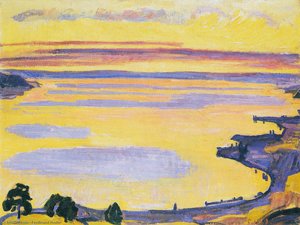
Sunset on Lake Geneva (1915) autorstwa Ferdinand Hodler

Sunset on Lake Geneva

1915 · Oil On Canvas · Kunsthaus Zürich, Zurych

The painting depicts a sunset over Lake Geneva. The sky above the water is rendered in shades of yellow, orange, and pink, creating a vibrant atmosphere. In the foreground, mountains are visible, providing depth to the landscape. A boat is positioned on the water, contributing to the serene scene.

5
Study of two figures (1897) autorstwa Ferdinand Hodler

Study of two figures

1897 · Acrylic On Paper · Muzeum Narodowe Bośni i Hercegowiny, Sarajewo

Ferdinand Hodler’s “Study of Two Figures” is not a grand, dramatic statement; rather, it's an invitation to linger in the quiet intimacy of a shared moment. Painted in 1897, this graphite drawing on paper captures two women seated together, their postures suggesting a profound sense of contemplation and perhaps even melancholy. Hodler, a pivotal figure within Swiss Symbolism, wasn’t interested in literal representation but rather in conveying emotional atmosphere and…

6
Unity (1911) autorstwa Ferdinand Hodler

Unity

1911 · Painting

In the monumental mural Unity, created in 1911, Ferdinand Hodler presents a profound meditation on the collective human spirit. This expansive work, stretching across an impressive scale, transcends mere portraiture to become a rhythmic tapestry of existence. The composition is masterfully arranged in rows of figures that seem to pulse with a shared vitality; some individuals press toward the foreground with palpable presence, while others recede into the background, creating…

7
Lake Geneva in Chexbres (1904) autorstwa Ferdinand Hodler

Lake Geneva in Chexbres

1904 · Oil On Canvas

To gaze upon Ferdinand Hodler's Lake Geneva in Chexbres is to be invited into a moment suspended between the vastness of nature and the quiet contemplation of the human spirit. This magnificent oil on canvas, dating from 1904, captures more than just a picturesque vista; it encapsulates the very essence of the Swiss landscape filtered through the profound lens of an artistic master. The scene unfolds across a broad expanse…

8
Composition study (1887) autorstwa Ferdinand Hodler

Composition study

1887 · Oil On Canvas · Muzeum Narodowe Bośni i Hercegowiny, Sarajewo

Ferdinand Hodler's "Composition Study," created in 1887, isn’t merely a sketch of three figures engaged in strenuous activity; it’s a profound meditation on the human condition, rendered with an arresting blend of anatomical precision and evocative symbolism. This work, now housed within the Tretyakov Gallery in Moscow, offers a rare glimpse into the artist's deeply personal vision – a world shaped by loss, contemplation, and a fascination with the ephemeral…

9
Self-portrait with stand (1879) autorstwa Ferdinand Hodler

Self-portrait with stand

1879 · Oil On Canvas · Kunst Museum Winterthur | Reinhart am Stadtgarten, Winterthur

To stand before Ferdinand Hodler’s Self-portrait with stand is to encounter a moment suspended between public presentation and private contemplation. This striking work, dating from 1879, captures the artist not merely as a likeness, but as a study in poised masculinity and burgeoning artistic self-awareness. The subject, impeccably dressed in a suit and tie, adopts a formal bearing, suggesting an occasion of importance or perhaps simply the necessary facade required…

10
The Wetterhorn (1912) autorstwa Ferdinand Hodler

The Wetterhorn

1912 · Oil On Canvas

To stand before Ferdinand Hodler’s The Wetterhorn is to be enveloped by the sublime majesty of the Swiss Alps, rendered through a lens of profound introspection. Painted in 1912, this oil on canvas masterpiece transcends mere topographical depiction; it is a meditation on permanence against the backdrop of fleeting human experience. The sheer scale of the snow-covered peak dominates the composition, its striking blue hue lending the entire scene an…

Obrazy artysty Ferdinand Hodler, uszeregowane od 11 do 100 miejsca

11Hilly Landscape with Ravens, in the Bernese Oberland (1910) autorstwa Ferdinand HodlerHilly Landscape with Ravens, in the Bernese Oberland1910 12View of Lake Leman from Chexbres (1905) autorstwa Ferdinand HodlerView of Lake Leman from Chexbres1905 · Kunstmuseum Basel 13Stockhorn chain (blue sky) autorstwa Ferdinand HodlerStockhorn chain (blue sky) 14Woman on her deathbed autorstwa Ferdinand HodlerWoman on her deathbed 15Lake Geneva from Chexbres (1904) autorstwa Ferdinand HodlerLake Geneva from Chexbres1904 · Musée cantonal des Beaux-Arts 16Portrait of Fraulein Kyburz (1873) autorstwa Ferdinand HodlerPortrait of Fraulein Kyburz1873 · Rhode Island School of Design Museum of Art 17Portrait of a Spanish woman autorstwa Ferdinand HodlerPortrait of a Spanish woman 18Studies of self-portrait (1911) autorstwa Ferdinand HodlerStudies of self-portrait1911 19Portret Berthe Hodler (1902) autorstwa Ferdinand HodlerPortret Berthe Hodler1902 · Muzeum Narodowe Bośni i Hercegowiny 20Landscape of the Swiss Alps (1918) autorstwa Ferdinand HodlerLandscape of the Swiss Alps1918 · Muzeum Izraela 21The fall in Silvaplana (1907) autorstwa Ferdinand HodlerThe fall in Silvaplana1907 · Kunsthaus Zürich 22Thun with symmetric mirroring (1909) autorstwa Ferdinand HodlerThun with symmetric mirroring1909 · Musée d'Art et d'Histoire de Genève 23Jeanne Cerani-Charles autorstwa Ferdinand HodlerJeanne Cerani-Charles 24Day (Truth) autorstwa Ferdinand HodlerDay (Truth)Art Institute of Chicago 25From Le Grand Muveran Villars (1912) autorstwa Ferdinand HodlerFrom Le Grand Muveran Villars1912 · Von der Heydt Museum 26The cobbler by the window (1882) autorstwa Ferdinand HodlerThe cobbler by the window1882 27Forest Stream at Champery (1916) autorstwa Ferdinand HodlerForest Stream at Champery1916 28The shoemaker (1878) autorstwa Ferdinand HodlerThe shoemaker1878 29Modern Rütli (1878) autorstwa Ferdinand HodlerModern Rütli1878 · Gottfried Keller Foundation 30The Reaper (1878) autorstwa Ferdinand HodlerThe Reaper1878 31Gymnasts' Banquet (1877) autorstwa Ferdinand HodlerGymnasts' Banquet1877 · Kunsthaus Zürich 32The Miller, his Son and the Donkey (1888) autorstwa Ferdinand HodlerThe Miller, his Son and the Donkey1888 · Musée d'Art et d'Histoire de Genève 33The Disillusioned One (1892) autorstwa Ferdinand HodlerThe Disillusioned One1892 · Los Angeles County Museum of Art 34Study of the disappointed souls or Weary of life (1891) autorstwa Ferdinand HodlerStudy of the disappointed souls or Weary of life1891 35Overall study of the life of weary (1887) autorstwa Ferdinand HodlerOverall study of the life of weary1887 36Surprised by the Storm (1887) autorstwa Ferdinand HodlerSurprised by the Storm1887 37Night (1890) autorstwa Ferdinand HodlerNight1890 38Worship (1893) autorstwa Ferdinand HodlerWorship1893 39Childhood (1893) autorstwa Ferdinand HodlerChildhood1893 · Städel Museum 40Battle scenes (1896) autorstwa Ferdinand HodlerBattle scenes1896 41The Halberdier (1895) autorstwa Ferdinand HodlerThe Halberdier1895 · Dallas Museum of Art 42View into Infinity (1903) autorstwa Ferdinand HodlerView into Infinity1903 · Hamburger Kunsthalle 43The Adored Youth (1904) autorstwa Ferdinand HodlerThe Adored Youth1904 44Character study (1902) autorstwa Ferdinand HodlerCharacter study1902 45The Woodcutter (1910) autorstwa Ferdinand HodlerThe Woodcutter1910 · Von der Heydt Museum 46Character study (1906) autorstwa Ferdinand HodlerCharacter study1906 47Farewell participating female figure (1908) autorstwa Ferdinand HodlerFarewell participating female figure1908 48Pulling soldiers (1908) autorstwa Ferdinand HodlerPulling soldiers1908 49The working mower (1909) autorstwa Ferdinand HodlerThe working mower1909 50Pulling soldiers (1908) autorstwa Ferdinand HodlerPulling soldiers1908 51Woman in Ecstasy (1911) autorstwa Ferdinand HodlerWoman in Ecstasy1911 52Jeanne Günzburger (1912) autorstwa Ferdinand HodlerJeanne Günzburger1912 · Toledo Museum of Art 53Portrait of Emma Schmidt-Müller (1915) autorstwa Ferdinand HodlerPortrait of Emma Schmidt-Müller1915 54Josef Müller (1916) autorstwa Ferdinand HodlerJosef Müller1916 55Der Frühling (Fassung IV) (1912) autorstwa Ferdinand HodlerDer Frühling (Fassung IV)1912 56The Patient (1914) autorstwa Ferdinand HodlerThe Patient1914 · Kunstmuseum Basel 57Head of a Soldier (1917) autorstwa Ferdinand HodlerHead of a Soldier1917 · Art Institute of Chicago 58Valentine Godé-Darel one day before her death (1915) autorstwa Ferdinand HodlerValentine Godé-Darel one day before her death1915 · Kunstmuseum Basel 59Swearing from behind (1912) autorstwa Ferdinand HodlerSwearing from behind1912 60Two swearing (1912) autorstwa Ferdinand HodlerTwo swearing1912 61Study of self-portrait (1916) autorstwa Ferdinand HodlerStudy of self-portrait1916 62Standing draped figure (1913) autorstwa Ferdinand HodlerStanding draped figure1913 63Untitled (529) autorstwa Ferdinand HodlerUntitled (529) 64Lake Thun Landscape autorstwa Ferdinand HodlerLake Thun Landscape 65Female figure with garland (1895) autorstwa Ferdinand HodlerFemale figure with garland1895 · Muzeum Narodowe Bośni i Hercegowiny 66Self portrait (1916) autorstwa Ferdinand HodlerSelf portrait1916 67Prayer in the Saint Pierre Cathedral in Geneva (1882) autorstwa Ferdinand HodlerPrayer in the Saint Pierre Cathedral in Geneva1882 · Building of the Winterthur Museum of Art 68Mother and Child autorstwa Ferdinand HodlerMother and Child 69Pulling soldiers (1908) autorstwa Ferdinand HodlerPulling soldiers1908 70Walking at the forest edge (1885) autorstwa Ferdinand HodlerWalking at the forest edge1885 71Lake Geneva on the evening in Chexbres (1895) autorstwa Ferdinand HodlerLake Geneva on the evening in Chexbres1895 72Lake Thun, Symmetric reflection (1905) autorstwa Ferdinand HodlerLake Thun, Symmetric reflection1905 73The river Aare in Solothurn (1915) autorstwa Ferdinand HodlerThe river Aare in Solothurn1915 74The Orator (1912) autorstwa Ferdinand HodlerThe Orator1912 75What are flowers saing (1893) autorstwa Ferdinand HodlerWhat are flowers saing1893 76Lake Geneva with Mont Blanc in the morning light (1918) autorstwa Ferdinand HodlerLake Geneva with Mont Blanc in the morning light1918 77The Lake Geneva from Chexbres (1898) autorstwa Ferdinand HodlerThe Lake Geneva from Chexbres1898 78Spring (1901) autorstwa Ferdinand HodlerSpring1901 79Transfiguration (1906) autorstwa Ferdinand HodlerTransfiguration1906 80Valentine Godé-Darel on her Deathbed (1915) autorstwa Ferdinand HodlerValentine Godé-Darel on her Deathbed1915 81Emotion (study) (1902) autorstwa Ferdinand HodlerEmotion (study)1902 82valentine gode darel sun autorstwa Ferdinand Hodlervalentine gode darel sun 83The road to Evordes autorstwa Ferdinand HodlerThe road to Evordes 84The Black Lutschina (1905) autorstwa Ferdinand HodlerThe Black Lutschina1905 85A morning in Interlaken (1875) autorstwa Ferdinand HodlerA morning in Interlaken1875 · Kunstmuseum Bern 86Dying cadet (1896) autorstwa Ferdinand HodlerDying cadet1896 87Thun, Stockhornkette (1910) autorstwa Ferdinand HodlerThun, Stockhornkette1910 88Thunersee with Niesen autorstwa Ferdinand HodlerThunersee with Niesen 89The road to a particular interest (1890) autorstwa Ferdinand HodlerThe road to a particular interest1890 · Kunst Museum Winterthur | Reinhart am Stadtgarten 90Portrait of Berthe Jacques, wife of the artist (1894) autorstwa Ferdinand HodlerPortrait of Berthe Jacques, wife of the artist1894 91Figure study (1901) autorstwa Ferdinand HodlerFigure study1901 · Muzeum Narodowe Bośni i Hercegowiny 92Sensation (1901) autorstwa Ferdinand HodlerSensation1901 93Lake Silvaplana in Autumn (1907) autorstwa Ferdinand HodlerLake Silvaplana in Autumn1907 · Kunsthaus Zürich 94Dents du Midi in Clouds (1917) autorstwa Ferdinand HodlerDents du Midi in Clouds1917 95Grammont autorstwa Ferdinand HodlerGrammont 96Autumn Landscape near Solothurn autorstwa Ferdinand HodlerAutumn Landscape near Solothurn 97The reader 1 autorstwa Ferdinand HodlerThe reader 1Thyssen-Bornemisza Museum 98untitled (774) autorstwa Ferdinand Hodleruntitled (774) 99Prayer in the Cathedral of St. Pierre, Geneva (1882) autorstwa Ferdinand HodlerPrayer in the Cathedral of St. Pierre, Geneva1882 100At the foot of the Petit Saleve (1890) autorstwa Ferdinand HodlerAt the foot of the Petit Saleve1890

Słynne obrazy Ferdinand Hodler epoka po epoce

Tematy, które przyciągnęły wzrok Ferdinand Hodler

Cztery motywy najczęściej powracające w tych oryginałach, z których każdy doczekał się swojego najdoskonalszego przykładu.

Muzea przechowujące oryginały Ferdinand Hodler

8 muzeów, w których znajduje się najwięcej obrazów z tej strony.

Muzea Miasto Dzieła artysty Ferdinand Hodler Obrazy z tej listy
Muzeum Narodowe Bośni i Hercegowiny, SarajewoMuzeum Narodowe Bośni i Hercegowiny Sarajewo 74 Study of two figures, Composition study, Portret Berthe Hodler
Kunsthaus Zürich, ZurychKunsthaus Zürich Zurych 16 Sunset on Lake Geneva, The fall in Silvaplana, Gymnasts' Banquet
Kunstmuseum Basel, BazyleaKunstmuseum Basel Bazylea 5 View of Lake Leman from Chexbres, The Patient, Valentine Godé-Darel one day before her death
Musée d'Art et d'Histoire de Genève, GenewaMusée d'Art et d'Histoire de Genève Genewa 8 Thun with symmetric mirroring, The Miller, his Son and the Donkey
Art Institute of Chicago, ChicagoArt Institute of Chicago Chicago 3 Day (Truth), Head of a Soldier
Von der Heydt Museum, WuppertalVon der Heydt Museum Wuppertal 3 From Le Grand Muveran Villars, The Woodcutter
Kunst Museum Winterthur | Reinhart am Stadtgarten, WinterthurKunst Museum Winterthur | Reinhart am Stadtgarten Winterthur 2 Self-portrait with stand, The road to a particular interest
Städel Museum, Frankfurt nad MenemStädel Museum Frankfurt nad Menem 3 Childhood

Ferdinand Hodler, jedno kultowe dzieło na dekadę

Dzieła według dekad

Wybierz dekadę, aby zobaczyć dzieło, które ją definiuje.

Obrazy artysty Ferdinand Hodler: odpowiedzi galerii

Który obraz Ferdinand Hodler jest najsłynniejszy ze wszystkich?Odkryj odpowiedź

Eiger, Monch and Jungfrau in Moonlight (1908). Następne są Woman in Ecstasy (1911) oraz Eiger, Monch and Jungfrau in Moonlight (1908).

Ile lat miał Ferdinand Hodler, gdy ukończył Eiger, Monch and Jungfrau in Moonlight?Odkryj odpowiedź

55 lat: Eiger, Monch and Jungfrau in Moonlight pochodzi z 1908, a Ferdinand Hodler urodził(a) się w 1853.

Które to 10 najlepszych obrazów Ferdinand Hodler?Odkryj odpowiedź

Eiger, Monch and Jungfrau in Moonlight, Woman in Ecstasy, Eiger, Monch and Jungfrau in Moonlight, Sunset on Lake Geneva, Study of two figures, Unity, Lake Geneva in Chexbres, Composition study, Self-portrait with stand i The Wetterhorn. Powyższy ranking zawiera rok powstania oraz muzeum dla każdego z nich.

Ile dzieł stworzył/a Ferdinand Hodler?Odkryj odpowiedź

Nasz katalog zawiera 609 dzieł artysty Ferdinand Hodler, datowanych od 1873 do 1918.

Gdzie można znaleźć najsłynniejsze oryginały autorstwa Ferdinand Hodler?Odkryj odpowiedź

W większości znajdują się w Muzeum Narodowe Bośni i Hercegowiny (Sarajewo), Kunsthaus Zürich (Zurych) i Kunstmuseum Basel (Bazylea). Powyższa tabela muzeów zawiera ich pełną listę.

Kiedy Ferdinand Hodler stworzył swoje najsłynniejsze obrazy?Odkryj odpowiedź

W 1910s: 29 z 100 dzieł na tej stronie powstało w tym czasie, w tym Woman in Ecstasy.

Które z najsłynniejszych dzieł Ferdinand Hodler należą do jego najwcześniejszych i najpóźniejszych prac?Odkryj odpowiedź

Na tej stronie najwcześniejszy to Portrait of Fraulein Kyburz (1873), a najpóźniejszy Landscape of the Swiss Alps (1918).

Do jakich tematów Ferdinand Hodler powracał najczęściej?Odkryj odpowiedź

Landscape (24), Mountains (13) i Swiss alps (9), w ramach 100 dzieł na tej stronie.

W jakiej technice najczęściej tworzył Ferdinand Hodler?Odkryj odpowiedź

Oil On Canvas, dla 41 z 100 dzieł na tej stronie.

Z jakim nurtem związany jest Ferdinand Hodler?Odkryj odpowiedź

Symbolism, parallelism & harmony i Art nouveau, sądząc po oryginałach na tej stronie.

Które oryginały artysty Ferdinand Hodler znajdują się w zbiorach Muzeum Narodowe Bośni i Hercegowiny?Odkryj odpowiedź

Study of two figures, Composition study i Portret Berthe Hodler: Muzeum Narodowe Bośni i Hercegowiny, Sarajewo posiada 5 dzieł widocznych na tej stronie.

Ferdinand Hodler: artysta

Architektura śmiertelności

Urodzony w 1853 roku w Bernie, w Szwajcarii, Ferdinand Hodler spędził wczesne lata w cieniu cichej, nieustającej żałoby. Zanim osiągnął wiek dojrzewania, gruźlica, która zabrała jego ojca i dwóch młodszych braci, pozostawiła pustkę w jego domu. To wczesne spotkanie ze stratą stało się powracającym motywem w jego twórczości, cieniem, który towarzyszył mu od skromnych początków praktyki rzemieślniczej aż po szczyty kariery zawodowej. Rozpoczął naukę jako malarz dekorator, pomagając ojczymowi w pracach przy komercyjnych szyldach, co dało mu praktyczne wykształcenie i wykształciło w nim precyzyjną kontrolę nad linią i formą. To rzemieślnicze fundamenty zapewniły mu rygor techniczny, który w późniejszych latach wspierał jego bardziej złożone rozważania filozoficzne.

Przeprowadzka do Genewy w 1871 roku oznaczała odejście od komercyjnych wymagań młodości. W mieście szukał głębszego zaangażowania w sztukę, uczęszczając na wykłady naukowe i kopiując dzieła mistrzów w lokalnym muzeum. To właśnie tam zaczął odchodzić od skrupulatnego realizmu swoich wczesnych pejzaży i portretów. Nie był już zadowolony z samego odtwarzania scenerii szwajcarskich Alp czy podobieństwa modela; pragnął uchwycić podskórne rytmy istnienia. Ta transformacja z obiektywizmu w stronę subiektywizmu ostatecznie doprowadziła go do wypracowania własnego, unikalnego języka wizualnego.

Logika paralelizmu

Najważniejszym wkładem Hodlera w ewolucję malarstwa nowoczesnego była jego teoria paralelizmu. Nie była to jedynie technika kompozycyjna, lecz sposób postrzegania świata jako serii połączonych, rytmicznych wzorów. Obserwował, jak formy w naturze – nachylenie góry, krzywizna ludzkiego kończyny czy odbicie w wodzie – często przeglądają się w sobie w ustrukturyzowanej, geometrycznej harmonii. Poprzez aranżowanie postaci i elementów krajobrazu w tych powtarzalnych, rytmicznych kadencjach, próbował przedstawić porządek strukturalny, który jego zdaniem rządził światem naturalnym. Podejście to pozwoliło mu zasypać przepaść między fizyczną rzeczywistością sceny a stanem emocjonalnym obserwatora.

Jego twórczość często zajmowała przestrzeń między symbolizmem a bardziej ustrukturyzowaną, nowoczesną wrażliwością. W dziełach takich jak Noc, ukończona w 1890 roku, zgłębiał tematy spoczynku i śmiertelności poprzez przedstawienia postaci leżących, co stanowiło wyzwanie dla ówczesnych gustów. Jego zdolność do łączenia klasycznej formy z nowoczesną, niemal strukturalną intensywnością jest widoczna w Prawda II (1897). Nie polegał na chaotycznym dukcie pędzla swoich współczesnych; zamiast tego używał świadomej, często przygaszonej palety ochry, brązów i zieleni, aby stworzyć poczucie trwałości i ciężaru. Jego płótna nie były jedynie oknami na scenę, lecz zorganizowanymi środowiskami, w których ludzki duch i krajobraz zostały splecione wspólną geometrią.

Życie w pejzażach

Szwajcarski krajobraz pozostawał stałym elementem jego dorobku, zwłaszcza majestat Alp. Postrzegał te góry nie tylko jako cechy topograficzne, ale jako byty duchowe. Jego przedstawienia Eigeru, Mönch i Jungfrau, czy widoki z Dents du Midi, odzwierciedlają pragnienie przełożenia skali gór na język emocjonalnego rezonansu. Często stosował proces warstwowania, nakładając cienkie laserunki koloru na grubsze impasto, aby uzyskać specyficzną luminancję, szczególnie w późniejszych studiach światła nad Jeziorem Genewskim. Prace te demonstrują mistrzostwo w kreowaniu atmosfery, chwytając zamgloną, eteryczną jakość alpejskiego światła bez poświęcania strukturalnej integralności terenu.

W chwili śmierci w Genewie w 1918 roku, Hodler ugruntował swoją pozycję jako centralna postać w historii sztuki szwajcarskiej. Jego wpływ można dostrzec w rozwoju ekspresjonizmu, gdyż nacisk na subiektywne emocje i rytmiczną formę położył fundament pod tych, którzy pragnęli wyjść poza tradycyjną reprezentację. Pozostał malarzem o głębokiej psychologicznej głębi, wykorzystującym narzędzia swojego rzemiosła do konfrontacji z fundamentalnymi pytaniami o życie i śmierć. Jego dziedzictwo odnajdujemy w sposobie, w jaki zmuszał widza do spojrzenia poza powierzchnię świata, aby odnaleźć ciche, powtarzające się wzorce, które trzymają go w całości.