A Renaissance Masterpiece Illuminated
Nestled in the spiritual heart of Padua, alongside the venerable Basilica of Saint Anthony, the Scuola del Santo stands as a breathtaking testament to the artistic fervor and religious devotion of the High Renaissance. This is not merely a building, but an immersive journey back to 16th-century Italy, where the echoes of papal patronage and the fervent piety of a dedicated confraternity converge. The unassuming exterior of this historic site belies the spectacular treasure housed within: a monumental cycle of fifteen frescoes that represent one of the most significant artistic achievements of the Venetian period. To step inside is to enter a sanctuary where light and color dance across walls, telling stories of miracles, faith, and the profound human condition.
The history of the Scuola is deeply intertwined with the legacy of Saint Anthony himself. Established in 1427 as a charitable organization, the institution flourished under the unwavering support of influential families such as the Capponi and Benedetti. These patrons did not merely seek to build a hall for meetings; they sought to create a celestial vision on earth. As the importance of the confraternity grew, so too did its architectural ambitions. The expansion of the adjoining basilica in 1504 mirrored this rising prestige, while the skilled hand of Giovanni Gloria introduced neoclassical elements that reflected Padua’s status as a premier cultural center. This architectural evolution created a stage perfectly suited for the dramatic narratives that would soon adorn its surfaces.
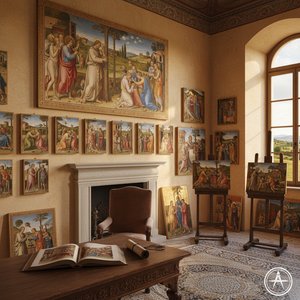
At the very soul of the Scuola lies its extraordinary collection of frescoes, dominated by the masterful hand of Titian and his workshop. These works are a dazzling panorama of Saint Anthony's life, showcasing the techniques that would define Venetian painting for generations. Titian’s unparalleled command of color and light breathes life into every scene, creating an atmosphere of profound emotional depth. One cannot stand before “The Healing of the Wrathful Son” without feeling the weight of the saint's compassion; through nuanced shading and expressive gestures, Titian captures a moment of intense psychological struggle and divine intervention. This mastery is further enriched by the influence of Domenico Campagnola, whose pioneering landscape drawings injected an atmospheric, breathing depth into the cycle, establishing Padua as a cradle of Renaissance landscape art.
For the discerning art lover or interior designer, the Scuola del Santo offers more than just historical insight; it provides a masterclass in decorative harmony and narrative power. Beyond the Titian frescoes, the museum houses a rich tapestry of religious paintings and sculptures that reflect the spiritual rhythms of the confraternity. The Sala Priorale, with its magnificent coffered ceiling designed by Giovanni Cavalieri, serves as a pinnacle of Renaissance decorative art, demonstrating how architecture and ornament can unite to inspire awe. Through meticulous recent conservation efforts, these vibrant colors and intricate details have been preserved, ensuring that the brilliance of the Venetian Renaissance continues to illuminate the halls of Padua, offering an eternal source of inspiration for those who seek beauty in its most sacred form.