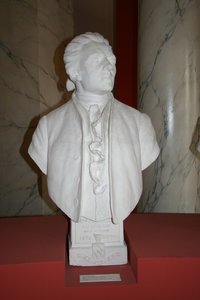
Discover the captivating works of José Inácio de Sam Paio, a 19th-century Portuguese painter renowned for his bold use of color and regal portraits, including the iconic 1824 portrait of King João VI. Explore his artistic legacy today.
Discover A. Ayres de Carvalho's captivating Portuguese art! Explore diverse styles & notable works like 'Portrait of João Frederico Ludovice.' See his legacy at the Currier Museum.
A master of Baroque religious painting known as Le Romain, Étienne Parrocel achieved great renown through luminous works like St. Dominic and St. Francis imploring Christ, inviting you to discover his celestial artistry.
A Royal Vision Forged in Gold: Exploring the Palace of Mafra
Rising from the plains north of Lisbon, the Palace of Mafra is not merely a building but a breathtaking embodiment of Portuguese ambition and artistic achievement. Conceived in 1717 by King John V, fueled by the immense wealth flowing from Brazil’s gold and diamond mines, it began as a vow – a Franciscan monastery promised upon the birth of an heir. It swiftly evolved into something far more expansive: a sprawling testament to royal power and Baroque splendor, seamlessly interwoven with Neoclassical influences. The sheer scale is almost incomprehensible; over 1,200 rooms unfold across 40,000 square meters, connected by a labyrinthine network of 156 stairways, all framed by an astonishing façade stretching 220 meters in length. It’s a space that whispers tales of the 45,000 individuals who labored for thirteen years to bring this vision to life—a human endeavor marked by both artistry and sacrifice. The very stones seem imbued with the echoes of their dedication.
A Symphony of Stone, Art, and Sound
Stepping inside is akin to entering another world – a realm where opulence and spirituality converge. At the heart of the complex lies the basilica, a magnificent example of Baroque architecture adorned with Italian sculptures that seem to breathe life into the stone. But it’s not just visual grandeur; sound permeates every corner. Six historical pipe organs fill the space with resonant tones, masterpieces in their own right echoing through the vastness of the church. Above them, two carillons—collections of 98 bells—offer another layer to the palace’s sonic landscape, capable of producing intricate melodies that once heralded royal occasions and religious ceremonies. Beyond the basilica lies the original Franciscan convent, a poignant reminder of the complex's humble beginnings, offering a glimpse into monastic life during the 18th century. Perhaps the most captivating space is the Grand Library, a haven for literary enthusiasts and scholars alike. Housing approximately 30,000 rare books, it’s a sanctuary of knowledge, its walls lined with volumes that represent centuries of human thought and creativity. The library itself is an architectural marvel, showcasing meticulously crafted woodwork and providing a serene atmosphere conducive to contemplation.
From Royal Residence to UNESCO Treasure
For generations, the Palace served as a royal residence, witnessing pivotal moments in Portuguese history. It was within these walls that Prince D. João VI resided, and later, it became the final home of King Manuel II before his exile in 1910. The palace’s story is one of shifting fortunes, having also briefly functioned as military barracks during periods of political upheaval. However, its enduring significance has been consistently recognized. Declared a National Monument in 1910, Mafra continued to captivate and inspire. In 2019, this recognition reached an international level when the Palace—along with its basilica, convent, gardens, and surrounding hunting park (Tapada)—was inscribed as a UNESCO World Heritage Site. This designation acknowledges not only the architectural brilliance of the complex but also its profound cultural and historical importance to Portugal and the world.
Gardens, Hunting Parks, and Enduring Legacy
The experience of Mafra extends beyond the palace walls. The expansive gardens offer a tranquil escape, showcasing meticulously manicured landscapes and elegant fountains—a testament to the royal family’s appreciation for beauty and leisure. Surrounding the palace is the Tapada Nacional de Mafra, a vast hunting park once reserved exclusively for the royal family. Today, it stands as a protected natural area, offering visitors a chance to connect with the region's diverse flora and fauna. The Palace of Mafra is more than just a historical site; it’s an immersive journey through time, a tangible link to Portugal’s golden age. It embodies the ambition of King John V, the skill of countless artisans, and the enduring power of art and architecture to inspire awe and wonder. It remains a unique monument—a place where history, spirituality, and artistic brilliance converge in an unforgettable experience.
Highlights:
Basilica with six historical organs, Grand Library (30,000 books), Convent, Gardens, Tapada National Hunting Park.
Architectural Style:
Baroque and Neoclassical
Historical Significance:
Royal residence, Franciscan monastery, UNESCO World Heritage Site.
By the OriginalUniqueArt.com Editorial Team
Art Quiz
There is only one correct answer for each question.
Question 1:
What is the Palace of Mafra primarily known for being?
Question 2:
From what source did King John V primarily fund the construction of the Palace of Mafra?
Question 3:
Approximately how many rooms are within the Palace of Mafra?
Question 4:
What significant feature is housed within the basilica of the Palace of Mafra?
Question 5:
What is the approximate number of books housed in the Grand Library of Mafra?
Question 6:
In what year was the Palace of Mafra inscribed as a UNESCO World Heritage Site?
Question 7:
Besides the palace itself, what other areas are included in the UNESCO World Heritage designation?
Question 8:
Who was the primary architect responsible for designing the Palace of Mafra?
Question 9:
What was one of the initial vows that led to the construction of Mafra?
Question 10:
Approximately how long did it take to complete the construction of the Palace of Mafra?
Explore the opulent world of Baroque interior design! Discover key elements, modern applications & how to bring dramatic elegance into your home with OriginalUniqueArt.com's authentic reproductions.
Explore the dramatic world of Baroque art! Discover iconic artists like Caravaggio & Rubens, defining techniques, and its lasting impact on art history. Expert insights for collectors & enthusiasts at OriginalUniqueArt.
Journey through the drama & grandeur of Baroque art! Explore 10 masterpieces by Caravaggio, Rembrandt, Rubens & more. Discover stunning oil paintings, rich colors & timeless stories. Find museum-quality reproductions at .