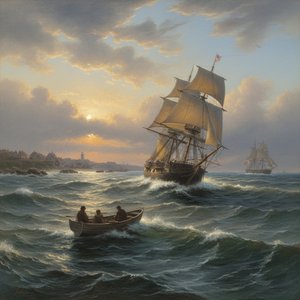
A Maritime Odyssey Within Stone Walls
To step into the Musée d'Histoire et du Pays Malouin is to surrender oneself to the rhythmic pulse of the Atlantic. Situated within the formidable, salt-sprayed ramparts of the Grand Donjon of the Château de Saint-Malo, this museum is far more than a mere collection of relics; it is a living chronicle of a city defined by the sea. As one wanders through the ancient stone corridors of this thirteenth-century fortress, the air seems to thicken with the ghosts of privateers and the salt of distant voyages. The architecture itself serves as the first great masterpiece of the experience, where the heavy, defensive masonry of the medieval era meets the grander, more refined reconstructions of the Napoleon III period, creating a space that feels both impenetrable and profoundly inviting.
The museum’s soul resides in its unparalleled ability to weave together the threads of maritime prowess, local ethnography, and high art. For the discerning collector or lover of history, the collection offers a breathtaking journey through the Age of Sail. One finds oneself captivated by the legendary tales of the corsairs —those daring privateers like Robert Surcouf, whose audacious maneuvers once dictated the economic tides of France. The exhibits do not merely present objects; they narratively reconstruct an era of global expansion and local grit, tracing the vital trade routes that linked this Breton stronghold to the icy, bountiful waters of Newfoundland. This connection is palpable in the museum's displays, where the tools of the cod fishing industry serve as poignant symbols of a shared destiny between Saint-Malo and the New World.
Beyond the historical narratives, the museum offers a sophisticated aesthetic encounter that will resonate deeply with interior designers and art enthusiasts alike. The collection is punctuated by luminous works of art that capture the very essence of the Breton light and maritime spirit. One cannot help but be moved by Paul Signac’s “Pardon of the NewFoundlanders,” a vibrant, Pointillist celebration of cultural tradition, or the sun-drenched, Impressionistic warmth of Henri Lebasque’s “The Siesta.” These masterpieces are complemented by the meticulous realism of Joaquín Sorolla’s “The Net,” which brings the tactile reality of maritime labor into sharp, emotive focus. Such works provide a stunning dialogue with the museum's historical artifacts, transforming a visit into a sensory exploration of light, texture, and human endurance.
What truly distinguishes this institution is its commitment to an emotionally resonant experience, bridging the gap between the scholarly past and the contemporary observer. Through multimedia reconstructions and carefully curated thematic exhibitions, the museum breathes life into the literary echoes of Chateaubriand, whose prose forever immortalized the landscape of Saint-Malo. Whether one is drawn by the architectural grandeur of the Château, the romanticism of the seafaring legends, or the exquisite beauty of its Impressionist treasures, the Musée d'Histoire et du Pays Malouin stands as a profound testament to the enduring power of heritage and the timeless allure of the sea.