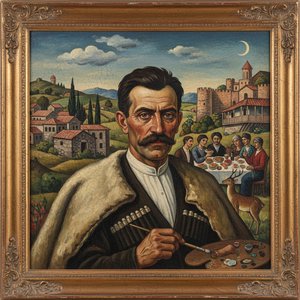
A Life Painted in Color and Light
The life of Zygmunt Waliszewski was a vibrant tapestry woven across the most significant cultural hubs of the early twentieth century. Born in 1897 in the imperial grandeur of Saint Petersburg to a Polish family, his early years were marked by a nomadic spirit that would later define his artistic breadth. As a child, he moved to Tbilisi, Georgia, where his innate talent first flickered into the public eye; by the age of eleven, his works were already being exhibited under the evocative title “Amazing Child.” This formative period in the Caucasus, far from the traditional centers of European art, allowed him to absorb a unique blend of influences, ranging from local traditions to the burgeoning energy of the Russian avant-garde.
The turbulence of World War I brought a temporary pause to his creative development as he served in the Russian Army, yet the conflict could not extinguish his artistic hunger. Upon returning to Tbilisi in 1917, Waliszewski found himself deeply moved by the Russian Futurists and the Mir Iskusstva (World of Art) movement. These encounters with modernism, characterized by a playful use of folk motifs and a sense of humor, planted the seeds for his later explorations of the grotesque and the experimental. His early works from this era, such as A Hammock, already hinted at a desire to push the boundaries of classical representation through a lens of raw, emotive expression.
The Mastery of the Kapist Movement
In the early 1920s, Waliszewski’s journey led him back to his Polish roots, settling in Kraków to refine his craft at the Academy of Fine Arts. Under the mentorship of masters like Wojciech Weiss and Józef Pankiewicz, he began to master the nuances of color and form that would become his hallmark. His education was not merely academic but deeply experiential; a move to Paris in 1924 placed him at the very heart of the international art scene. Alongside his fellow members of the "Paris Committee," he participated in plein-air workshops across the sun-drenched landscapes of Cagnes, Valence, and Avignon, learning to capture the fleeting essence of light on canvas.
As a prominent figure within the Kapist movement, Waliszewski became a pioneer of colorism. For him, color was not merely a descriptive tool but the primary vehicle for emotional and structural expression. His technique was characterized by a swift, precise application of paint that maintained a sense of individual vitality. This period saw him engaging in a profound dialogue with the past; at the Louvre, he meticulously studied and created "travesties" or reinterpretations of works by old masters such as Titian, Velázquez, and Vermeer. By blending the techniques of these legends with the modern sensibilities of Cézanne, Van Gogh, and Matisse, he bridged the gap between classical tradition and contemporary innovation.
Legacy and Artistic Significance
Though his life was tragically cut short in 1936 at the age of only thirty-nine, Waliszewski’s impact on both Polish and Georgian art remains indelible. His versatility allowed him to transcend the boundaries of a single genre; while he is most celebrated for his portraits and landscapes, he was also a gifted draftsman, designer of scenery, and illustrator. His ability to navigate between the structured discipline of colorist painting and the wilder impulses of the avant-garde allowed him to create works that were both aesthetically harmonious and intellectually provocative.
Today, Waliszewski is remembered as an artist who could find the extraordinary within the ordinary. Whether through a hauntingly beautiful landscape of the rural countryside or a sharp, satirical caricature, his work continues to resonate with a sense of movement and life. His legacy lives on in the vibrant palettes and bold strokes that continue to inspire those who seek the soul of color, marking him as a true luminary of the interwar period.
Questions & Answers
Can I browse Zygmunt Waliszewski's works by medium?
To find all works by Zygmunt Waliszewski in a given medium, use the artist's All Medium page.
What are the birth city and country of Zygmunt Waliszewski?
Zygmunt Waliszewski was born in Saint Petersburg, in Russia.
How did Zygmunt Waliszewski's art evolve over time?
The Chronicle of Zygmunt Waliszewski is a scroll-driven timeline that presents the artist's works in chronological order, grouped into career-period chapters.