Menu
FREE ART CONSULTATION

yvonne jean haffen

1895 - 1993

Quick Facts

  • Color intensity:
    • balanced
    • vivid
  • Lifespan: 98 years
  • Top-ranked work: Pommiers en fleur dans un champ de colza
  • Best occasions:
    • mood
    • relaxation
  • Movements:
    • impressionism
    • art deco
  • Museums on APS:
    • Maison D'artiste de la Grande Vigne
    • Maison D'artiste de la Grande Vigne
    • Maison D'artiste de la Grande Vigne
    • Maison D'artiste de la Grande Vigne
    • Maison D'artiste de la Grande Vigne
  • Corpus themes:
    • art deco aesthetics
    • breton landscapes
    • regional identity
    • art deco elegance
    • rural french life
  • Topics explored:
    • art deco style
    • nature
    • impressionism
    • french countryside
    • brittany
  • Vibe: serene
  • Top 3 works:
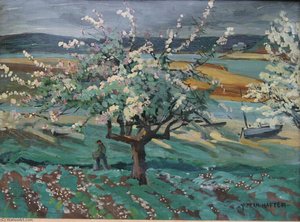
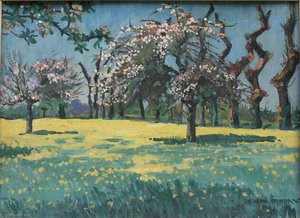
    • Pommiers en fleur dans un champ de colza
    • Moulin près de Concarneau (titre inscrit)
    • Tentad à St Nicodème
  • More…
  • Art period: Modern
  • Emotional tone: tranquil
  • Died: 1993
  • Mediums:
    • oil on canvas
    • watercolor
  • Copyright status: Under copyright
  • Room fit:
    • living room
    • wellness center
  • Born: 1895
  • Typical colors: clay
  • Works on APS: 95
  • Creative periods:
    • mature period
    • early modern

Art Quiz

There is only one correct answer for each question.

Question 1:
What is Yvonne Jean-Haffen known for?
Question 2:
In which art movement did Yvonne Jean-Haffen primarily work?
Question 3:
Where was Yvonne Jean-Haffen born?
Question 4:
What is the main subject of her paintings?
Question 5:
When did Yvonne Jean-Haffen pass away?

Yvonne Jean Haffen: A Breton Soul Captured in Art Deco Landscapes

Yvonne Jean Haffen (1895 – 1993) emerged from the vibrant artistic milieu of Paris, yet her heart belonged to Brittany—specifically Dinan and its surrounding landscapes. Born into a family steeped in artistic tradition, she honed her skills independently, eschewing formal training for a profound connection with nature and a masterful grasp of Art Deco aesthetics. Her canvases bear witness to this duality, presenting serene Breton vistas imbued with geometric precision and luminous color palettes characteristic of the era.

Early Life and Artistic Influences

Little is known about Haffen’s formative years beyond her birth in Paris. However, anecdotal evidence suggests she possessed an innate talent for drawing from a young age—a gift nurtured by her father, who was himself a painter. This familial encouragement undoubtedly fostered her artistic inclinations and instilled within her a lifelong appreciation for visual expression. Crucially, Haffen absorbed the stylistic currents of Art Deco, which dominated European design during the 1920s and 30s. The streamlined forms, bold colors, and stylized ornamentation found in buildings and decorative arts profoundly impacted her artistic vision. Artists like Maurice Sterne and Jean Dubois served as important references for her style.

The Breton Landscape: A Recurring Motif

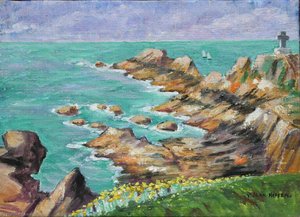
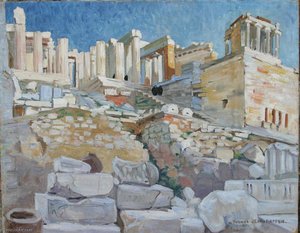
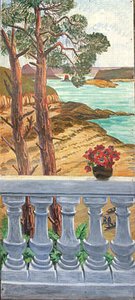
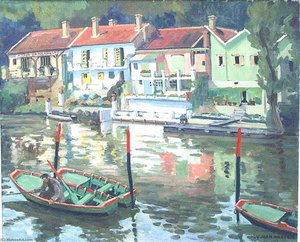
Haffen’s oeuvre is overwhelmingly devoted to depicting Brittany's rural landscapes—particularly the Vallée de la Rance and Dinan vu de la Grande Vigne. These paintings aren’t merely topographical representations; they are imbued with a palpable sense of atmosphere and emotion. She skillfully employed techniques reminiscent of Impressionism, blending brushstrokes to capture fleeting moments of light and color, yet she tempered this approach with Art Deco's geometric rigor. The resulting compositions convey both tranquility and dynamism—a reflection of the region’s beauty and vitality. Her meticulous attention to detail—the textures of stone walls, the shimmering surface of water, the delicate hues of autumn foliage—elevates her work beyond mere visual accuracy.

Notable Works and Recognition

Among Haffen's most celebrated paintings are “Chapelle en Finistère” and “The Women of Pont-Aven.” “Chapelle en Finistère,” executed in 1933, exemplifies her mastery of color and form, capturing the solemn grandeur of a Breton chapel bathed in golden sunlight. Similarly, "The Women of Pont-Aven," completed around 1928, portrays a group of women gathered on the bridge overlooking Pont-Aven—a scene rendered with understated elegance and symbolic resonance. Her work gained recognition within the artistic circles of Paris during her lifetime, securing exhibitions at prestigious galleries and establishing her reputation as a distinctive voice in Breton art.

Legacy and Artistic Significance

Yvonne Jean Haffen’s contribution to Breton painting is undeniable. She skillfully blended Impressionistic sensibilities with Art Deco principles, creating landscapes that are both aesthetically captivating and emotionally resonant. Her paintings serve as invaluable documents of the region's cultural heritage—a testament to the enduring power of art to capture beauty and convey emotion. Furthermore, she represents a significant figure in the broader context of Art Deco’s influence on European painting, demonstrating how stylistic innovations could be adapted to express profound artistic vision. Her legacy continues to inspire artists today who seek to honor the spirit of Brittany's landscapes through their own creative endeavors.