Portrait of William Sidney Mount

The 76 Most Famous William Sidney Mount Paintings, a Gallery Selection

Updated November 2026 · ranked by our popularity score (searches, visits and orders for each work) · 78 works by William Sidney Mount in our catalogue

In short

Of all the originals William Sidney Mount left, the most famous is Loss and Gain (1848), in the collection of the Museums at Stony Brook, Stony Brook. Close behind it come School Boys Quarreling (1830) and Bar-room Scene (1835). Our catalog holds 78 works by William Sidney Mount; the gallery has kept the 76 the world admires most, each shown with its date, its museum and its story.

1807 – 1868, Long Island Genre painting Most works: Museums at Stony Brook

William Sidney Mount's top 10 paintings: the gallery's choice

1
Loss and Gain (1848) by William Sidney Mount

Loss and Gain

1848 · Oil On Canvas · Museums at Stony Brook, Stony Brook

To stand before William Sidney Mount's Loss and Gain is to step across the threshold of time and into a moment suspended by profound thought. This oil on canvas, dating from 1848, does more than merely depict a scene; it invites an intimate dialogue with the viewer regarding the delicate balance of human existence. The composition centers upon an elderly man seated quietly upon a log within the embrace of…

2
School Boys Quarreling (1830) by William Sidney Mount

School Boys Quarreling

1830 · Oil On Canvas · Museums at Stony Brook, Stony Brook

To stand before William Sidney Mount’s School Boys Quarreling is to be instantly transported back to the vibrant, unscripted moments of early nineteenth-century life. This oil on canvas, dating from 1830, is far more than a mere depiction of boys playing; it is a masterful study in human interaction, capturing the raw energy and complex emotional currents that define childhood itself. Mount, celebrated as a pioneer of American genre painting,…

3
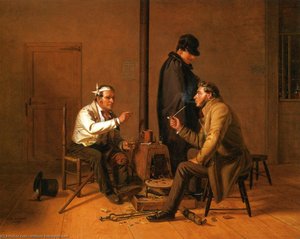
Bar-room Scene (1835) by William Sidney Mount

Bar-room Scene

1835 · Oil On Canvas · Art Institute of Chicago, Chicago

Bar-room Scene is an oil on canvas work by William Sidney Mount, executed about 1835. The artist, born in 1807 in Long Island, United States, established himself as a pioneer of American genre painting. His focus remained largely on the rural landscapes and social interactions of his native region.

4
Portrait of Laertes Chapin (1833) by William Sidney Mount

Portrait of Laertes Chapin

1833 · Oil · High Museum of Art, Atlanta

In Portrait of Laertes Chapin, William Sidney Mount employs a vertical bust-length composition to establish a sense of formal dignity. The sitter is positioned slightly off-center, facing forward with a subtle three-quarter turn that provides a sculptural quality to the subject's features. This arrangement directs the viewer's attention toward the interplay of light and shadow across the face and neck.

5
Portrait of Laura Colton Chapin (1833) by William Sidney Mount

Portrait of Laura Colton Chapin

1833 · Oil · High Museum of Art, Atlanta

In the Portrait of Laura Colton Chapin by William Sidney Mount, the subject sits in a quiet three-quarter view, her gaze turned slightly toward the viewer. She is framed by hair styled into intricate, tight ringlets that trace the line of her forehead, all topped by a dark, decorative headpiece. The color palette remains dominated by deep, somber tones. Her dress appears as a heavy, smooth black, which contrasts against…

6
Self Portrait (1832) by William Sidney Mount

Self Portrait

1832 · Oil On Canvas

In this 1832 oil on canvas, the artist William Sidney Mount gazes out from the past, presenting a formal portrait of a young man. The subject looks directly at us, capturing a moment of quiet dignity. This work, titled Self Portrait, offers a rare glimpse into the early years of William Sidney Mount as he establishes his presence through the medium of paint. He presents himself with a sense of…

7
Portrait of Julia Ann Seabury (1846) by William Sidney Mount

Portrait of Julia Ann Seabury

1846 · Oil · Museum of Fine Arts, Houston

In the Portrait of Julia Ann Seabury by William Sidney Mount, the subject is presented in a bust-length composition. She is positioned slightly off-center, with her gaze directed toward the viewer's right. The color palette is dominated by warm, natural tones, including the creamy white of her chemise, the red of her shawl, and the soft pinks and ochres used for her skin and the surrounding environment. The background consists…

8
Portrait of Maria Seabury (1846) by William Sidney Mount

Portrait of Maria Seabury

1846 · Oil On Canvas · Museum of Fine Arts, Houston

In the Portrait of Maria Seabury by William Sidney Mount, a young woman is captured in a bust-length view. She sits slightly off-center, her steady gaze meeting the viewer with a quiet dignity. A bright white chemise and a red shawl provide a sharp contrast against the muted tones of the environment. These colors anchor her presence within the frame, separating her from the hazy atmosphere behind her.

10
The Banjo Player (1850) by William Sidney Mount

The Banjo Player

1850 · Oil On Canvas · Detroit Institute of Arts, Detroit

The Banjo Player by William Sidney Mount presents a young Black boy positioned within a dimly lit interior. The subject is dressed in a striped cap, a vest, and a tie. He is captured in a moment of quietude, his gaze directed toward the right of the frame.

The William Sidney Mount selection continues, 11 to 76

11Portrait of Hannah Muncy Smith (1852) by William Sidney MountPortrait of Hannah Muncy Smith1852 · Rhode Island School of Design Museum of Art 12Julia Parish Raymond (1851) by William Sidney MountJulia Parish Raymond1851 · Museum of Fine Arts 13After Dinner (1834) by William Sidney MountAfter Dinner1834 · Yale University Art Gallery 14Martin Euclid Thompson (1830) by William Sidney MountMartin Euclid Thompson1830 · Metropolitan Museum of Art 15The Painter's Triuimph (also known as Artist Showing His Own Work) (1838) by William Sidney MountThe Painter's Triuimph (also known as Artist Showing His Own Work)1838 · Pennsylvania Academy of Fine Arts 16Dancing on the Barn Floor (1831) by William Sidney MountDancing on the Barn Floor1831 · Museums at Stony Brook 17The Long Story (also known as The Tough Story) (1837) by William Sidney MountThe Long Story (also known as The Tough Story)1837 · National Gallery of Art 18Dance of the Haymakers (1845) by William Sidney MountDance of the Haymakers1845 · Museums at Stony Brook 19The Truant Gamblers (also known as Undutiful Boys) (1835) by William Sidney MountThe Truant Gamblers (also known as Undutiful Boys)1835 · New York Historical Society 20Ringing the Pig (also known as Scene in a Long Island Farm-Yard) (1842) by William Sidney MountRinging the Pig (also known as Scene in a Long Island Farm-Yard)1842 21Saul and the Witch of Endor (1828) by William Sidney MountSaul and the Witch of Endor1828 · Smithsonian American Art Museum 22Farmer Whetting His Sythe (1848) by William Sidney MountFarmer Whetting His Sythe1848 · Museums at Stony Brook 23Catching Rabbits (1839) by William Sidney MountCatching Rabbits1839 · Museums at Stony Brook 24Caught Napping (1848) by William Sidney MountCaught Napping1848 · Brooklyn Museum 25Great-Grand-Father's Tale of the Revolution—A Portrait of Reverend Zachariah Greene (1852) by William Sidney MountGreat-Grand-Father's Tale of the Revolution—A Portrait of Reverend Zachariah Greene1852 · Metropolitan Museum of Art 26Crane Neck Across the Marsh (1841) by William Sidney MountCrane Neck Across the Marsh1841 · Museums at Stony Brook 27Gideon Tucker (1830) by William Sidney MountGideon Tucker1830 · Metropolitan Museum of Art 28Self Portrait With Flute (1828) by William Sidney MountSelf Portrait With Flute1828 29Farmers Nooning (1836) by William Sidney MountFarmers Nooning1836 · Museums at Stony Brook 30Portrait of Reuben Merrill (1832) by William Sidney MountPortrait of Reuben Merrill1832 31Catherine Adele Smith (1846) by William Sidney MountCatherine Adele Smith1846 32The Trap is Sprung (1844) by William Sidney MountThe Trap is Sprung1844 33The Card Players (1847) by William Sidney MountThe Card Players1847 34The Novice (1847) by William Sidney MountThe Novice1847 35Mount’s trompe l’oeil painted music stand (1855) by William Sidney MountMount’s trompe l’oeil painted music stand1855 36Cradle of Harmony Violin (1851) by William Sidney MountCradle of Harmony Violin1851 37Quarter of Twelve (1855) by William Sidney MountQuarter of Twelve1855 38Portrait of William Vickham Mills Smith (1849) by William Sidney MountPortrait of William Vickham Mills Smith1849 · Detroit Institute of Arts 39Setauket Military Band (1855) by William Sidney MountSetauket Military Band1855 40Just in Tune (1849) by William Sidney MountJust in Tune1849 · Museums at Stony Brook 41Cracking Nuts (1856) by William Sidney MountCracking Nuts1856 42Fruit Piece: Apples on Tin Cups (1863) by William Sidney MountFruit Piece: Apples on Tin Cups1863 43The Residence of the Honorable William H. Ludlow (1859) by William Sidney MountThe Residence of the Honorable William H. Ludlow1859 44The Picnic (1856) by William Sidney MountThe Picnic1856 45Spring Bouquet (1857) by William Sidney MountSpring Bouquet1857 46The Banjo Player (1856) by William Sidney MountThe Banjo Player1856 47Thomas Strongs House, Setauket, Long Island (1864) by William Sidney MountThomas Strongs House, Setauket, Long Island1864 48The Bone Player (1856) by William Sidney MountThe Bone Player1856 · Museum of Fine Arts 49Right and Left (1850) by William Sidney MountRight and Left1850 · Museums at Stony Brook 50Rustic Dance After a Sleigh Ride (1830) by William Sidney MountRustic Dance After a Sleigh Ride1830 · Museum of Fine Arts 51The Stone Bridge (1843) by William Sidney MountThe Stone Bridge1843 · Thyssen-Bornemisza Museum 52Christ Raising the Daughter of Jairus (1828) by William Sidney MountChrist Raising the Daughter of Jairus1828 · Museums at Stony Brook 53Long Island Farmhouses (1862) by William Sidney MountLong Island Farmhouses1862 · Metropolitan Museum of Art 54The Painter's Triumph (1838) by William Sidney MountThe Painter's Triumph1838 55Courtship (also known as Winding Up) (1836) by William Sidney MountCourtship (also known as Winding Up)1836 · Nelson-Atkins Museum of Art 56Coming to the Point (1854) by William Sidney MountComing to the Point1854 57Coming to the Point (1854) by William Sidney MountComing to the Point1854 58Cider Making (1841) by William Sidney MountCider Making1841 · Metropolitan Museum of Art 59Dregs in the Cup (also known as Fortune Telling) (1838) by William Sidney MountDregs in the Cup (also known as Fortune Telling)1838 60Fair Exchange, No Robbery (1865) by William Sidney MountFair Exchange, No Robbery1865 · Museums at Stony Brook 61Eel Spearing at Setauket (also known as Recolections of Early Days - Fishing Along Shore'')'' (1845) by William Sidney MountEel Spearing at Setauket (also known as Recolections of Early Days - Fishing Along Shore'')''1845 62Raffling for the Goose (also known as The Raffle) (1837) by William Sidney MountRaffling for the Goose (also known as The Raffle)1837 · Metropolitan Museum of Art 63The Sportsman's Last Visit (1835) by William Sidney MountThe Sportsman's Last Visit1835 · Museums at Stony Brook 64Long Island Farmer Husking Corn (1833) by William Sidney MountLong Island Farmer Husking Corn1833 · Museums at Stony Brook 65The Fence on the Hill by William Sidney MountThe Fence on the HillMuseum of Fine Arts 66The Barn by the Pool by William Sidney MountThe Barn by the PoolMuseum of Fine Arts 67Mrs gideon tucker by William Sidney MountMrs gideon tuckerMetropolitan Museum of Art 68The raffle by William Sidney MountThe raffleMetropolitan Museum of Art 69Long island farmhouses by William Sidney MountLong island farmhouses 70Great grand fathers tale of the revolution by William Sidney MountGreat grand fathers tale of the revolution 71Catching Crabs by William Sidney MountCatching Crabs 72Self Portrait (also known as The Artist Sketching) by William Sidney MountSelf Portrait (also known as The Artist Sketching)Harvard Art Museums 73Kitchen in the Mount House, Stony Brook by William Sidney MountKitchen in the Mount House, Stony Brook 74Catching the Tune (1866) by William Sidney MountCatching the Tune1866 · Museums at Stony Brook 75Cider Making (1840) by William Sidney MountCider Making1840 · Metropolitan Museum of Art 76The Power of Music (1847) by William Sidney MountThe Power of Music1847 · Cleveland Museum of Art

William Sidney Mount's famous paintings, period by period

The subjects that held William Sidney Mount's eye

The four subjects that come back most often in these originals, each with its finest example.

The museums that keep William Sidney Mount's originals

The 8 museums that hold the most of the paintings on this page.

Museum City Works by William Sidney Mount Paintings from this list
Museums at Stony Brook, Stony BrookMuseums at Stony Brook Stony Brook 15 Loss and Gain, School Boys Quarreling, Dancing on the Barn Floor
Metropolitan Museum of Art, New YorkMetropolitan Museum of Art New York 9 Martin Euclid Thompson, Great-Grand-Father's Tale of the Revolution—A Portrait of Reverend Zachariah Greene, Gideon Tucker
Museum of Fine Arts, BostonMuseum of Fine Arts Boston 5 Julia Parish Raymond, The Bone Player, Rustic Dance After a Sleigh Ride
High Museum of Art, AtlantaHigh Museum of Art Atlanta 2 Portrait of Laertes Chapin, Portrait of Laura Colton Chapin
Museum of Fine Arts, HoustonMuseum of Fine Arts Houston 2 Portrait of Julia Ann Seabury, Portrait of Maria Seabury
Detroit Institute of Arts, DetroitDetroit Institute of Arts Detroit 2 The Banjo Player, Portrait of William Vickham Mills Smith
Art Institute of Chicago, ChicagoArt Institute of Chicago Chicago 1 Bar-room Scene
New Britain Museum of American Art, New BritainNew Britain Museum of American Art New Britain 1 At the Well

William Sidney Mount decade by decade: the original that defines each

Works per decade

Pick a decade to see the original that defines it.

Collectors' questions about William Sidney Mount's paintings

Which work is William Sidney Mount most famous for?Reveal the answer

Loss and Gain (1848), Museums at Stony Brook, Stony Brook. School Boys Quarreling (1830) and Bar-room Scene (1835) come next.

What age was William Sidney Mount when Loss and Gain was made?Reveal the answer

41 years old: Loss and Gain dates from 1848, and William Sidney Mount was born in 1807.

What are the ten most famous William Sidney Mount paintings?Reveal the answer

Loss and Gain, School Boys Quarreling, Bar-room Scene, Portrait of Laertes Chapin, Portrait of Laura Colton Chapin, Self Portrait, Portrait of Julia Ann Seabury, Portrait of Maria Seabury, At the Well and The Banjo Player. The ranking above gives each one's year and museum.

How many paintings did William Sidney Mount leave?Reveal the answer

Our catalog holds 78 works by William Sidney Mount, dated from 1828 to 1866.

In which museums do William Sidney Mount's masterpieces hang?Reveal the answer

Mostly in Museums at Stony Brook (Stony Brook), Metropolitan Museum of Art (New York) and Museum of Fine Arts (Boston). The museum table above lists them all.

In which years did William Sidney Mount paint the most famous works?Reveal the answer

In 1830s: 22 of the 76 works on this page were made then, School Boys Quarreling among them.

What are the first and the last famous originals of William Sidney Mount?Reveal the answer

On this page, the earliest is Saul and the Witch of Endor (1828) and the latest Catching the Tune (1866).

Which subjects did William Sidney Mount choose most often?Reveal the answer

American art (9), Rural life (9) and 19th century (6), across the 76 works on this page.

Which technique did William Sidney Mount use most?Reveal the answer

Oil On Canvas, for 28 of the 76 works on this page.

To which art movement does William Sidney Mount belong?Reveal the answer

Genre painting, judging by the originals on this page.

Which William Sidney Mount works hang at the Museums at Stony Brook?Reveal the answer

Loss and Gain, School Boys Quarreling and Dancing on the Barn Floor: the Museums at Stony Brook, Stony Brook holds 15 of the works on this page.

William Sidney Mount: life and work

A Pioneer of American Genre Painting

William Sidney Mount, born November 26, 1807, in the quiet hamlet of Setauket, Long Island, emerged as a pivotal figure in the development of distinctly American art. He wasn’t drawn to the grand historical narratives or formal portraiture favored by many of his contemporaries; instead, Mount turned his keen eye toward the everyday lives unfolding around him – the farmers, musicians, and ordinary folk who populated the rural landscapes of 19th-century Long Island. This dedication to depicting scenes of common life established him as a pioneer of genre painting in America, a style that celebrated the dignity and inherent beauty found within the mundane. His artistic journey was deeply rooted in his upbringing; his father operated a bustling farm, store, and tavern, while his uncle Micah Hawkins was a man of varied talents – a composer, playwright, mimic, and poet – fostering an environment rich with both artistic expression and observation of human character.

Early Training and Artistic Awakening

Mount’s initial foray into the art world began not in a formal academy but through an apprenticeship with his older brother, Henry Smith Mount, a sign painter in New York City. This practical training honed his skills in draftsmanship and painting technique, providing a solid foundation for future endeavors. However, it was a visit to the American Academy of the Fine Arts exhibition in 1825 that truly ignited his artistic passion. Immersed in the works of established artists, Mount experienced an awakening, shifting his focus from traditional subjects toward capturing authentic moments from everyday life. He established his own studio in New York City in 1829, a significant step towards independence and solidifying his commitment to pursuing art as a profession. Though initially influenced by historical painting—he created works like *Christ Raising the Daughter of Jairus* (1828)—Mount soon found his true calling lay in portraying the world he knew best: the rural life of Long Island. He was captivated by the rhythms and interactions of those around him, recognizing a compelling narrative within their simple existence.

Capturing Rural Life with Realism and Warmth

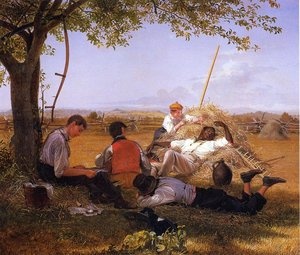
Mount’s artistic style is characterized by an unwavering realism coupled with a remarkable ability to infuse his scenes with warmth and humor. He didn't idealize rural life; rather, he presented it as it was – full of both labor and leisure, hardship and joy. His attention to detail is meticulous, from the textures of clothing to the expressions on faces, creating a sense of immediacy and authenticity. *Dancing on the Barn Floor* (1831), one of his early successes, exemplifies this approach; it’s a lively depiction of a rural dance, brimming with energy and capturing the spirit of communal celebration. Later works like *The Banjo Player* (1856) demonstrate not only his technical skill but also a profound sensitivity to his subjects. This poignant portrait of an African American musician is particularly noteworthy for its dignified portrayal, challenging prevailing stereotypes of the time. Other notable paintings include *The Long Story* (also known as *The Tough Story*) and *Right and Left*, each offering a glimpse into the lives and experiences of ordinary Americans.

Innovation Beyond the Canvas

Mount’s creativity extended beyond painting; he was also an accomplished musician and inventor. He played the fiddle with skill, composed music, and dedicated considerable time to designing his own version of the violin, which he affectionately named the “Cradle of Harmony.” This passion for music frequently found its way into his artwork, with many paintings featuring musicians or scenes of musical performance. In 1860, demonstrating a remarkable spirit of innovation, Mount constructed a portable studio within a horse-drawn wagon. This mobile workspace allowed him to travel freely throughout Long Island, painting directly from life and capturing spontaneous moments as they unfolded. It was a testament to his dedication to authenticity and his desire to connect with the people he depicted.

Legacy and Enduring Influence

William Sidney Mount passed away on November 19, 1868, in his beloved Setauket, leaving behind a rich artistic legacy that continues to resonate today. His pioneering work in genre painting helped establish it as a significant force within the American art landscape, paving the way for future generations of artists who sought to capture the essence of American identity and culture. He is remembered not only for his technical skill and realistic depictions but also for his compassionate portrayal of everyday people, celebrating their lives with dignity and respect. His home and studio are now designated as a National Historic Landmark, preserving his creative space as a testament to his enduring influence. Mount’s paintings offer a valuable window into 19th-century American life, reminding us of the beauty and significance found within the ordinary moments that shape our shared history. He was truly a chronicler of rural America, an artist who understood the power of art to connect us to our past and to each other.