Portrait of William Shiels

The 42 Most Famous William Shiels Paintings, Each One of a Kind

Updated November 2026 · ranked by our popularity score (searches, visits and orders for each work) · 42 works by William Shiels in our catalogue

In short

Portrait of a Man Sitting at a Table with an Open Book (1830) is the William Shiels painting that draws the most eyes; the original belongs to the Llyfrgell Genedlaethol Cymru / The National Library of Wales, Aberystwyth. After it, the eye goes to Discussing a Catch of Salmon in a Scottish Fishing-Lodge (1840) and Five Glamorgan Cattle. Among the 42 works of William Shiels in our catalog, these 42 are the most famous, each a unique original presented with its year, its museum and the reason it endures.

1785 – 1857 Contemporary realism Most works: National Museums Scotland Reserve Collection

Top 10 paintings by William Shiels, through the gallery's eye

3
Five Glamorgan Cattle by William Shiels

Five Glamorgan Cattle

Oil

In this oil painting, five cows occupy a grassy field under a soft light. The animals are positioned at varying depths within the landscape, with some figures situated in the immediate foreground while others recede toward the middle ground. The cattle appear in states of rest or grazing, their forms defined by subtle shifts in tone and shadow. Two horses are also present in the scene; one is positioned near…

4
Reverend George Home of Gunsgreen (1749–1836) (1814) by William Shiels

Reverend George Home of Gunsgreen (1749–1836)

1814 · Oil

The portrait presents a man of significant social standing, captured in a moment of stern contemplation. He wears a traditional wig and a crisp white collar, markers of his clerical or societal importance during the early nineteenth century. His gaze is direct, meeting the viewer with an intensity that suggests a life of discipline and authority. The composition is anchored by a deep red background, a choice that provides a…

5
Three Welsh Sheep (1835) by William Shiels

Three Welsh Sheep

1835 · Oil

A ram and two ewes occupy a rugged, rocky hillside under a heavy, clouded sky. The composition is structured vertically, placing the ram in a dominant position above the ewes to create a sense of depth and hierarchy. Light descends from the upper left, casting subtle shadows that define the musculature of the animals and the uneven texture of the terrain. The palette remains muted, relying on shades of brown,…

6
Two Welsh Goats (1835) by William Shiels

Two Welsh Goats

1835 · Oil

The mountain air feels still as two Welsh goats occupy a rugged slope. One animal pauses, its gaze fixed upon its companion who is already turning away, moving toward the edge of the frame. This subtle interaction creates a sense of fleeting movement, a momentary pause in the daily rhythm of the herd. Nearby, a ram and a sheep linger within the same landscape, their presence grounding the scene in…

7
Possibly William Loades Rix (c.1777–1855) (1832) by William Shiels

Possibly William Loades Rix (c.1777–1855)

1832 · Oil

This portrait, titled Possibly William Loades Rix (c.1777–1855), presents a man captured in a moment of quiet stillness. Painted by William Shiels about 1832, the work focuses on the subject from the chest up. The figure emerges from a dark, shadowed background, a choice that pushes the man toward the viewer. He is a man of the early nineteenth century, his presence defined by the formal weight of his attire…

William Shiels's famous paintings, numbers 11 to 42

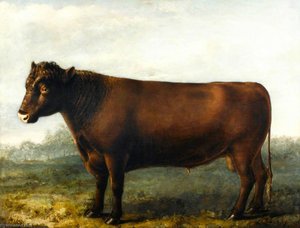
11John Dick (c.1769–1844) by William ShielsJohn Dick (c.1769–1844) 12Two Children Feeding Chickens by William ShielsTwo Children Feeding ChickensNational Trust 13Longhorn Cow by William ShielsLonghorn CowNational Museums Scotland Reserve Collection 14Shorthorn by William ShielsShorthornNational Museums Scotland Reserve Collection 15The Galloway Breed by William ShielsThe Galloway BreedNational Museums Scotland Reserve Collection 16South Down Ram by William ShielsSouth Down RamNational Museums Scotland Reserve Collection 17Black faced Horned Ram by William ShielsBlack faced Horned RamNational Museums Scotland Reserve Collection 18Ewe and Lamb by William ShielsEwe and LambNational Museums Scotland Reserve Collection 19Suffolk Punch Stallion (diptych) by William ShielsSuffolk Punch Stallion (diptych)National Museums Scotland Reserve Collection 20Polled Suffolk Bull by William ShielsPolled Suffolk BullNational Museums Scotland Reserve Collection 21Cotswold Ram (diptych) by William ShielsCotswold Ram (diptych)National Museums Scotland Reserve Collection 22Shorthorn Bull by William ShielsShorthorn BullNational Museums Scotland Reserve Collection 23Old Lincoln Ewe and Lamb (diptych) by William ShielsOld Lincoln Ewe and Lamb (diptych)National Museums Scotland Reserve Collection 24Siamese Sow and Piglets by William ShielsSiamese Sow and PigletsNational Museums Scotland Reserve Collection 25Old English Black Horse by William ShielsOld English Black HorseNational Museums Scotland Reserve Collection 26Brecon and Glamorgan Highland Goats (diptych) by William ShielsBrecon and Glamorgan Highland Goats (diptych)National Museums Scotland Reserve Collection 27Hereford Cow and Calf (diptych) by William ShielsHereford Cow and Calf (diptych)National Museums Scotland Reserve Collection 28Somerset Ewe and Lamb (diptych) by William ShielsSomerset Ewe and Lamb (diptych)National Museums Scotland Reserve Collection 29Dorset Ram and Ewe by William ShielsDorset Ram and EweNational Museums Scotland Reserve Collection 30Margaret Home of Gunsgreen by William ShielsMargaret Home of Gunsgreen 31Connemara Gelding by William ShielsConnemara GeldingNational Museums Scotland Reserve Collection 32Exmoor Ram and Ewe (diptych) by William ShielsExmoor Ram and Ewe (diptych)National Museums Scotland Reserve Collection 33Ryeland Ram, Ewe and Lamb (diptych) by William ShielsRyeland Ram, Ewe and Lamb (diptych)National Museums Scotland Reserve Collection 34North Devon Cow by William ShielsNorth Devon CowNational Museums Scotland Reserve Collection 35The Fifeshire Breed (also known as the Fife Horned Cow or Falkland Breed) by William ShielsThe Fifeshire Breed (also known as the Fife Horned Cow or Falkland Breed) 36West Highland Ponies by William ShielsWest Highland Ponies 37A Berkshire Pig by William ShielsA Berkshire Pig 38Orkney and Shetland Sheep by William ShielsOrkney and Shetland Sheep 39Improved Leicester Ewe by William ShielsImproved Leicester EweNational Museums Scotland Reserve Collection 40Four Dogs a Collie from Tweedale, a Scots Deerhound, an Otter Terrier and a Scots Terrier by William ShielsFour Dogs a Collie from Tweedale, a Scots Deerhound, an Otter Terrier and a Scots Terrier 41An Old Lincoln Ram by William ShielsAn Old Lincoln RamNational Museums Scotland Reserve Collection 42A Shorthorn Bull ('Romulus' from Roxburghshire) by William ShielsA Shorthorn Bull ('Romulus' from Roxburghshire)

The subjects that held William Shiels's eye

The four subjects that come back most often in these originals, each with its finest example.

The museums that keep William Shiels's originals

The 4 museums that hold the most of the paintings on this page.

Museum City Works by William Shiels Paintings from this list
National Museums Scotland Reserve Collection, EdinburghNational Museums Scotland Reserve Collection Edinburgh 23 Longhorn Cow, Shorthorn, The Galloway Breed
Llyfrgell Genedlaethol Cymru / The National Library of Wales, AberystwythLlyfrgell Genedlaethol Cymru / The National Library of Wales Aberystwyth 3 Portrait of a Man Sitting at a Table with an Open Book, Portrait of a Seated Woman, Portrait of a Seated Man
Yale Center for British Art, New HavenYale Center for British Art New Haven 1 Discussing a Catch of Salmon in a Scottish Fishing-Lodge
National Trust, DerbyNational Trust Derby 1 Two Children Feeding Chickens

William Shiels across the decades: one unique original for each

Works per decade

Pick a decade to see the original that defines it.

William Shiels's paintings: questions for the gallery

What is the single most famous work of William Shiels?Reveal the answer

Portrait of a Man Sitting at a Table with an Open Book (1830), Llyfrgell Genedlaethol Cymru / The National Library of Wales, Aberystwyth. Discussing a Catch of Salmon in a Scottish Fishing-Lodge (1840) and Five Glamorgan Cattle come next.

At what age did William Shiels create Portrait of a Man Sitting at a Table with an Open Book?Reveal the answer

45 years old: Portrait of a Man Sitting at a Table with an Open Book dates from 1830, and William Shiels was born in 1785.

Which ten paintings by William Shiels are the most famous?Reveal the answer

Portrait of a Man Sitting at a Table with an Open Book, Discussing a Catch of Salmon in a Scottish Fishing-Lodge, Five Glamorgan Cattle, Reverend George Home of Gunsgreen (1749–1836), Three Welsh Sheep, Two Welsh Goats, Possibly William Loades Rix (c.1777–1855), Portrait of a Seated Woman, Portrait of a Seated Man and William Dick (1793–1866). The ranking above gives each one's year and museum.

How many works by William Shiels are known?Reveal the answer

Our catalog holds 42 works by William Shiels, dated from 1814 to 1843.

Where can the most famous William Shiels originals be seen?Reveal the answer

Mostly in National Museums Scotland Reserve Collection (Edinburgh), Llyfrgell Genedlaethol Cymru / The National Library of Wales (Aberystwyth) and Yale Center for British Art (New Haven). The museum table above lists them all.

During which period did William Shiels create the best-known paintings?Reveal the answer

In 1830s: 4 of the 42 works on this page were made then, Portrait of a Man Sitting at a Table with an Open Book among them.

Which famous William Shiels painting is the earliest, and which the latest?Reveal the answer

On this page, the earliest is Reverend George Home of Gunsgreen (1749–1836) (1814) and the latest Portrait of a Seated Woman (1843).

What subjects did William Shiels favour?Reveal the answer

Portrait (3), Rural landscape (3) and Victorian (2), across the 42 works on this page.

What materials did William Shiels paint with most?Reveal the answer

Oil, for 6 of the 42 works on this page.

Which movement does the work of William Shiels belong to?Reveal the answer

Contemporary realism, judging by the originals on this page.

What William Shiels originals can I see at the National Museums Scotland Reserve Collection?Reveal the answer

Longhorn Cow, Shorthorn and The Galloway Breed: the National Museums Scotland Reserve Collection, Edinburgh holds 23 of the works on this page.

William Shiels: a portrait of the artist

William Shiels: Bridging the Victorian Era Through Portraiture and Artistic Patronage

William Shiels (1785-1857) stands as a significant, yet often understated, figure in 19th-century British art. More than simply a portrait painter, he was a pivotal director of the South Carolina Academy of Fine Arts, a role that shaped the artistic landscape of early American art institutions and provided a platform for emerging talent. His career spanned several decades, marked by a dedication to capturing distinguished figures – from nobility and politicians to prominent members of society – and a quiet but consistent contribution to the evolving aesthetic sensibilities of his time.

Born in Maghera, County Londonderry, Ireland, Shiels’ early life was steeped in Presbyterian traditions. He arrived in Melbourne, Australia, as a young child in 1853, an experience that profoundly influenced his artistic perspective and likely informed the nuanced portrayals of character he would later develop. He received a solid education, graduating from Scotch College and the University of Melbourne with degrees in law and arts, demonstrating a breadth of intellectual curiosity alongside his burgeoning artistic talent. His legal training, surprisingly, provided a grounding in observation and detail – skills that translated directly to his meticulous portraiture.

A Career Defined by Patronage and Artistic Direction

Shiels’ career trajectory reveals a fascinating interplay between independent practice and institutional leadership. Initially, he established himself as a portrait painter, gaining recognition for his ability to capture the essence of his subjects – their personalities, social standing, and even subtle emotional states. His work frequently featured gentlemen engaged in conversation, often within domestic settings or reflecting on shared experiences, indicative of a keen interest in human interaction and psychological depth. He exhibited at both the Royal Academy in London and the American Academy in New York City, showcasing his versatility and establishing a network of contacts crucial to his professional development.

However, Shiels’ most enduring legacy lies in his tenure as director of the South Carolina Academy of Fine Arts from 1821 to 1822. This role was far more than simply administrative; it represented a deliberate effort to cultivate artistic talent within the burgeoning American South. He actively sought out promising young artists, providing them with opportunities for training and exhibition – effectively laying the groundwork for future generations of Southern painters. His commitment to fostering artistic growth demonstrates a rare blend of entrepreneurial spirit and genuine dedication to the advancement of art.

Style and Influences: A Blend of Neo-Classicism and Romanticism

Shiels’ style is often described as a sophisticated synthesis of neo-classical restraint and romantic sensibility. His portraits are characterized by careful attention to detail, precise draughtsmanship, and an understated elegance. He skillfully employed light and shadow to create a sense of depth and atmosphere, capturing not just the physical likeness of his subjects but also their inner character. While influenced by the prevailing academic traditions of portraiture, Shiels’ work possesses a subtle emotional resonance that distinguishes it from purely formal representations.

The influence of British artists like Sir Thomas Lawrence, known for his idealized portraits of royalty and nobility, is evident in Shiels' compositions and techniques. However, he also incorporated elements of Romanticism – particularly the emphasis on capturing fleeting emotions and the beauty of nature – into his work. This fusion resulted in a distinctive style that resonated with the tastes of the Victorian era.

Legacy and Historical Significance

Despite not achieving widespread fame during his lifetime, William Shiels’ contributions to the development of American art are considerable. His role as director of the South Carolina Academy of Fine Arts was particularly significant, providing a vital platform for artistic education and exhibition in a region where opportunities were limited. His portraits offer valuable insights into the social and cultural dynamics of 19th-century Britain and America, capturing the personalities and aspirations of a diverse range of individuals.

Today, Shiels’ work is appreciated for its technical skill, understated elegance, and subtle psychological depth. His legacy endures through his influence on subsequent generations of artists and his enduring contribution to the rich tapestry of American art history. Further research into his life and works continues to illuminate the complexities of this often-overlooked figure.