Portrait of William Morris Hunt

William Morris Hunt Paintings: The 100 Most Famous, Through a Gallery's Eye

Updated November 2026 · ranked by our popularity score (searches, visits and orders for each work) · 129 works by William Morris Hunt in our catalogue

In short

To the gallery's eye, William Morris Hunt's most famous painting is Charles Francis Adams (1807-1886) (1867), whose original hangs in the Harvard Art Museums, Cambridge. Landscape (1852) and Landscape (1852) complete the trio every eye recognises. Of the 129 works by William Morris Hunt in our catalog, the gallery presents the 100 most famous below, each original with its year, its museum and what makes it unique.

1824 – 1879, Brattleboro Barbizon school Most works: Museum of Fine Arts

The gallery's top 10 William Morris Hunt paintings

1
Charles Francis Adams (1807-1886) (1867) by William Morris Hunt

Charles Francis Adams (1807-1886)

1867 · Oil On Canvas · Harvard Art Museums, Cambridge

The portrait depicts an elderly man, Charles Francis Adams, positioned in a three-quarter length view. He is oriented toward the left of the frame, though his torso is angled toward the viewer. He wears a dark, heavy overcoat with visible lapels and formal 19th-century attire. In his left hand, he holds a rolled document. The lighting originates from the upper left, casting shadows across the right side of his face…

2
Landscape (1852) by William Morris Hunt

Landscape

1852 · Oil On Board

In this 1852 oil painting, a man and a woman walk along a path through a dense woodland. The figures move away from the viewer, positioned within a landscape defined by thickets of trees and a dirt path. A dog follows closely behind the couple, its form slightly smaller as it trails in the wake of the two walkers. The trees in the foreground are rendered with visible, loose brushstrokes,…

3
Landscape (1852) by William Morris Hunt

Landscape

1852 · Oil On Board · Metropolitan Museum of Art, New York

There is a certain stillness in this scene, a moment caught in the soft light of a rural vista. A solitary figure moves along a wooded path, accompanied by a dog, their presence adding a sense of scale to the surrounding trees. The composition is balanced, with the figures positioned slightly off-center, drawing the eye into the depth of the landscape. A rocky outcrop anchors the left side of the…

4
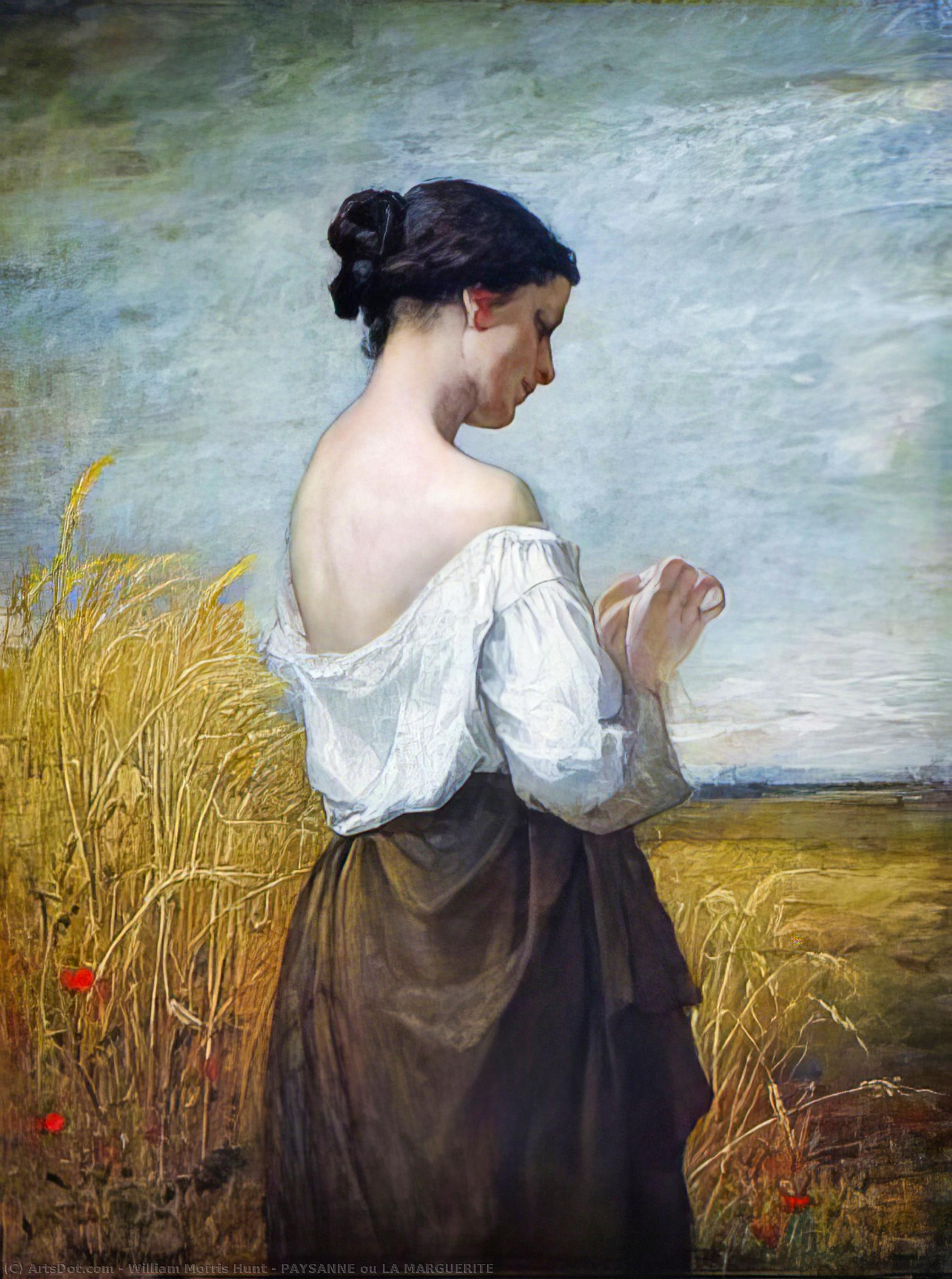
Peasant or the Marguerite by William Morris Hunt

Peasant or the Marguerite

Oil On Canvas

The oil on canvas painting titled Peasant or the Marguerite is a work by the American artist William Morris Hunt. This piece depicts a rural scene centered on a peasant woman positioned within a field of tall wheat. The subject is shown in a moment of quietude, looking down at an object held in her hands.

6
Study for The Fortune Teller (1852) by William Morris Hunt

Study for The Fortune Teller

1852 · Oil · Museum of Fine Arts, Boston

Study for The Fortune Teller is an oil study by the American painter William Morris Hunt. Created about 1852, this work emerged during a formative period in the artist's development. Hunt was born in Brattleboro, United States, in 1824 and remained a significant figure in the American art landscape until his death in 1879.

7
Head of a Girl (1849) by William Morris Hunt

Head of a Girl

1849 · Oil On Canvas · Museum of Fine Arts, Boston

In this intimate portrait, Head of a Girl by William Morris Hunt, we encounter a quiet moment of introspection. The composition focuses closely on the subject's head and shoulders, presenting a view that feels both private and immediate. Rather than a standard rectangular framing, the girl is positioned slightly off-center within an oval-shaped vignette. This choice draws the eye inward, centering our attention on the soft contours of her face…

8
Sheep Shearing at Barbizon (1852) by William Morris Hunt

Sheep Shearing at Barbizon

1852 · Oil · Museum of Fine Arts, Boston

Sheep Shearing at Barbizon is an oil painting by William Morris Hunt. The artist, William Morris Hunt, was born in Brattleboro, United States. This specific work was created in 1852. The painting depicts a scene of manual labor involving sheep and figures within a rustic, dimly lit structure.

9
The Hurdy-Gurdy Boy (1851) by William Morris Hunt

The Hurdy-Gurdy Boy

1851 · Oil On Canvas · Museum of Fine Arts, Boston

A vertical portrait depicts a young boy from the waist up, positioned slightly to the left of the center. He holds a hurdy-gurdy, an instrument characterized by its mechanical complexity and wooden construction. The boy wears a jacket of saturated red, which provides a sharp contrast against the muted, earthy tones of the background. His skin and the fabric of his clothing are rendered with visible, tactile brushstrokes that suggest…

10
Girl Reading (1853) by William Morris Hunt

Girl Reading

1853 · Oil On Canvas · Museum of Fine Arts, Boston

A young woman sits in an armchair, her attention entirely consumed by the book held in her hands. The composition centers her within a shallow space, pushing her figure forward against a dark, indistinct background. Soft, directional light enters from the upper left, catching the white of her blouse and the pale pages of the book to create a focal point amidst the surrounding shadows. This illumination highlights the contours…

William Morris Hunt paintings, ranked 11 to 100

11Self Portrait (1849) by William Morris HuntSelf Portrait1849 · Museum of Fine Arts 12The Violet Girl (1856) by William Morris HuntThe Violet Girl1856 · Rhode Island School of Design Museum of Art 13Mrs. Robert C. Winthrop (Frances Pickering Adams) (1861) by William Morris HuntMrs. Robert C. Winthrop (Frances Pickering Adams)1861 · Museum of Fine Arts 14The Snow Storm (1859) by William Morris HuntThe Snow Storm1859 · Museum of Fine Arts 15The Wounded Drummer Boy (1862) by William Morris HuntThe Wounded Drummer Boy1862 · Museum of Fine Arts 16Morris Hunt (1857) by William Morris HuntMorris Hunt1857 · Museum of Fine Arts 17Girl with Cat (1856) by William Morris HuntGirl with Cat1856 · Museum of Fine Arts 18James Walker (1794-1874) (1860) by William Morris HuntJames Walker (1794-1874)1860 · Harvard Art Museums 19The Lost Profile - Portrait of the Artist's Wife (1856) by William Morris HuntThe Lost Profile - Portrait of the Artist's Wife1856 20Italian Girl (WAM) (1870) by William Morris HuntItalian Girl (WAM)1870 · Worcester Art Museum 21Lt. Huntington Frothingham Wolcott (1867) by William Morris HuntLt. Huntington Frothingham Wolcott1867 · Museum of Fine Arts 22Senator Charles Sumner (1870) by William Morris HuntSenator Charles Sumner1870 · Museum of Fine Arts 23Italian Peasant Boy (1866) by William Morris HuntItalian Peasant Boy1866 · Museum of Fine Arts 24Marguerite (1870) by William Morris HuntMarguerite1870 · Museum of Fine Arts 25Italian Girl (1867) by William Morris HuntItalian Girl1867 · Museum of Fine Arts 26Abraham Lincoln (1865) by William Morris HuntAbraham Lincoln1865 · Museum of Fine Arts 27The Gleaner (1865) by William Morris HuntThe Gleaner1865 · Museum of Fine Arts 28Portrait of a Lady (1870) by William Morris HuntPortrait of a Lady1870 · Museum of Fine Arts 29Hamlet (1864) by William Morris HuntHamlet1864 · Museum of Fine Arts 30Felix Regamy (1864) by William Morris HuntFelix Regamy1864 · Museum of Fine Arts 31Mother and Child (1865) by William Morris HuntMother and Child1865 · Museum of Fine Arts 32Susan Heard Oliver Dabney (1865) by William Morris HuntSusan Heard Oliver Dabney1865 · Harvard Art Museums 33Mary Elizabeth Robbins (1866) by William Morris HuntMary Elizabeth Robbins1866 · Harvard Art Museums 34Portrait of Ellen M. Brown (Mrs. Ellen Berry) (1874) by William Morris HuntPortrait of Ellen M. Brown (Mrs. Ellen Berry)1874 · Rhode Island School of Design Museum of Art 35His First Model-Miss Russell (1873) by William Morris HuntHis First Model-Miss Russell1873 · Cleveland Museum of Art 36Winged Fortune (1878) by William Morris HuntWinged Fortune1878 · Cleveland Museum of Art 37Barthold Schlesinger (1873) by William Morris HuntBarthold Schlesinger1873 · Museum of Fine Arts 38Priscilla (1873) by William Morris HuntPriscilla1873 · Museum of Fine Arts 39Anahita. The Flight of Night (1878) by William Morris HuntAnahita. The Flight of Night1878 · Museum of Fine Arts 40The Gainsborough Hat (1876) by William Morris HuntThe Gainsborough Hat1876 · Museum of Fine Arts 41Miss Ida Mason (1878) by William Morris HuntMiss Ida Mason1878 · Museum of Fine Arts 42Lady with a White Collar (1873) by William Morris HuntLady with a White Collar1873 · Museum of Fine Arts 43Head of a Woman (1872) by William Morris HuntHead of a Woman1872 · Museum of Fine Arts 44Isaac Fenno (1872) by William Morris HuntIsaac Fenno1872 · Museum of Fine Arts 45Sketch for the State Capitol at Albany (Discoverer) (1878) by William Morris HuntSketch for the State Capitol at Albany (Discoverer)1878 · Museum of Fine Arts 46Judge John Lowell (1824-1897) (1872) by William Morris HuntJudge John Lowell (1824-1897)1872 · Harvard Art Museums 47Jean Louis Rodolphe Agassiz (1807-1873) (1874) by William Morris HuntJean Louis Rodolphe Agassiz (1807-1873)1874 · Harvard Art Museums 48Woman with Cow (1874) by William Morris HuntWoman with Cow1874 49Self Portrait (1879) by William Morris HuntSelf Portrait1879 · Museum of Fine Arts 50Portrait of Edward Wheelwright (1857) by William Morris HuntPortrait of Edward Wheelwright1857 · Los Angeles County Museum of Art 51The Horses of Anahita or The Flight of Night (1848) by William Morris HuntThe Horses of Anahita or The Flight of Night1848 · Metropolitan Museum of Art 52Girl with Kitten (also known as Girl with Cat) (1856) by William Morris HuntGirl with Kitten (also known as Girl with Cat)1856 53Girl with Cows (1860) by William Morris HuntGirl with Cows1860 · Los Angeles County Museum of Art 54Acanthus by William Morris HuntAcanthus 55Peasant Girl by William Morris HuntPeasant Girl 56On the Edge of the Forest (1853) by William Morris HuntOn the Edge of the Forest1853 · Museum of Fine Arts 57Sheep (1853) by William Morris HuntSheep1853 · Museum of Fine Arts 58Jane Maria Leavitt Hunt (1850) by William Morris HuntJane Maria Leavitt Hunt1850 59The Jewess (1850) by William Morris HuntThe Jewess1850 60Landscape (1860) by William Morris HuntLandscape1860 · Worcester Art Museum 61Landscape at Newport (1860) by William Morris HuntLandscape at Newport1860 · Museum of Fine Arts 62Sheep Pasture (1857) by William Morris HuntSheep Pasture1857 · Museum of Fine Arts 63Study for The Flight of Night (1863) by William Morris HuntStudy for The Flight of Night1863 · Museum of Fine Arts 64Landscape, The Village Church (1863) by William Morris HuntLandscape, The Village Church1863 · Isabella Stewart Gardner Museum 65The Drummer Boy (1862) by William Morris HuntThe Drummer Boy1862 · Museum of Fine Arts 66Farm Scene (1866) by William Morris HuntFarm Scene1866 · Rhode Island School of Design Museum of Art 67The Spouting Whale (1870) by William Morris HuntThe Spouting Whale1870 · Smithsonian American Art Museum 68Dinan, Brittany (1866) by William Morris HuntDinan, Brittany1866 69Felix Regamy (1864) by William Morris HuntFelix Regamy1864 70Self Portrait (1866) by William Morris HuntSelf Portrait1866 · Museum of Fine Arts 71Captain William Madigan (1866) by William Morris HuntCaptain William Madigan1866 72The Ball Players (1877) by William Morris HuntThe Ball Players1877 · Detroit Institute of Arts 73The Bathers (1877) by William Morris HuntThe Bathers1877 · Worcester Art Museum 74Haying by Oxen (1876) by William Morris HuntHaying by Oxen1876 · Museum of Fine Arts 75Nautilus Fleet (1877) by William Morris HuntNautilus Fleet1877 · Museum of Fine Arts 76Beach Scene with Horses (1874) by William Morris HuntBeach Scene with Horses1874 · Museum of Fine Arts 77Study of Rocks, North Easton (1877) by William Morris HuntStudy of Rocks, North Easton1877 · Museum of Fine Arts 78Meadows in Summer (1877) by William Morris HuntMeadows in Summer1877 · Museum of Fine Arts 79The Gypsies' Parlor (1877) by William Morris HuntThe Gypsies' Parlor1877 · Harvard Art Museums 80Seascape (1877) by William Morris HuntSeascape1877 · Harvard Art Museums 81Niagara Falls (1878) by William Morris HuntNiagara Falls1878 82Niagara Falls (1878) by William Morris HuntNiagara Falls1878 · Museum of Fine Arts 83Portrait of Agnes Elizabeth Clafllin (1875) by William Morris HuntPortrait of Agnes Elizabeth Clafllin1875 · Smithsonian American Art Museum 84View of the St. Johns River, (painting) (1874) by William Morris HuntView of the St. Johns River, (painting)1874 85Study for Fortune'', Albany Murals'' (1878) by William Morris HuntStudy for Fortune'', Albany Murals''1878 86Niagara Falls (1878) by William Morris HuntNiagara Falls1878 87Plowing (1876) by William Morris HuntPlowing1876 88Mother and Children by William Morris HuntMother and ChildrenRhode Island School of Design Museum of Art 89Ideal Head by William Morris HuntIdeal HeadIndianapolis Museum of Art 90Head -- Daughter of Concierge by William Morris HuntHead -- Daughter of ConciergeMuseum of Fine Arts 91Olivia Buckminster Lothrop (Mrs. Lewis William Tappan, Jr.) by William Morris HuntOlivia Buckminster Lothrop (Mrs. Lewis William Tappan, Jr.)Museum of Fine Arts 92Charles J. Morrill by William Morris HuntCharles J. MorrillMuseum of Fine Arts 93Girl at Piano by William Morris HuntGirl at PianoMuseum of Fine Arts 94Enid by William Morris HuntEnidMuseum of Fine Arts 95Portrait of a Lady by William Morris HuntPortrait of a LadyMuseum of Fine Arts 96Portrait of a Lady by William Morris HuntPortrait of a LadyMuseum of Fine Arts 97The Belated Kid by William Morris HuntThe Belated KidMuseum of Fine Arts 98Head of a Girl by William Morris HuntHead of a GirlMuseum of Fine Arts 99Fortune a study for the discoverer by William Morris HuntFortune a study for the discovererMetropolitan Museum of Art 100Fortune anahita a study for the flight of night by William Morris HuntFortune anahita a study for the flight of nightMetropolitan Museum of Art

William Morris Hunt's famous paintings, period by period

The subjects that held William Morris Hunt's eye

The four subjects that come back most often in these originals, each with its finest example.

The museums that keep William Morris Hunt's originals

The 8 museums that hold the most of the paintings on this page.

Museum City Works by William Morris Hunt Paintings from this list
Museum of Fine Arts, BostonMuseum of Fine Arts Boston 62 French Peasant Woman with Pig, Study for The Fortune Teller, Head of a Girl
Harvard Art Museums, CambridgeHarvard Art Museums Cambridge 9 Charles Francis Adams (1807-1886), James Walker (1794-1874), Susan Heard Oliver Dabney
Metropolitan Museum of Art, New YorkMetropolitan Museum of Art New York 10 Landscape, The Horses of Anahita or The Flight of Night, Fortune a study for the discoverer
Rhode Island School of Design Museum of Art, ProvidenceRhode Island School of Design Museum of Art Providence 4 The Violet Girl, Portrait of Ellen M. Brown (Mrs. Ellen Berry), Farm Scene
Worcester Art Museum, WorcesterWorcester Art Museum Worcester 3 Italian Girl (WAM), Landscape, The Bathers
Cleveland Museum of Art, ClevelandCleveland Museum of Art Cleveland 2 His First Model-Miss Russell, Winged Fortune
Los Angeles County Museum of Art, Los AngelesLos Angeles County Museum of Art Los Angeles 2 Portrait of Edward Wheelwright, Girl with Cows
Smithsonian American Art Museum, Washington, D.C.Smithsonian American Art Museum Washington, D.C. 2 The Spouting Whale, Portrait of Agnes Elizabeth Clafllin

William Morris Hunt, one signature painting per decade

Works per decade

Pick a decade to see the original that defines it.

William Morris Hunt's paintings: the gallery answers

Which William Morris Hunt painting is the most famous of all?Reveal the answer

Charles Francis Adams (1807-1886) (1867), Harvard Art Museums, Cambridge. Landscape (1852) and Landscape (1852) come next.

How old was William Morris Hunt on completing Charles Francis Adams (1807-1886)?Reveal the answer

43 years old: Charles Francis Adams (1807-1886) dates from 1867, and William Morris Hunt was born in 1824.

Which are William Morris Hunt's top 10 paintings?Reveal the answer

Charles Francis Adams (1807-1886), Landscape, Landscape, Peasant or the Marguerite, French Peasant Woman with Pig, Study for The Fortune Teller, Head of a Girl, Sheep Shearing at Barbizon, The Hurdy-Gurdy Boy and Girl Reading. The ranking above gives each one's year and museum.

How many works did William Morris Hunt create?Reveal the answer

Our catalog holds 129 works by William Morris Hunt, dated from 1848 to 1879.

Where do William Morris Hunt's most famous originals hang?Reveal the answer

Mostly in Museum of Fine Arts (Boston), Harvard Art Museums (Cambridge) and Metropolitan Museum of Art (New York). The museum table above lists them all.

When did William Morris Hunt create the most famous paintings?Reveal the answer

In 1870s: 37 of the 100 works on this page were made then, Italian Girl (WAM) among them.

Which are William Morris Hunt's earliest and latest famous works?Reveal the answer

On this page, the earliest is The Horses of Anahita or The Flight of Night (1848) and the latest Self Portrait (1879).

Which subjects did William Morris Hunt return to most?Reveal the answer

Woman (24), Portrait (17) and Man (15), across the 100 works on this page.

Which medium did William Morris Hunt work in most?Reveal the answer

Oil On Canvas, for 38 of the 100 works on this page.

Which movement is William Morris Hunt associated with?Reveal the answer

Barbizon school, judging by the originals on this page.

Which William Morris Hunt originals does the Museum of Fine Arts hold?Reveal the answer

French Peasant Woman with Pig, Study for The Fortune Teller and Head of a Girl: the Museum of Fine Arts, Boston holds 55 of the works on this page.

William Morris Hunt: the artist

A Pioneer of American Barbizon Painting

William Morris Hunt, born in Brattleboro, Vermont, in 1824, stands as a pivotal figure in the development of American art during the 19th century. He wasn’t merely a painter; he was an advocate, an educator, and a catalyst who championed the principles of the Barbizon School on American soil. Hunt's lineage reflected both established societal roots – his father descended from Vermont founders, while his mother hailed from Connecticut wealth – and a burgeoning artistic sensibility that would ultimately redefine the landscape of American painting. His early life was marked by privilege but also by an initial suppression of creative inclinations, a situation rectified when his determined mother, Jane Leavitt Hunt, defied convention and relocated the family to Europe in pursuit of proper artistic training for her children. This bold move set the stage for Hunt’s profound engagement with European masters and ultimately shaped his distinctive style.

Formative Years in France: Millet and the Barbizon Circle

Hunt's formal education began under Thomas Couture in Paris, where he received a grounding in classical techniques. However, it was an encounter at the 1851 Paris Salon that irrevocably altered his artistic trajectory. Jean-François Millet’s *The Sower* resonated deeply with Hunt, sparking a profound shift in his aesthetic sensibilities. He abandoned the rigid constraints of academic painting and embarked on a two-year period of direct study with Millet at Barbizon. This immersion into the heart of the Barbizon School proved transformative. The emphasis on plein air painting – working directly from nature – and a commitment to depicting rural life with honesty and realism became cornerstones of Hunt’s artistic philosophy. He absorbed not only Millet's technical approach but also his profound respect for the dignity of labor and the beauty inherent in everyday existence. Historian David McCullough noted that this French training significantly advanced Hunt’s development, while S.G.W. Benjamin recognized his role in directing younger American artists towards Paris and Munich, fostering a new boldness in technique and style.

Returning to America: Portraiture and Landscape

Upon returning to the United States in 1855, following his marriage to Louise Dumaresq Perkins, Hunt established himself as a prominent artist in Boston. While he achieved considerable success as a portrait painter – capturing the likenesses of notable figures like William M. Evarts, Charles Francis Adams, and Senator Charles Sumner – landscape painting remained central to his artistic identity. His landscapes reflected the Barbizon influence: loose brushwork, realistic depictions of rural scenes, and an acute sensitivity to atmospheric effects. He didn’t simply reproduce nature; he sought to capture its essence, its mood, and its fleeting moments of beauty. Notable works from this period include *The Belated Kid*, *Girl at the Fountain*, *Hurdy-Gurdy Boy*, *View of the St. Johns River* (1874), *Woman with Cow* (1874) and *Niagara Falls* (1878). However, tragedy struck in 1872 when the Great Boston Fire consumed many of his paintings, along with a valuable collection of French art, including his cherished copy of Millet’s *The Sower*.

Later Years, Legacy, and Artistic Philosophy

Despite this devastating loss, Hunt continued to paint, accepting commissions for murals at the State Capitol in Albany, New York. These allegorical scenes, unfortunately, deteriorated rapidly due to faulty installation, contributing to a period of profound disappointment and depression. This experience underscored his commitment to artistic integrity and the importance of proper materials and execution. In 1878, he published *Talks About Art*, a collection of essays that articulated his artistic philosophy and received widespread acclaim. Hunt’s legacy extends beyond his own paintings. He was a dedicated teacher who encouraged younger artists to embrace realism and plein air painting, leaving an indelible mark on the development of American art. He championed a shift away from academic conventions towards a more direct and honest engagement with nature, fostering a uniquely American artistic voice. His influence can be seen in the work of countless artists who followed, solidifying his position as a leading figure in the American Barbizon movement and a true pioneer of modern painting. He remains an important link between European traditions and the burgeoning artistic identity of 19th-century America.