Portrait of William Holbrook Beard

The 45 Most Famous William Holbrook Beard Paintings, Each One of a Kind

Updated November 2026 · ranked by our popularity score (searches, visits and orders for each work) · 45 works by William Holbrook Beard in our catalogue

In short

Santa Claus (1862) is the William Holbrook Beard painting that draws the most eyes. After it, the eye goes to Owls (1851) and The Fox Hunter's Dream (1859). Among the 45 works of William Holbrook Beard in our catalog, these 45 are the most famous, each a unique original presented with its year, its museum and the reason it endures.

1825 – 1900, Painesville Most works: Rhode Island School of Design Museum of Art

Top 10 paintings by William Holbrook Beard, through the gallery's eye

1
Santa Claus (1862) by William Holbrook Beard

Santa Claus

1862 · Oil On Canvas

The night air holds a quiet magic in Santa Claus, a work by the American painter William Holbrook Beard. Created about 1862, this scene captures a moment of mid-flight wonder. The subject matter centers on Santa Claus himself, navigating his sleigh through a hazy, winter sky. He is accompanied by a team of reindeer, their forms moving through the atmosphere above a sleeping winter cityscape.

2
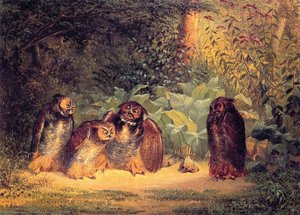
Owls (1851) by William Holbrook Beard

Owls

1851 · Oil On Canvas

Created in 1851, Owls by William Holbrook Beard presents a group of five owls situated within a forest environment. This oil on canvas work focuses on the birds in their natural habitat, surrounded by trees and scattered leaves. The composition includes one owl on the left side of the frame, two in the center, and two on the right. A small bird is also perched on a branch toward the…

3
The Fox Hunter's Dream (1859) by William Holbrook Beard

The Fox Hunter's Dream

1859 · Oil On Canvas

Created in 1859, this work reflects a period fascinated by the intersection of nature and human activity. The scene captures a specific type of outdoor pursuit that was deeply embedded in the social fabric of the era. Through the use of oil on canvas, the artist employs glazing techniques to build up layers of color, allowing light to filter through the scene and create an atmospheric depth. The shadows and…

4
The Spirit of the Storm (1872) by William Holbrook Beard

The Spirit of the Storm

1872 · Oil On Canvas

A central figure commands the composition, gesturing with a sense of absolute dominion over a gathering of lions. This man, positioned amidst the predators, appears to exert a spiritual or sovereign control that transcends the physical threat of the beasts. The presence of two angels, flanking the scene on the left and right, shifts the narrative from a mere encounter in the wild to a profound allegory of divine or…

5
Santa Claus (1862) by William Holbrook Beard

Santa Claus

1862 · Oil On Canvas · Rhode Island School of Design Museum of Art, Providence

The oil painting titled Santa Claus was created by the American artist William Holbrook Beard in 1862. This work captures a singular moment of folklore suspended in the night. The subject matter centers on the figure of Santa Claus as he navigates a sleigh through a hazy, winter sky. He moves through the darkness accompanied by a team of reindeer, their forms cutting through the atmosphere.

6
Teddy's Christmas Greeting (1890) by William Holbrook Beard

Teddy's Christmas Greeting

A small, furry face peeks from the shadows of a dark, arched opening, its eyes wide with a quiet, inquisitive light. This little creature, perhaps a bear cub or a fox, rests a single paw upon a pale, yellowish-cream ledge, creating a moment of sudden, intimate connection. The darkness within the aperture feels deep and textured, a rich reddish-brown that pushes the subject forward into the soft, diffused light. There…

7
For What Was I Created? (1886) by William Holbrook Beard

For What Was I Created?

1886 · Oil On Canvas · Brooklyn Museum, Brooklyn

An anthropomorphic monkey sits in a seated, contemplative pose within this 1886 oil painting. The figure is dressed in a jester's costume, featuring saturated red and bright yellow fabric that contrasts against a muted background. The monkey's fur is rendered with fine brushwork, showing a velvety texture. To the left, a heavy stone pedestal or balcony base provides a solid architectural element, while the right side of the frame opens…

8
The Poker Game (1887) by William Holbrook Beard

The Poker Game

1887 · Oil On Canvas

In "The Poker Game" by William Holbrook Beard, we find ourselves drawn into a highly theatrical and fantastical scene. The composition is centered upon a table where a group of monkeys is engaged in a game of cards. This central activity is framed by several figures positioned around the periphery, observing the proceedings from the shadows. The arrangement creates a sense of intimacy, pulling the viewer into the immediate circle…

9
And The Sky Was Full of Forms (1893) by William Holbrook Beard

And The Sky Was Full of Forms

1893 · Oil On Canvas · Rhode Island School of Design Museum of Art, Providence

In this landscape oil painting, And The Sky Was Full of Forms by William Holbrook Beard, we find ourselves before a scene of profound isolation. Created about 1893, the work presents a dramatic, atmospheric landscape set within a rocky, desolate terrain. The environment feels heavy and vast, dominated by a rugged landscape that stretches toward a distant, hazy horizon. It is a quiet, somewhat lonely setting that invites a closer…

10
So You Wanna Get Married, Eh. (1886) by William Holbrook Beard

So You Wanna Get Married, Eh.

1886 · Oil On Canvas

In this 1886 oil on canvas, we find ourselves drawn into a quiet, wooded clearing where the boundaries between the animal kingdom and human social ritual begin to blur. Three bears occupy the center of the composition, their presence suggesting a narrative of courtship and curiosity. One bear stands to the left, another occupies the central space, and a third is positioned to the right, creating a triangular tension that…

William Holbrook Beard's famous paintings, numbers 11 to 45

William Holbrook Beard's famous paintings, period by period

The subjects that held William Holbrook Beard's eye

The four subjects that come back most often in these originals, each with its finest example.

The museums that keep William Holbrook Beard's originals

The 8 museums that hold the most of the paintings on this page.

Museum City Works by William Holbrook Beard Paintings from this list
Rhode Island School of Design Museum of Art, ProvidenceRhode Island School of Design Museum of Art Providence 3 Santa Claus, Teddy's Christmas Greeting, And The Sky Was Full of Forms
New York Historical Society, New York CityNew York Historical Society New York City 3 The Bear Dance, The Bulls and Bears in the Market, Self Portrait in the Studio
Brooklyn Museum, BrooklynBrooklyn Museum Brooklyn 2 For What Was I Created?, In the Forest
Smithsonian American Art Museum, Washington, D.C.Smithsonian American Art Museum Washington, D.C. 2 The Runaway Match, The Lost Balloon
Buffalo AKG Art Museum, BuffaloBuffalo AKG Art Museum Buffalo 1 The March of Selenus
Museum of Fine Arts, BostonMuseum of Fine Arts Boston 1 The Wreckers
Indianapolis Museum of Art, IndianapolisIndianapolis Museum of Art Indianapolis 1 His Majesty Receives
Buffalo Bill Center of The West, LaramieBuffalo Bill Center of The West Laramie 1 Deer on the Prairie

William Holbrook Beard across the decades: one unique original for each

Works per decade

Pick a decade to see the original that defines it.

William Holbrook Beard's paintings: questions for the gallery

What is the single most famous work of William Holbrook Beard?Reveal the answer

Santa Claus (1862). Owls (1851) and The Fox Hunter's Dream (1859) come next.

At what age did William Holbrook Beard create Santa Claus?Reveal the answer

37 years old: Santa Claus dates from 1862, and William Holbrook Beard was born in 1825.

Which ten paintings by William Holbrook Beard are the most famous?Reveal the answer

Santa Claus, Owls, The Fox Hunter's Dream, The Spirit of the Storm, Santa Claus, Teddy's Christmas Greeting, For What Was I Created?, The Poker Game, And The Sky Was Full of Forms and So You Wanna Get Married, Eh.. The ranking above gives each one's year and museum.

How many works by William Holbrook Beard are known?Reveal the answer

Our catalog holds 45 works by William Holbrook Beard, dated from 1851 to 1894.

Where can the most famous William Holbrook Beard originals be seen?Reveal the answer

Mostly in Rhode Island School of Design Museum of Art (Providence), New York Historical Society (New York City) and Brooklyn Museum (Brooklyn). The museum table above lists them all.

During which period did William Holbrook Beard create the best-known paintings?Reveal the answer

In 1880s: 11 of the 45 works on this page were made then, For What Was I Created? among them.

Which famous William Holbrook Beard painting is the earliest, and which the latest?Reveal the answer

On this page, the earliest is Owls (1851) and the latest Scientists at Work (1894).

What subjects did William Holbrook Beard favour?Reveal the answer

Animal allegory (3), Santa claus (2) and Reindeer (2), across the 45 works on this page.

What materials did William Holbrook Beard paint with most?Reveal the answer

Oil On Canvas, for 9 of the 45 works on this page.

What William Holbrook Beard originals can I see at the Rhode Island School of Design Museum of Art?Reveal the answer

Santa Claus, Teddy's Christmas Greeting and And The Sky Was Full of Forms: the Rhode Island School of Design Museum of Art, Providence holds 3 of the works on this page.

William Holbrook Beard: a portrait of the artist

William Holbrook Beard: A Painter of Humor and Symbolism

William Holbrook Beard (1825-1900) stands as a singular figure in American genre painting, distinguished by his distinctive blend of whimsical storytelling and profound symbolic representation. Born in Painesville, Ohio, Beard’s artistic journey began amidst the natural beauty of his surroundings—a formative influence evident throughout his oeuvre. His father, James Henry Beard, was himself an accomplished artist, fostering a familial tradition of visual creativity that profoundly shaped William's own sensibilities. Notably, he possessed a close relationship with Daniel Carter Beard, another celebrated illustrator and naturalist who would later establish the Boy Scouts of America – a connection reflecting the broader Victorian fascination with outdoor pursuits and moral education.
  • Early Life & Influences:
  • Beard’s childhood in Painesville instilled within him an enduring appreciation for observation and meticulous detail, skills he honed during his formative years studying under Frederic Church and Worthington Whittemore.

A Unique Narrative Style: Humor and Allegory

Beard's artistic approach transcended mere depiction; he sought to convey complex ideas through engaging narratives populated by animals—a technique that cemented his reputation as a pioneer of animal allegory. Unlike many artists of his time who adhered to academic conventions, Beard deliberately eschewed formal rigidity in favor of dynamic compositions and expressive brushwork. His paintings frequently tackled social commentary with subtle irony, presenting moral dilemmas within seemingly carefree scenes of courtship or school life. This playful juxtaposition of humor and seriousness distinguishes him from his contemporaries and underscores his commitment to communicating profound truths through accessible imagery.
  • Technique & Materials:
  • Beard favored oil paints on canvas, employing a loose brushstroke style that prioritized capturing the essence of movement and emotion. He meticulously blended colors—often utilizing glazing techniques—to achieve luminous effects and imbue his canvases with atmospheric depth.

Notable Works & Achievements

Beard’s artistic output encompassed a remarkable range of subjects, including depictions of biblical scenes, mythological narratives, and portraits. However, it is arguably his animal allegories that garnered him enduring acclaim. Pieces like “The Power of Death,” featuring a dramatic tiger attack on an old prophet—a masterful illustration embodying Christian symbolism—and “So You Wanna Get Married, Eh.” exemplify his ability to distill complex moral concepts into captivating visual narratives. These works continue to resonate with audiences today due to their timeless themes and masterful execution.
  • Legacy & Significance:
  • William Holbrook Beard’s contribution to American art lies in his innovative blending of genre painting and animal allegory—a stylistic approach that anticipated developments in Surrealist art decades later. His work serves as a testament to the Victorian conviction that art could illuminate moral truths while entertaining the eye, securing his place as an artist who championed both intellectual engagement and aesthetic beauty.

Further Exploration

For deeper insights into Beard’s artistic vision and techniques, consider examining reproductions of “Owls” and exploring scholarly analyses available on platforms like OriginalUniqueArt.com. These resources offer invaluable perspectives on his stylistic evolution and the enduring relevance of his distinctive narrative style.