Portrait of William Harnett

The 100 Most Famous William Harnett Paintings, Each One of a Kind

Updated November 2026 · ranked by our popularity score (searches, visits and orders for each work) · 117 works by William Harnett in our catalogue

In short

Still Life: Writing Table (1877) is the William Harnett painting that draws the most eyes; the original belongs to the Philadelphia Museum of Art, Philadelphia. After it, the eye goes to For Sunday's Dinner (1888) and Still Life with Pewter Candlestick and Clarinet (1886). Among the 117 works of William Harnett in our catalog, these 100 are the most famous, each a unique original presented with its year, its museum and the reason it endures.

1848 – 1892, Clonakilty Most works: Metropolitan Museum of Art

Top 10 paintings by William Harnett, through the gallery's eye

1
Still Life: Writing Table (1877) by William Harnett

Still Life: Writing Table

1877 · Oil On Canvas · Philadelphia Museum of Art, Philadelphia

To stand before William Michael Harnett’s Still Life: Writing Table is not merely to observe an arrangement of objects; it is to step into a moment suspended in time—a quiet drama played out on a dark, richly textured wooden surface. This masterful oil painting from 1877 transports us into the intimate sanctum of a scholar’s study or a prosperous gentleman's office. Harnett, the celebrated illusionist of everyday life, possesses an…

2
For Sunday's Dinner (1888) by William Harnett

For Sunday's Dinner

1888 · Oil On Canvas · Art Institute of Chicago, Chicago

“For Sunday’s Dinner” exemplifies Harnett’s unparalleled skill as a trompe-l'œil painter—a technique that deliberately deceives the eye by presenting an image that appears to exist beyond its physical boundaries. Painted in 1888, this unsettling still life depicts a dead rooster hanging upside down from the ceiling by its feet against a dark, textured background resembling aged wood paneling. The composition is centered around the rooster, which dominates the frame with…

3
Still Life with Pewter Candlestick and Clarinet (1886) by William Harnett

Still Life with Pewter Candlestick and Clarinet

1886 · Oil On Canvas · Harvard Art Museums, Cambridge

This highly detailed, realistic still life painting, executed in 1886, is rendered in the Trompe l'oeil style. The composition features a dense arrangement of objects resting upon a wooden table draped with a dark cloth. A single white candle sits within a pewter candlestick, serving as a focal point of light that casts soft highlights across the various items. The arrangement includes a clarinet, old books, scattered sheet music, and…

4
After the Hunt (1885) by William Harnett

After the Hunt

1885 · Oil On Canvas · Fine Arts Museums of San Francisco, San Francisco

The painting After the Hunt by William Harnett presents a quiet, still moment of repose. Created in 1885, this work belongs to a quartet of canvases that explore the stillness of hunting paraphernalia and deceased game. The image captures a specific, frozen instant of the aftermath of a trek through the brush.

5
Still Life (1885) by William Harnett

Still Life

1885 · Oil On Panel

The oil on panel painting titled Still Life was executed by the artist William Harnett. This work is dated 1890. The composition focuses on themes of abundance and material beauty through a collection of various objects.

6
The Faithful Colt (1890) by William Harnett

The Faithful Colt

1890 · Oil On Canvas

In "The Faithful Colt" by William Harnett, a meticulously rendered still life, the eye is immediately drawn to a central, heavy presence. A gun dominates the frame, positioned diagonally across the dark wooden surface. This sharp, slanted line cuts through the stillness of the composition. In the upper left corner, a bottle sits quietly, while a small piece of paper is affixed to the lower right corner with a single…

7
The Banker's Table (1877) by William Harnett

The Banker's Table

1877 · Oil On Paper · Metropolitan Museum of Art, New York

William Michael Harnett’s The Banker's Table invites us into an intimate glimpse of a bygone era—a world where commerce, scholarship, and the passage of time converged upon a single wooden surface. Unlike the lush bounty of fruit that characterized some of his earlier still lifes, this piece turns its meticulous gaze toward the manufactured artifacts of intellectual and financial life. It is a masterclass in elevating the mundane; Harnett does…

8
Still Life: Violin and Music (also known as Music Literature) (1888) by William Harnett

Still Life: Violin and Music (also known as Music Literature)

1888 · Oil On Canvas · Metropolitan Museum of Art, New York

The Enigmatic Still Life William Michael Harnett’s “Still Life: Violin and Music,” often referred to as “Music Literature,” isn't merely a depiction of objects; it’s an invitation into a carefully constructed world of illusion. Painted in 1888, this oil on canvas transcends the boundaries of a traditional still life, becoming a masterclass in trompe-l’œil – a technique designed to deceive the eye and create the startling impression that what we…

9
Still Life with Portrait by Raphael (1878) by William Harnett

Still Life with Portrait by Raphael

1878 · Oil On Panel

Still Life with Portrait by Raphael is a work by William Harnett, executed in 1878. The artist, born in Clonakilty, Ireland, in 1848, became a significant figure in American realism through his specialized focus on the illusion of three-dimensional objects.

10
New York Daily News (1888) by William Harnett

New York Daily News

1888 · Painting · Metropolitan Museum of Art, New York

To stand before William Michael Harnett’s New York Daily News is not merely to observe an arrangement of objects; it is to step directly into the meticulously curated, quiet moments of late nineteenth-century urban life. This painting possesses an almost startling intimacy, drawing the viewer close enough to discern the texture of aged paper, the subtle sheen on a ceramic mug, and the varied patina of everyday detritus. Harnett elevates…

William Harnett's famous paintings, numbers 11 to 100

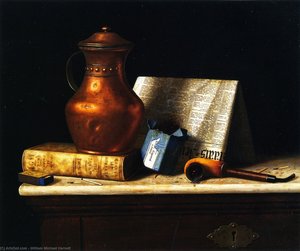
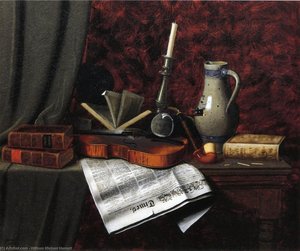
11Still Life with Bric-a-Brac (1878) by William HarnettStill Life with Bric-a-Brac1878 · Fogg Art Museum 12For Sunday's Dinner (1888) by William HarnettFor Sunday's Dinner1888 · Art Institute of Chicago 13Still Life (1888) by William HarnettStill Life1888 · Metropolitan Museum of Art 14Still Life (1875) by William HarnettStill Life1875 · Reading Public Museum 15Still Life: Ten-Cent Bill (1879) by William HarnettStill Life: Ten-Cent Bill1879 · Philadelphia Museum of Art 16Still Life with Flute, Vase and Roman Lamp (1885) by William HarnettStill Life with Flute, Vase and Roman Lamp1885 · Yale University Art Gallery 17Alas, Poor Yorick (1877) by William HarnettAlas, Poor Yorick1877 · Los Angeles County Museum of Art 18Mortality and Immortality (1876) by William HarnettMortality and Immortality1876 19The Meerschaum (1886) by William HarnettThe Meerschaum1886 · Fine Arts Museums of San Francisco 20Still Life with the Toledo Blade (1886) by William HarnettStill Life with the Toledo Blade1886 · Toledo Museum of Art 21Still Life with Letter to Thomas B. Clarke (1879) by William HarnettStill Life with Letter to Thomas B. Clarke1879 · Addison Gallery of American Art 22Study of a Pipe and Other Objects (1874) by William HarnettStudy of a Pipe and Other Objects1874 · Fine Arts Museums of San Francisco 23Still-life with Flute and Times (1877) by William HarnettStill-life with Flute and Times1877 · Minneapolis Institute of Art 24Still LIfe with Pipe and Book (1878) by William HarnettStill LIfe with Pipe and Book1878 25Still Life, Pipe and Mug (1878) by William HarnettStill Life, Pipe and Mug1878 26Still LIfe with Pipe (1877) by William HarnettStill LIfe with Pipe1877 27Still Life with Raisin Cake, Fruit and Wine (1876) by William HarnettStill Life with Raisin Cake, Fruit and Wine1876 · Museum of Fine Arts 28Still Life with Pipe and New York Herald (1878) by William HarnettStill Life with Pipe and New York Herald1878 29Peaches and Grapes (1877) by William HarnettPeaches and Grapes1877 30Still Life with Blue Tobacco Box (1878) by William HarnettStill Life with Blue Tobacco Box1878 31Still Life with Ginger Jar (1876) by William HarnettStill Life with Ginger Jar1876 32Still Life with Apples, Grapes and Almonds (1876) by William HarnettStill Life with Apples, Grapes and Almonds1876 33Munich Still Life (1882) by William HarnettMunich Still Life1882 · Dallas Museum of Art 34Job Lot Cheap (1878) by William HarnettJob Lot Cheap1878 35Still Life (1877) by William HarnettStill Life1877 36Still Life with Cigar, Pipe, New York Herald and Wiine Glass (1877) by William HarnettStill Life with Cigar, Pipe, New York Herald and Wiine Glass1877 37A Smoke Backstage (1877) by William HarnettA Smoke Backstage1877 38Solace (1878) by William HarnettSolace1878 39Still Life with Goblet, Fruit and Nuts (1876) by William HarnettStill Life with Goblet, Fruit and Nuts1876 40Still Life with Mug, Pipe and New York Herald (1877) by William HarnettStill Life with Mug, Pipe and New York Herald1877 41A Sprig of Plums (1873) by William HarnettA Sprig of Plums1873 42Still Life with Ink Bottle, Book and Letter (also known as Still Life with Universal Gazetteer) (1878) by William HarnettStill Life with Ink Bottle, Book and Letter (also known as Still Life with Universal Gazetteer)1878 43Munchener Bote (1881) by William HarnettMunchener Bote1881 · Yale University Art Gallery 44STILL LIFE WITH PIPE AND MUG (1880) by William HarnettSTILL LIFE WITH PIPE AND MUG1880 · Cincinnati Art Museum 45LOBSTER AND LE FIGARO (1882) by William HarnettLOBSTER AND LE FIGARO1882 · Cincinnati Art Museum 46Still Life with Violin (1885) by William HarnettStill Life with Violin1885 · Museum of Fine Arts 47Trophy of the Hunt (1885) by William HarnettTrophy of the Hunt1885 · Carnegie Museum of Art 48Still LIfe with Jug and Newspaper (1881) by William HarnettStill LIfe with Jug and Newspaper1881 49Still Life: Le Mot d'Or (1880) by William HarnettStill Life: Le Mot d'Or1880 50The Social Club (1879) by William HarnettThe Social Club1879 51After the Hunt (1883) by William HarnettAfter the Hunt1883 52New York Herald, July 11, 1880 (1880) by William HarnettNew York Herald, July 11, 18801880 53Still Life with Fruit and Vase (1881) by William HarnettStill Life with Fruit and Vase1881 54After the Hunt (1884) by William HarnettAfter the Hunt1884 55His Mug and His Pipe (1880) by William HarnettHis Mug and His Pipe1880 56Still Life with Letter to Mr. Lask (1879) by William HarnettStill Life with Letter to Mr. Lask1879 57To this Favor - A Thought from Shakespeare (1879) by William HarnettTo this Favor - A Thought from Shakespeare1879 58Still Life with a Violin, Pewter Tankard and Sheet Music (1883) by William HarnettStill Life with a Violin, Pewter Tankard and Sheet Music1883 59Still Life with Fruit and Vase (1881) by William HarnettStill Life with Fruit and Vase1881 60Secretary's Table (1879) by William HarnettSecretary's Table1879 61Merganser (1883) by William HarnettMerganser1883 62Still Life: Box of Havana Cigars (1884) by William HarnettStill Life: Box of Havana Cigars1884 63Still Life (1884) by William HarnettStill Life1884 64Still Life (1883) by William HarnettStill Life1883 65Plucked Clean (1882) by William HarnettPlucked Clean1882 · National Gallery of Art 66Momento Mori, To This Favour'''' (1879) by William HarnettMomento Mori, To This Favour''''1879 · Cleveland Museum of Art 67Still Life with Three Castles Tobacco (1880) by William HarnettStill Life with Three Castles Tobacco1880 · Brooklyn Museum 68Lobster and Pester Lloyd (1882) by William HarnettLobster and Pester Lloyd1882 69Still Life with Inkwell, Book, Pipe and Stoneware Jug (1880) by William HarnettStill Life with Inkwell, Book, Pipe and Stoneware Jug1880 70Still Life with Fruit, Champagne Bottle and Newspaper (1881) by William HarnettStill Life with Fruit, Champagne Bottle and Newspaper1881 71A Study Table (1882) by William HarnettA Study Table1882 72Still Life with Pipe, Mug and Newspaper (1879) by William HarnettStill Life with Pipe, Mug and Newspaper1879 73Materials for a Leisure Hour (1879) by William HarnettMaterials for a Leisure Hour1879 · Thyssen-Bornemisza Museum 74Still Life with Clarinet (1883) by William HarnettStill Life with Clarinet1883 75Cigar Box, Pitcher and 'New York World' (1880) by William HarnettCigar Box, Pitcher and 'New York World'1880 76Still Life with Decanter and Frankfurter Zeitung (1881) by William HarnettStill Life with Decanter and Frankfurter Zeitung1881 77Still Life with 'Le Figaro' (1882) by William HarnettStill Life with 'Le Figaro'1882 78Still Life with Lobster, Fruit, Champagne and Newspaper (1882) by William HarnettStill Life with Lobster, Fruit, Champagne and Newspaper1882 79The Old Violin (1886) by William HarnettThe Old Violin1886 · National Gallery of Art 80Music (1886) by William HarnettMusic1886 81Still Life with Blue and White Pitcher, Tobacco Case and Pipe (1888) by William HarnettStill Life with Blue and White Pitcher, Tobacco Case and Pipe1888 82The Old Cupboard Door (1889) by William HarnettThe Old Cupboard Door1889 83With the Staatszeitung (1890) by William HarnettWith the Staatszeitung1890 84The Violin (1886) by William HarnettThe Violin1886 · Amon Carter Museum of American Art 85The Professor's Old Friends (1891) by William HarnettThe Professor's Old Friends1891 86Mr. Hulings' Rack Picture (1888) by William HarnettMr. Hulings' Rack Picture1888 · Museum of Fine Arts 87Still LIfe with Copper Jug (1888) by William HarnettStill LIfe with Copper Jug1888 88Still Life with Violin (1886) by William HarnettStill Life with Violin1886 · New Britain Museum of American Art 89The Golden Horseshoe (1886) by William HarnettThe Golden Horseshoe1886 90Still Life with Bust of Dante (1883) by William HarnettStill Life with Bust of Dante1883 · High Museum of Art 91Munich Still Life (1884) by William HarnettMunich Still Life1884 92Still Life (also known as Copper tankard, bos, apples, wine bottles, ginger pot, cigar box and peeled orange) (1884) by William HarnettStill Life (also known as Copper tankard, bos, apples, wine bottles, ginger pot, cigar box and peeled orange)1884 93Old Models (1892) by William HarnettOld Models1892 · Museum of Fine Arts 94Still LIfe with Universal Gazetteer (1878) by William HarnettStill LIfe with Universal Gazetteer1878 95Philadelphia Public Ledger, March 2, 1880 (1880) by William HarnettPhiladelphia Public Ledger, March 2, 18801880 96Still Life with Pipe and Tobacco by William HarnettStill Life with Pipe and Tobacco 97The meerschaum pipe by William HarnettThe meerschaum pipe 98Memento mori by William HarnettMemento mori 99A Mans-Talbe Reversed by William HarnettA Mans-Talbe Reversed 100Just dessert by William HarnettJust dessertArt Institute of Chicago

The subjects that held William Harnett's eye

The four subjects that come back most often in these originals, each with its finest example.

The museums that keep William Harnett's originals

The 8 museums that hold the most of the paintings on this page.

Museum City Works by William Harnett Paintings from this list
Metropolitan Museum of Art, New YorkMetropolitan Museum of Art New York 5 The Banker's Table, Still Life: Violin and Music (also known as Music Literature), New York Daily News
Museum of Fine Arts, BostonMuseum of Fine Arts Boston 4 Still Life with Raisin Cake, Fruit and Wine, Still Life with Violin, Mr. Hulings' Rack Picture
Art Institute of Chicago, ChicagoArt Institute of Chicago Chicago 3 For Sunday's Dinner, For Sunday's Dinner, Just dessert
Fine Arts Museums of San Francisco, San FranciscoFine Arts Museums of San Francisco San Francisco 3 After the Hunt, The Meerschaum, Study of a Pipe and Other Objects
National Gallery of Art, WashingtonNational Gallery of Art Washington 3 Plucked Clean, The Old Violin
Philadelphia Museum of Art, PhiladelphiaPhiladelphia Museum of Art Philadelphia 2 Still Life: Writing Table, Still Life: Ten-Cent Bill
Yale University Art Gallery, New HavenYale University Art Gallery New Haven 2 Still Life with Flute, Vase and Roman Lamp, Munchener Bote
Cincinnati Art Museum, CincinnatiCincinnati Art Museum Cincinnati 2 STILL LIFE WITH PIPE AND MUG, LOBSTER AND LE FIGARO

William Harnett across the decades: one unique original for each

Works per decade

Pick a decade to see the original that defines it.

William Harnett's paintings: questions for the gallery

What is the single most famous work of William Harnett?Reveal the answer

Still Life: Writing Table (1877), Philadelphia Museum of Art, Philadelphia. For Sunday's Dinner (1888) and Still Life with Pewter Candlestick and Clarinet (1886) come next.

At what age did William Harnett create Still Life: Writing Table?Reveal the answer

29 years old: Still Life: Writing Table dates from 1877, and William Harnett was born in 1848.

Which ten paintings by William Harnett are the most famous?Reveal the answer

Still Life: Writing Table, For Sunday's Dinner, Still Life with Pewter Candlestick and Clarinet, After the Hunt, Still Life, The Faithful Colt, The Banker's Table, Still Life: Violin and Music (also known as Music Literature), Still Life with Portrait by Raphael and New York Daily News. The ranking above gives each one's year and museum.

How many works by William Harnett are known?Reveal the answer

Our catalog holds 117 works by William Harnett, dated from 1873 to 1892.

Where can the most famous William Harnett originals be seen?Reveal the answer

Mostly in Metropolitan Museum of Art (New York), Museum of Fine Arts (Boston) and Art Institute of Chicago (Chicago). The museum table above lists them all.

During which period did William Harnett create the best-known paintings?Reveal the answer

In 1880s: 54 of the 100 works on this page were made then, For Sunday's Dinner among them.

Which famous William Harnett painting is the earliest, and which the latest?Reveal the answer

On this page, the earliest is A Sprig of Plums (1873) and the latest Old Models (1892).

What subjects did William Harnett favour?Reveal the answer

Life (31), Still life (16) and Books (10), across the 100 works on this page.

What materials did William Harnett paint with most?Reveal the answer

Oil On Canvas, for 13 of the 100 works on this page.

What William Harnett originals can I see at the Metropolitan Museum of Art?Reveal the answer

The Banker's Table, Still Life: Violin and Music (also known as Music Literature) and New York Daily News: the Metropolitan Museum of Art, New York holds 4 of the works on this page.

William Harnett: a portrait of the artist

William Michael Harnett: The Illusionist of Everyday Life

William Michael Harnett (1848 – 1892) stands as a singular figure in American art history, celebrated for his masterful trompe-l'œil paintings that elevate the mundane into breathtaking illusions. Born in Clonakilty, County Cork, Ireland, Harnett’s early life was marked by emigration to Philadelphia shortly after his birth, shaping him into an artist deeply rooted in both European tradition and burgeoning American realism. His formative years were spent honing skills in engraving design on table silver – a craft that instilled precision and attention to detail – alongside pursuing formal artistic training at institutions like the Pennsylvania Academy of Fine Arts and Cooper Union.
  • Early Training & Technique: Harnett’s dedication to mastering technique began with night classes at Penn and NYAD, where he absorbed influences from luminaries like Raphael Peale Jr., who pioneered tabletop still life in America. This influence is palpable in Harnett's distinctive style – a deliberate departure from prevailing academic conventions.
  • The Trompe-l’œil Vision: Harnett’s breakthrough came with his embrace of trompe-l’œil, a technique borrowed from 17th-century Dutch masters like Pieter Claesz. Unlike traditional depictions that strive for accurate representation, trompe-l'œil seeks to deceive the eye, creating an illusion of depth and dimensionality within a flat surface. Harnett skillfully manipulated perspective, shading, and texture to achieve this astonishing feat.

Notable Works & Artistic Style

Harnett’s oeuvre is characterized by its unwavering focus on commonplace objects – pipe, newspaper, tobacco pouch, violin, apple, wine bottle—presented with an extraordinary level of realism that borders on hallucinatory. His paintings aren't merely representations; they are invitations to engage in a perceptual puzzle. Consider “After the Hunt,” a quartet of canvases depicting hunting paraphernalia and deceased game animals. Harnett’s meticulous rendering captures every nuance of texture and light, exploiting the limitations of trompe-l'œil to heighten its impact. The shallow space of these paintings is crucial – any movement by the viewer disrupts the illusion, emphasizing Harnett’s genius in manipulating visual perception.
  • “After the Hunt” Series: This series exemplifies Harnett’s technique perfectly, demonstrating how he utilizes optical tricks to create a convincing illusion of depth within a confined space.
  • Recurring Themes: Recurring motifs include instruments (particularly violins), tobacco pouches, and meticulously arranged fruit – objects that speak to both the artist's personal interests and his broader engagement with artistic precedents.

Recognition & Legacy

Harnett’s work gained considerable acclaim during his lifetime and continues to resonate with contemporary audiences. Museums such as the Albright-Knox Art Gallery, the American Museum of Natural History, and The Metropolitan Museum of Art proudly display his paintings, ensuring that his vision persists across generations. Harnett's influence extends beyond stylistic imitation; he championed a new approach to realism—one that prioritized illusionistic depth over mere surface accuracy. His legacy is cemented in the works of artists who followed him, particularly Jefferson David Chalfant, whose trompe-l’œil technique owes considerable debt to Harnett’s pioneering vision.

Further Exploration

To delve deeper into William Michael Harnett's artistic journey and explore his captivating paintings, visit OriginalUniqueArt.com for detailed information about his life and oeuvre. Also consider exploring the collections of institutions like Residenz in Munich and The Philadelphia Museum of Art to experience Harnett’s art firsthand.