Portrait of Wilhelm Leibl

The 61 Most Famous Wilhelm Leibl Paintings, a Gallery Selection

Updated November 2026 · ranked by our popularity score (searches, visits and orders for each work) · 67 works by Wilhelm Leibl in our catalogue

In short

Of all the originals Wilhelm Leibl left, the most famous is Three Women in Church, in the collection of the Hamburger Kunsthalle, Hamburg. Close behind it come Interior (1897) and Portrait of a boy with a large ruff (1869). Our catalog holds 67 works by Wilhelm Leibl; the gallery has kept the 61 the world admires most, each shown with its date, its museum and its story.

1844 – 1900, Cologne Realism Most works: Bavarian State Painting Collections

Wilhelm Leibl's top 10 paintings: the gallery's choice

1
Three Women in Church by Wilhelm Leibl

Three Women in Church

Oil On Canvas · Hamburger Kunsthalle, Hamburg

This exquisite painting captures a quiet, contemplative moment of three women engaged in reading within a serene church setting. The scene exudes a sense of reverence and introspection, inviting viewers to reflect on the profound simplicity of daily life and spiritual devotion. The artist masterfully portrays the women’s expressions and gestures, emphasizing their inner worlds and the shared moment of quiet fellowship.

2
Interior (1897) by Wilhelm Leibl

Interior

1897 · Oil On Panel · Bavarian State Painting Collections, Munich

A heavy, somber stillness settles over the room, where the air feels thick with the scent of old wood and damp earth. To the right, a woman stands partially swallowed by deep, velvety shadows, her presence felt more through the sudden brightness of her white apron than through any sharp detail of her features. She exists in a moment of profound solitude, a solitary figure caught in the dimness of…

3
Portrait of a boy with a large ruff (1869) by Wilhelm Leibl

Portrait of a boy with a large ruff

1869 · Oil On Canvas · Germanisches Nationalmuseum, Nuremberg

In this oil on canvas, titled Portrait of a boy with a large ruff, the artist Wilhelm Leibl presents a quiet study of youth. Created about 1869, the work captures a specific moment of stillness through a careful application of paint. The scale of the piece, measuring 75.8 x 61.0cm, allows for an intimate encounter with the subject, inviting a close observation of the textures present on the surface.

4
Women from Dachau (Girl with a black headscarf) (1879) by Wilhelm Leibl

Women from Dachau (Girl with a black headscarf)

1879 · Oil On Panel · Alte Nationalgalerie, Berlin

Women from Dachau (Girl with a black headscarf) is a portrait executed by Wilhelm Leibl in 1879. The work originated in Berbling, located in the Voralpenland region. Leibl produced this piece during a period of intense creative focus, capturing a subject who was the daughter of a local resident living near the artist's own residence.

5
The Painter Julius Bodenstein (1876) by Wilhelm Leibl

The Painter Julius Bodenstein

1876 · Oil On Canvas · Lenbachhaus, Munich

A formal, realistic portrait of a man, rendered in a traditional academic style. The subject is positioned slightly off-center, facing towards the viewer's right while his gaze is directed forward. A dark, somber background and clothing provide a stark contrast to the warm, natural flesh tones of the face. The composition is a bust-length portrait, capturing the subject with a direct, eye-level perspective that establishes an immediate connection.

6
Portrait of Ernst Schoenlin (?) (1866) by Wilhelm Leibl

Portrait of Ernst Schoenlin (?)

1866 · Oil On Canvas · Staatliche Kunsthalle Karlsruhe, Carlsruhe

A somber, three-quarter view portrait emerges from a dark, indistinct background, focusing on the head and upper torso of a middle-aged man. The composition relies heavily on chiaroscuro, with light entering from the upper left to strike the subject's forehead and hands, leaving the remainder of the figure in deep shadow. This directional lighting creates a profound sense of three-dimensional volume, carving the man's features out of the gloom. He…

7
Dachau Woman and Child (1873) by Wilhelm Leibl

Dachau Woman and Child

1873 · Oil On Panel · Alte Nationalgalerie, Berlin

The painting titled Dachau Woman and Child is a significant work by the German realist Wilhelm Leibl. Created around 1873 or 1874, this oil on panel work captures a quiet, intimate moment from the Bavarian countryside. The subjects are not anonymous figures of a generic scene, but rather the miller’s wife of Plon, depicted with a directness that defines the artist's approach to his subjects.

8
Farmboy (1876) by Wilhelm Leibl

Farmboy

1876 · Oil On Canvas · Alte Nationalgalerie, Berlin

In this intimate portrait titled Farmboy, the artist Wilhelm Leibl presents a quiet, unadorned moment from the late 19th century. Created about 1876, the work captures a sense of stillness that feels both immediate and deeply personal. The subject is a shy boy, appearing somewhat awkward and vulnerable as he slouches in a chair that seems slightly too large for his frame. There is a certain heaviness to his posture,…

9
Man in a Top Hat (1870) by Wilhelm Leibl

Man in a Top Hat

1870 · Oil On Canvas · Ernest Zmeták Art Gallery, Nové Zámky

In "Man in a Top Hat" by Wilhelm Leibl, a middle-aged or elderly man meets the viewer's gaze from an eye-level perspective. The subject's head and shoulders fill most of the frame in a close-up bust portrait, creating an immediate sense of presence. He wears a top hat that casts a soft shadow over his features, while a full beard covers his weathered face. His expression remains somber and contemplative,…

The Wilhelm Leibl selection continues, 11 to 61

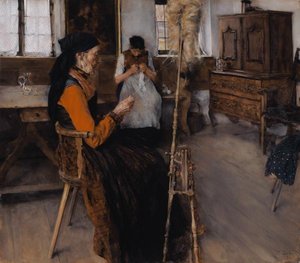
11The Critics (1868) by Wilhelm LeiblThe Critics1868 12Head Portrait of a Young Man (1866) by Wilhelm LeiblHead Portrait of a Young Man1866 13Portrait of a Lady in Black Dress with White Ruff (1870) by Wilhelm LeiblPortrait of a Lady in Black Dress with White Ruff1870 · Staatliche Kunsthalle Karlsruhe 14Portrait of Lina Kirchdorffer (1871) by Wilhelm LeiblPortrait of Lina Kirchdorffer1871 · Bavarian State Painting Collections 15The Painter Sattler with dogge (1870) by Wilhelm LeiblThe Painter Sattler with dogge1870 · Bavarian State Painting Collections 16Pastoral Scene (after Rubens) (1870) by Wilhelm LeiblPastoral Scene (after Rubens)1870 · Bavarian State Painting Collections 17Portrait of Mrs Gedon (1869) by Wilhelm LeiblPortrait of Mrs Gedon1869 · Bavarian State Painting Collections 18Portrait of Johann Heinrich Pallenberg (1871) by Wilhelm LeiblPortrait of Johann Heinrich Pallenberg1871 · Wallraf-Richartz-Museum 19The Painter Victor Müller (1870) by Wilhelm LeiblThe Painter Victor Müller1870 · Wallraf-Richartz-Museum 20Young Parisian woman (1869) by Wilhelm LeiblYoung Parisian woman1869 · Wallraf-Richartz-Museum 21Rosine Fischler, Countess Treuberg (1877) by Wilhelm LeiblRosine Fischler, Countess Treuberg1877 22The painter Johann Sperl (1872) by Wilhelm LeiblThe painter Johann Sperl1872 · Wallraf-Richartz-Museum 23Portrait of Freiherr Max von Perfall auf Greifenstein (1814-1877) (1877) by Wilhelm LeiblPortrait of Freiherr Max von Perfall auf Greifenstein (1814-1877)1877 · Bavarian State Painting Collections 24The painter Jean Paul Selinger (1880) by Wilhelm LeiblThe painter Jean Paul Selinger1880 · Bavarian State Painting Collections 25a Farmer couple (1879) by Wilhelm Leibla Farmer couple1879 26Head of a youth (1879) by Wilhelm LeiblHead of a youth1879 27Head of a Man (1879) by Wilhelm LeiblHead of a Man1879 · Harvard Art Museums 28The Newspaper Reader (1891) by Wilhelm LeiblThe Newspaper Reader1891 29Peasant Boy (1888) by Wilhelm LeiblPeasant Boy1888 30In a farmhouse interior (1890) by Wilhelm LeiblIn a farmhouse interior1890 · Bavarian State Painting Collections 31Julius Mayr (1890) by Wilhelm LeiblJulius Mayr1890 · Neue Pinakothek 32Boy's Head (1896) by Wilhelm LeiblBoy's Head1896 · Lenbachhaus 33Portrait of a Young Man with Hat on Green Background (1896) by Wilhelm LeiblPortrait of a Young Man with Hat on Green Background1896 34Head of peasant girl (1897) by Wilhelm LeiblHead of peasant girl1897 35Girl standing at a window (1899) by Wilhelm LeiblGirl standing at a window1899 · Wallraf-Richartz-Museum 36Portrait of the Artist's Sister, Katharina (later Frau Kirchdorffer) by Wilhelm LeiblPortrait of the Artist's Sister, Katharina (later Frau Kirchdorffer)Staatliche Kunsthalle Karlsruhe 37Left Hand (1867) by Wilhelm LeiblLeft Hand1867 · Staatliche Kunsthalle Karlsruhe 38Head of a Blind Man by Wilhelm LeiblHead of a Blind ManLenbachhaus 39The Chemist J Jais by Wilhelm LeiblThe Chemist J JaisNationalmuseum 40Death's-head Hawkmoth with Mushroom on White Cloth (1868) by Wilhelm LeiblDeath's-head Hawkmoth with Mushroom on White Cloth1868 · Staatliche Kunsthalle Karlsruhe 41Skull with Shroud (1868) by Wilhelm LeiblSkull with Shroud1868 · Staatliche Kunsthalle Karlsruhe 42Left Hand of the "Girl with the Carnation" (1880) by Wilhelm LeiblLeft Hand of the "Girl with the Carnation"1880 · Staatliche Kunsthalle Karlsruhe 43Right Hand of the "Girl with the Carnation" (1880) by Wilhelm LeiblRight Hand of the "Girl with the Carnation"1880 · Staatliche Kunsthalle Karlsruhe 44Peasant Girl with a White Headcloth (1885) by Wilhelm LeiblPeasant Girl with a White Headcloth1885 · Metropolitan Museum of Art 45Two Hands with Red Cloth on Blue Apron (1890) by Wilhelm LeiblTwo Hands with Red Cloth on Blue Apron1890 46Friedrich rauert by Wilhelm LeiblFriedrich rauert 47Big Portrait Privy Councillor Seeger by Wilhelm LeiblBig Portrait Privy Councillor Seeger 48Savoyard boy sleeping by Wilhelm LeiblSavoyard boy sleepingHermitage Museum 49Portrait Of Mrs Helene Auspitz by Wilhelm LeiblPortrait Of Mrs Helene Auspitz 50Die Spinnerin by Wilhelm LeiblDie Spinnerin 51Countess Rosine Treuberg by Wilhelm LeiblCountess Rosine Treuberg 52Portrait of Carl Schuch by Wilhelm LeiblPortrait of Carl SchuchBavarian State Painting Collections 53The Old Farmer by Wilhelm LeiblThe Old Farmer 54Girl With A White Headscarf by Wilhelm LeiblGirl With A White HeadscarfBavarian State Painting Collections 55The Village Politicians by Wilhelm LeiblThe Village Politicians 56Kopf eines Bauernmaedchens by Wilhelm LeiblKopf eines BauernmaedchensStaatliche Kunstsammlungen Dresden 57The Dissimilar Couple by Wilhelm LeiblThe Dissimilar CoupleStädel Museum 58Portrait of Pal Szinyei Merse by Wilhelm LeiblPortrait of Pal Szinyei MerseSzépművészeti Múzeum 59The Veterinarian Dr. Reindl in an Arbor by Wilhelm LeiblThe Veterinarian Dr. Reindl in an ArborLenbachhaus 60Head of a Peasant Girl by Wilhelm LeiblHead of a Peasant Girl 61The spinner by Wilhelm LeiblThe spinner

Wilhelm Leibl's famous paintings, period by period

The subjects that held Wilhelm Leibl's eye

The four subjects that come back most often in these originals, each with its finest example.

The museums that keep Wilhelm Leibl's originals

The 8 museums that hold the most of the paintings on this page.

Museum City Works by Wilhelm Leibl Paintings from this list
Bavarian State Painting Collections, MunichBavarian State Painting Collections Munich 11 Interior, Portrait Study of a Young Bearded Man, Portrait of Lina Kirchdorffer
Staatliche Kunsthalle Karlsruhe, CarlsruheStaatliche Kunsthalle Karlsruhe Carlsruhe 8 Portrait of Ernst Schoenlin (?), Portrait of a Lady in Black Dress with White Ruff, Portrait of the Artist's Sister, Katharina (later Frau Kirchdorffer)
Wallraf-Richartz-Museum, CologneWallraf-Richartz-Museum Cologne 5 Portrait of Johann Heinrich Pallenberg, The Painter Victor Müller, Young Parisian woman
Lenbachhaus, MunichLenbachhaus Munich 4 The Painter Julius Bodenstein, Boy's Head, Head of a Blind Man
Alte Nationalgalerie, BerlinAlte Nationalgalerie Berlin 3 Women from Dachau (Girl with a black headscarf), Dachau Woman and Child, Farmboy
Hamburger Kunsthalle, HamburgHamburger Kunsthalle Hamburg 1 Three Women in Church
Germanisches Nationalmuseum, NurembergGermanisches Nationalmuseum Nuremberg 1 Portrait of a boy with a large ruff
Ernest Zmeták Art Gallery Nové Zámky 1 Man in a Top Hat

Wilhelm Leibl decade by decade: the original that defines each

Works per decade

Pick a decade to see the original that defines it.

Collectors' questions about Wilhelm Leibl's paintings

Which work is Wilhelm Leibl most famous for?Reveal the answer

Three Women in Church, Hamburger Kunsthalle, Hamburg. Interior (1897) and Portrait of a boy with a large ruff (1869) come next.

What are the ten most famous Wilhelm Leibl paintings?Reveal the answer

Three Women in Church, Interior, Portrait of a boy with a large ruff, Women from Dachau (Girl with a black headscarf), The Painter Julius Bodenstein, Portrait of Ernst Schoenlin (?), Dachau Woman and Child, Farmboy, Man in a Top Hat and Portrait Study of a Young Bearded Man. The ranking above gives each one's year and museum.

How many paintings did Wilhelm Leibl leave?Reveal the answer

Our catalog holds 67 works by Wilhelm Leibl, dated from 1866 to 1899.

In which museums do Wilhelm Leibl's masterpieces hang?Reveal the answer

Mostly in Bavarian State Painting Collections (Munich), Staatliche Kunsthalle Karlsruhe (Carlsruhe) and Wallraf-Richartz-Museum (Cologne). The museum table above lists them all.

In which years did Wilhelm Leibl paint the most famous works?Reveal the answer

In 1870s: 18 of the 61 works on this page were made then, Women from Dachau (Girl with a black headscarf) among them.

What are the first and the last famous originals of Wilhelm Leibl?Reveal the answer

On this page, the earliest is Portrait of Ernst Schoenlin (?) (1866) and the latest Girl standing at a window (1899).

Which subjects did Wilhelm Leibl choose most often?Reveal the answer

Man (23), Portrait (20) and Woman (15), across the 61 works on this page.

Which technique did Wilhelm Leibl use most?Reveal the answer

Oil On Canvas, for 28 of the 61 works on this page.

To which art movement does Wilhelm Leibl belong?Reveal the answer

Realism, judging by the originals on this page.

Which Wilhelm Leibl works hang at the Bavarian State Painting Collections?Reveal the answer

Interior, Portrait Study of a Young Bearded Man and Portrait of Lina Kirchdorffer: the Bavarian State Painting Collections, Munich holds 11 of the works on this page.

Wilhelm Leibl: life and work

A Life Rooted in Realism: Wilhelm Leibl and the Depiction of Bavarian Existence

Wilhelm Maria Hubertus Leibl, born in Cologne in 1844, emerged as a pivotal figure in German painting during a period grappling with artistic identity. His father’s position as director of the cathedral choir instilled an early appreciation for discipline and form, yet Leibl's path wasn’t immediately destined for canvas. An apprenticeship to a locksmith preceded his formal artistic training under Hermann Becker in 1861, signaling a pragmatic grounding before embracing creative pursuits. This initial experience perhaps contributed to the solidity and directness that would later characterize his work. In 1864, he entered the Munich Academy, immersing himself in the established art world but soon seeking alternatives to prevailing Romantic sensibilities. His studies with artists like Carl Theodor von Piloty provided technical foundation, yet it was the arrival of Gustave Courbet in Munich around 1869 that proved truly transformative.

The Influence of Courbet and the Pursuit of ‘Alla Prima’

Courbet's exhibition and demonstrations of *alla prima* painting – working directly from nature with bold, immediate brushstrokes – resonated deeply with Leibl and a cohort of young German artists. This approach liberated them from the meticulous academic style then dominant, encouraging a more visceral connection to their subjects. Leibl’s existing admiration for Dutch Old Masters, particularly their mastery of light and character, found new expression through Courbet's influence. His paintings began to loosen in style, embracing thicker applications of paint against darker backgrounds, capturing fleeting moments with an unprecedented immediacy. A brief sojourn to Paris in 1869, facilitated by Courbet’s suggestion, introduced Leibl to Édouard Manet, further broadening his artistic horizons. However, the outbreak of the Franco-Prussian War forced a premature return to Germany in 1870, curtailing what might have been an extended period of Parisian immersion.

Bavarian Landscapes and the Essence of Peasant Life

In 1873, Leibl deliberately retreated from Munich’s artistic center, seeking solitude and authenticity in the isolated Bavarian countryside. This marked a turning point in his career. He dedicated himself to depicting the lives of local peasants, not with romanticized idealization, but with unflinching realism. He eschewed sentimentality or anecdotal storytelling, instead focusing on capturing the dignity and hardship inherent in their daily existence. The sketchlike quality of his earlier works gave way to greater precision and a meticulous attention to drawing. Living in Berbling from 1878 to 1882, he produced some of his most celebrated paintings, including Three Women in Church, now housed at the Kunsthalle Hamburg. This masterpiece exemplifies his intensely realistic style, recalling the clarity and psychological depth of Hans Holbein.

A Legacy of Realism: The Leibl Circle and Lasting Impact

Leibl’s commitment to representing reality as he perceived it – without embellishment or pretense – earned him recognition as a leading figure in German art. He became the central influence for a group known as the “Leibl-Kreis” (Leibl Circle), which included artists such as Carl Schuch, Wilhelm Trübner, Otto Scholderer, and Hans Thoma. These artists shared Leibl’s dedication to realism and his rejection of academic conventions. He painted directly with color, without preliminary drawings, a technique paralleling the innovations of Impressionism while remaining firmly rooted in observational accuracy. His later works, created during periods living in Bad Aibling and Kutterling, demonstrated a refined balance between disciplined drawing and a newfound luminosity. Wilhelm Leibl died in Würzburg in 1900, leaving behind a body of work that continues to resonate for its honesty, technical mastery, and profound empathy for the lives of ordinary people. His paintings stand as powerful testaments to the beauty and dignity found within the everyday realities of Bavarian existence.