


1


Updated November 2026 · ranked by our popularity score (searches, visits and orders for each work) · 63 works by Victor Gilbert in our catalogue
In short
Of all the originals Victor Gilbert left, the most famous is Le Marche aux Legumes (1878). Close behind it come The lower market, Paris (1881) and Resting (1890). Our catalog holds 63 works by Victor Gilbert; the gallery has kept the 63 the world admires most, each shown with its date, its museum and its story.


 Flower vendor before the Madeleine Church Paris
12
 Market day
13
 After the visit
14
 Sweeping the Feathers
15
 A good haul
16
 A parisian flower market
17
 Boys playing
18
 Easter Eggs In The Country
19
 The Fish Hall At The Central Market
20
 Father's Day
21
 The Ball
22
 In The Market
23
 Unloading The Catch
24
 The Fish Wife
25
 Grape Tasting
26
 At The Champs-elysees Gardens
27
 A Vegetable Stand
28
 The Kitchen Maid Washing-Up
29
 The Marketplace
30
 A Cup of Coffee
31
 The Flower Market
32
 The Fruit Seller
33
 The Flower Market By The Seine
34
 Little Boy At The Market
35
 Playing With The Hoop
36
 The Fish Market In The Morning
37
 VG The Fairgrounds at Porte de Clignancourt
38
 Après la visite
39
 The Puppet Show
40
 The Market Place
41
 Sweet repose
42
 Flower Seller In Front Of The Madeleine Church
43
 The song sellerPetit Palais
44
 The horoscope
45
 Lady in a garden
46
 Sorting the Fish
47
 Preparing for departure london
48
 Place DAnvers Et Le Sacre Coeur Paris
49
 The flower seller place de l opera paris
50
 A Plate of Oysters
51
 Un repas à deux
52
 La place de la trinite
53
 New tricks
54
 La Marchande de fleurs
55
 The favourite teddy bear
56
 Le jeune boucher
57
 Quai aux fleurs
58
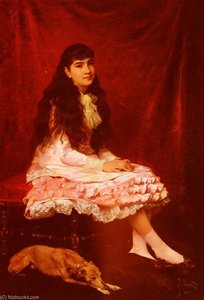 Portrait de jeune fille
59
 Arranging flowers for a spring bouquet
60
 Le marche de maubeuge
61
 Le gouter des enfants
62
 Le jour de marche
63
 The Square In Front Of Les Halles
The four subjects that come back most often in these originals, each with its finest example.
The 2 museums that hold the most of the paintings on this page.
| Museum | City | Works by Victor Gilbert | Paintings from this list |
|---|---|---|---|
 Carnavalet Museum |
Paris | 1 | The Market of the Madeleine |
 Petit Palais |
Paris | 1 | The song seller |
Pick a decade to see the original that defines it.
Le Marche aux Legumes (1878). The lower market, Paris (1881) and Resting (1890) come next.
31 years old: Le Marche aux Legumes dates from 1878, and Victor Gilbert was born in 1847.
Le Marche aux Legumes, The lower market, Paris, Resting, The Flower vendor on the pont des arts, Laying the table, La Marchande d'huitres, Flower Power; Flower Seller, The Market of the Madeleine, A flower seller on les Grands Boulevards and The harvest. The ranking above gives each one's year and museum.
Our catalog holds 63 works by Victor Gilbert, dated from 1878 to 1933.
Mostly in Carnavalet Museum (Paris) and Petit Palais (Paris). The museum table above lists them all.
In 1890s: 2 of the 63 works on this page were made then, Resting among them.
On this page, the earliest is Le Marche aux Legumes (1878) and the latest Laying the table (1933).
Markets (7), Fish (4) and 19th century france (3), across the 63 works on this page.
Impressionism, judging by the originals on this page.
Born in the heart of Paris in 1847, Victor Gabriel Gilbert was a painter whose destiny seemed initially tethered to the humble craft of carpentry, following in the footsteps of his father. However, a natural aptitude for drawing and a resilient spirit steered him toward a much more luminous path. Lacking the means to attend the prestigious École des Beaux-Arts, Gilbert sought his education through grit and apprenticeship, studying under the artisan painter and decorator Eugène Adam and later with Charles Busson. This early immersion in the tactile world of textures and decorative arts would later manifest in his profound ability to render the organic beauty of fruit, vegetables, and the bustling atmosphere of the French capital.
Gilbert’s artistic evolution is a captivating study of a painter finding his voice amidst a sea of shifting movements. His early works, appearing at the Salon des artistes français in the 1870s, were characterized by a somber, realist palette, heavily influenced by the moody, dark tones of masters like Bonvin and Ribot. Yet, as the vibrant energy of Impressionism began to sweep through Paris, Gilbert did not merely observe the change; he embraced it. He transitioned from the heavy shadows of realism toward a brighter, more luminous approach, adopting the loose brushstrokes and spontaneous light effects that defined the era. This stylistic metamorphosis allowed him to capture not just the physical presence of his subjects, but the very ephemeral essence of light dancing across a flower market or a crowded café.
The true legacy of Victor Gabriel Gilbert lies in his role as a chronicler of Parisian life. He became the preeminent painter of Les Halles, the legendary central marketplace of Paris, transforming mundane scenes of commerce into poetic celebrations of urban existence. His oeuvre, which spans over 60 and includes hundreds of works, focuses on the rhythmic vitality of the streets. Whether depicting a florist tending to colorful blooms at the Pont Neuf or the organized chaos of a morning fish market, Gilbert possessed a rare gift for finding grandeur in the ordinary.
His technique was a masterful blend of precision and impressionistic freedom. While his compositions often utilized the soft, atmospheric light characteristic of Impressionism, he maintained a meticulous attention to detail that anchored his work in reality. One can observe his skill in the delicate textures of a ripening peach, the translucent petals of a poppy, or the heavy drape of a merchant's apron. This duality—the ability to evoke a fleeting moment while celebrating the tangible weight of objects—is what makes his paintings so enduringly tactile and emotionally resonant.
Throughout his prolific career, Gilbert earned significant acclaim within the French art establishment. His contributions were recognized with prestigious honors, including:
Beyond the accolades, Gilbert’s historical significance resides in his ability to bridge the gap between the structured traditions of 19th-century realism and the sensory revolution of Impressionism. He provided a window into a vanished era of Paris—a time of bustling street markets and a burgeoning urban culture that felt both intimate and grand. Today, his works reside in esteemed collections such as the Musée Carnavalet in Paris and the Philadelphia Museum of Art, serving as vibrant, breathing reminders of the beauty found in the daily rhythms of Parisian life.