Portrait of Vittore Carpaccio

The 100 Most Famous Vittore Carpaccio Paintings, a Gallery Selection

Updated November 2026 · ranked by our popularity score (searches, visits and orders for each work) · 201 works by Vittore Carpaccio in our catalogue

In short

Of all the originals Vittore Carpaccio left, the most famous is Christ with the Symbols of the Passion Surrounded by Angels (1510), in the collection of the Metropolitan Museum of Art, New York. Close behind it come The Ten Thousand Martyrs on the Mount Ararat (1515) and Meeting of the Betrothed Couple (detail) (1495). Our catalog holds 201 works by Vittore Carpaccio; the gallery has kept the 100 the world admires most, each shown with its date, its museum and its story.

1465 – 1526, Venice Venetian renaissance Most works: Gallerie dell'Accademia di Venezia

Vittore Carpaccio's top 10 paintings: the gallery's choice

1
Christ with the Symbols of the Passion Surrounded by Angels (1510) by Vittore Carpaccio

Christ with the Symbols of the Passion Surrounded by Angels

1510 · Oil On Panel · Metropolitan Museum of Art, New York

Exquisite Depiction of the Crucifixion and Passion Immerse yourself in a profound visual narrative that captures the suffering and sacrifice of Jesus Christ. This masterful painting vividly portrays the pivotal moment of the Crucifixion, surrounded by symbolic elements of the Passion. The composition draws viewers into a deeply emotional scene filled with mourners, angels, and divine symbolism, evoking both reverence and contemplation. Its compelling subject matter makes it an ideal…

2
The Ten Thousand Martyrs on the Mount Ararat (1515) by Vittore Carpaccio

The Ten Thousand Martyrs on the Mount Ararat

1515 · Oil On Panel · Gallerie dell'Accademia di Venezia, Venice

To stand before this monumental canvas is to be enveloped by a wave of profound spiritual energy. Vittore Carpaccio’s depiction, The Ten Thousand Martyrs on the Mount Ararat, is not merely a painting; it is an overwhelming testament to faith, endurance, and the ultimate promise of resurrection. The sheer scale of the work—a dramatic expanse measuring 307 by 205 centimeters—demands attention, drawing the viewer into its complex narrative heart. It…

3
Meeting of the Betrothed Couple (detail) (1495) by Vittore Carpaccio

Meeting of the Betrothed Couple (detail)

1495 · Oil · Gallerie dell'Accademia di Venezia, Venice

Vittore Carpaccio's “Meeting of the Betrothed Couple” is not merely a depiction of a historical event; it’s a meticulously crafted window into the vibrant, complex world of 15th-century Venice. This particular detail, focusing on the central figures amidst a throng of nobility and civic officials, offers an intimate invitation to explore the artist's unique approach to narrative painting – a style that eschewed the prevailing humanist trends of his time…

4
The Lion of St Mark (detail) (1516) by Vittore Carpaccio

The Lion of St Mark (detail)

1516 · Tempera · Doge's Palace, Venice

In this detail from 1516, a winged lion occupies the foreground, its physical presence defined by a heavy, stone-like texture. The creature is positioned with its hind legs submerged in water while its forelegs rest upon dry land. Its wings are spread wide across the upper portion of the frame. In its paws, the lion holds an open book. The pages contain Latin text that reads "PAX TIBI MARCE EVANGELISTA…

5
The Lion of St Mark (detail) (1516) by Vittore Carpaccio

The Lion of St Mark (detail)

1516 · Tempera On Panel · Doge's Palace, Venice

In the heart of the Palazzo Ducale, where the echoes of history still resonate through the marble halls of Venice, resides one of the most profound symbols of a vanished republic. Vittore Carpaccio’s "The Lion of St Mark," completed in 1516, is far more than a mere depiction of a mythical creature; it is a breathtaking window into the soul of the Venetian Renaissance. To gaze upon this work is…

6
Lamentation of Christ (1510) by Vittore Carpaccio

Lamentation of Christ

1510 · Oil

In the heavy stillness that follows the Crucifixion, Vittore Carpaccio’s Lamentation of Christ captures a moment of profound theological and human tragedy. Painted around 1510, the scene unfolds with a somber atmosphere, inviting a slow, meditative gaze. At the center of this spiritual drama, the figure of Jesus hangs from the cross, his body a silent witness to sacrifice. The composition is meticulously detailed, creating a stage where the divine…

7
The Dead Christ (1520) by Vittore Carpaccio

The Dead Christ

1520 · Oil On Canvas · Staatliche Museen zu Berlin, Berlin

The body of Jesus lies upon a cold stone slab, a pale weight amidst the shadows of a rocky landscape. Around him, the air is heavy with the silence of the departed. Figures gather, their faces etched with the quiet geometry of grief. Some stand close to the lifeless limbs, while others linger in the periphery, caught in a moment of profound stillness. A single tree rises nearby, its branches…

8
St George and the Dragon (detail) (1502) by Vittore Carpaccio

St George and the Dragon (detail)

1502 · Tempera On Panel · Scuola di San Giorgio degli Schiavoni, Venice

In the heart of Venice, within the hallowed halls of the Scuola di San Giorgio degli Schiavoni, lies a fragment of a much larger epic. The detail from Vittore Carpaccio’s St George and the Dragon serves as a breathtaking window into the height of the Italian Renaissance. Painted in 1502, this tempera on wood panel is not merely a depiction of a myth, but a visceral experience of movement and…

9
St George and the Dragon (1516) by Vittore Carpaccio

St George and the Dragon

1516 · Tempera On Panel · San Giorgio Maggiore, Venice

In the heart of the Venetian Renaissance, where the shimmering reflections of the canals met the burgeoning spirit of humanism, Vittore Carpaccio captured a moment of eternal struggle. St George and the Dragon is not merely a depiction of a legendary battle; it is a breathtaking narrative tapestry that weaves together the chivalric ideals of the sixteenth century with a profound spiritual allegory. As the viewer’s eye meets the canvas,…

10
Meeting of the Betrothed Couple (detail) (1495) by Vittore Carpaccio

Meeting of the Betrothed Couple (detail)

1495 · Acrylic On Canvas · Gallerie dell'Accademia di Venezia, Venice

Vittore Carpaccio’s “Meeting of the Betrothed Couple,” a meticulously rendered detail from his monumental cycle depicting scenes from Dante Alighieri's *Divine Comedy*, offers a captivating glimpse into the vibrant, complex world of 15th-century Venice. Far more than a simple illustration, this panel—a fragment of a larger narrative—is a masterclass in observation and storytelling, revealing Carpaccio’s unique approach to Renaissance painting. It’s a scene brimming with social nuance, legal formality, and…

The Vittore Carpaccio selection continues, 11 to 100

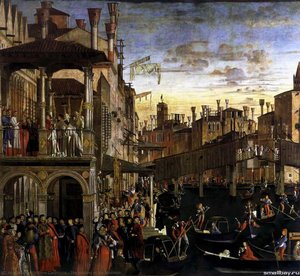
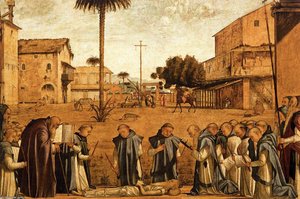
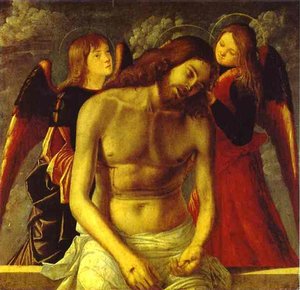
11Martyrdom of the Pilgrims and the Funeral of St Ursula (detail) (1493) by Vittore CarpaccioMartyrdom of the Pilgrims and the Funeral of St Ursula (detail)1493 · Gallerie dell'Accademia di Venezia 12The Healing of the Madman (detail) (1496) by Vittore CarpaccioThe Healing of the Madman (detail)1496 · Gallerie dell'Accademia di Venezia 13Portrait of a Knight (1510) by Vittore CarpaccioPortrait of a Knight1510 · Thyssen-Bornemisza Museum 14The Miracle of the Relic of the True Cross on the Rialto Bridge (1494) by Vittore CarpaccioThe Miracle of the Relic of the True Cross on the Rialto Bridge1494 · Gallerie dell'Accademia di Venezia 15The Healing of the Madman (detail) (1496) by Vittore CarpaccioThe Healing of the Madman (detail)1496 · Gallerie dell'Accademia di Venezia 16The Arrival of the Pilgrims in Cologne (1490) by Vittore CarpaccioThe Arrival of the Pilgrims in Cologne1490 · Gallerie dell'Accademia di Venezia 17St Stephen is Consecrated Deacon (detail) by Vittore CarpaccioSt Stephen is Consecrated Deacon (detail)Staatliche Museen zu Berlin 18Saint Peter Martyr (1505) by Vittore CarpaccioSaint Peter Martyr1505 · Philbrook Museum of Art 19The Ambassadors Return to the English Court (detail) (1495) by Vittore CarpaccioThe Ambassadors Return to the English Court (detail)1495 · Gallerie dell'Accademia di Venezia 20The Dream of St Ursula (1495) by Vittore CarpaccioThe Dream of St Ursula1495 · Gallerie dell'Accademia di Venezia 21The Meditation on the Passion (1510) by Vittore CarpaccioThe Meditation on the Passion1510 · Metropolitan Museum of Art 22Portrait of a lady (1495) by Vittore CarpaccioPortrait of a lady1495 · Museum of Fine Arts 23Vision of St. Augustine (1507) by Vittore CarpaccioVision of St. Augustine1507 24Departure of the Pilgrims (detail) (1495) by Vittore CarpaccioDeparture of the Pilgrims (detail)1495 · Gallerie dell'Accademia di Venezia 25Martyrdom of the Pilgrims and the Funeral of St Ursula (detail) (1493) by Vittore CarpaccioMartyrdom of the Pilgrims and the Funeral of St Ursula (detail)1493 · Gallerie dell'Accademia di Venezia 26St Catherine of Alexandria and St Veneranda (1500) by Vittore CarpaccioSt Catherine of Alexandria and St Veneranda1500 · Музей Кастельвеккіо 27Madonna and Child with two Saints (1490) by Vittore CarpaccioMadonna and Child with two Saints1490 · Gemäldegalerie 28The Lion of St Mark by Vittore CarpaccioThe Lion of St Mark 29Portrait of a Man (1510) by Vittore CarpaccioPortrait of a Man1510 · Museum of Fine Arts 30Madonna and Child Enthroned with Saints and Donor (1507) by Vittore CarpaccioMadonna and Child Enthroned with Saints and Donor1507 · Walters Art Museum 31A Gondolier (1517) by Vittore CarpaccioA Gondolier1517 · Isabella Stewart Gardner Museum 32St George and the Dragon (1516) by Vittore CarpaccioSt George and the Dragon1516 33The Baptism of the Selenites (detail) (1507) by Vittore CarpaccioThe Baptism of the Selenites (detail)1507 · Scuola di San Giorgio degli Schiavoni 34Salvator Mundi (1520) by Vittore CarpaccioSalvator Mundi1520 35Two Court Ladies by Vittore CarpaccioTwo Court Ladies 36The Marriage of the Virgin (1504) by Vittore CarpaccioThe Marriage of the Virgin1504 · Pinacoteca di Brera 37A Bishop Saint Blessing (1514) by Vittore CarpaccioA Bishop Saint Blessing1514 · Philbrook Museum of Art 38Mary with the Child and Saints Catherine and Jerome (1508) by Vittore CarpaccioMary with the Child and Saints Catherine and Jerome1508 · Staatliche Kunsthalle Karlsruhe 39Crucifixion and Apotheosis of the Ten Thousand Martyrs (1515) by Vittore CarpaccioCrucifixion and Apotheosis of the Ten Thousand Martyrs1515 · Gallerie dell'Accademia di Venezia 40Disputation of St Stephen (detail) (1514) by Vittore CarpaccioDisputation of St Stephen (detail)1514 · Pinacoteca di Brera 41Apotheosis of St Ursula (1491) by Vittore CarpaccioApotheosis of St Ursula1491 · Gallerie dell'Accademia di Venezia 42The Lion of St Mark (detail) (1516) by Vittore CarpaccioThe Lion of St Mark (detail)1516 · Doge's Palace 43The Ambassadors Depart (detail) (1495) by Vittore CarpaccioThe Ambassadors Depart (detail)1495 · Gallerie dell'Accademia di Venezia 44The Healing of the Madman (1496) by Vittore CarpaccioThe Healing of the Madman1496 · Gallerie dell'Accademia di Venezia 45Death of the Virgin by Carpaccio (1508) by Vittore CarpaccioDeath of the Virgin by Carpaccio1508 · Pinacoteca Nazionale 46The Ambassadors Return to the English Court (detail) (1495) by Vittore CarpaccioThe Ambassadors Return to the English Court (detail)1495 · Gallerie dell'Accademia di Venezia 47Disputation of St Stephen (detail) (1514) by Vittore CarpaccioDisputation of St Stephen (detail)1514 · Pinacoteca di Brera 48Arrival of the English Ambassadors (detail) (13) (1495) by Vittore CarpaccioArrival of the English Ambassadors (detail) (13)1495 · Gallerie dell'Accademia di Venezia 49Arrival of the English Ambassadors (detail) (1495) by Vittore CarpaccioArrival of the English Ambassadors (detail)1495 · Gallerie dell'Accademia di Venezia 50Presentation of Jesus in the Temple (detail) (1510) by Vittore CarpaccioPresentation of Jesus in the Temple (detail)1510 · Gallerie dell'Accademia di Venezia 51Arrival of the English Ambassadors (detail) (9) (1495) by Vittore CarpaccioArrival of the English Ambassadors (detail) (9)1495 · Gallerie dell'Accademia di Venezia 52Funeral of St Jerome (1502) by Vittore CarpaccioFuneral of St Jerome1502 · Scuola di San Giorgio degli Schiavoni 53Portrait of a lady (1485) by Vittore CarpaccioPortrait of a lady1485 54The Departure of the English Ambassadors (1498) by Vittore CarpaccioThe Departure of the English Ambassadors1498 55Glorification of St. Ursula and her Companions (1491) by Vittore CarpaccioGlorification of St. Ursula and her Companions1491 56the ambassadors depart - 280x253 - (1494) by Vittore Carpacciothe ambassadors depart - 280x253 -1494 57Hunting on the Lagoon (1490) by Vittore CarpaccioHunting on the Lagoon1490 58Meeting of the Betrothed Couple (detail) (1495) by Vittore CarpaccioMeeting of the Betrothed Couple (detail)1495 · Gallerie dell'Accademia di Venezia 59Agony in the Garden (1502) by Vittore CarpaccioAgony in the Garden1502 · Scuola di San Giorgio degli Schiavoni 60The Crucifixion and the Glorification the Ten Thousand Martyrs on Mount Ararat (1515) by Vittore CarpaccioThe Crucifixion and the Glorification the Ten Thousand Martyrs on Mount Ararat1515 61Portrait of a Venetian Nobleman (1510) by Vittore CarpaccioPortrait of a Venetian Nobleman1510 62The Baptism of the Selenites (1502) by Vittore CarpaccioThe Baptism of the Selenites1502 63The Triumph of St. George (1507) by Vittore CarpaccioThe Triumph of St. George1507 64Young Knight in a Landscape (1510) by Vittore CarpaccioYoung Knight in a Landscape1510 65Holy Conversation (detail) (1505) by Vittore CarpaccioHoly Conversation (detail)1505 · Musée du Petit Palais 66Baptism of the Selenites (detail) (1502) by Vittore CarpaccioBaptism of the Selenites (detail)1502 · Scuola di San Giorgio degli Schiavoni 67St. George Killing the Dragon (1507) by Vittore CarpaccioSt. George Killing the Dragon1507 68St. George Baptising the Gentile (1507) by Vittore CarpaccioSt. George Baptising the Gentile1507 69The Glory of St. Vidal (1514) by Vittore CarpaccioThe Glory of St. Vidal1514 70The Annunciation (1504) by Vittore CarpaccioThe Annunciation1504 · Ca' d'Oro 71The Dead Christ Supported by Angels. (1502) by Vittore CarpaccioThe Dead Christ Supported by Angels.1502 72Presentation in the Temple (1510) by Vittore CarpaccioPresentation in the Temple1510 73St. Stephen is Consecrated Deacon (1514) by Vittore CarpaccioSt. Stephen is Consecrated Deacon1514 74Salvator Mundi (1520) by Vittore CarpaccioSalvator Mundi1520 75The Annunciation (1504) by Vittore CarpaccioThe Annunciation1504 76Saint John the Baptist (1505) by Vittore CarpaccioSaint John the Baptist1505 · Philbrook Museum of Art 77Dream of St.Ursula (1495) by Vittore CarpaccioDream of St.Ursula1495 78St Jerome and the Lion (1502) by Vittore CarpaccioSt Jerome and the Lion1502 · Scuola di San Giorgio degli Schiavoni 79Vision of St Augustin (1502) by Vittore CarpaccioVision of St Augustin1502 · Scuola di San Giorgio degli Schiavoni 80The Stoning of St Stephen (1520) by Vittore CarpaccioThe Stoning of St Stephen1520 · Staatsgalerie 81Debate of St. Stephen (1514) by Vittore CarpaccioDebate of St. Stephen1514 82Portrait of a Woman by Vittore CarpaccioPortrait of a WomanRijksmuseum 83St George and the Dragon (detail) (1502) by Vittore CarpaccioSt George and the Dragon (detail)1502 · Scuola di San Giorgio degli Schiavoni 84Apotheosis of St Ursula (detail) (1491) by Vittore CarpaccioApotheosis of St Ursula (detail)1491 · Gallerie dell'Accademia di Venezia 85St. Stephen Preaching (1514) by Vittore CarpaccioSt. Stephen Preaching1514 86The Birth of the Virgin (1508) by Vittore CarpaccioThe Birth of the Virgin1508 87The Virgin Reading to the Infant Christ/The Virgin Adoring the Infant Christ with Saint John\n\nThe Virgin Reading to the Infant Christ (recto) (1490) by Vittore CarpaccioThe Virgin Reading to the Infant Christ/The Virgin Adoring the Infant Christ with Saint John\n\nThe Virgin Reading to the Infant Christ (recto)1490 · Courtauld Gallery 88Birth of the Virgin (1504) by Vittore CarpaccioBirth of the Virgin1504 · Accademia Carrara 89The Ten Thousand Martyrs on the Mount Ararat (detail) (1515) by Vittore CarpaccioThe Ten Thousand Martyrs on the Mount Ararat (detail)1515 · Gallerie dell'Accademia di Venezia 90Two Venetian Ladies (1510) by Vittore CarpaccioTwo Venetian Ladies1510 · Museo Correr 91Allegorical Figure of a Woman in a Landscape Holding a Spear and a Cornucopia by Vittore CarpaccioAllegorical Figure of a Woman in a Landscape Holding a Spear and a Cornucopia 92Madonna and Child by Vittore CarpaccioMadonna and ChildCollection Bemberg 93Resurrection of Christ by Vittore CarpaccioResurrection of ChristGemäldegalerie 94Coronation of Mary by Vittore CarpaccioCoronation of MaryGemäldegalerie 95Arrival of the English Ambassadors (detail - ) by Vittore CarpaccioArrival of the English Ambassadors (detail - ) 96The Madonna Reading by Vittore CarpaccioThe Madonna Reading 97Sacra Conversazione by Vittore CarpaccioSacra Conversazione 98Annunciation by Vittore CarpaccioAnnunciation 99the ambassadors depart by Vittore Carpacciothe ambassadors depart 100The Ambassadors Return to the English Court (detail) by Vittore CarpaccioThe Ambassadors Return to the English Court (detail)

Vittore Carpaccio's famous paintings, period by period

The subjects that held Vittore Carpaccio's eye

The four subjects that come back most often in these originals, each with its finest example.

The museums that keep Vittore Carpaccio's originals

The 8 museums that hold the most of the paintings on this page.

Museum City Works by Vittore Carpaccio Paintings from this list
Gallerie dell'Accademia di Venezia, VeniceGallerie dell'Accademia di Venezia Venice 36 The Ten Thousand Martyrs on the Mount Ararat, Meeting of the Betrothed Couple (detail), Meeting of the Betrothed Couple (detail)
Scuola di San Giorgio degli Schiavoni, VeniceScuola di San Giorgio degli Schiavoni Venice 17 St George and the Dragon (detail), The Baptism of the Selenites (detail), Funeral of St Jerome
Pinacoteca di Brera, MilanPinacoteca di Brera Milan 6 The Marriage of the Virgin, Disputation of St Stephen (detail), Disputation of St Stephen (detail)
Doge's Palace, VeniceDoge's Palace Venice 4 The Lion of St Mark (detail), The Lion of St Mark (detail), The Lion of St Mark (detail)
Gemäldegalerie, BerlinGemäldegalerie Berlin 4 Madonna and Child with two Saints, Resurrection of Christ, Coronation of Mary
Philbrook Museum of Art, TulsaPhilbrook Museum of Art Tulsa 3 Saint Peter Martyr, A Bishop Saint Blessing, Saint John the Baptist
Metropolitan Museum of Art, New YorkMetropolitan Museum of Art New York 3 Christ with the Symbols of the Passion Surrounded by Angels, The Meditation on the Passion
Staatliche Museen zu Berlin, BerlinStaatliche Museen zu Berlin Berlin 3 The Dead Christ, St Stephen is Consecrated Deacon (detail)

Vittore Carpaccio decade by decade: the original that defines each

Works per decade

Pick a decade to see the original that defines it.

Collectors' questions about Vittore Carpaccio's paintings

Which work is Vittore Carpaccio most famous for?Reveal the answer

Christ with the Symbols of the Passion Surrounded by Angels (1510), Metropolitan Museum of Art, New York. The Ten Thousand Martyrs on the Mount Ararat (1515) and Meeting of the Betrothed Couple (detail) (1495) come next.

What age was Vittore Carpaccio when Christ with the Symbols of the Passion Surrounded by Angels was made?Reveal the answer

45 years old: Christ with the Symbols of the Passion Surrounded by Angels dates from 1510, and Vittore Carpaccio was born in 1465.

What are the ten most famous Vittore Carpaccio paintings?Reveal the answer

Christ with the Symbols of the Passion Surrounded by Angels, The Ten Thousand Martyrs on the Mount Ararat, Meeting of the Betrothed Couple (detail), The Lion of St Mark (detail), The Lion of St Mark (detail), Lamentation of Christ, The Dead Christ, St George and the Dragon (detail), St George and the Dragon and Meeting of the Betrothed Couple (detail). The ranking above gives each one's year and museum.

How many paintings did Vittore Carpaccio leave?Reveal the answer

Our catalog holds 201 works by Vittore Carpaccio, dated from 1485 to 1520.

In which museums do Vittore Carpaccio's masterpieces hang?Reveal the answer

Mostly in Gallerie dell'Accademia di Venezia (Venice), Scuola di San Giorgio degli Schiavoni (Venice) and Pinacoteca di Brera (Milan). The museum table above lists them all.

In which years did Vittore Carpaccio paint the most famous works?Reveal the answer

In 1490s: 28 of the 100 works on this page were made then, Meeting of the Betrothed Couple (detail) among them.

What are the first and the last famous originals of Vittore Carpaccio?Reveal the answer

On this page, the earliest is Portrait of a lady (1485) and the latest The Dead Christ (1520).

Which subjects did Vittore Carpaccio choose most often?Reveal the answer

Narrative painting (13), Man (10) and People (10), across the 100 works on this page.

Which technique did Vittore Carpaccio use most?Reveal the answer

Oil On Canvas, for 19 of the 100 works on this page.

To which art movement does Vittore Carpaccio belong?Reveal the answer

Venetian renaissance, judging by the originals on this page.

Which Vittore Carpaccio works hang at the Gallerie dell'Accademia di Venezia?Reveal the answer

The Ten Thousand Martyrs on the Mount Ararat, Meeting of the Betrothed Couple (detail) and Meeting of the Betrothed Couple (detail): the Gallerie dell'Accademia di Venezia, Venice holds 24 of the works on this page.

Vittore Carpaccio: life and work

Early Life and Artistic Training

Born in Venice around 1465, Vittore Carpaccio grew up in a city defined by its maritime trade and its unique light. As a young man in the Venetian school, he sought out the guidance of Gentile Bellini. This apprenticeship was a formative period that shaped his technical approach and provided the necessary foundation for his future success as a painter.

The training Carpaccio received under Bellini allowed him to develop a steady hand and an eye for the specific details of Venetian life. He learned to navigate the complexities of composition and color that were essential to the era. This early education helped him establish himself within the competitive artistic landscape of the Republic, setting the stage for a career spent documenting both sacred stories and the daily realities of his home city.

Artistic Style and Influences

Carpaccio’s approach to painting remained notably conservative, even as the world around him shifted. While many of his contemporaries embraced the sweeping humanist trends that redefined Italian Renaissance art, he often looked in a different direction. His work carries a sense of fantasy, frequently reaching back toward the spirit of medieval romance rather than the pastoral ideals favored by the next generation of painters. This preference gave his scenes a unique atmosphere, one that felt distinct from the evolving tastes of the Venetian mainland.

His visual language was shaped by a specific blend of influences. He drew heavily from the style of Antonello da Messina and the meticulous traditions of early Netherlandish art. This combination allowed him to develop a command of perspective and a precision in architectural detail that set him apart from other artists of his time. He had a way of placing his subjects within highly specific, structured environments, using light and shadow to build a sense of depth that felt both grounded and otherworldly.

This attention to detail is particularly evident in his large-scale narrative works, where he could weave complex stories into the very fabric of the setting. His ability to render the textures of clothing and the exact geometry of a building helped create a sense of realism that supported his more imaginative storytelling. By focusing on these precise elements, he built a world that felt lived-in, even when the subject matter leaned into the legendary or the sacred.

Notable Works and Narrative Cycles

Carpaccio found his greatest expression through large-scale storytelling. His most famous undertaking was a cycle of nine paintings known as The Legend of Saint Ursula, a project he began in 1490. These works allowed him to build complex worlds, drawing the viewer into the specific details of the saint's life. He also had a talent for capturing the spirit of his home city. In the Miracle of the Relic of the Cross at the Ponte di Rialto, he illustrated Venice at the height of its power, using the urban landscape to ground his religious narratives in a recognizable reality.

His ability to handle different subjects is evident in his varied commissions. He produced the Portrait of Doge Leonardo Loredan, a work that reflects his standing as a significant figure in the Venetian Renaissance. He also painted St. George and the Dragon, a tempera on wood panel painting currently held at the Scuola di San Giorgio degli Schiavoni in Venice. This work captures a sense of drama through its composition and the interaction of its figures.

Career and Major Commissions

Carpaccio’s most productive years took place between 1490 and 1519. During this time, he became a frequent presence in the religious life of Venice, receiving various church commissions that allowed him to explore complex narratives. His work often moved through the streets of the city, capturing the spirit of the Republic in large urban scenes. One such example is the Miracle of the Relic of the Cross at the Ponte di Rialto, a work that illustrates Venice at the height of its civic pride.

As his career progressed, the nature of his patronage began to shift. While his earlier years were defined by large-scale religious cycles and public works, his output after 1510 moved toward the private sphere. He began to work primarily for individual Venetian patrons, creating pieces that reflected the personal tastes of the city's growing merchant class. This transition saw him move from the grand, public storytelling of his youth toward more intimate engagements with his collectors.

His religious output remained steady through the first decade of the sixteenth century. Notable commissions from this period include:

  • St. Thomas Aquinas Enthroned (1507)
  • Presentation of Christ in the Temple (1510)

Legacy and Historical Standing

Vittore Carpaccio holds a place among the early masters of the Venetian Renaissance, a period of profound change in Italian art. While his contemporaries were moving toward new humanist trends, Carpaccio often remained anchored to a more traditional way of seeing. By 1510, those living and working alongside him began to perceive his style as too conservative. He did not chase the shifting currents of his era, preferring a method that looked back toward the detailed, narrative traditions of the past.

This steadfastness meant that his name has sometimes been overlooked in the shadow of figures like Giovanni Bellini or Giorgione. While others moved toward a different kind of visual language, Carpaccio continued to build his worlds through precise architectural detail and a fascination with the exotic. His work remains a window into a specific moment in Venice, capturing the city's civic pride and its connection to the Levant through a lens that felt increasingly old-fashioned to his peers. He died in 1526, leaving behind a body of work that reflects a unique, if somewhat stubborn, devotion to his craft.

  • The Legend of Saint Ursula
  • The Miracle of the Relic of the True Cross at the Ponte di Rialto
  • St. George and the Dragon