


1


Updated October 2026 · ranked by our popularity score (searches, visits and orders for each work) · 112 works by Thomas Thompson in our catalogue
In short
Of all the originals Thomas Thompson left, the most famous is Trees And Stump Above A Shore. Close behind it come Landscape With Storm Clouds (1913) and Snow Pillars In The Sky. Our catalog holds 112 works by Thomas Thompson; the gallery has kept the 100 the world admires most, each shown with its date, its museum and its story.

Thomas Thompson's Landscape with Storm Clouds, painted in 1913, is a captivating piece that embodies the dramatic and powerful essence of nature. This oil painting, available as a handmade reproduction on AllPaintingsStore.com, offers a unique blend of serenity and turmoil, making it a fascinating subject for art enthusiasts. The Composition The painting features a serene landscape with storm clouds looming in the sky above a body of water. The background…


 Snow In The Woods (ii)
12
 Near Owen Sound
13
 Canoe Lake
14
 On Georgian Bay
15
 Evening Sky
16
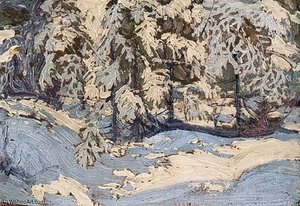 First Snow In Autumn
17
 Thunderhead
18
 The Silent Lake
19
 Shore With HousesNational Gallery of Canada
20
 Nocturne
21
 Rainbow
22
 Tamarack Swamp, Dawn
23
 Snow In The Woods
24
 View Over A Lake Sunset Sky
25
 Stormy Sky
26
 Windy Evening
27
 Misty Sky
28
 The Light That Never WasNational Gallery of Canada
29
 RiverNational Gallery of Canada
30
 Wooded Point And Rough Water
31
 Snow BanksNational Gallery of Canada
32
 Grey Day, Giant's TombNational Gallery of Canada
33
 White Frost
34
 Dark WatersNational Gallery of Canada
35
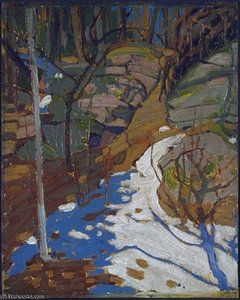 Snow And Rocks
36
 Northern Lake
37
 Petawawa Gorges
38
 Landscape
39
 Hot Summer Moonlight
40
 Lightning, Canoe Lake
41
 Mississauga
42
 Rough Weather In The Islands
43
 Burnt LandNational Gallery of Canada
44
 Storm Cloud
45
 Red Leaves
46
 Birches
47
 Snow-covered Trees
48
 Birch Woods In Autumn
49
 Canadian WildflowersNational Gallery of Canada
50
 Burnt Country, Evening
51
 The Lily Pond
52
 Cottage On A Rocky ShoreNational Gallery of Canada
53
 Snow In October
54
 Ice Reflections, Spring
55
 The Enchanted Stream, Midnight
56
 Tea Lake DamNational Gallery of Canada
57
 Sketch For In The NorthlandNational Gallery of Canada
58
 Rocky Shore
59
 Ice In Spring
60
 Tamarack
61
 Stormy Evening
62
 Frost-laden Cedars, Big Cauchon Lake
63
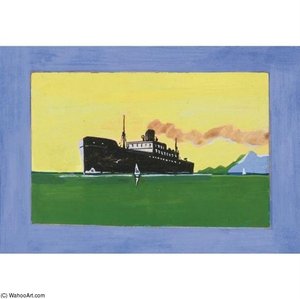 Lake Freighter
64
 The Zeppelins
65
 Poplars By A LakeNational Gallery of Canada
66
 Early April
67
 Forest Undergrowth Iii
68
 Larry Dickson's Cabin
69
 Yellow Sunset
70
 Spring
71
 Petawawa
72
 Decorative Panel (ii)
73
 Moonlight
74
 Northern Spring
75
 Maccallum's Island
76
 Winter Sunset, Algonquin Park
77
 View Over A Lake, Autumn
78
 Lake In Autumn
79
 Decorative Panel (iv)
80
 Autumn Hillside
81
 Winter In The Woods
82
 SunsetNational Gallery of Canada
83
 Northern Lights
84
 The Lake, Bright Day
85
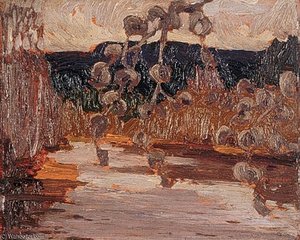 Pine Cones
86
 Cranberry Marsh
87
 Campfire
88
 Sunset Sky
89
 Hills And Swirling Sky
90
 Blue Clouds, Wooded Hills, And Marshes
91
 White Birches, Round Lake
92
 Old Lumber Dam, Algonquin ParkNational Gallery of Canada
93
 Decorative Panel
94
 The Marsh, Early Spring
95
 Larry Dickson's Shack
96
 Tangled Trees
97
 Decorative Panel (iii)
98
 Maple Woods, Bare Trunks
99
 The Jack Pine
100
 Spruce And Maple
The four subjects that come back most often in these originals, each with its finest example.
The 2 museums that hold the most of the paintings on this page.
| Museum | City | Works by Thomas Thompson | Paintings from this list |
|---|---|---|---|
 National Gallery of Canada |
Ottawa | 21 | Hillside, Smoke Lake, The Opening Of The Rivers, Parry Sound Harbour |
 Metropolitan Museum of Art |
New York | 1 | The U. S. Ship Franklin, with a View of the Bay of New York |
1913 is the year of every dated Thomas Thompson work in this selection: here they are, ranked by fame.
Pick a year to see its originals.
Thomas Thompson's Landscape with Storm Clouds, painted in 1913, is a captivating piece that embodies the dramatic and powerful essence of nature. This oil painting, available as a handmade reproduction on AllPaintingsStore.com, offers a unique blend of serenity and turmoil, making it a fascinating subject for art enthusiasts. The Composition The painting features a serene landscape with storm clouds looming in the sky above a body of water. The background…
Trees And Stump Above A Shore. Landscape With Storm Clouds (1913) and Snow Pillars In The Sky come next.
Trees And Stump Above A Shore, Landscape With Storm Clouds, Snow Pillars In The Sky, Hillside, Smoke Lake, The Opening Of The Rivers, Fall Woods, Algonquin Park, Parry Sound Harbour, The U. S. Ship Franklin, with a View of the Bay of New York, Sketchbook and Decorated Pannikin. The ranking above gives each one's year and museum.
Our catalog holds 112 works by Thomas Thompson.
Mostly in National Gallery of Canada (Ottawa) and Metropolitan Museum of Art (New York). The museum table above lists them all.
Lakes (12), Landscape (10) and Sunset (8), across the 100 works on this page.
Impressionism, judging by the originals on this page.
Hillside, Smoke Lake, The Opening Of The Rivers and Parry Sound Harbour: the National Gallery of Canada, Ottawa holds 17 of the works on this page.
Yes, as a reproduction: the original stays in its museum, but any painting on this page can be painted by hand for you, made to order one at a time, from the painting's own page.
Thomas Thomson stands as a pivotal figure in Canadian art history—a painter who profoundly shaped the aesthetic sensibilities of his time and cemented the legacy of the Group of Seven. Born in Claremont, Ontario, amidst a family steeped in farming traditions, Thomson’s artistic journey began with an instinctive fascination for the natural world, particularly the rugged beauty of Algonquin Park. Unlike many artists of his era who pursued formal training, Thomson honed his craft largely through self-teaching and observation—a method that instilled in him a unique perspective on capturing the essence of Ontario's wilderness.
Thomson’s childhood was marked by hardship and rural simplicity, yet it nurtured within him an appreciation for craftsmanship and detail—qualities that would later translate into his distinctive painting style. He worked various jobs before enrolling in a business college, acquiring skills in penmanship and copperplate writing, demonstrating a pragmatic approach to life alongside burgeoning artistic inclinations. Crucially, Thomson’s formative years coincided with the influence of William Brodie, a naturalist who instilled in him a deep respect for scientific observation and encouraged him to immerse himself in the intricacies of Ontario's flora and fauna. This early exposure would prove instrumental in shaping his artistic vision—a vision characterized by an unwavering commitment to portraying nature with uncompromising honesty and emotional resonance.
Thomson’s artistic style is instantly recognizable through its expressive power and tactile presence. His work is defined by expansive brushstrokes combined with a liberal application of paint—a technique known as impasto—which became his unmistakable trademark. Rejecting the rigid academic conventions of the late 19th century, he prioritized the conveyance of feeling over precise realism. In masterpieces such as Snow In The Woods (ii), one can observe how his heavy, textured application of paint evokes a profound sense of isolation and melancholy, turning a simple winter forest scene into a deeply psychological landscape.
His ability to manipulate light and atmosphere allowed him to capture the fleeting drama of the Canadian elements. Whether depicting the turbulent energy of a Stormy Sky or the heavy, brooding presence of Landscape With Storm Clouds, Thomson utilized a textured impasto and often a muted palette to communicate the raw power of nature. His work does not merely represent the landscape; it embodies the very movement of the wind and the weight of the clouds, inviting the viewer to experience the sensory reality of the North.
Though his life was tragically short, ending in 1917, the impact of Thomas Thomson on the trajectory of Canadian art remains immeasurable. He served as a vital precursor and inspiration for the Group of Seven, providing a blueprint for how the Canadian identity could be expressed through a rugged, non-European aesthetic. By moving away from the soft, pastoral traditions of colonial landscape painting, he paved the way for a nationalistic style that celebrated the untamed, often harsh, beauty of the Canadian Shield.
Today, Thomson is remembered not just as a painter of scenery, but as a poet of the earth. His contributions can be summarized through several enduring legacies:

