1


Updated October 2026 · ranked by our popularity score (searches, visits and orders for each work) · 35 works by Robert Colquhoun in our catalogue
In short
To the gallery's eye, Robert Colquhoun's most famous painting is Encounter (1942). Two Irish People (1947) and Woman with Leaping Cat (1945) complete the trio every eye recognises. Of the 35 works by Robert Colquhoun in our catalog, the gallery presents the 35 most famous below, each original with its year, its museum and what makes it unique.


In the evocative landscape of mid-century British art, few works capture the tension between simplicity and profound emotion as effectively as Robert Colquhoun’s Seated Woman and Cat. Painted in 1946, this striking oil on canvas serves as a masterclass in early modernism, blending the structural rigor of Cubism with the raw, visceral energy of Expressionism. The composition immediately commands attention through its bold, geometric architecture, where flattened planes and sharp…

In the evocative realm of mid-century British Expressionism, few works capture the raw, psychological tension of the human condition as poignantly as Robert Colquhoun’s 1947 masterpiece, Woman in a Blue Hat. This striking portrait serves as a profound window into the artist's ability to transmute simple observation into deep emotional resonance. At first glance, the viewer is met with a bold, chromatic confrontation: the vibrant, almost aggressive yellow of the…

The Lock Gate is a captivating oil on canvas painting created by the renowned artist Robert Colquhoun in 1942. Measuring 39 x 58 cm, this artwork is currently housed at the Glasgow Museums Resource Centre in the United Kingdom. As a prominent figure in the British art scene, Colquhoun's works are highly regarded for their unique blend of realism and modernism. Composition and Style The Lock Gate painting features a…

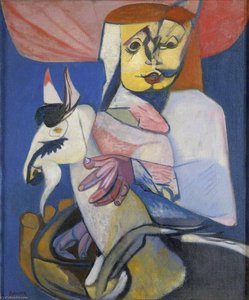
The oil painting titled Woman with a Circus Goat was executed by the artist Robert Colquhoun. This work dates to 1948. It is currently held within the British Council Collection.
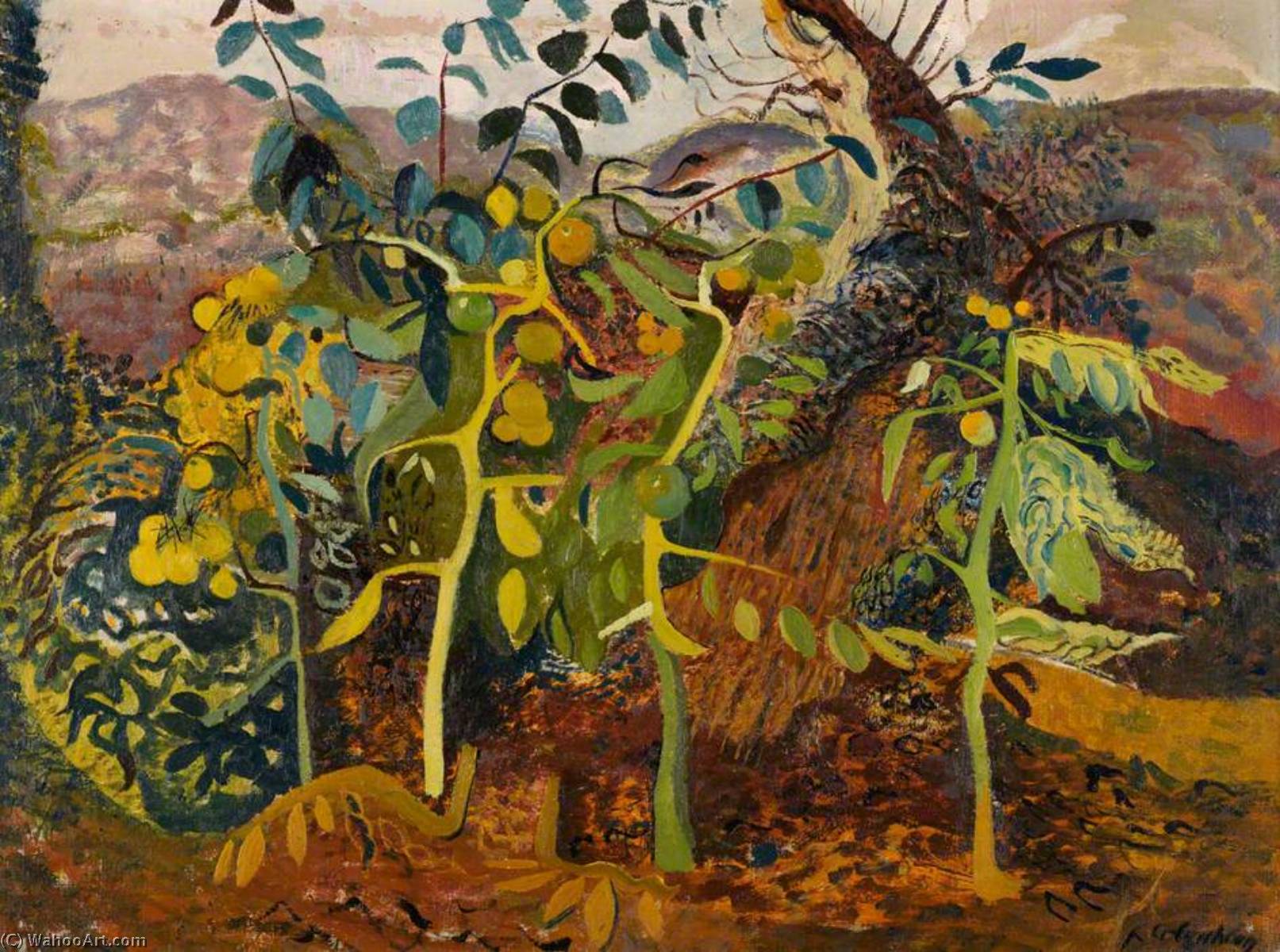
In the evocative realm of mid-century British expressionism, few works capture the pulse of the natural world with as much kinetic energy as Robert Colquanno’s 1942 masterpiece, Tomato Plants. At first glance, the canvas presents a lush, sprawling forest scene, yet beneath its vibrant surface lies a complex tapestry of movement and light. The composition is anchored by a magnificent tree adorned with luminous yellow leaves, a brilliant focal point…

 Thea Neu1943
12
 Young Man in a Landscape (David Haughton, 1924–1991, Artist)1943
13
 Marrowfield, Worcestershire1941
14
 Church Lench1942 · Arts Council Collection
15
 Robert Colquhoun (1914–1962), Artist, Self Portrait1940
16
 Woman with a Birdcage1946
17
 The Fortune Teller1946
18
 The Dubliners1946
19
 The Goatherd1948 · County Hall
20
 The Potato Diggers1946 · Aberystwyth University School of Art Museum And Galleries
21
 Weaving Army Cloth1945 · British Council Collection
22
 The Peasant Woman1944 · County Hall
23
 Circus Woman1949
24
 Woman in Green1949
25
 Costume for Donald (in a Palace Scene)1952
26
 The Goatmen (costume design for Leonide Massine's ballet 'Donald of the Burthens' of 1951)1952
27
 Boy with a Basket1949
28
 Man with a Donkey Saddle1950 · Middlesbrough Institute of Modern Art
29
 Woman and Goat1948 · The Hepworth Wakefield
30
 The Students1947 · British Council Collection
31
 Seeded Plants1942 · Royal College of Art
32
 Girl and PigSalford Museum - Art Gallery
33
 Religious Procession, Italy
34
 Woman with a Goat
35
 Weeping Woman1948 · The Dick Institute
The four subjects that come back most often in these originals, each with its finest example.
The 8 museums that hold the most of the paintings on this page.
| Museum | City | Works by Robert Colquhoun | Paintings from this list |
|---|---|---|---|
 British Council Collection |
London | 4 | Woman in a Blue Hat, Woman with a Circus Goat, Weaving Army Cloth |
 County Hall |
Leicester | 3 | Seated Figure, The Goatherd, The Peasant Woman |
 Arts Council Collection |
London | 2 | Seated Woman and Cat, Church Lench |
 Jerwood Gallery |
Hastings | 1 | Two Irish People |
 Government Art Collection |
London | 1 | Tomato Plants |
 The Fleming Collection |
London | 1 | Head Study |
 Aberystwyth University School of Art Museum And Galleries |
Aberystwyth | 1 | The Potato Diggers |
 Middlesbrough Institute of Modern Art |
Middlesbrough | 1 | Man with a Donkey Saddle |
Robert Colquhoun's career on this page runs 13 years, 1940 to 1952: each year appears here with its most famous originals.
Pick a year to see its originals.


In the evocative landscape of mid-century British art, few works capture the tension between simplicity and profound emotion as effectively as Robert Colquhoun’s Seated Woman and Cat. Painted in 1946, this striking oil on canvas serves as a masterclass in early modernism, blending the structural rigor of Cubism with the raw, visceral energy of Expressionism. The composition immediately commands attention through its bold, geometric architecture, where flattened planes and sharp…
More from 1946
The oil painting titled Woman with a Circus Goat was executed by the artist Robert Colquhoun. This work dates to 1948. It is currently held within the British Council Collection.
More from 1948


Encounter (1942). Two Irish People (1947) and Woman with Leaping Cat (1945) come next.
28 years old: Encounter dates from 1942, and Robert Colquhoun was born in 1914.
Encounter, Two Irish People, Woman with Leaping Cat, Seated Figure, Seated Woman and Cat, Woman in a Blue Hat, The Lock Gate, Woman with a Circus Goat, Tomato Plants and Head Study. The ranking above gives each one's year and museum.
Our catalog holds 35 works by Robert Colquhoun, dated from 1940 to 1952.
Mostly in British Council Collection (London), County Hall (Leicester) and Arts Council Collection (London). The museum table above lists them all.
In 1942: 5 of the 35 works on this page were made then, Encounter among them.
On this page, the earliest is Robert Colquhoun (1914–1962), Artist, Self Portrait (1940) and the latest Costume for Donald (in a Palace Scene) (1952).
Women (6), Melancholy mood (3) and Geometric forms (3), across the 35 works on this page.
Oil On Canvas, for 5 of the 35 works on this page.
Cubism and Expressionism, judging by the originals on this page.
Woman in a Blue Hat, Woman with a Circus Goat and Weaving Army Cloth: the British Council Collection, London holds 4 of the works on this page.