Portrait of Ogata Kōrin

Ogata Kōrin Paintings: The 36 Most Famous, Through a Gallery's Eye

Updated November 2026 · ranked by our popularity score (searches, visits and orders for each work) · 36 works by Ogata Kōrin in our catalogue

In short

To the gallery's eye, Ogata Kōrin's most famous painting is Title(Japanese): 円形図案集 (1700), whose original hangs in the Osaka City Museum of Fine Arts, Осака. Fukurokuju (1700) and Hotei (1704) complete the trio every eye recognises. Of the 36 works by Ogata Kōrin in our catalog, the gallery presents the 36 most famous below, each original with its year, its museum and what makes it unique.

1658 – 1716, Heian-kyō Rinpa Most works: Metropolitan Museum of Art

The gallery's top 10 Ogata Kōrin paintings

1
Title(Japanese): 円形図案集 (1700) by Ogata Kōrin

Title(Japanese): 円形図案集

1700 · Ink On Paper · Osaka City Museum of Fine Arts, Осака

A single deer pauses within a ring of shifting life. It stands on one leg, a momentary stillness amidst the quiet movement of the woods. Leaves and flowers drift through the composition, some clinging to the earth near the animal's feet, others floating in the empty space of the background. The scene captures a breath held in the forest. It is a small, circular world where nature is distilled into…

2
Fukurokuju (1700) by Ogata Kōrin

Fukurokuju

1700 · Ink · Minneapolis Institute of Art, Minneapolis

In Fukurokuju, Ogata Kōrin presents the deity through a highly stylized and expressive lens. The subject is rendered as an elderly man, defined by a long beard and a high, prominent forehead. The artist employs a flat perspective, prioritizing the silhouette and the essential features of the figure over three-dimensional depth. This approach emphasizes the character's iconographic form rather than anatomical realism.

3
Hotei (1704) by Ogata Kōrin

Hotei

1704 · Ink On Paper

A heavy, dark sphere rests behind a seated figure, a moon of ink that anchors the composition. Hotei sits with a quiet, rounded presence, his form defined by the sweeping, confident strokes of a brush. He cradles two black cats against his robes, their small shapes mirroring the curves of his own body. The ink is deep and certain, flowing across the cream-colored paper to create a sense of weight…

4
Rabbits under the Moon, Peonies, and Hollyhocks (801) by Ogata Kōrin

Rabbits under the Moon, Peonies, and Hollyhocks

801 · Ink On Paper

The scene unfolds in Rabbits under the Moon, Peonies, and Hollyhocks, a work that breathes with the quiet energy of the Rinpa school. Here, Ogata Kōrin captures a moment of botanical grace, inviting the viewer into a world where nature and design meet in a delicate dance. The artist, born in Heian-kyō, Japan, moves through the medium with the practiced hand of a man who understands both the flow of…

5
Pheasant (1687) by Ogata Kōrin

Pheasant

1687 · Ink On Paper · Cleveland Museum of Art, Cleveland

A single pheasant occupies the left side of the composition, its body rendered in profile with the beak slightly parted as if in mid-call. The bird's long, sweeping tail extends toward the bottom right corner, creating an asymmetrical balance typical of the Rinpa school. Fine, rhythmic brushstrokes define the texture of the feathers, while a striking patch of red marks the bird's face. The surrounding flowers are depicted with delicate,…

7
Seiobo (1705) by Ogata Kōrin

Seiobo

1705 · Ink · Kimbell Art Museum, Fort Worth

In the delicate dance of ink and color upon silk, Ogata Kōrin captures a moment that transcends the earthly realm. Seiobo, a masterpiece dating to approximately 1705, invites the viewer into a mythic landscape where the boundaries between the mortal and the divine blur. The painting depicts the legendary Queen Mother of the West, known in Japan as Seiobo, an immortal Taoist deity of profound significance. Kōrin presents her not…

8
Plum Tree (1700) by Ogata Kōrin

Plum Tree

1700 · Ink On Paper · Cleveland Museum of Art, Cleveland

We are looking at Plum Tree, a work created by Ogata Kōrin around 1700. This piece emerges from the Rinpa School, a tradition that Kōrin helped define through his diverse talents. He was a practitioner of many disciplines, working as a Japanese landscape illustrator, lacquerer, painter, and textile designer.

9
Writing box, Design of Yatsu-hashi bridge (1700) by Ogata Kōrin

Writing box, Design of Yatsu-hashi bridge

1700 · Lacquer

The Writing box, Design of Yatsu-hashi bridge emerges from the hands of Ogata Kōrin, a leading figure of the Rinpa School. This object, a suzuribako, carries the unmistakable touch of an artist who transformed the decorative arts of the Edo period. Born in Heian-kyō, Japan, Ogata Kōrin lived from 1658 to 1716, a life that saw the evolution of a distinct visual language. This specific piece dates to about 1700,…

10
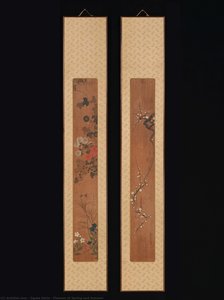
Flowers of Spring and Autumn (1701) by Ogata Kōrin

Flowers of Spring and Autumn

1701 · Ink

Flowers of Spring and Autumn, painted by Ogata Kōrin around 1701, captures the shifting breath of the seasons across two panels. On the right-hand side, white plum blossoms cling to the stark, dark branches of a leafless tree. These blossoms act as a quiet harbinger of spring, emerging from the wood's fine grain. The composition relies on the tension between the bare limbs and the sudden, pale life of the…

Ogata Kōrin paintings, ranked 11 to 36

The subjects that held Ogata Kōrin's eye

The four subjects that come back most often in these originals, each with its finest example.

The museums that keep Ogata Kōrin's originals

The 8 museums that hold the most of the paintings on this page.

Museum City Works by Ogata Kōrin Paintings from this list
Metropolitan Museum of Art, New YorkMetropolitan Museum of Art New York 13 Irises at Yatsuhashi (Eight Bridges), Rabbits, Preliminary Drawing of Three Deer Mounted on a Hanging-scroll Painting of Flowering Bush Clover
Cleveland Museum of Art, ClevelandCleveland Museum of Art Cleveland 3 Pheasant, Chrysanthemums by a Stream, Plum Tree
Osaka City Museum of Fine Arts, ОсакаOsaka City Museum of Fine Arts Осака 2 Title(Japanese): 円形図案集, Title(Japanese): 梅蒔絵箱図案
Detroit Institute of Arts, DetroitDetroit Institute of Arts Detroit 2 Corn and Pampas Grass: Corn, Corn and Pampas Grass: Pampas Grass
Minneapolis Institute of Art, MinneapolisMinneapolis Institute of Art Minneapolis 1 Fukurokuju
Kimbell Art Museum, Fort WorthKimbell Art Museum Fort Worth 1 Seiobo
Suntory Museum of Art, TokyoSuntory Museum of Art Tokyo 1 Flowering Plants in Autumn
Museum of Fine Arts, BostonMuseum of Fine Arts Boston 1 Waves at Matsushima

Ogata Kōrin, one signature painting per decade

Works per decade

Pick a decade to see the original that defines it.

Ogata Kōrin's paintings: the gallery answers

Which Ogata Kōrin painting is the most famous of all?Reveal the answer

Title(Japanese): 円形図案集 (1700), Osaka City Museum of Fine Arts, Осака. Fukurokuju (1700) and Hotei (1704) come next.

How old was Ogata Kōrin on completing Title(Japanese): 円形図案集?Reveal the answer

42 years old: Title(Japanese): 円形図案集 dates from 1700, and Ogata Kōrin was born in 1658.

Which are Ogata Kōrin's top 10 paintings?Reveal the answer

Title(Japanese): 円形図案集, Fukurokuju, Hotei, Rabbits under the Moon, Peonies, and Hollyhocks, Pheasant, Chrysanthemums by a Stream, Seiobo, Plum Tree, Writing box, Design of Yatsu-hashi bridge and Flowers of Spring and Autumn. The ranking above gives each one's year and museum.

How many works did Ogata Kōrin create?Reveal the answer

Our catalog holds 36 works by Ogata Kōrin, dated from 1687 to 1709.

Where do Ogata Kōrin's most famous originals hang?Reveal the answer

Mostly in Metropolitan Museum of Art (New York), Cleveland Museum of Art (Cleveland) and Osaka City Museum of Fine Arts (Осака). The museum table above lists them all.

When did Ogata Kōrin create the most famous paintings?Reveal the answer

In 1700s: 12 of the 36 works on this page were made then, Title(Japanese): 円形図案集 among them.

Which are Ogata Kōrin's earliest and latest famous works?Reveal the answer

On this page, the earliest is Pheasant (1687) and the latest Irises at Yatsuhashi (Eight Bridges) (1709).

Which subjects did Ogata Kōrin return to most?Reveal the answer

Traditional japan (7), Flowers (4) and Japanese art (4), across the 36 works on this page.

Which medium did Ogata Kōrin work in most?Reveal the answer

Ink On Paper, for 6 of the 36 works on this page.

Which movement is Ogata Kōrin associated with?Reveal the answer

Rinpa, judging by the originals on this page.

Which Ogata Kōrin originals does the Metropolitan Museum of Art hold?Reveal the answer

Irises at Yatsuhashi (Eight Bridges), Rabbits and Preliminary Drawing of Three Deer Mounted on a Hanging-scroll Painting of Flowering Bush Clover: the Metropolitan Museum of Art, New York holds 13 of the works on this page.

Ogata Kōrin: the artist

Ogata Kōrin: A Master of the Rinpa School

Ogata Kōrin (1658-1716) stands as a pivotal figure in Japanese art history, a master whose vibrant paintings and innovative designs profoundly shaped the Rinpa school. Born into a wealthy merchant family dedicated to textiles in Kyoto, Kōrin’s artistic journey was one of late blossoming, transforming him from a youthful dilettante into a celebrated artist renowned for his breathtaking byōbu folding screens and exquisite depictions of nature. His legacy endures not only through his iconic works but also through his influence on generations of artists, most notably Sakai Hōitsu, who championed and popularized Kōrin’s distinctive style.

Kōrin's early life was steeped in the traditions of Kyoto’s elite. His father, Ogata Sōken, a respected calligrapher and patron of Noh theater, instilled in his sons an appreciation for the arts. While initially more inclined towards social pursuits, Kōrin received a formal artistic education, likely influenced by the teachings of the Kanō school, though definitive proof remains elusive. Crucially, he was deeply impacted by the works of his great-granduncle, Hon'ami Kōetsu, and the painter Tawaraya Sōtatsu – the foundational figures of the Rinpa school itself. These predecessors’ emphasis on naturalism, meticulous detail, and a revolutionary approach to color theory served as the bedrock for Kōrin’s own artistic development.

The Rise of a Master

Kōrin's emergence as a significant artist occurred later in life, around 1701-1705. This period witnessed the creation of his most celebrated works, including the iconic “Irises” (a pair of six-panel byōbu screens now designated a National Treasure). These paintings are not merely representations of nature; they are meticulously constructed compositions brimming with symbolism and demonstrating Kōrin’s mastery of color, texture, and perspective. The vibrant hues, achieved through the skillful use of mineral pigments and organic materials on silk or paper, were revolutionary for their time, moving away from the more restrained palettes favored by earlier schools.

Beyond “Irises,” Kōrin's oeuvre encompasses a diverse range of subjects – plum blossoms, cranes and pine trees (a traditional symbol of longevity), and even scenes depicting everyday life. However, it is his folding screens that truly define his artistic legacy. The “Red and White Plum Blossoms” screens (painted circa 1714-1715) exemplify this mastery, showcasing a dynamic interplay of color and form within a carefully orchestrated composition. These works are not simply decorative; they represent a sophisticated understanding of aesthetics and symbolism, reflecting the values of the Edo period.

Technique and Innovation

Kōrin’s artistic technique was characterized by an extraordinary attention to detail and a profound understanding of materials. He employed a unique approach to color mixing, utilizing mineral pigments – such as safflower red, ultramarine blue, and malachite green – alongside organic dyes to achieve astonishingly rich and luminous effects. His use of gold leaf, meticulously applied to the paper, added an ethereal quality to his paintings, creating a shimmering depth that captivated viewers.

Furthermore, Kōrin’s mastery extended beyond painting; he was also a skilled lacquerer and designer of decorative objects like *makie* (relief designs) and *inrō* (medicine cases). These works demonstrate his versatility and his ability to seamlessly integrate artistic principles across various mediums. His innovative approach to design—particularly in the realm of textiles—influenced fashion trends throughout the Edo period.

Legacy and Influence

Ogata Kōrin’s impact on Japanese art is immeasurable. He didn't merely continue a tradition; he revitalized and consolidated the Rinpa school, establishing it as a dominant force in the artistic landscape of his time. His work served as a model for subsequent generations of artists, most notably Sakai Hōitsu, who meticulously copied Kōrin’s paintings and disseminated his style throughout Japan. Hōitsu's efforts ensured that Kōrin’s legacy would endure long after the artist’s death.

Today, Kōrin’s masterpieces are housed primarily at the Museum of Art in Atami, Shizuoka Prefecture, a testament to their enduring value and significance. His work continues to inspire artists and art enthusiasts alike, offering a glimpse into the vibrant world of Edo-period Japan and the genius of one of its most celebrated painters.

Key Works

  • Irises (1701-1705): A pair of six-panel byōbu screens, National Treasure.
  • Red and White Plum Blossoms (1714 or 1715): A pair of two-panel byōbu folding screens.
  • Wind God and Thunder God (c. 1700): A monumental pair of byōbu screens, now in the Tokyo National Museum.
  • Cranes, Pines, and Bamboo : A classic example of Rinpa style, showcasing longevity symbols.