


1


Updated October 2026 · ranked by our popularity score (searches, visits and orders for each work) · 29 works by Nathan Altman in our catalogue
In short
Postal Stamps. The Russian Republic. (1917) is the Nathan Altman painting that draws the most eyes. After it, the eye goes to The Arch of the General Staff (1920) and Lenin. Drawings by Nathan Altman. (1921). Among the 29 works of Nathan Altman in our catalog, these 29 are the most famous, each a unique original presented with its year, its museum and the reason it endures.


The Nathan Altman painting, Lady with a Dog. Portrait of Esther Schwartzmann, is a captivating example of Cubism, created in 1911. This oil on canvas piece measures 67 x 47 cm and showcases the artist's unique ability to capture intimate moments with bold colors and geometric shapes. Artist Background Nathan Altman was a Jewish, Russian, and Soviet avant-garde artist, born in Vinnytsia, Ukraine. He studied painting and sculpture at the…


 Blue Landscape.1912
12
 Self-portrait1912 · The State Russian Museum
13
 Jug and Tomatoes1912
14
 The Sun of the October Revolution Has Risen1920
15
 Russia, Labour1921
16
 Land - to the Working People1918
17
 Petro-commune1919
18
 Proletarians of All Countries - Unite!1920
19
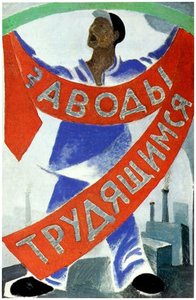 Factories - to the Working People1918
20
 He Who Was Nothing Shall Become Everything1918
21
 Land - to the Working People1919
22
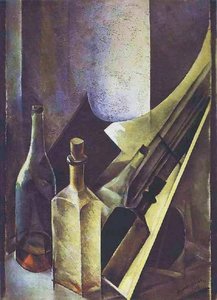 A Still Life. Coloured Bottles and Planes.1918
23
 Still Life with a White Jug1919
24
 A Composition with Material Objects1920
25
 Self Portrait1926
26
 Poster for ''Jewish Luck''1925
27
 Still Life1923
28
 LandscapeMuseum of Fine Arts of Tatarstan
29
 Portrait of Anna Akhmatova1914 · The State Russian Museum
The four subjects that come back most often in these originals, each with its finest example.
The 2 museums that hold the most of the paintings on this page.
| Museum | City | Works by Nathan Altman | Paintings from this list |
|---|---|---|---|
 The State Russian Museum |
St. Petersburg | 2 | Self-portrait, Portrait of Anna Akhmatova |
 Museum of Fine Arts of Tatarstan |
Καζαń | 1 | Landscape |
Pick a decade to see the original that defines it.
Postal Stamps. The Russian Republic. (1917). The Arch of the General Staff (1920) and Lenin. Drawings by Nathan Altman. (1921) come next.
28 years old: Postal Stamps. The Russian Republic. dates from 1917, and Nathan Altman was born in 1889.
Postal Stamps. The Russian Republic., The Arch of the General Staff, Lenin. Drawings by Nathan Altman., The lady at the piano, On the Coast, Square in a Provincial Town, Portrait of the Poet Boris Kornilov, Lady with a Dog. Portrait of Esther Schwartzmann., Landscape «La Ruche» and Still life with blue slippers. The ranking above gives each one's year and museum.
Our catalog holds 29 works by Nathan Altman, dated from 1911 to 1935.
Mostly in The State Russian Museum (St. Petersburg) and Museum of Fine Arts of Tatarstan (Καζαń). The museum table above lists them all.
In 1910s: 16 of the 29 works on this page were made then, Postal Stamps. The Russian Republic. among them.
On this page, the earliest is Lady with a Dog. Portrait of Esther Schwartzmann. (1911) and the latest Portrait of the Poet Boris Kornilov (1935).
Dishware (5), Designs and sketches (4) and Landscape (4), across the 29 works on this page.
Cubism and Constructivism, judging by the originals on this page.
Self-portrait and Portrait of Anna Akhmatova: the The State Russian Museum, St. Petersburg holds 2 of the works on this page.
Nathan Isaachevich Altman stands as a monumental figure in the annals of Russian avant-garde art, embodying a unique confluence of Jewish heritage, Cubist experimentation, and fervent engagement with the shifting tides of Soviet ideology. Born in 1889 in Vinnytsia, Ukraine, to a family of Jewish merchants, Altman’s formative years instilled within him an appreciation for cultural diversity and intellectual curiosity—qualities that would profoundly shape his artistic trajectory. His early studies at Odessa Art College laid the groundwork for a burgeoning talent, culminating in his debut exhibition in 1906 where he immediately established himself as a promising artist of his generation.
The Parisian sojourn of 1910 proved pivotal, immersing Altman in the crucible of European artistic innovation. He enrolled at the Free Russian Academy under Vladimir Baranoff-Rossine, fostering connections with luminaries like Marc Chagall, Alexander Archipenko, and Ilya Shterenberg—artists who championed radical stylistic departures from traditional conventions. This exposure to Cubism ignited Altman’s creative spirit, propelling him toward a groundbreaking fusion of geometric abstraction and expressive realism. His membership in the Soyuz Molodyozhi (Union of Youth) solidified his position within the vanguard movement, cementing his commitment to challenging established artistic norms through a lens of modern dynamism.
By 1912, Altman relocated to Saint Petersburg, where he embarked on a prolific period of artistic production characterized by ambitious portraiture and revolutionary theatrical design. His ability to deconstruct the human form while maintaining an emotional resonance became his hallmark. One of his most enduring achievements is the Portrait of Anna Akhmatova, executed in a striking Cubist style. In this masterpiece, Altman captures the dignified essence of the celebrated poet through fragmented planes and a sophisticated palette, demonstrating how he could utilize the language of modernism to honor the psychological depth of his subjects.
Altman's versatility extended far beyond the canvas into the realm of the stage, where he sought to transform theater into a total work of art. His designs were not mere decorations but integral components of a new visual language for the Soviet era. This period also saw him exploring themes that bridged the gap between personal identity and political reality. Whether through his delicate depictions in works like Lady with a Dog: Portrait of Esther Schwartzmann or his more politically charged sketches, such as his Drawings of Lenin, Altman navigated the complex intersection of individual expression and the collective spirit of a changing nation.
The trajectory of Nathan Altman's career reflects the turbulent history of the twentieth century itself. As the revolutionary fervor of the Soviet Union took hold, his work evolved to meet the demands of a new era, often blending the structural rigor of Cubism with the burgeoning aesthetics of Constructivism and later, elements of Art Deco. His contribution to the visual identity of the Russian avant-garde cannot be overstated; he was a bridge between the experimental freedom of pre-revolutionary Paris and the structured, ideological landscape of early Soviet art.
Ultimately, Altman's legacy is defined by his refusal to remain static. He remained a pioneer who:
