Portrait of Lucian Freud

The 100 Most Famous Lucian Freud Paintings, a Gallery Selection

Updated November 2026 · ranked by our popularity score (searches, visits and orders for each work) · 121 works by Lucian Freud in our catalogue

In short

Of all the originals Lucian Freud left, the most famous is Benefits Supervisor Sleeping (also known as Big Sue) (1995). Close behind it come Reflection with Two Children (Self-Portrait) (1965) and The Painter's Room (1944). Our catalog holds 121 works by Lucian Freud; the gallery has kept the 100 the world admires most, each shown with its date, its museum and its story.

1922 – 2011, Berlin Expressionism Most works: Thyssen-Bornemisza Museum

Lucian Freud's top 10 paintings: the gallery's choice

1
Benefits Supervisor Sleeping (also known as Big Sue) (1995) by Lucian Freud

Benefits Supervisor Sleeping (also known as Big Sue)

1995 · Oil On Canvas

Lucian Freud’s 1995 masterpiece is a powerfully honest and unflinching depiction of the human form, challenging conventional notions of beauty and inviting profound contemplation. This large-scale oil painting presents “Big Sue,” as she became known – performance artist Sue Tilley – reclining nude on a floral patterned couch, rendered with an intensity that feels both deeply personal and strikingly public. It’s a work that demands attention, not through sensationalism, but…

3
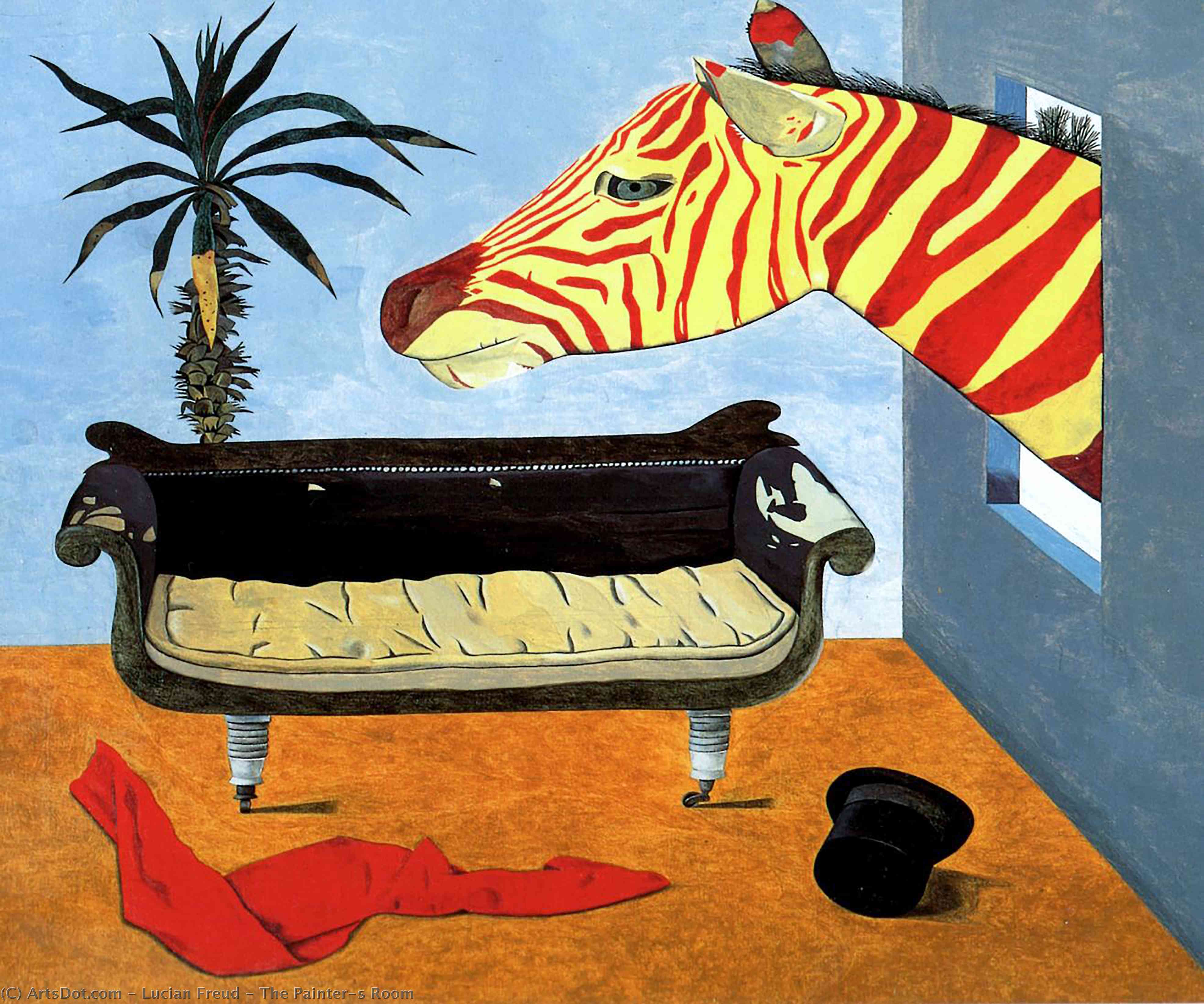
The Painter's Room (1944) by Lucian Freud

The Painter's Room

1944 · Oil On Canvas

To stand before Lucian Freud's "The Painter's Room" is not merely to observe a painting; it is to step through a threshold into a meticulously rendered, yet utterly dreamlike, interior space. Created in 1944, this work captures an atmosphere thick with the residue of creativity and the peculiar weight of the subconscious mind. The scene itself presents a tableau vivant—a room where the mundane objects of artistic endeavor collide with…

4
Reflection (Self-Portrait) (1985) by Lucian Freud

Reflection (Self-Portrait)

1985 · Oil On Canvas

In the intimate theater of Reflection (Self-Portrait), created in 1985, we encounter one of the most profound encounters with the human psyche ever captured on canvas. Lucian Freud, a titan of 20th-century realism, does not merely present a likeness; he presents an excavation of the self. The painting serves as a window into a moment of deep introspection, where the artist’s gaze drifts toward a distant, unseen horizon, inviting the…

5
Interior with Plant, Reflection Listening (Self-Portrait) (1968) by Lucian Freud

Interior with Plant, Reflection Listening (Self-Portrait)

1968 · Oil On Canvas

The artwork, titled Interior with Plant, Reflection Listening (Self-Portrait), is an oil on canvas painting created between 1967 and 1968. The composition is dominated by a large, lush indoor plant housed in a terracotta pot, which occupies the majority of the frame. The plant features variegated green and yellow leaves rendered with meticulous attention to detail, focusing on the texture and form of the foliage.

6
And the Bridegroom (2001) by Lucian Freud

And the Bridegroom

2001 · Oil On Canvas

A heavy silence settles over the bed. The canvas holds a scene of physical presence, where the human form is stripped of all pretense. A male figure, dressed in a suit and tie, sits with his back to the viewer, yet his head turns to meet the gaze of the observer. His expression is one of quiet contemplation. Beside him, the composition shifts into a more raw, visceral territory. The…

7
Double Portrait (1986) by Lucian Freud

Double Portrait

1986 · Oil On Canvas

In the quiet, heavy atmosphere of Double Portrait, created in 1986, we are invited into a private sanctuary of rest and vulnerability. This masterpiece by Lucian Freud, one of the most formidable portraitists of the twentieth century, transcends mere representation to capture a profound moment of shared existence. The painting depicts Freud’s daughter and her dog, caught in a state of deep, undisturbed slumber. There is an undeniable weight to…

8
Benefits Supervisor Sleeping II (1995) by Lucian Freud

Benefits Supervisor Sleeping II

1995 · Oil On Canvas

A voluminous female figure reclines upon an upholstered couch, her limbs splayed in a state of deep repose. The skin possesses a pinkish hue, rendered with meticulous attention to the physical presence of the body. In the background, two chairs are visible, one positioned behind the sofa and another further back on the right, anchoring the subject within a muted, understated interior.

9
Ali (1974) by Lucian Freud

Ali

1974 · Oil On Canvas

In the pantheon of twentieth-century portraiture, few works possess the visceral, psychological weight found in Lucian Freud’s 1974 masterpiece, Ali. This evocative oil on canvas is far more than a mere depiction of a seated figure; it is an intimate encounter with the human condition. Through his signature approach to Expressionism, Freud transcends the boundaries of traditional portraiture to present a subject that feels both profoundly exposed and deeply introsive.…

10
Interior at Paddington (1951) by Lucian Freud

Interior at Paddington

1951 · Oil On Canvas

In this 1951 oil on canvas, a man stands within a room in Paddington, London, positioned before a window that looks out toward a wall bordering the Grand Union Canal. The subject, Harry Diamon, is captured in a pose that mirrors the aggressive stance of Holbein’s full-length portraits of Henry VIII, yet the regal associations are stripped away. Instead of velvet or silk, he wears a drab, dirty mackintosh. His…

The Lucian Freud selection continues, 11 to 100

11Girl white dog by Lucian FreudGirl white dog 12After Chardin (1999) by Lucian FreudAfter Chardin1999 13After Cezanne (2000) by Lucian FreudAfter Cezanne2000 14The Butcher's Daughter (2000) by Lucian FreudThe Butcher's Daughter2000 15The Painter's Mother Reading (1975) by Lucian FreudThe Painter's Mother Reading1975 16Head of Bruce Bernard (1985) by Lucian FreudHead of Bruce Bernard1985 17Bruce Bernard Seated (1996) by Lucian FreudBruce Bernard Seated1996 18Self-Portrait (2002) by Lucian FreudSelf-Portrait2002 19Buttercups (1968) by Lucian FreudButtercups1968 20Blond Girl, Night Portrait (1985) by Lucian FreudBlond Girl, Night Portrait1985 21Pregnant Girl (1961) by Lucian FreudPregnant Girl1961 22Red Haired Man on a Chair (1963) by Lucian FreudRed Haired Man on a Chair1963 23The Painter's Father (1970) by Lucian FreudThe Painter's Father1970 24Girl Writing (1976) by Lucian FreudGirl Writing1976 25Annabel (1975) by Lucian FreudAnnabel1975 26Blond Girl (1985) by Lucian FreudBlond Girl1985 27Bella Final Version State II (1987) by Lucian FreudBella Final Version State II1987 28Girl in Striped Nightshirt (1985) by Lucian FreudGirl in Striped Nightshirt1985 29Bella in her Pluto T-Shirt (1995) by Lucian FreudBella in her Pluto T-Shirt1995 30Bella (1996) by Lucian FreudBella1996 31Portrait of Christian Berard (1948) by Lucian FreudPortrait of Christian Berard1948 32The Painter's Doctor (2006) by Lucian FreudThe Painter's Doctor2006 33Bella (1981) by Lucian FreudBella1981 34Paper (24) by Lucian FreudPaper (24) 35Paper (27) by Lucian FreudPaper (27) 36The Big Man (1977) by Lucian FreudThe Big Man1977 37Man's Head, Self Portrait (1963) by Lucian FreudMan's Head, Self Portrait1963 38Paper (52) by Lucian FreudPaper (52) 39Paper (53) by Lucian FreudPaper (53) 40Paper (21) by Lucian FreudPaper (21) 41Paper (76) by Lucian FreudPaper (76) 42Paper (75) by Lucian FreudPaper (75) 43Paper (36) by Lucian FreudPaper (36) 44Paper (32) by Lucian FreudPaper (32) 45Paper (46) by Lucian FreudPaper (46) 46Paper (29) by Lucian FreudPaper (29) 47Paper (11) by Lucian FreudPaper (11) 48Interior with Hand Mirror (Self-Portrait) by Lucian FreudInterior with Hand Mirror (Self-Portrait) 49Paper (19) by Lucian FreudPaper (19) 50Fragment Head of Gerald Wilde (1943) by Lucian FreudFragment Head of Gerald Wilde1943 51Untitled (1948) by Lucian FreudUntitled1948 52Self-Portrait with Hyacinth in a Pot (1948) by Lucian FreudSelf-Portrait with Hyacinth in a Pot1948 53Man at Night (Self-Portrait) (1948) by Lucian FreudMan at Night (Self-Portrait)1948 54Boy's Head (1952) by Lucian FreudBoy's Head1952 55Man in a Headscarf (also known as The Procurer) (1954) by Lucian FreudMan in a Headscarf (also known as The Procurer)1954 56Child with a Toy Dog (1958) by Lucian FreudChild with a Toy Dog1958 57Man's Head, Small Portrait III (Self-Portrait) (1963) by Lucian FreudMan's Head, Small Portrait III (Self-Portrait)1963 58Annie (1962) by Lucian FreudAnnie1962 59Annabel (1972) by Lucian FreudAnnabel1972 60Wasteground with Houses, Paddington (1972) by Lucian FreudWasteground with Houses, Paddington1972 61Large Interior, London W.9. (1973) by Lucian FreudLarge Interior, London W.9.1973 62Acacia (1975) by Lucian FreudAcacia1975 63The Painter's Mother Resting I (1976) by Lucian FreudThe Painter's Mother Resting I1976 64The Painter's Daughter Ib (1978) by Lucian FreudThe Painter's Daughter Ib1978 65Blonde Girl on a Bed (1987) by Lucian FreudBlonde Girl on a Bed1987 66The Painter's Brother, Stephen (1986) by Lucian FreudThe Painter's Brother, Stephen1986 67Bella (1986) by Lucian FreudBella1986 68Bella and Esther (1988) by Lucian FreudBella and Esther1988 69Annabel Sleeping (1988) by Lucian FreudAnnabel Sleeping1988 70Naked Man, Back View (1991) by Lucian FreudNaked Man, Back View1991 · Metropolitan Museum of Art 71Bruce Bernard (1992) by Lucian FreudBruce Bernard1992 72Still-Life with a Book (1992) by Lucian FreudStill-Life with a Book1992 73Seated Nude (1991) by Lucian FreudSeated Nude1991 74Annabel and Rattler (1998) by Lucian FreudAnnabel and Rattler1998 75Sleeping by the Lion Carpet (also known as Sue Tilley) (1996) by Lucian FreudSleeping by the Lion Carpet (also known as Sue Tilley)1996 76Armchair by the Fireplace (1997) by Lucian FreudArmchair by the Fireplace1997 77Aline (2000) by Lucian FreudAline2000 78Alice and Okie (1999) by Lucian FreudAlice and Okie1999 79Alice Costelloe (2003) by Lucian FreudAlice Costelloe2003 80After Breakfast (2001) by Lucian FreudAfter Breakfast2001 81The Painter's Garden (2004) by Lucian FreudThe Painter's Garden2004 82Albie (2004) by Lucian FreudAlbie2004 83Naked Portrait (2005) by Lucian FreudNaked Portrait2005 84Annie and Alice (1975) by Lucian FreudAnnie and Alice1975 85Self-Portrait, Reflection (2004) by Lucian FreudSelf-Portrait, Reflection2004 86Naked Girl Asleep I (1967) by Lucian FreudNaked Girl Asleep I1967 87Naked Man, Back View (1991) by Lucian FreudNaked Man, Back View1991 88Paper (68) by Lucian FreudPaper (68) 89Paper (18) by Lucian FreudPaper (18) 90Paper (58) by Lucian FreudPaper (58) 91Paper (31) by Lucian FreudPaper (31) 92Paper (33) by Lucian FreudPaper (33) 93John minton by Lucian FreudJohn minton 94Paper (45) by Lucian FreudPaper (45) 95Paper (51) by Lucian FreudPaper (51) 96Annabel by Lucian FreudAnnabel 97Paper (44) by Lucian FreudPaper (44) 98Paper (57) by Lucian FreudPaper (57) 99Paper (55) by Lucian FreudPaper (55) 100Paper (54) by Lucian FreudPaper (54)

Lucian Freud's famous paintings, period by period

The subjects that held Lucian Freud's eye

The four subjects that come back most often in these originals, each with its finest example.

The museums that keep Lucian Freud's originals

The 2 museums that hold the most of the paintings on this page.

Museum City Works by Lucian Freud Paintings from this list
Thyssen-Bornemisza Museum, MadridThyssen-Bornemisza Museum Madrid 1 Reflection with Two Children (Self-Portrait)
Metropolitan Museum of Art, New YorkMetropolitan Museum of Art New York 1 Naked Man, Back View

Lucian Freud decade by decade: the original that defines each

Works per decade

Pick a decade to see the original that defines it.

Collectors' questions about Lucian Freud's paintings

Which work is Lucian Freud most famous for?Reveal the answer

Benefits Supervisor Sleeping (also known as Big Sue) (1995). Reflection with Two Children (Self-Portrait) (1965) and The Painter's Room (1944) come next.

What age was Lucian Freud when Benefits Supervisor Sleeping (also known as Big Sue) was made?Reveal the answer

73 years old: Benefits Supervisor Sleeping (also known as Big Sue) dates from 1995, and Lucian Freud was born in 1922.

What are the ten most famous Lucian Freud paintings?Reveal the answer

Benefits Supervisor Sleeping (also known as Big Sue), Reflection with Two Children (Self-Portrait), The Painter's Room, Reflection (Self-Portrait), Interior with Plant, Reflection Listening (Self-Portrait), And the Bridegroom, Double Portrait, Benefits Supervisor Sleeping II, Ali and Interior at Paddington. The ranking above gives each one's year and museum.

How many paintings did Lucian Freud leave?Reveal the answer

Our catalog holds 121 works by Lucian Freud, dated from 1943 to 2006.

In which museums do Lucian Freud's masterpieces hang?Reveal the answer

Mostly in Thyssen-Bornemisza Museum (Madrid) and Metropolitan Museum of Art (New York). The museum table above lists them all.

In which years did Lucian Freud paint the most famous works?Reveal the answer

In 1990s: 15 of the 100 works on this page were made then, Benefits Supervisor Sleeping (also known as Big Sue) among them.

What are the first and the last famous originals of Lucian Freud?Reveal the answer

On this page, the earliest is Fragment Head of Gerald Wilde (1943) and the latest The Painter's Doctor (2006).

Which subjects did Lucian Freud choose most often?Reveal the answer

Men (14), Nudes (12) and Portrait (11), across the 100 works on this page.

Which technique did Lucian Freud use most?Reveal the answer

Oil On Canvas, for 14 of the 100 works on this page.

To which art movement does Lucian Freud belong?Reveal the answer

Expressionism and Contemporary realism, judging by the originals on this page.

Lucian Freud: life and work

A Life Forged in Realism: The World of Lucian Freud

Lucian Michael Freud, born in Berlin in 1922, carried a lineage steeped in intellectual weight—the grandson of the pioneering psychoanalyst Sigmund Freud. Yet, young Lucian’s path diverged from exploring the subconscious through theory, instead finding expression through the intensely physical act of painting. The looming shadow of Nazism forced his family to flee Germany in 1933, settling in London, a relocation that profoundly shaped both his life and the often somber, unsettling tone defining his artistic vision. His early education was fragmented, marked by expulsion from Bryanston School, but formative instruction at Cedric Morris’s East Anglian School of Painting and Drawing proved pivotal. There, an emphasis on direct observation took root, becoming a cornerstone of his evolving style—a deliberate departure from the growing abstraction embraced by many contemporaries. This grounding in meticulous study of the visible world set him apart, establishing a unique artistic identity.

From Surrealist Echoes to Unflinching Portraiture

Freud’s artistic journey didn't begin with the stark realism for which he became celebrated. His early work flirted with surrealism and German Expressionism, blending dreamlike imagery with emotional intensity. However, these influences were gradually distilled into something uniquely his own. By the early 1950s, a distinctive style had emerged—characterized by thickly impastoed paint, muted backgrounds amplifying flesh tones, and an almost brutal honesty in depicting the human form. He eschewed idealization or flattery, seeking instead to capture raw physicality, vulnerability, and psychological weight. This intense focus on portraiture quickly established Freud as a leading figure in British art, a chronicler of his time whose work resonated with a post-war sensibility grappling with existential questions. He often worked from life, demanding grueling sittings—sometimes lasting hours or even days—to achieve the level of detail and psychological depth he desired. The act of painting became an endurance test for both artist and model, forging a unique intimacy that permeated his canvases.

Technique as Revelation: The Tactility of Being

Freud’s technical approach was integral to the emotional impact of his paintings. He favored large hogs-hair brushes, applying paint with a physicality mirroring the subject matter itself. This created a textured surface, almost sculptural in quality, where every brushstroke revealed the weight and substance of flesh. The contrast between vibrant, often fleshy tones and subdued palettes for interiors or landscapes heightened isolation and introspection. Frequently painting while standing, later adopting a high chair as his age progressed, he maintained a dynamic relationship with canvas and model. This physical engagement wasn’t merely technique; it was immersion in the act of seeing—truly *observing* subjects and translating that observation into paint. Works like Girl with a Kitten (1947) demonstrate this early development, while later pieces such as Benefits Supervisor Sleeping (1995) exemplify his mature style—an unflinching gaze upon the human condition. The sheer materiality of the paint itself became a vehicle for conveying not just appearance but also sensation and feeling.

Legacy and Influence: A Lasting Impression

Lucian Freud’s 60-year career left an indelible mark on British portraiture, challenging conventional notions of beauty and representation. He wasn't interested in capturing social status or outward appearances; he sought to reveal something deeper, more primal—the essence of being human in all its complexity and imperfection. His influence extends beyond painting, inspiring artists across disciplines with his uncompromising vision and technical mastery. The intensity and psychological depth of his work continue to captivate audiences worldwide, securing his place as one of the most important and influential artists of the 20th century. He was a key member of the “School of London,” a group of figurative painters working in London during a period dominated by abstract expressionism, united by their commitment to direct observation and emotional honesty. His paintings are held in major museums globally—the Tate in London, the Freud Museum London, and Goldsmiths’ College, University of London—enduring testaments to his artistic genius. His work remains a powerful reminder of the enduring power of figurative art to confront us with ourselves.