Portrait of Luca Signorelli

The 100 Most Famous Luca Signorelli Paintings, a Gallery Selection

Updated November 2026 · ranked by our popularity score (searches, visits and orders for each work) · 215 works by Luca Signorelli in our catalogue

In short

Of all the originals Luca Signorelli left, the most famous is Portrait of an Elderly Man (1492), in the collection of the Staatliche Museen zu Berlin, Berlin. Close behind it come St Augustine Altarpiece (left wing) (1498) and Christ and the Doubting Thomas (1477). Our catalog holds 215 works by Luca Signorelli; the gallery has kept the 100 the world admires most, each shown with its date, its museum and its story.

1450 – 1523, Cortona Renaissance Most works: Basilica of Santa Casa

Luca Signorelli's top 10 paintings: the gallery's choice

1
Portrait of an Elderly Man (1492) by Luca Signorelli

Portrait of an Elderly Man

1492 · Oil On Canvas · Staatliche Museen zu Berlin, Berlin

Subject and Composition This captivating portrait captures the introspective presence of an elderly man, dressed in a striking red uniform and hat, commanding immediate attention with his expressive gaze and detailed features. The composition emphasizes the individual's character, blending realism with subtle allegorical elements that invite viewers to explore deeper narratives. Surrounding the central figure are scenes and figures that hint at historical, mythological, or cultural stories, creating a layered…

2
St Augustine Altarpiece (left wing) (1498) by Luca Signorelli

St Augustine Altarpiece (left wing)

1498 · Oil On Canvas · Staatliche Museen zu Berlin, Berlin

The left wing of Luca Signorelli's “St Augustine Altarpiece,” completed in 1498 for the Bichi Chapel within the church of Sant’Agostino in Siena, is more than just a beautiful painting; it’s a profound meditation on faith, charity, and the intertwined destinies of earthly and divine figures. Measuring a modest 146 x 76 centimeters, this panel offers an intimate glimpse into the artistic sensibilities of a master navigating the complexities of…

3
Christ and the Doubting Thomas (1477) by Luca Signorelli

Christ and the Doubting Thomas

1477 · Fresco · Basilica of Santa Casa, Loreto Marches

Within the Loreto basilica, Signorelli’s 1482 fresco, Christ and the Doubting Thomas, captures a heavy, singular instant. We witness Thomas Aquinas reaching out to touch the wounds of Jesus Christ, a gesture bridging skepticism and faith. There is a tension in the air, a meeting of the physical and the spiritual as the apostle seeks tangible proof. The composition draws the eye toward the interaction of hands, where the vulnerability…

4
Madonna and Child (1505) by Luca Signorelli

Madonna and Child

1505 · Acrylic On Canvas · Metropolitan Museum of Art, New York

Luca Signorelli’s 1505 “Madonna and Child” is more than just a religious painting; it’s a profound meditation on motherhood, faith, and the enduring power of human connection. Born in Cortona, Italy, around 1441-1445, Signorelli was a pivotal figure in the late Renaissance, renowned for his meticulous draftsmanship and his ability to seamlessly blend classical ideals with deeply felt emotion. This particular work, gifted to his daughter, offers a rare glimpse…

5
The Hell (1502) by Luca Signorelli

The Hell

1502 · Fresco

The Hell is a fresco by Luca Signorelli. Painted in 1502, this work captures a vision of the underworld. It occupies a space of profound movement and spiritual weight. The scene is populated by a multitude of figures, specifically a vast assembly of demons and angels. These entities occupy the air and the ground in a state of constant, restless interaction.

6
The Last Judgment (The right part of the composition - The Damned Consigned to Hell) (1502) by Luca Signorelli

The Last Judgment (The right part of the composition - The Damned Consigned to Hell)

1502 · Fresco

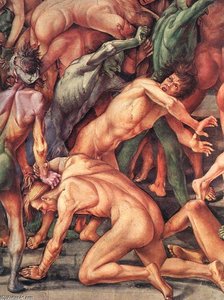
The painting depicts a crowded, chaotic scene of divine retribution set against a structured architectural backdrop. In the center, a figure of Jesus Christ is positioned, surrounded by a gathering of angels and demons. The composition is divided by the movement of various figures, some ascending and others descending. To the right, the focus shifts toward the damned, as humans are shown being cast into a dark, subterranean space. Figures…

7
The Last Judgment (The right part of the composition - The Damned Consigned to Hell; the left part of the composition - The Blessed Taken into Paradise) (1502) by Luca Signorelli

The Last Judgment (The right part of the composition - The Damned Consigned to Hell; the left part of the composition - The Blessed Taken into Paradise)

1502 · Fresco

The fresco presents a bifurcated view of the afterlife, divided by a central archway. On the left side, the composition depicts the blessed being led into Paradise. These figures move toward a celestial realm, characterized by a sense of upward motion and light. On the right side, the scene shifts to the damned being consigned to Hell. This section contains a convoluted mass of human forms, many of them naked,…

8
The Holy Family (1492) by Luca Signorelli

The Holy Family

1492 · Oil On Panel · National Gallery, London

In this 1492 oil on panel, the Virgin Mary cradles the Christ Child within a tight, pyramidal composition. Behind them, Saint Joseph is positioned to complete the group, creating a sense of enclosure and quietude. The figures emerge from a dark, undifferentiated background, a technique that utilizes chiaroscuro to push the subjects toward the viewer. Light enters from the upper left, catching the soft skin of the infant and the…

9
Man on a Ladder (1504) by Luca Signorelli

Man on a Ladder

1504 · Oil On Panel · National Gallery, London

The world holds its breath as a single figure climbs. A man, caught in mid-motion, pulls himself upward along a wooden ladder that cuts vertically through the frame. He leans forward, his body tensed with the physical effort of the ascent. His face, seen in profile, carries a look of deep focus, perhaps even a hint of strain, as he navigates the rungs. A bright red tunic, trimmed in white,…

10
Figures in a Landscape: Two Nude Youths (1490) by Luca Signorelli

Figures in a Landscape: Two Nude Youths

1490 · Tempera On Panel · Toledo Museum of Art, Toledo

The sun hangs suspended in a hazy sky, casting a diffused light over a rugged, rocky landscape. Two young men exist in this stillness, their bodies rendered with a sculptural weight that feels immediate and tangible. One youth stands with his back turned, a large piece of light blue drapery caught in a moment of movement as he holds it up, partially veiling his head and upper back. His musculature…

The Luca Signorelli selection continues, 11 to 100

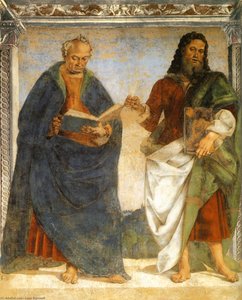
11The Adoration of the Magi (1508) by Luca SignorelliThe Adoration of the Magi1508 · Yale University Art Gallery 12Mary Magdalene (1504) by Luca SignorelliMary Magdalene1504 · Museo dell'Opera del Duomo 13The Martyrdom of Saint Catherine of Alexandria (1490) by Luca SignorelliThe Martyrdom of Saint Catherine of Alexandria1490 14Lamentation over the Dead Christ (1489) by Luca SignorelliLamentation over the Dead Christ1489 · Pollok House 15Christ in the House of Simon the Pharisee (1498) by Luca SignorelliChrist in the House of Simon the Pharisee1498 · National Gallery of Ireland 16The Annunciation (1493) by Luca SignorelliThe Annunciation1493 · Philadelphia Museum of Art 17The Archangel Gabriel (1490) by Luca SignorelliThe Archangel Gabriel1490 · Walters Art Museum 18Fifteen Characters (1490) by Luca SignorelliFifteen Characters1490 19The Penitent St. Jerome in Ecstasy (1500) by Luca SignorelliThe Penitent St. Jerome in Ecstasy1500 20Apocalypse (1499) by Luca SignorelliApocalypse1499 21The Resurrected Christ Appearing to His Disciples (1514) by Luca SignorelliThe Resurrected Christ Appearing to His Disciples1514 · Detroit Institute of Arts 22The Resurrected Christ Appearing to St. Magdalene (1514) by Luca SignorelliThe Resurrected Christ Appearing to St. Magdalene1514 · Detroit Institute of Arts 23Martyrs and Saint Virgins (1502) by Luca SignorelliMartyrs and Saint Virgins1502 24Prophet holding a Scroll (1523) by Luca SignorelliProphet holding a Scroll1523 · Musée Des Beaux 25Madonna of the milk in glory (1475) by Luca SignorelliMadonna of the milk in glory1475 · Pinacoteca di Brera 26The Apostles Peter and John the Evangelist (1477) by Luca SignorelliThe Apostles Peter and John the Evangelist1477 · Basilica of Santa Casa 27Lamentation over the Dead Christ with Angels and Saints (1516) by Luca SignorelliLamentation over the Dead Christ with Angels and Saints1516 28Figures in a Landscape: Man, Woman and Child (1490) by Luca SignorelliFigures in a Landscape: Man, Woman and Child1490 · Toledo Museum of Art 29St Augustine Altarpiece (right wing) (1498) by Luca SignorelliSt Augustine Altarpiece (right wing)1498 · Staatliche Museen zu Berlin 30Madonna and Child with Saints and Angels (1510) by Luca SignorelliMadonna and Child with Saints and Angels1510 31View of the Sacristy of St John (1477) by Luca SignorelliView of the Sacristy of St John1477 · Basilica of Santa Casa 32Life of St Benedict, Scene 28: Benedict Recognizes and Receives Totila (1499) by Luca SignorelliLife of St Benedict, Scene 28: Benedict Recognizes and Receives Totila1499 33Virgin and Child with Sts Jerome and Bernard of Clairvaux (1492) by Luca SignorelliVirgin and Child with Sts Jerome and Bernard of Clairvaux1492 · Galleria Corsini 34Virgin and Child with Sts Michael, Vincent of Saragozza, Margaret of Cortona and Mark (1512) by Luca SignorelliVirgin and Child with Sts Michael, Vincent of Saragozza, Margaret of Cortona and Mark1512 35The Great Cloister (1497) by Luca SignorelliThe Great Cloister1497 36View of the Vaulting of the Sacristy of St John (1477) by Luca SignorelliView of the Vaulting of the Sacristy of St John1477 · Basilica of Santa Casa 37Pair of Apostles in Dispute (1482) by Luca SignorelliPair of Apostles in Dispute1482 38Pair of Apostles in Dispute (1482) by Luca SignorelliPair of Apostles in Dispute1482 39The Flagellation (1480) by Luca SignorelliThe Flagellation1480 40Pair of Apostles in Dispute (1477) by Luca SignorelliPair of Apostles in Dispute1477 · Basilica of Santa Casa 41View of the Chapel of San Brizio (1499) by Luca SignorelliView of the Chapel of San Brizio1499 42The Crucifixion (1500) by Luca SignorelliThe Crucifixion1500 43Doctors of the Church (1499) by Luca SignorelliDoctors of the Church1499 44The Elect (detail) (1499) by Luca SignorelliThe Elect (detail)1499 45The Damned (detail) (8) (1499) by Luca SignorelliThe Damned (detail) (8)1499 46Apocalypse (detail) (1499) by Luca SignorelliApocalypse (detail)1499 47Apocalypse (detail) (1499) by Luca SignorelliApocalypse (detail)1499 48The Damned (detail) (1499) by Luca SignorelliThe Damned (detail)1499 49Sermon and Deeds of the Antichrist (detail) (1499) by Luca SignorelliSermon and Deeds of the Antichrist (detail)1499 50Apocalypse (detail) (1499) by Luca SignorelliApocalypse (detail)1499 51Resurrection of the Flesh (detail) (10) (1499) by Luca SignorelliResurrection of the Flesh (detail) (10)1499 52The Elect Being Called to Paradise (1499) by Luca SignorelliThe Elect Being Called to Paradise1499 53Resurrection of the Flesh (detail) (1499) by Luca SignorelliResurrection of the Flesh (detail)1499 54Apocalypse (detail) (1499) by Luca SignorelliApocalypse (detail)1499 55Apocalypse (detail) (1499) by Luca SignorelliApocalypse (detail)1499 56Sermon and Deeds of the Antichrist (detail) (1499) by Luca SignorelliSermon and Deeds of the Antichrist (detail)1499 57Dante and Virgil Entering Purgatory (1499) by Luca SignorelliDante and Virgil Entering Purgatory1499 58The Virgins (1499) by Luca SignorelliThe Virgins1499 59The Damned (detail) (1499) by Luca SignorelliThe Damned (detail)1499 60Dante Alighieri (1499) by Luca SignorelliDante Alighieri1499 61The Damned Being Plunged into Hell (detail) (1499) by Luca SignorelliThe Damned Being Plunged into Hell (detail)1499 62The Angel Arrives in Purgatory (1499) by Luca SignorelliThe Angel Arrives in Purgatory1499 63Sermon and Deeds of the Antichrist (detail) (8) (1499) by Luca SignorelliSermon and Deeds of the Antichrist (detail) (8)1499 64Empedocles (1499) by Luca SignorelliEmpedocles1499 65The Damned (detail) (1499) by Luca SignorelliThe Damned (detail)1499 66Cappellina dei Corpi Santi (1499) by Luca SignorelliCappellina dei Corpi Santi1499 67The Elect (detail) (1499) by Luca SignorelliThe Elect (detail)1499 68Allegory of Fecundity and Abundance (1500) by Luca SignorelliAllegory of Fecundity and Abundance1500 69Marriage of the Virgin (1491) by Luca SignorelliMarriage of the Virgin1491 · National Gallery of Art 70Sermon and Deeds of the Antichrist (detail) (10) (1499) by Luca SignorelliSermon and Deeds of the Antichrist (detail) (10)1499 71Self-Portrait with Niccolò d'Angeli Franceschi (1500) by Luca SignorelliSelf-Portrait with Niccolò d'Angeli Franceschi1500 · Museo dell'Opera del Duomo 72Scenes from the Lives of Joachim and Anne (1490) by Luca SignorelliScenes from the Lives of Joachim and Anne1490 73The Birth of the Virgin (1490) by Luca SignorelliThe Birth of the Virgin1490 74Decoration (detail) (1499) by Luca SignorelliDecoration (detail)1499 75Resurrection of the Flesh (detail) (1499) by Luca SignorelliResurrection of the Flesh (detail)1499 76Lamentation over the Dead Christ with Sts Faustinus and Parentius (1499) by Luca SignorelliLamentation over the Dead Christ with Sts Faustinus and Parentius1499 77Fresco fragment (1499) by Luca SignorelliFresco fragment1499 78Resurrection of the Flesh (detail) (1499) by Luca SignorelliResurrection of the Flesh (detail)1499 79Ceiling Frescoes in the Chapel of San Brizio (1499) by Luca SignorelliCeiling Frescoes in the Chapel of San Brizio1499 80Sermon and Deeds of the Antichrist (detail) (1499) by Luca SignorelliSermon and Deeds of the Antichrist (detail)1499 81The Damned (detail) (1499) by Luca SignorelliThe Damned (detail)1499 82The Damned Being Plunged into Hell (detail) (1499) by Luca SignorelliThe Damned Being Plunged into Hell (detail)1499 83Sallust (1499) by Luca SignorelliSallust1499 84Claudian (1499) by Luca SignorelliClaudian1499 85The Damned (detail) (9) (1499) by Luca SignorelliThe Damned (detail) (9)1499 86Life of St Benedict, Scene 27: Benedict Benedict Discovers Totila's Deceit (1499) by Luca SignorelliLife of St Benedict, Scene 27: Benedict Benedict Discovers Totila's Deceit1499 87The Holy Family with Saint (1490) by Luca SignorelliThe Holy Family with Saint1490 88The Assumption of the Virgin with Saints Michael and Benedict (1493) by Luca SignorelliThe Assumption of the Virgin with Saints Michael and Benedict1493 · Metropolitan Museum of Art 89Saint James the Greater with a Living and a Dead Pilgrim (1508) by Luca SignorelliSaint James the Greater with a Living and a Dead Pilgrim1508 · Szépművészeti Múzeum 90Self-portrait of Luca Signorelli (left) (1503) by Luca SignorelliSelf-portrait of Luca Signorelli (left)1503 91Self-portrait with Vitelozzo Vitelli (1503) by Luca SignorelliSelf-portrait with Vitelozzo Vitelli1503 92Frescoes in the Chapel of San Brizio (1502) by Luca SignorelliFrescoes in the Chapel of San Brizio1502 93The Triumph of Chastity - Love Disarmed and Bound (1509) by Luca SignorelliThe Triumph of Chastity - Love Disarmed and Bound1509 · National Gallery 94The Poet Virgil (1504) by Luca SignorelliThe Poet Virgil1504 95Resurrection of the Dead (1502) by Luca SignorelliResurrection of the Dead1502 96The last judgement, fresk, Orvieto cat (1502) by Luca SignorelliThe last judgement, fresk, Orvieto cat1502 97The Prayer in the Garden. (1502) by Luca SignorelliThe Prayer in the Garden.1502 · Museo Diocesano 98The Capture of Christ (1502) by Luca SignorelliThe Capture of Christ1502 · Museo Diocesano 99Lamentation over the Dead Christ (detail) (1502) by Luca SignorelliLamentation over the Dead Christ (detail)1502 · Museo Diocesano 100The Last Supper (1502) by Luca SignorelliThe Last Supper1502 · Museo Diocesano

Luca Signorelli's famous paintings, period by period

The subjects that held Luca Signorelli's eye

The four subjects that come back most often in these originals, each with its finest example.

The museums that keep Luca Signorelli's originals

The 8 museums that hold the most of the paintings on this page.

Museum City Works by Luca Signorelli Paintings from this list
Basilica of Santa Casa, Loreto MarchesBasilica of Santa Casa Loreto Marches 7 Christ and the Doubting Thomas, The Apostles Peter and John the Evangelist, View of the Sacristy of St John
Museo Diocesano, CortonaMuseo Diocesano Cortona 10 The Prayer in the Garden., The Capture of Christ, Lamentation over the Dead Christ (detail)
National Gallery, LondonNational Gallery London 9 The Holy Family, Man on a Ladder, The Triumph of Chastity - Love Disarmed and Bound
Staatliche Museen zu Berlin, BerlinStaatliche Museen zu Berlin Berlin 4 Portrait of an Elderly Man, St Augustine Altarpiece (left wing), St Augustine Altarpiece (right wing)
Metropolitan Museum of Art, New YorkMetropolitan Museum of Art New York 2 Madonna and Child, The Assumption of the Virgin with Saints Michael and Benedict
Toledo Museum of Art, ToledoToledo Museum of Art Toledo 2 Figures in a Landscape: Two Nude Youths, Figures in a Landscape: Man, Woman and Child
Museo dell'Opera del Duomo, OrvietoMuseo dell'Opera del Duomo Orvieto 2 Mary Magdalene, Self-Portrait with Niccolò d'Angeli Franceschi
Detroit Institute of Arts, DetroitDetroit Institute of Arts Detroit 2 The Resurrected Christ Appearing to His Disciples, The Resurrected Christ Appearing to St. Magdalene

Luca Signorelli decade by decade: the original that defines each

Works per decade

Pick a decade to see the original that defines it.

Collectors' questions about Luca Signorelli's paintings

Which work is Luca Signorelli most famous for?Reveal the answer

Portrait of an Elderly Man (1492), Staatliche Museen zu Berlin, Berlin. St Augustine Altarpiece (left wing) (1498) and Christ and the Doubting Thomas (1477) come next.

What age was Luca Signorelli when Portrait of an Elderly Man was made?Reveal the answer

42 years old: Portrait of an Elderly Man dates from 1492, and Luca Signorelli was born in 1450.

What are the ten most famous Luca Signorelli paintings?Reveal the answer

Portrait of an Elderly Man, St Augustine Altarpiece (left wing), Christ and the Doubting Thomas, Madonna and Child, The Hell, The Last Judgment (The right part of the composition - The Damned Consigned to Hell), The Last Judgment (The right part of the composition - The Damned Consigned to Hell; the left part of the composition - The Blessed Taken into Paradise), The Holy Family, Man on a Ladder and Figures in a Landscape: Two Nude Youths. The ranking above gives each one's year and museum.

How many paintings did Luca Signorelli leave?Reveal the answer

Our catalog holds 215 works by Luca Signorelli, dated from 1475 to 1523.

In which museums do Luca Signorelli's masterpieces hang?Reveal the answer

Mostly in Basilica of Santa Casa (Loreto Marches), Museo Diocesano (Cortona) and National Gallery (London). The museum table above lists them all.

In which years did Luca Signorelli paint the most famous works?Reveal the answer

In 1490s: 60 of the 100 works on this page were made then, Portrait of an Elderly Man among them.

What are the first and the last famous originals of Luca Signorelli?Reveal the answer

On this page, the earliest is Madonna of the milk in glory (1475) and the latest Prophet holding a Scroll (1523).

Which subjects did Luca Signorelli choose most often?Reveal the answer

People (44), Figures (32) and Man (21), across the 100 works on this page.

Which technique did Luca Signorelli use most?Reveal the answer

Fresco, for 59 of the 100 works on this page.

To which art movement does Luca Signorelli belong?Reveal the answer

Renaissance, judging by the originals on this page.

Which Luca Signorelli works hang at the Basilica of Santa Casa?Reveal the answer

Christ and the Doubting Thomas, The Apostles Peter and John the Evangelist and View of the Sacristy of St John: the Basilica of Santa Casa, Loreto Marches holds 5 of the works on this page.

Luca Signorelli: life and work

Early Life, Family and Training

Cortona, Tuscany, provides the setting for the beginning of Luca Signorelli. Born Luca d'Egidio di Ventura, his arrival occurs in a window of uncertainty, likely between 1441 and 1445. The landscape of his youth is defined by the humanist currents of the Italian Renaissance, though his specific formative years remain partially obscured by the passage of time.

Perugia offers the first real glimpse of his artistic inclinations. It is here that his early impressions of art take shape, absorbing the visual language of the era. This period of discovery sets the stage for a formal education that would define his technical capabilities. According to historical accounts, his path into professional practice was secured through family connections. His maternal uncle, Lazzaro Vasari, facilitates an apprenticeship under Piero della Francesca. This connection places him directly under the influence of one of the most significant figures of the period, a mentorship that anchors his development in the rigorous principles of perspective and form.

Artistic Career and Travels

The early years of his career see him moving through the artistic hubs of central Italy. In 1472, he is working in Arezzo, followed by a period in Città di Castello in 1474. These early commissions establish his presence across the Tuscan and Umbrian landscapes. By the late 1470s, his scope expands significantly. Between 1478 and 1484, he operates within Florence, Siena, and Rome. During this Roman period, he contributes to the decoration of the Sistine Chapel, though the specific section he painted is now lost to history.

As he enters his early 40s, the constant movement across city-states slows. He returns to his birthplace of Cortona, settling there for the remainder of his life. While he remains based in Cortona, he continues to travel to fulfill various commissions, maintaining his professional reach even as his primary residence remains fixed in his home town.

  • 1472: Painting in Arezzo
  • 1474: Painting in Città di Castello
  • 1478–1484: Work in Florence, Siena, and Rome

Technique and Artistic Style

The human form occupies the center of Signorelli’s visual language. He moves beyond mere representation, focusing on a burgeoning fascination with the physical body and its capacity for movement. His figures possess a robust physicality, rendered with a realistic depiction that emphasizes anatomical accuracy. This focus on the corporeal is driven by a dynamic energy that animates his compositions, pushing against the static traditions of the past. He does not merely place figures in a space; he integrates them through a sophisticated command of linear perspective.

Draftsmanship defines his technical execution. He is noted for an exceptional ability as a draftsman, a skill that allows him to navigate complex spatial arrangements. This is most evident in his innovative use of foreshortening, a technique that pulls the viewer into the depth of the scene. By manipulating the way limbs and torsos recede into space, he creates a sense of three-dimensional volume that feels immediate and tangible. Light and shadow work in tandem with these structural concerns. Through a mastery of chiaroscuro, he carves out the musculature of his subjects, using high-contrast modeling to define the weight and tension of the human frame.

Notable Masterpieces and Works

The scale of Signorelli's ambition reaches its peak within the Orvieto Cathedral. Here, he executed massive frescoes for the Last Judgment between 1499 and 1503. These works depict the apocalypse with a dramatic intensity that defines his mature period. The sheer size of the Orvieto frescoes demands a command of narrative and space, marking a high point in his career as a painter of monumental religious scenes.

His reach extended into the private collections of the powerful, such as when he presented the painting "School of Pan" to Lorenzo de' Medici. This work highlights his ability to handle classical themes alongside his technical skill. Around 1502–1505, he turned his attention to the Crucifixion with Saint Mary Magdalene, a piece that captures a specific tension in his compositional approach. In 1507, he produced the Polyptych of St. Medard, a work held in the Museum San Medardo in Arcevia, Italy, which functions as a prime example of his detailed and naturalistic handling of the human form.

Legacy and Influence

Signorelli’s presence in the Italian Renaissance leaves a permanent mark on the trajectory of Western art. His technical precision, particularly his mastery of foreshortening, provides a blueprint for the anatomical accuracy and spatial depth that defined the era. Artists who followed his lead adopted his rigorous approach to draftsmanship, moving away from the flatter traditions of the medieval period toward a more robust, physical reality. This shift in perspective changed how the human form occupies space on a surface.

His influence radiates from the massive frescoes of the Orvieto Cathedral, where his depictions of the apocalypse demand attention through complex movement and structural clarity. These works, alongside his detailed studies of the human figure, established a standard for narrative intensity. His ability to render the human body in motion helped bridge the gap between the early Renaissance and the more complex compositions of the High Renaissance. Today, his presence is felt in the quiet halls of various museums and cathedrals across Italy, where his surviving works continue to anchor the history of the Tuscan and Umbrian regions.