Portrait of Luca della Robbia

The 79 Most Famous Luca della Robbia Paintings, Each One of a Kind

Updated November 2026 · ranked by our popularity score (searches, visits and orders for each work) · 80 works by Luca della Robbia in our catalogue

In short

Madonna and Child (1445) is the Luca della Robbia painting that draws the most eyes; the original belongs to the Metropolitan Museum of Art, New York. After it, the eye goes to Cantoria: third bottom relief (1431) and Bronze Doors of the New Sacristy (1446). Among the 80 works of Luca della Robbia in our catalog, these 79 are the most famous, each a unique original presented with its year, its museum and the reason it endures.

1399 – 1482, Florence Renaissance Most works: Museo dell'Opera del Duomo

Top 10 paintings by Luca della Robbia, through the gallery's eye

1
Madonna and Child (1445) by Luca della Robbia

Madonna and Child

1445 · Terracotta · Metropolitan Museum of Art, New York

To gaze upon this depiction of the Madonna and Child is to step directly into the luminous heart of the early Italian Renaissance. It captures not merely a portrait, but an eternal moment of divine connection—a quiet communion between mother and son that has resonated with humanity for centuries. The composition itself is masterfully arranged, centering the Virgin Mary in a posture of gentle support as she cradles the infant…

2
Cantoria: third bottom relief (1431) by Luca della Robbia

Cantoria: third bottom relief

1431 · Marble · Museo dell'Opera del Duomo, Florence

To gaze upon this relief is to step directly into the vibrant heart of the early Italian Renaissance. Depicting six youthful male figures, perhaps muses or celestial beings, these forms are captured in a moment of exquisite, shared resonance. The composition itself feels alive, a tightly woven tapestry of flesh and gesture rendered in pale beige-grey marble. One senses not merely stone, but the lingering warmth of human connection—a celebration…

3
Bronze Doors of the New Sacristy (1446) by Luca della Robbia

Bronze Doors of the New Sacristy

1446 · Bronze · Duomo, Florence

Luca della Robbia’s “Bronze Doors of the New Sacristy,” crafted in 1446, stands as a testament to the burgeoning artistic spirit of early Florence. This extraordinary work, now meticulously reproduced at 420 x 200 cm, offers a captivating glimpse into the heart of the Renaissance – a period defined by an unprecedented reverence for classical antiquity and a profound exploration of human experience. More than just decorative panels, these doors…

4
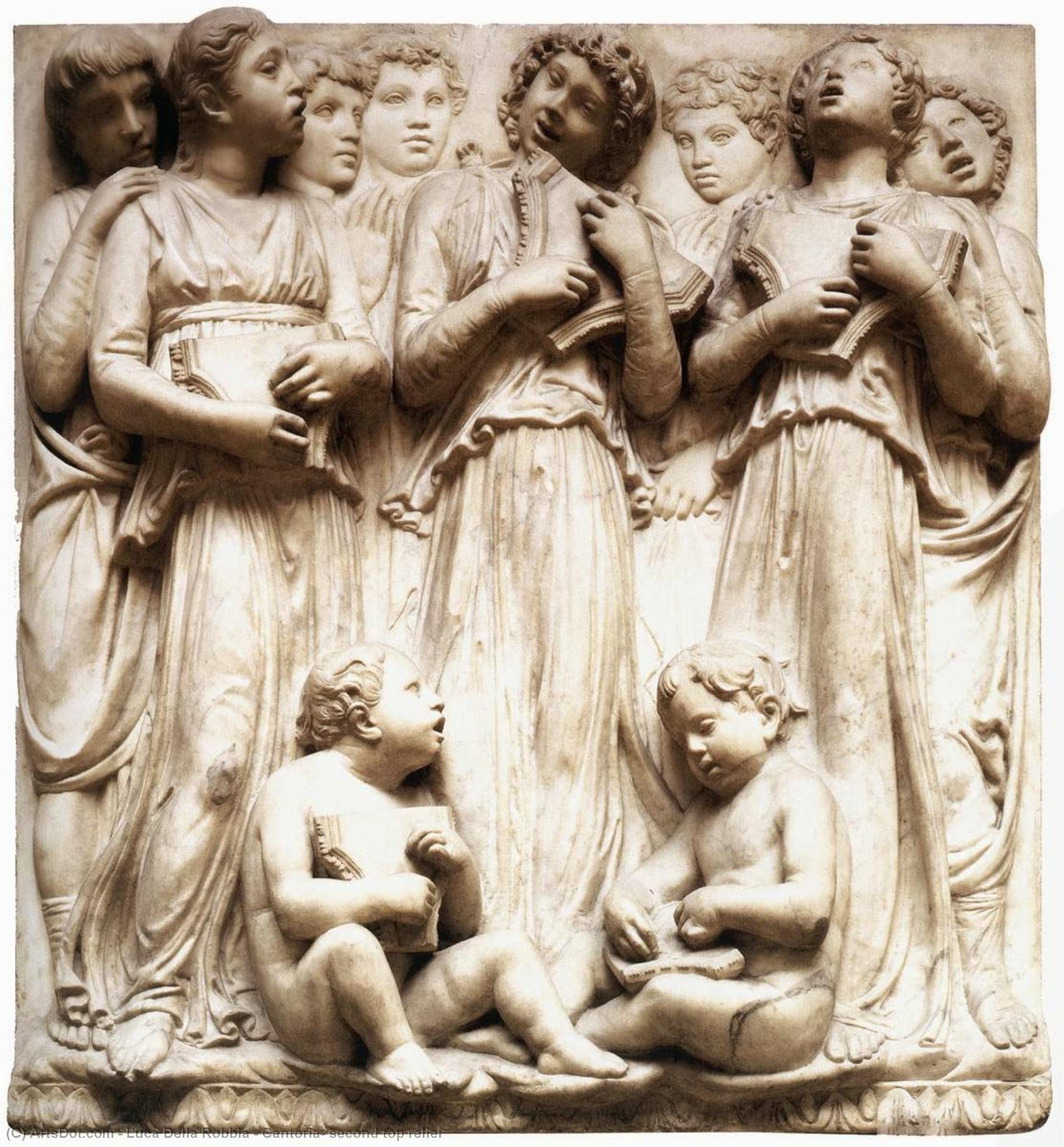
Cantoria: second top relief (1431) by Luca della Robbia

Cantoria: second top relief

1431 · Marble · Museo dell'Opera del Duomo, Florence

To stand before Cantoria: second top relief is to step directly into the vibrant intellectual atmosphere of early Quattrocento Florence. This magnificent marble work, executed by the master craftsman Luca della Robbia in 1431, is far more than a mere sculptural grouping; it is a tangible echo of Renaissance humanism itself. The scene unfolds with an arresting sense of community, depicting a gathering of figures whose very presence speaks to…

5
Cantoria: first bottom relief (1431) by Luca della Robbia

Cantoria: first bottom relief

1431 · Marble · Museo dell'Opera del Duomo, Florence

In the heart of the Italian Renaissance, where the revival of classical antiquity met a new, profound humanism, Luca della Robbia breathed life into cold stone with his Cantoria: first bottom relief. Created in 1431, this exquisite marble masterpiece transcends its medium to capture a fleeting moment of pure, unadulterated jubilation. At first glance, the viewer is swept into a whirlwind of movement, as a group of nude male children—putti—engage…

6
Cantoria: second top relief (1431) by Luca della Robbia

Cantoria: second top relief

1431 · Ceramics · Museo dell'Opera del Duomo, Florence

To gaze upon Luca della Robbia's Cantoria: second top relief is to step directly into the vibrant, sun-drenched heart of Quattrocento Florence. This work is not merely a depiction of musicians; it is an effervescent portrait of community, artistry, and shared human joy. The scene unfolds with remarkable vitality, capturing a moment where music acts as the invisible thread weaving together a gathering of souls. One can almost hear the…

7
Cantoria: first top relief (1431) by Luca della Robbia

Cantoria: first top relief

1431 · Marble · Museo dell'Opera del Duomo, Florence

In the heart of the Florentine Renaissance, where the rebirth of classical ideals met a newfound passion for human emotion, Luca della Robbia carved a moment of eternal celebration into marble. His Cantoria: first top relief, completed in 1431, is not merely a sculpture but a rhythmic explosion of life captured in stone. To gaze upon this masterpiece is to be transported to a period of profound artistic awakening, where…

8
Madonna and Child (1445) by Luca della Robbia

Madonna and Child

1445 · Ceramics · Ospedale degli Innocenti, Florence

The air feels heavy with a quiet, holy peace as we gaze upon the Virgin Mary and her infant son. She cradles the child in a posture of gentle support, her presence radiating a soft, maternal warmth that seems to pull the viewer into her private world of devotion. The figures emerge from their medium with a peculiar, celestial glow, appearing almost as if they are made of light itself…

9
Madonna of the Apple (1455) by Luca della Robbia

Madonna of the Apple

1455 · Terracotta · Museo Nazionale del Bargello, Florence

The Madonna of the Apple, crafted in exquisite terracotta by Luca della Robbia around 1455, is more than simply a depiction of the Virgin Mary cradling her Christ Child; it's a profound meditation on humanity’s relationship with divine grace, temptation, and redemption. Housed within the Museo Nazionale del Bargello in Florence, this sculpture stands as a testament to Della Robbia’s revolutionary technique – his masterful application of vibrant glazes to…

10
Cantoria: right side relief (1431) by Luca della Robbia

Cantoria: right side relief

1431 · Marble · Museo dell'Opera del Duomo, Florence

To stand before Cantoria: right side relief is to step directly into the vibrant heart of the early Italian Renaissance. This breathtaking marble sculpture, executed by the prodigious hands of Luca Della Robbia in 1431, is far more than a decorative panel; it is a frozen moment of profound human expression. It captures the very essence of communal artistry—the joy, devotion, and skill inherent in music. The scene unfolds with…

Luca della Robbia's famous paintings, numbers 11 to 79

11Cantoria: second bottom relief (1431) by Luca della RobbiaCantoria: second bottom relief1431 · Museo dell'Opera del Duomo 12Cantoria (1431) by Luca della RobbiaCantoria1431 · Museo dell'Opera del Duomo 13Deliverance of St Peter from Prison (1439) by Luca della RobbiaDeliverance of St Peter from Prison1439 · Museo Nazionale del Bargello 14Ceiling decoration (1461) by Luca della RobbiaCeiling decoration1461 · San Miniato al Monte 15Crucifixion of St Peter (1439) by Luca della RobbiaCrucifixion of St Peter1439 · Museo Nazionale del Bargello 16Cantoria: fourth top relief (1431) by Luca della RobbiaCantoria: fourth top relief1431 · Museo dell'Opera del Duomo 17Cantoria (1431) by Luca della RobbiaCantoria1431 · Museo dell'Opera del Duomo 18Cantoria: fourth bottom relief (1431) by Luca della RobbiaCantoria: fourth bottom relief1431 · Museo dell'Opera del Duomo 19Madonna in a Rose-Garden (Madonna del Roseto) (1450) by Luca della RobbiaMadonna in a Rose-Garden (Madonna del Roseto)1450 · Museo Nazionale del Bargello 20North Sacristy Doors with the Resurrection (1442) by Luca della RobbiaNorth Sacristy Doors with the Resurrection1442 · Duomo 21Labours of the Months: June (1450) by Luca della RobbiaLabours of the Months: June1450 · Victoria and Albert Museum 22The Peretola Tabernacle (1441) by Luca della RobbiaThe Peretola Tabernacle1441 · Santa Maria 23Christ and Thomas (1465) by Luca della RobbiaChrist and Thomas1465 · Szépművészeti Múzeum 24Ascension of Christ (1446) by Luca della RobbiaAscension of Christ1446 · Duomo 25Nativity (1460) by Luca della RobbiaNativity1460 26Madonna and Child with Scroll (1455) by Luca della RobbiaMadonna and Child with Scroll1455 · Metropolitan Museum of Art 27Saint Michael the Archangel (1475) by Luca della RobbiaSaint Michael the Archangel1475 · Metropolitan Museum of Art 28Tondo Portrait of a Lady (1465) by Luca della RobbiaTondo Portrait of a Lady1465 · Museo Nazionale del Bargello 29Visitation (1445) by Luca della RobbiaVisitation1445 · San Giovanni Fuorcivitas 30Resurrection (1442) by Luca della RobbiaResurrection1442 · Duomo 31Cantoria: left side relief (1431) by Luca della RobbiaCantoria: left side relief1431 · Museo dell'Opera del Duomo 32Labours of the Months: January (1450) by Luca della RobbiaLabours of the Months: January1450 · Victoria and Albert Museum 33Cantoria: fourth top relief (1431) by Luca della RobbiaCantoria: fourth top relief1431 · Museo dell'Opera del Duomo 34Madonna and Child between Two Angels (1450) by Luca della RobbiaMadonna and Child between Two Angels1450 · Museo Nazionale del Bargello 35St James the Great (1440) by Luca della RobbiaSt James the Great1440 36Monument to Bishop Benozzo Federighi (1453) by Luca della RobbiaMonument to Bishop Benozzo Federighi1453 · Santa Trinità 37Cantoria: first bottom relief (detail) (1431) by Luca della RobbiaCantoria: first bottom relief (detail)1431 · Museo dell'Opera del Duomo 38Cantoria: first bottom relief (detail) (1431) by Luca della RobbiaCantoria: first bottom relief (detail)1431 · Museo dell'Opera del Duomo 39Cantoria: first top relief (detail) (1431) by Luca della RobbiaCantoria: first top relief (detail)1431 · Museo dell'Opera del Duomo 40Cantoria: third bottom relief (detail) (1431) by Luca della RobbiaCantoria: third bottom relief (detail)1431 · Museo dell'Opera del Duomo 41Cantoria (1431) by Luca della RobbiaCantoria1431 · Museo dell'Opera del Duomo 42Cantoria: second top relief (detail) (1431) by Luca della RobbiaCantoria: second top relief (detail)1431 · Museo dell'Opera del Duomo 43Cantoria: fourth bottom relief (detail) (1431) by Luca della RobbiaCantoria: fourth bottom relief (detail)1431 · Museo dell'Opera del Duomo 44Cantoria: second bottom relief (detail) (1431) by Luca della RobbiaCantoria: second bottom relief (detail)1431 · Museo dell'Opera del Duomo 45Cantoria: first bottom relief (1431) by Luca della RobbiaCantoria: first bottom relief1431 · Museo dell'Opera del Duomo 46Cantoria: third top relief (1431) by Luca della RobbiaCantoria: third top relief1431 · Museo dell'Opera del Duomo 47Cupola of the Portico (1440) by Luca della RobbiaCupola of the Portico1440 48Visitation (detail) (1445) by Luca della RobbiaVisitation (detail)1445 · San Giovanni Fuorcivitas 49Interior (1440) by Luca della RobbiaInterior1440 50Madonna and Child between Saints (1449) by Luca della RobbiaMadonna and Child between Saints1449 · Galleria Nazionale delle Marche 51Madonna and Child (9) (1440) by Luca della RobbiaMadonna and Child (9)1440 52The Peretola Tabernacle (detail) (1441) by Luca della RobbiaThe Peretola Tabernacle (detail)1441 · Santa Maria 53Logic (or Philosophy) (1437) by Luca della RobbiaLogic (or Philosophy)1437 · Museo dell'Opera del Duomo 54Madonna and Child (1455) by Luca della RobbiaMadonna and Child1455 · Museo Nazionale del Bargello 55Madonna of the Apple (detail) (1455) by Luca della RobbiaMadonna of the Apple (detail)1455 · Museo Nazionale del Bargello 56Monument to Bishop Benozzo Federighi (detail) (1453) by Luca della RobbiaMonument to Bishop Benozzo Federighi (detail)1453 · Santa Trinità 57Madonna and Child (1465) by Luca della RobbiaMadonna and Child1465 · Santa Maria 58Monument to Bishop Benozzo Federighi (detail) (1453) by Luca della RobbiaMonument to Bishop Benozzo Federighi (detail)1453 · Santa Trinità 59Ceiling decoration (1461) by Luca della RobbiaCeiling decoration1461 · San Miniato al Monte 60Crucifixion (detail) (1465) by Luca della RobbiaCrucifixion (detail)1465 · Santa Maria 61Madonna and Child (11) (1455) by Luca della RobbiaMadonna and Child (11)1455 · Orsanmichele 62Crucifixion (1465) by Luca della RobbiaCrucifixion1465 · Santa Maria 63Madonna and Child by Luca della RobbiaMadonna and Child 64Cantoria (detail)4 by Luca della RobbiaCantoria (detail)4 65Tabernacle by Luca della RobbiaTabernacle 66Cantoria (detail) by Luca della RobbiaCantoria (detail) 67Madonna and Child between Angels (1475) by Luca della RobbiaMadonna and Child between Angels1475 · Museo Nazionale del Bargello 68Candelabrum-Bearing Angel (1448) by Luca della RobbiaCandelabrum-Bearing Angel1448 · Duomo 69Cantoria (1431) by Luca della RobbiaCantoria1431 · Museo dell'Opera del Duomo 70Cantoria: fourth top relief (detail) (1431) by Luca della RobbiaCantoria: fourth top relief (detail)1431 · Museo dell'Opera del Duomo 71Candelabrum-Bearing Angel (1448) by Luca della RobbiaCandelabrum-Bearing Angel1448 · Duomo 72Grammar (1437) by Luca della RobbiaGrammar1437 · Museo dell'Opera del Duomo 73Madonna with Two Angels in Adoration (1450) by Luca della RobbiaMadonna with Two Angels in Adoration1450 74Cantoria (detail)6 by Luca della RobbiaCantoria (detail)6 75Madonna of Roses by Luca della RobbiaMadonna of Roses 76Meeting of Mary and Elisabeth by Luca della RobbiaMeeting of Mary and Elisabeth 77Christ and Thomas by Luca della RobbiaChrist and ThomasSzépművészeti Múzeum 78Madonna with Child and Angels by Luca della RobbiaMadonna with Child and AngelsPalazzo di Parte Guelfa 79Cappuccini tondo by Luca della RobbiaCappuccini tondo

Luca della Robbia's famous paintings, period by period

The subjects that held Luca della Robbia's eye

The four subjects that come back most often in these originals, each with its finest example.

The museums that keep Luca della Robbia's originals

The 8 museums that hold the most of the paintings on this page.

Museum City Works by Luca della Robbia Paintings from this list
Museo dell'Opera del Duomo, FlorenceMuseo dell'Opera del Duomo Florence 27 Cantoria: third bottom relief, Cantoria: second top relief, Cantoria: first bottom relief
Museo Nazionale del Bargello, FlorenceMuseo Nazionale del Bargello Florence 9 Madonna of the Apple, Deliverance of St Peter from Prison, Crucifixion of St Peter
Duomo, FlorenceDuomo Florence 6 Bronze Doors of the New Sacristy, North Sacristy Doors with the Resurrection, Ascension of Christ
Metropolitan Museum of Art, New YorkMetropolitan Museum of Art New York 3 Madonna and Child, Madonna and Child with Scroll, Saint Michael the Archangel
Santa Trinità, FlorenceSanta Trinità Florence 3 Monument to Bishop Benozzo Federighi, Monument to Bishop Benozzo Federighi (detail), Monument to Bishop Benozzo Federighi (detail)
Santa Maria, ImprunetaSanta Maria Impruneta 3 Madonna and Child, Crucifixion (detail), Crucifixion
San Miniato al Monte, ФлоренціяSan Miniato al Monte Флоренція 2 Ceiling decoration, Ceiling decoration
Victoria and Albert Museum, LondonVictoria and Albert Museum London 2 Labours of the Months: June, Labours of the Months: January

Luca della Robbia across the decades: one unique original for each

Works per decade

Pick a decade to see the original that defines it.

Luca della Robbia's paintings: questions for the gallery

What is the single most famous work of Luca della Robbia?Reveal the answer

Madonna and Child (1445), Metropolitan Museum of Art, New York. Cantoria: third bottom relief (1431) and Bronze Doors of the New Sacristy (1446) come next.

At what age did Luca della Robbia create Madonna and Child?Reveal the answer

46 years old: Madonna and Child dates from 1445, and Luca della Robbia was born in 1399.

Which ten paintings by Luca della Robbia are the most famous?Reveal the answer

Madonna and Child, Cantoria: third bottom relief, Bronze Doors of the New Sacristy, Cantoria: second top relief, Cantoria: first bottom relief, Cantoria: second top relief, Cantoria: first top relief, Madonna and Child, Madonna of the Apple and Cantoria: right side relief. The ranking above gives each one's year and museum.

How many works by Luca della Robbia are known?Reveal the answer

Our catalog holds 80 works by Luca della Robbia, dated from 1431 to 1475.

Where can the most famous Luca della Robbia originals be seen?Reveal the answer

Mostly in Museo dell'Opera del Duomo (Florence), Museo Nazionale del Bargello (Florence) and Duomo (Florence). The museum table above lists them all.

During which period did Luca della Robbia create the best-known paintings?Reveal the answer

In 1430s: 29 of the 79 works on this page were made then, Cantoria: third bottom relief among them.

Which famous Luca della Robbia painting is the earliest, and which the latest?Reveal the answer

On this page, the earliest is Cantoria: third bottom relief (1431) and the latest Saint Michael the Archangel (1475).

What subjects did Luca della Robbia favour?Reveal the answer

Sculpture (14), Terracotta (13) and Terracotta sculpture (12), across the 79 works on this page.

What materials did Luca della Robbia paint with most?Reveal the answer

Terracotta, for 26 of the 79 works on this page.

Which movement does the work of Luca della Robbia belong to?Reveal the answer

Renaissance, judging by the originals on this page.

What Luca della Robbia originals can I see at the Museo dell'Opera del Duomo?Reveal the answer

Cantoria: third bottom relief, Cantoria: second top relief and Cantoria: first bottom relief: the Museo dell'Opera del Duomo, Florence holds 27 of the works on this page.

Luca della Robbia: a portrait of the artist

The Master of Glazed Earth: The Life and Legacy of Luca della Robbia

In the heart of the Florentine Renaissance, a period defined by the rebirth of classical ideals and the pursuit of anatomical perfection, Luca della Robbia emerged as a visionary who transformed the very medium of sculpture. While his contemporaries often sought glory in the heavy permanence of marble or the shimmering prestige of bronze, Luca found a profound, luminous beauty in the humble earth. His life, spanning from 1399 to 1482, was dedicated to the perfection of tin-glazed terracotta, a technique that would not only define his personal legacy but also provide a vibrant, colorful voice to the religious and civic landscapes of Italy.

Born into a lineage of skilled craftsmen in Florence, Luca’s early years were steeped in the rigorous traditions of the Florentine workshop. Though much of his formative period remains veiled by the mists of history, his artistic DNA was undeniably shaped by the giants of his era. He moved within the same intellectual and creative circles as Donatello and Ghiberti, absorbing the burgeoning humanist spirit that sought to marry Christian devotion with the grace of classical antiquity. His early associations, particularly his work on the monumental projects of the Florence Baptistry, allowed him to witness firsthand the evolution of naturalism—a movement toward capturing the subtle nuances of human emotion and the delicate textures of life.

Innovation in Color and Clay

The true genius of Luca della Robbia lay in his ability to innovate within a medium that was previously considered secondary to stone. By developing a specialized tin-glaze, he achieved a brilliant, weather-resistant finish that allowed for a striking palette of whites and blues. This technique, often referred to as della Robbia ware, brought an unprecedented luminosity to sculptural reliefs. Unlike the monochromatic austerity of marble, Luca’s works possessed a celestial glow, making them ideal for the altars and cloisters of churches where light played a crucial role in spiritual contemplation.

His technical mastery allowed him to bridge the gap between fine art and decorative excellence. The process required an intimate knowledge of chemistry and kiln temperatures to ensure that the glaze adhered perfectly to the clay without cracking or losing its brilliance. This innovation had a profound impact on the accessibility of art; while marble was reserved for the most elite commissions, Luca’s glazed terracotta could be produced with a certain level of repeatable excellence, allowing his aesthetic to permeate both grand cathedrals and smaller, more intimate devotional spaces.

A Devotional Vision: Themes and Achievements

The subject matter of Luca’s oeuvre was deeply rooted in the religious fervor of the Quattrocento. His sculptures served as visual sermons, designed to evoke tenderness, piety, and awe. Through his hands, the most sacred figures of the Christian tradition were rendered with a humanizing warmth that resonated deeply with the faithful.

Notable highlights of his career include:

  • The Nativity: A masterpiece completed around 1460, which showcases his ability to blend the monumental scale of Renaissance composition with an intimate, tender portrayal of the Holy Family.
  • Madonna and Child: His various iterations of this theme demonstrate a mastery of the "sweet" style, where the divine is made approachable through soft facial features and graceful, flowing drapery.
  • Relief Paneling: His ability to utilize the flat surface of terracotta to create depth and narrative movement, often framed by intricate garlands of fruit and foliage that became a hallmark of his studio's style.

Beyond his individual technical triumphs, Luca della Robbia’s historical significance lies in the establishment of a lasting artistic dynasty. His workshop became a beacon of Florentine craftsmanship, influencing generations of sculptors and decorators across Europe. By elevating terracotta from a utilitarian medium to a high art form, he expanded the vocabulary of the Renaissance, ensuring that the brilliance of his glazed earth would continue to shine long after the era of the masters had passed.