


1


Updated October 2026 · ranked by our popularity score (searches, visits and orders for each work) · 39 works by Leandre Cristòfol in our catalogue
In short
Of all the originals Leandre Cristòfol left, the most famous is Morfologia (1933), in the collection of the Museu d'Art Jaume Morera, Lleida. Close behind it come Effort (1932) and Drawing (1934). Our catalog holds 39 works by Leandre Cristòfol; the gallery has kept the 39 the world admires most, each shown with its date, its museum and its story.


In this evocative 1934 drawing by the Catalan master Leandre Cristòfol i Peralba, we are invited into a world that feels both intimately personal and vibrantly communal. The artwork presents a bustling gathering of women, perhaps within the lively confines of a local market or a shared social space, captured through a lens of soft, impressionistic warmth. There is an undeniable sense of immediacy in the composition; the figures overlap…

Temàtica gravitant is a non-figurative assemblage created by Leandre Cristòfol Peralba in 1976. The work belongs to the artist's later period, moving away from the early Impressionistic tendencies of his youth toward a more structured, abstract language. It exists as a physical exploration of form and spatial relationships.

In the evocative masterpiece Al néixer l, created in 1975 by the visionary Catalan sculptor Leandre Cristòfol i Peralba, we are invited into a private universe where geometry meets the ethereal. The work presents a mesmerizing arrangement of concentric rings that appear to float with a weightless grace, reminiscent of celestial orbits or the ripples of a stone dropped into a silent pool. At the heart of this cosmic configuration…

In the quiet, contemplative halls of modern sculpture, few pieces command attention with such enigmatic grace as "De l" by the Catalan master Leandre Cristòfol i Peralba. Created in 1933, this striking work serves as a profound testament to the dawn of surrealism in Catalonia. At first glance, the eye is immediately ensnared by a central, sweeping metal ring, its surface etched with a mesmerizing spiral design that seems to…

In the evocative realm of Anticipació òntica, created in 1939 by the visionary Catalan sculptor and painter Leandre Cristòfol i Peralba, we find ourselves suspended between the tangible world and the subconscious. This striking assemblage piece serves as a profound meditation on existence, utilizing a wooden board base to ground its ethereal elements. At first glance, the viewer is drawn to the delicate interplay of textures: the rustic, organic feel…

In the quiet corridors of the Museu d'Art Jaume Morera, there exists a profound dialogue between the mundane and the metaphysical, embodied in Leandre Cristòfol i Peralba’s 1933 masterpiece, Temàtica limitada. This evocative work transcends the boundaries of traditional painting, presenting itself as an assemblage that challenges our very perception of what constitutes a canvas. At first glance, the viewer is met with the rugged, tactile reality of a wooden…


 Untitled1933 · Museu d'Art Jaume Morera
12
 Morfologia 31933 · Museu d'Art Jaume Morera
13
 Untitled (dimensió contemplada?)1935 · Museu d'Art Jaume Morera
14
 Volàtil nocturn1934 · Museu d'Art Jaume Morera
15
 Moment vital1934 · Museu d'Art Jaume Morera
16
 Morfologia1940 · Museu d'Art Jaume Morera
17
 Composició1976 · Museu d'Art Jaume Morera
18
 Metamorfosi constant (ralentí)1957 · Museu d'Art Jaume Morera
19
 Harmonia estel·lar (ralentí)1957 · Museu d'Art Jaume Morera
20
 Cosa lírica (de l1933 · Museu d'Art Jaume Morera
21
 Intent al diàleg1958 · Museu d'Art Jaume Morera
22
 Formes volàtils1961 · Museu d'Art Jaume Morera
23
 Lírica casual1964 · Museu d'Art Jaume Morera
24
 Sculpture1964 · Museu d'Art Jaume Morera
25
 Trajecte orbital1963 · Museu d'Art Jaume Morera
26
 Dialèctica interior II1969 · Museu d'Art Jaume Morera
27
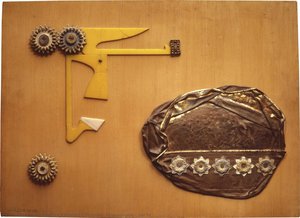 Dimensional - plà III1968 · Museu d'Art Jaume Morera
28
 Dimensional - plà I1967 · Museu d'Art Jaume Morera
29
 Woman1974 · Museu d'Art Jaume Morera
30
 Objecte Consum (Objecte I Forma Consum)1975 · Museu d'Art Jaume Morera
31
 Moviment contradictori1976 · Museu d'Art Jaume Morera
32
 Diàleg informal1974 · Museu d'Art Jaume Morera
33
 Trivolumètric1980 · Museu d'Art Jaume Morera
34
 Robot1978 · Museu d'Art Jaume Morera
35
 Trajectòria atrapada1978 · Museu d'Art Jaume Morera
36
 Automatisme1978 · Museu d'Art Jaume Morera
37
 Untitled1982 · Museu d'Art Jaume Morera
38
 Volumetria en dues direccions1982 · Museu d'Art Jaume Morera
39
 Moonlit Night1935 · Museu Nacional d'Art de Catalunya
The four subjects that come back most often in these originals, each with its finest example.
The 2 museums that hold the most of the paintings on this page.
| Museum | City | Works by Leandre Cristòfol | Paintings from this list |
|---|---|---|---|
 Museu d'Art Jaume Morera |
Lleida | 38 | Morfologia, Effort, Drawing |
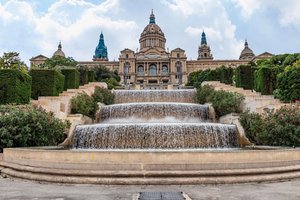 Museu Nacional d'Art de Catalunya |
Barcelona | 1 | Moonlit Night |
Pick a decade to see the original that defines it.


Temàtica gravitant is a non-figurative assemblage created by Leandre Cristòfol Peralba in 1976. The work belongs to the artist's later period, moving away from the early Impressionistic tendencies of his youth toward a more structured, abstract language. It exists as a physical exploration of form and spatial relationships.

Morfologia (1933), Museu d'Art Jaume Morera, Lleida. Effort (1932) and Drawing (1934) come next.
25 years old: Morfologia dates from 1933, and Leandre Cristòfol was born in 1908.
Morfologia, Effort, Drawing, Temàtica gravitant, Al néixer l, De l, Anticipació òntica, Temàtica limitada, Nude and Testa rural. La mare. The ranking above gives each one's year and museum.
Our catalog holds 39 works by Leandre Cristòfol, dated from 1930 to 1982.
Mostly in Museu d'Art Jaume Morera (Lleida) and Museu Nacional d'Art de Catalunya (Barcelona). The museum table above lists them all.
In 1930s: 15 of the 39 works on this page were made then, Morfologia among them.
On this page, the earliest is Testa rural. La mare (1930) and the latest Untitled (1982).
Abstract (6), Geometric (4) and Sculpture (3), across the 39 works on this page.
Painting, for 3 of the 39 works on this page.
Surrealism, judging by the originals on this page.
Morfologia, Effort and Drawing: the Museu d'Art Jaume Morera, Lleida holds 38 of the works on this page.
In the quiet landscapes of Olesa de Balaguer, Spain, a profound artistic journey began in 1908, marking the birth of one of Catalonia's most distinctive creative spirits: Leandre Cristòfol i Peralba. A self-taught master, Cristòfol did not merely observe the world; he sought to dismantle its traditional structures to reveal the subconscious truths lying beneath. His life, spanning nearly a century until his passing in 1998, was defined by a relentless pursuit of an aesthetic universe that transcended the boundaries of classical form. As a pioneer of surrealist sculpture in Catalonia, he carved out a legacy that bridged the gap between the tangible and the dreamlike, establishing himself as a vital figure in the evolution of 20th-century Spanish modernism.
Cristòfol’s artistic development was characterized by a courageous rejection of academic rigidity. Rather than adhering to the established methods of his era, he embraced an intuitive approach that allowed for the exploration of non-figurative shapes and complex textures. His work often functioned as a dialogue between the physical and the spiritual, frequently weaving religious themes into abstract compositions. This unique intersection of the sacred and the surreal gave his pieces a haunting, meditative quality, inviting viewers to contemplate the mysteries of faith through the lens of modern abstraction.
The breadth of Cristòfol’s talent is most evident in the diverse mediums he commanded. While many remember him as a sculptor who manipulated metal and iron to create intricate, balanced assemblages, his hand was equally expressive in drawing and painting. His early works, such as his 1934 drawings, showcased a captivating Impressionistic sensibility, using soft tones and fluid lines to capture the rhythmic movement of daily life. As his style matured, however, it drifted toward the more enigmatic territories of surrealism, where the weight of iron and the starkness of metal could better represent the gravity of human dreams.
In his sculptural masterpieces, such as the 1963 work Trajecte orbital, one can witness his profound ability to balance heavy, industrial materials like iron on wooden bases to create a sense of celestial motion. These works were not merely objects but explorations of equilibrium and tension. His technical prowess allowed him to transform cold, hard elements into poetic expressions of:
Leandre Cristòfol i Peralba remains a cornerstone in the study of Catalan surrealism. His influence extends far beyond his physical works, reaching into the pedagogical foundations of art in the region; notably, he served as an instructor for future generations of artists, including figures like Albert Bayona i Fernández. By challenging the traditional sculptural methods of his time, he paved the way for a more experimental and liberated approach to Catalan art, ensuring that the movement would continue to evolve through abstraction and innovation.
Today, the echoes of his creativity can be felt in the halls of significant institutions that celebrate the diverse heritage of Catalonia. While his works reside in precious collections such as the Museu d'Art Jaume Morera, his true impact is found in the way he redefined the sculptor's role—not as a mere imitator of nature, but as an architect of the unseen. His life stands as a testament to the power of the self-taught artist to reshape the cultural landscape, leaving behind a body of work that continues to inspire awe and introspection in all who encounter its surrealist beauty.


